Skip to content




Daily Necklaces: Chain Length and Comfort Tips
I’d use 18 inches as a starting point - not a fit rule. Measure your neck, preview the length with string, and check the necklace while sitting, bending, and reaching. Then wear it for 15–30 minutes before trying a full day. <u>Nothing should press into your throat or limit breathing or swallowing.</u>
Here’s what I’d check before choosing a daily necklace:
- Listing details: Confirm LaCkore Couture’s chain length, metal content, pendant size, and clasp.
- Placement: Choose where you want the necklace to rest, including the pendant’s full drop.
- Movement: Check for pulling, swinging, and snags from clothing, bags, or seat belts.
- Pendant weight: Match the pendant and bail to the chain so it doesn’t tug or twist.
- Layer spacing: Start with 2–4 inches between layers, then check for overlap. This also helps keep layered necklaces from tangling throughout the day.
- Necklines: Keep chains and pendants clear of fabric edges and buttons.
- Hardware and skin: Check for rough links, clasp pressure, and irritation.
My goal: a necklace that feels comfortable without constant adjustment.
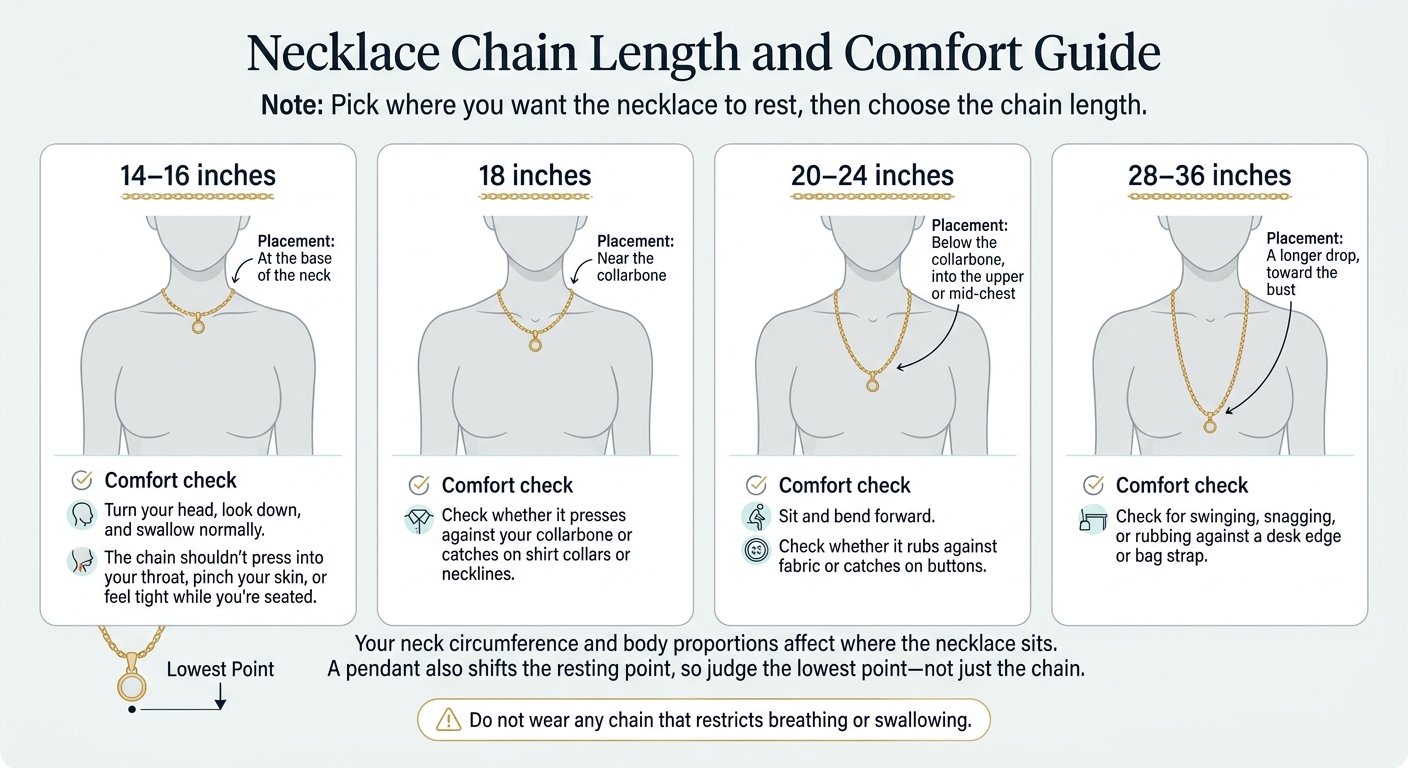
Necklace Chain Length and Comfort Guide
Measure Your Neck and Check Necklace Placement
Wrap a soft, flexible tape around the base of your neck. Keep your head neutral and the tape level, resting against your skin without pulling tight. Record the measurement in inches, then measure again to check it. No tape? Wrap a piece of string around your neck, mark where it overlaps, and measure that length with a ruler.
Add 1–3 inches for a close, relaxed fit as a starting point. Adjust for your neck shape, chain thickness, pendant weight, and how loose you like your necklaces. The goal is a fit that stays comfortable throughout the day.
Before choosing a chain length, use string to preview the full necklace length, including the clasp and extender. Check the front and sides in a mirror. If you’re unsure where you want the chain to rest, compare 16-, 18-, and 20-inch lengths.
Next, check how the pendant affects the fit. Include its full drop, including the bail or connector. A heavy or long pendant can pull the necklace out of place. Hold a small paper marker at the attachment point to preview the drop, then try it over the clothes you wear most often. A length that works on bare skin may sit differently over a sweater or high collar.
Once you’ve narrowed down the length, check how it feels when you turn your head, look down, walk, and sit. Do not wear any chain that restricts breathing or swallowing. If it feels restrictive at any point, choose a longer length or skip it for daily wear.
1. Review Necklace Details at LaCkore Couture
Once you know your target length, check the listing for details that affect comfort and fit. LaCkore Couture offers handcrafted necklaces in a range of styles, so review each listing separately.
Check the chain length, pendant size, finish, and clasp type. See whether the listed length includes an extender or adjustment points. Make sure the clasp suits daily wear, and don’t assume the necklace adjusts.
If you have sensitive skin, check the metal content and plating - not just the color. When details are missing, ask the brand for the actual chain length, clasp style, and approximate weight, if available.
Before customizing, confirm that the charms are compatible.
With those details checked, look at where the necklace sits on your body.
2. Choose Where Your Necklace Sits
Pick where you want the necklace to rest, then choose the chain length. Check the listing details and use the guide below to match the length to your preferred spot.
| Chain length | Where it usually rests | What to check |
|---|---|---|
| 14–16 inches | At the base of the neck | Turn your head, look down, and swallow normally. The chain shouldn't press into your throat, pinch your skin, or feel tight while you're seated. |
| 18 inches | Near the collarbone | Check whether it presses against your collarbone or catches on shirt collars or necklines. |
| 20–24 inches | Below the collarbone, into the upper or mid-chest | Sit and bend forward. Check whether it rubs against fabric or catches on buttons. |
| 28–36 inches | A longer drop, toward the bust | Check for swinging, snagging, or rubbing against a desk edge or bag strap. |
Your neck circumference and body proportions affect where the necklace sits. A pendant also shifts the resting point, so judge the lowest point - not just the chain.
3. Test the Fit as You Move
Once you’ve chosen the length, test the necklace for five minutes as you move. Check for pulling at the back of your neck, hair catching, or the clasp sliding to the front.
Put on your jacket, zip or button it, and carry your everyday bag. Does the strap trap the pendant or pull the chain sideways? Pay extra attention to longer chains and heavier pendants. If anything catches, try a different length or a flatter pendant.
Next, check for pendant pressure under your seat belt. Keep the belt correctly positioned: the lap belt low on your hips and the shoulder belt across your chest and shoulder. Never route the belt around jewelry. Avoid bulky pendants under the belt. If a pendant presses against you, choose a smaller, flatter one.
Remove necklaces before exercise, going to bed, or using equipment with moving parts. Tucking a chain under your shirt can reduce swinging during light activity, but it’s no substitute for removing it around moving equipment.
4. Match Pendant Weight to the Chain
Comfort depends on more than chain length. Match the pendant to the chain’s full structure - not just its thickness. Check the maker’s weight guidance, the chain’s construction, and the clasp. A thicker chain isn’t automatically stronger or more comfortable. The pendant shouldn’t twist the chain or pull the necklace off center.
Check the pendant’s drop: how far it hangs below the chain. A longer drop puts the pendant’s pull farther below the chain, while a compact pendant may sit more steadily. The bail opening, the loop that attaches the pendant, must fit the chain. Any end caps or jump rings that need to pass through should also fit without scraping or binding.
Try the necklace on. Make sure the clasp closes fully, its mechanism springs back, and the jump ring has no visible gap. If the pendant pulls, brings the clasp forward, or sits unevenly, try a lighter pendant or better-matched chains for pendants.
Once the pendant and hardware feel balanced, check how layered chains sit together.
5. Space Layers to Reduce Tangling
Once you’ve balanced pendant weight, give each chain room to move on its own. Start with 2–4 inches between layers, then check where each piece rests. Allow more space if pendants or bulky links overlap. Measure the gap between each piece’s lowest point - not just the difference in listed chain lengths.
Chain texture matters, too. Rather than stacking identical fine chains, mix textures or thicknesses. Try placing heavier pieces lower if that helps keep the upper layers still.
Avoid letting clasps stack at the back of your neck. A spacer or layering clasp can help, but use one only if it lies flat and doesn’t rub your neck.
Good spacing reduces tangling, but it won’t prevent every knot. Wear the full stack for several minutes and check for overlap. If chains keep crossing, increase the length gap, switch textures, or remove a layer.
Put necklaces on after getting dressed, and store each chain separately so tomorrow’s layers start untangled.
6. Check the Fit With Your Necklines
Once you’ve spaced your layers, try each necklace with the necklines you wear most.
Keep the necklace clear of the neckline’s edge. With a V-neck or scoop neck, the chain and pendant should sit inside the open area - not along the edge, where they can rub or slip underneath.
With crew necks, give the chain enough room to clear the neckline without crowding it. Check where the pendant actually lands rather than relying on the listed length.
Button-ups move the chain differently than open necklines. Try wearing the necklace inside the open collar or over the shirt. Then move the collar edge to see whether the chain catches on buttons or collar points.
Test it against the fabric you’ll wear. Against skin, check for pinching or hair pulling. With knits, watch for snagging on loops or texture. If the necklace keeps catching, choose a smoother design or wear it over a smoother layer.
7. Check Clasps, Links, and Skin Comfort
After checking length, weight, and layering, inspect the parts that touch your skin. Run a fingertip or thin cloth over the links, jump rings, bail, and clasp. Look for rough seams, bent links, burrs, or sharp edges that could snag hair or irritate your skin as you move. Have a jeweler repair any damaged parts.
The clasp should sit flat without pressing into your neck.
Wear the necklace for 15–30 minutes before trying it all day. Move through your usual daily positions and notice whether the clasp or extender presses into your neck. A flatter closure may help reduce pressure. If pressure or tenderness persists, the fit needs attention.
If you have sensitive skin, check the plating and base metal of every part, including the clasp - not just the chain. Color terms don’t tell you what metals are present, and skin-safe labels don’t guarantee comfort for everyone.
Stop wearing the necklace if you develop itching, burning, redness, or a rash. A delayed skin reaction can appear 24–72 hours after exposure, so a comfortable first try doesn’t rule one out. Address fit-related pressure before daily wear, and seek medical advice if skin symptoms last or return.
Conclusion: Check Comfort Before Daily Wear
After testing the fit in motion, check once more before wearing your necklace all day. As you swallow, turn, bend, reach, and walk, look for room at the neck, no pendant tugging, little clothing friction, easy movement, chains that stay apart, and a clasp that lies flat without catching.
If anything feels off, fix it first. Add length, choose a lighter pendant, or move a neckline that rubs. For layered necklaces, leave a 2–4-inch gap and check that the chains stay apart as you move.
Use 18 inches as a reference, not a rule. Your necklace should feel comfortable all day without constant adjustment.
FAQs
Will a chain extender affect my necklace’s balance?
Yes, a chain extender can slightly change your necklace’s balance. The added length affects where the pendant rests against your neck and clothing.
For layering, leave about 2 inches between necklaces. Wear the set for 15–30 minutes to check for shifting or pinching. You can also use extenders to adjust each layer’s length and help reduce tangling.
Which chain styles tangle least during daily wear?
Thicker chains are less likely to tangle, making them a good choice for your top layer. Mix chain weights, textures, and styles to reduce movement and friction. For example, pair a sturdy rope or cable chain with a smooth snake chain.
Heavier pendants or thicker chains paired with lighter, delicate necklaces also help keep pieces in place as you move throughout the day.
How can I tell if my pendant is too heavy?
Give the necklace a 15- to 30-minute wear test. Walk, sit, type, and turn your head while wearing it. If you feel pulling, pinching, itching, pain, or skin irritation, take it off. It may be too heavy or otherwise uncomfortable for all-day wear.
If the pendant keeps catching on clothing or causes lasting discomfort, it may be too heavy for the chain or for daily wear.