Skip to content




Shape Meanings in Rings, Necklaces, and Charms
I start with the message - not the shape. Choose whether you want your jewelry to stay private, stand out, or hold new memories over time. A heart can suggest love and a circle can suggest unity, but your intent, beliefs, and personal ties matter more than a fixed definition.
I compare five jewelry types by meaning, visibility, personalization, and comfort. Rings keep a symbol in your view; necklaces create a focal point; bracelets show it through movement; earrings frame your face; and charms let you build a story.
Quick Comparison
| Type | How the message comes across | Personal touch | What I’d check |
|---|---|---|---|
| Ring | Often linked to commitment or identity | Inside engraving, stones, stacked bands | Size, setting height, resizing limits |
| Necklace | A central symbol, hidden or displayed | Initials, birthstones, back engraving | Chain length, pendant weight, clasp |
| Bracelet | Seen as your wrist moves | Engraved plate, links, added charms | Wrist fit, snagging, contact with a watch |
| Earrings | Shapes frame the face | Stones, motifs, matched or mixed pairs | Each earring’s weight, closures, metal sensitivity |
| Charms | Separate symbols form a personal story | Dates, names, places, milestones | Attachments, total weight, room for additions |
My final check is simple: <u>meaning and comfort should work together</u>. An 18-inch necklace often sits just below the collarbone, but I’d test the fit rather than rely on length alone. For a gift, I’d ask what the symbol means to the recipient - and confirm spelling, sizing, and return options before ordering. A meaningful piece should also feel good to wear.
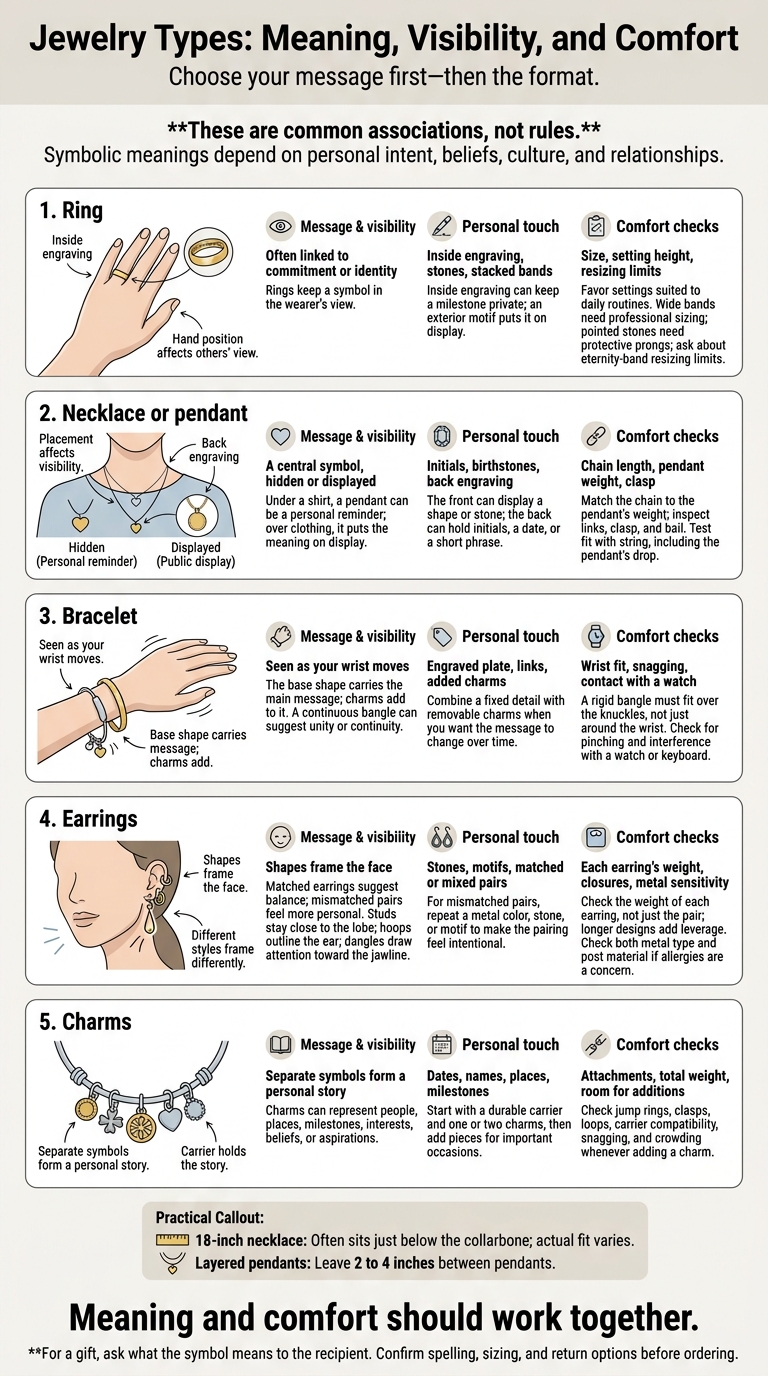
Jewelry Types: Meaning, Visibility, and Comfort
1. Rings
Symbolic Meaning
An unbroken band represents continuity, unity, and lasting commitment. Hearts add affection, while interlocking or braided designs suggest connection. Stars express ambition or aspiration, and geometric shapes often feel balanced and modern.
Round stones tend to feel harmonious; square cuts can look more structured and contemporary. These are common associations, not rules.
Visibility and Placement
Where you wear a ring changes how people read its shape. In the United States, the left-hand ring finger is the conventional spot for engagement and wedding rings. A right-hand ring often signals achievement or personal style rather than commitment, though customs vary.
Personalization
An engraving inside the band keeps a milestone private. An exterior motif puts it on display. Stacking bands lets you mark separate events over time.
Wearability
Choose a setting that fits your routine. Opt for low-profile settings, and have wide bands professionally sized. Pointed stones, such as pear or marquise cuts, need protective prongs. For an eternity band with stones all the way around, ask about resizing limits before buying.
Necklaces and pendants bring the same shapes closer to the face, changing how people read them.
2. Necklaces and Pendants
Symbolic Meaning
Like rings, necklaces can express commitment or identity. Their position near the face and chest can make that message feel more personal - or more public. A pendant might represent affection, identity, or faith: hearts suggest love, while crosses often express Christian faith. Initials and birthstones can represent someone important. Near the face, stars can suggest guidance, while squares give a modern feel. Placement and chain length also shape how people read the symbol.
Visibility and Placement
Decide whether the message is private or public. Under a shirt, a pendant can serve as a personal reminder. Over clothing, it puts the meaning on display. An 18-inch chain usually sits just below the collarbone, though the fit varies. Position the pendant above or below the neckline rather than right on its edge. When layering, leave 2 to 4 inches between pendants.
Personalization
The chain determines where the pendant sits. Let the front show the shape or stone, and use the back for initials, a date, or a short phrase. Before ordering engraving, check how much space is available so the lettering stays readable.
Wearability
Match the chain to the pendant’s weight. Check the clasp, links, and bail - the loop that connects the pendant to the chain. Test the length with string, including the pendant’s drop. Then turn your head and lift your arms to check comfort. If you wear it often, inspect the clasp, links, and stone settings regularly. Stop wearing it if the clasp won’t close securely or a stone comes loose.
Bracelets move these same shapes to the wrist, where motion changes how people read them.
3. Bracelets
Symbolic Meaning
Unlike pendants, bracelets communicate through movement as well as shape. The base shape carries the main message; charms add to it. A continuous bangle can suggest unity or continuity, while a cuff gives a bold, architectural impression. Slim chains feel understated; chunky links make a stronger statement. A heart charm adds affection without defining the bracelet’s overall meaning.
Visibility and Placement
Bracelets catch the eye during everyday movement, making them a good fit for messages you want seen often. Choose a slim, close-fitting piece for a quiet message or a broad cuff for more impact. To balance stacking bracelets, start with one anchor piece, then add one or two simpler bracelets in the same color or metal. Let charms play a supporting role so the base shape remains easy to read.
Personalization
Combine one fixed detail with removable charms so the message can change over time. Put engraving on a flat plate, away from spots that rub against your wrist. Make sure stacked pieces don’t hide it. This approach is a key part of stacking jewelry to create a custom look.
Wearability
A rigid bangle must fit over your knuckles - not just around your wrist. Heavy charms need a sturdy base and enough room to swing freely. Check that cuffs don’t pinch and that stacks stay out of the way of your watch and keyboard. Look for stretched or fraying elastic. Remove bracelets before contact with water, workouts, or cleaning.
Earrings shift the meaning of shape from the wrist to the face, where scale and symmetry matter more.
4. Earrings
Earrings sit closest to the face, where balance, size, and movement shape how their meaning comes across based on your face shape.
Symbolic Meaning
Matched earrings suggest balance; mismatched pairs feel more personal. Circles and hoops can suggest unity or continuity, hearts affection, and stars hope or guidance. Squares and triangles may suggest structure, direction, or growth. These are common associations, not fixed meanings. Drops and dangles add movement and make the shapes easier to see.
Visibility and Placement
Studs keep symbolism close to the lobe. Hoops outline the ear, while dangles draw attention toward the jawline. Check how each style looks with your usual hairstyle: small studs may disappear behind thick hair, while an updo puts longer designs on display.
With multiple piercings, let one moving piece lead so the shapes don’t compete. Earrings can make a shape easy to read at a glance without overpowering your look.
Personalization
Birthstones, initials, and small charms can connect earrings to a person or memory. For mismatched pairs, repeat one detail - metal color, stone, or motif - to make the pairing feel intentional.
Wearability
Check the weight of each earring, not just the pair. Longer designs put more leverage on the piercing. Open shapes can make a strong visual statement without as much weight.
Try statement earrings at home before an event, and check that the closures stay secure. Remove them if they cause pulling, soreness, redness, or drooping. If you have metal allergies, check both the metal type and the post material rather than relying only on a “hypoallergenic” label.
5. Charms
Charms work differently from single-shape jewelry: every addition adds to the story.
Symbolic Meaning
Charms tell a story one piece at a time, holding memories and marking achievements instead of centering on a single symbol. Each motif can stand for a relationship, milestone, interest, belief, or aspiration. Keys suggest opportunity, locks security, anchors stability, and flowers growth or remembrance. Religious symbols, including crosses, hamsas, and Stars of David, have specific meanings tied to faith and community, so choose them with care.
Visibility and Placement
A bracelet spreads meaning across several charms. A necklace draws attention to one charm or a small group near the face.
On a bracelet, place the charm with the most meaning at the center or front. Smaller pieces or spacers can help connect the set into one story. A necklace keeps the focus tighter but leaves less room for additions. The meaning grows as you add charms; it isn’t fixed.
Personalization
The base chain matters as much as the motifs because you’ll add charms over time. Start with a durable bracelet or necklace and one or two starting charms. Then add pieces for important occasions rather than filling the chain right away.
Initials, names, dates, short engraved phrases, birthstones, zodiac symbols, miniature portraits, coordinates, or meaningful colors can tie each addition to a memory or milestone. Matching metals, enamel colors, or related shapes helps the pieces look like they belong together.
Wearability
Check the attachments whenever you add a charm. Look for gaps in jump rings, loose clasps, bent loops, and other weak points. Choose a base chain sturdy enough to support your planned collection. Heavy charms can pull a fine chain downward, while sharp edges can catch on clothing or skin.
Before ordering, check the space for engraving and whether the text will be easy to read. Wearing a charm bracelet on your non-dominant wrist may reduce everyday abrasion. Follow the maker’s cleaning instructions, especially for enamel or glued-in stones. Remove delicate pieces before contact with water, exercise, or products that could loosen settings.
How Jewelry Type Changes Shape Meaning
Shape Meanings: Circles, Hearts, Stars, Squares, and Triangles
A shape suggests meaning - it doesn’t set a rule. Symbolic references link circles with continuity or unity and hearts with love or emotional connection. Stars can suggest aspiration, guidance, celebration, or individuality. Squares may express stability, structure, balance, or groundedness. Triangles can suggest direction, transformation, strength, or a three-part idea. Styling, orientation, and the wearer’s background can change how each shape reads.
| Shape | Ring interpretation | Necklace interpretation | Bracelet interpretation | Earring interpretation | Charm interpretation |
|---|---|---|---|---|---|
| Circle | The band can reinforce continuity or commitment | A closed pendant may suggest wholeness or connection | Repeated circles can suggest a lasting connection | Matching circles emphasize balance or coordinated symmetry | Can serve as a personal reminder of continuity, family, or a life cycle |
| Heart | Can read as a personal love token, affection, or devotion | Makes affection more direct when worn near the chest | Repeated hearts can suggest affection or friendship | Can feel romantic, playful, or sentimental, depending on size | Can represent a person, relationship, memory, or cause the wearer chooses |
| Star | May suggest aspiration, guidance, or individuality | Gives hope or ambition a visible focal point | Repeated stars can create a celebratory or celestial theme | Adds sparkle and brightness near the face | May mark a goal, achievement, interest, or personal inspiration |
| Square | Can feel stable, structured, or modern | Makes a geometric statement with a grounded feel | Repeated square links can feel architectural or organized | Reads as simple, graphic, or fashion-forward | May suggest home, balance, work, or another meaningful place |
| Triangle | May suggest direction, transformation, strength, or a three-part bond | Its point draws the eye and can suggest direction | Angular links can feel dynamic or modern | The point and swing create an energetic, graphic effect | Can stand for a family of three, a journey, faith, or another personal idea |
Placement and Visibility
Placement changes emphasis more reliably than meaning. Common necklace lengths include 16, 18, and 20 inches. Shorter chains generally sit higher; longer chains let a pendant hang lower and move more. Check where the necklace sits against your neck size, pendant dimensions, neckline, and preferences - not just the chain length.
| Jewelry format | Placement | Visibility | Effects of scale or movement |
|---|---|---|---|
| Ring | Finger or hand | Often visible to the wearer; others’ view depends on hand position | A broad or high-set shape makes more of a statement; a low-profile shape is easier for daily wear |
| Necklace or pendant | Throat, collarbone, upper chest, or lower chest | Usually central and easy to frame with clothing | A larger pendant dominates; a longer chain adds swing and may increase snagging |
| Bracelet | Around the wrist | Comes in and out of view with arm movement and sleeves | Repeated shapes create rhythm; loose pieces move more but may hit surfaces |
| Earring | Earlobe, cartilage, or hanging below the ear | Highly visible because it frames the face | Dangling or jointed shapes draw attention through movement; heavier designs pull more |
| Charm | Bracelet, necklace, anklet, or accessory | Depends on its location, clothing, and whether it’s hidden or displayed | Small charms feel discreet; multiple charms can tell a story or create a collected look |
Personalization: Engraving, Stones, and Motifs
Personal details can matter more than a shape’s usual meaning. Engraving adds words, stones add color, and stacking or layering combines messages. Handcrafted proportions, texture, and mixed metals shift the visual focus. LaCkore Couture offers handcrafted jewelry made in the USA, including rings, necklaces, bracelets, earrings, and charms. Options include gold and silver, natural stones, customization, and mix-and-match styling. Available features vary by piece.
| Jewelry format | Personalization methods | Message conveyed | Practical limits |
|---|---|---|---|
| Ring | Engraving, stones, initials, stacking, mixed metals | Commitment, identity, memory, or coordinated personal style | Engraving space is limited; setting height, finger fit, and room for stacked bands matter |
| Necklace | Engraved pendants, initials, stones, layering, interchangeable motifs | A visible focal message or layered story | Chain length, pendant weight, neckline, and pendant-to-chain proportion affect wear |
| Bracelet | Engraved plates, charms, initials, link patterns, stacking, mixed metals | Friendship, milestones, a collection, or everyday identity | Clasp strength, wrist fit, charm contact, and total weight limit additions |
| Earrings | Stones, motifs, mixed metals, mismatched pairs, interchangeable components | Facial framing, self-expression, polish, or playful individuality | Surface area is small; post security, balance, and earring weight matter |
| Charm | Interchangeable motifs, initials, stones, engraving, collected symbols | Personal history, relationships, interests, or milestones | Bail and clasp compatibility, snagging, crowding, and charm weight limit combinations |
Wearability: Fit, Weight, and Durability
Construction matters more than the outline alone. Fit, weight, chain or clasp quality, prong security, surface edges, and material affect comfort and durability. Before settling on a stack or layered arrangement, try your normal hand and head movements. Pieces shouldn’t pinch, pull, or repeatedly collide.
| Jewelry format | Comfort and fit | Snagging or contact risks | Durability considerations | Stacking or layering considerations |
|---|---|---|---|---|
| Ring | Must clear the knuckle but stay secure; width and setting height affect movement | High-set stones can catch on fabric or brush neighboring fingers | Prongs, bezels, band thickness, and metal hardness matter | Leave room for adjacent bands; friction can scratch finishes |
| Necklace or pendant | Chain length, pendant weight, and neckline affect comfort | Chains and pendants can catch on hair or clothing; longer lengths swing more | Check the clasp, bail, chain gauge, and stone setting | Vary lengths and chain weights to reduce tangling and visual crowding |
| Bracelet | Should allow movement without sliding too much | Charms and links can catch on sleeves or hit hard surfaces | Link construction, hinge points, clasp, and charm attachment affect how long it lasts | Keep heavier pieces lower in the stack and watch for metal-on-metal friction |
| Earring | Posts, backs, hooks, and total weight affect comfort | Hoops and drops may catch on hair, masks, or clothing | Inspect closures, soldered joints, and stone settings for security | Balance size and weight across multiple piercings; avoid overcrowding |
| Charm | Attachment must be secure and sized to suit its carrier | Protruding motifs can snag; multiple charms can tangle or collide | Bail, jump ring, clasp, and surface finish must withstand repeated movement | Limit total weight and separate crowded motifs so each remains easy to see |
Pros and Cons of Each Jewelry Type
The same shape can look different on a finger, at the throat, on the wrist, near the face, or on a charm carrier. Compare each format by visibility, movement, and room for personalization.
| Jewelry format | Advantages | Limitations | Best for |
|---|---|---|---|
| Rings | Send a strong commitment message that the wearer can see | Sizing and bold settings can get in the way of hand use | Commitment, a promise, identity, achievement, or heritage |
| Necklaces and pendants | Create a clear focal point and are easy to layer | Clothing, tangling, and pendant weight can affect comfort and wear | Love, faith, remembrance, or a central personal value |
| Bracelets | Stand out in motion and are easy to add to | Typing, sleeves, watches, and noisy additions can get in the way | Friendship, encouragement, or changing interests |
| Earrings | Frame the face with shapes in matched or mismatched pairs | Weight, skin sensitivity, and closures affect comfort and wear | Confidence, celebration, or personal style |
| Charms | Offer the most options for additions, rearrangement, or transfer | Carrier capacity and crowding limit weight and make symbols harder to read | Separate people, events, places, interests, or milestones |
These associations aren't rules. A ring often sends a stronger commitment message, but a heart pendant can hold just as much meaning.
Choose a format based on how public, private, or expandable you want the message to be. One motif sends a single message; several can tell a broader story. The wearer gives those motifs meaning - repeating a symbol doesn't, by itself, give each one a separate meaning. More elements leave room for more stories, but make individual symbols less clear.
Choose a design you can add to only when future additions matter more than clarity now. Before adding charms, check attachment compatibility and carrier capacity. Before ordering, confirm spelling, dates, initials, sizing, chain length, and return or resizing policies.
Conclusion: Match the Shape to Your Message
A shape’s meaning depends on how and why you wear it. Placement affects visibility, while size affects impact. Engravings and stones can tie a piece to a person or event. Family, faith, and culture can give a motif meaning that no general guide can define.
The examples below connect your message to a jewelry format. Treat them as a guide, not a rule:
Intended message Suggested jewelry format Shape or motif Customization Design considerations Commitment or milestone Ring Circle or meaningful stone Inside engraving Proper fit and protected setting Single focal message Necklace or pendant Heart, star, initial, or locket Engraving Match pendant size to neckline Growing memories Charms People, places, or achievements Dated charms Leave room to grow; limit weight Linked symbols Bracelet Linked circles or coordinated stones Family birthstones Balance the pieces; limit movement Balanced pair Earrings Circles, stars, squares, or triangles Stone color Keep weight light and closures secure
Jewelry type shapes how your message comes across through visibility, movement, and personalization. For a gift, check what the symbol means to the recipient. For yourself, choose a piece that reflects your intent and feels comfortable to wear.
FAQs
How can I avoid unintended symbolism in jewelry?
Jewelry meanings are guides, not fixed rules. They depend on culture, history, and personal intent. To avoid misreading a piece, look at it as a whole: its motifs, gemstone colors, and metal types work together to shape its message.
Start with the feeling or story you want to share. Then choose symbols and materials that express it. Your personal meaning matters most, so pick pieces that reflect who you are and suit your style.
Can I combine shapes with different meanings?
Yes, combining shapes with different meanings can turn jewelry into a story that’s yours. A heart paired with a snake can emphasize romantic devotion, while a star with a crescent can symbolize hope and growth.
Whether you’re stacking rings, layering necklaces, or putting together a charm bracelet, mixing symbols, gemstones, and engravings adds layers of meaning that reflect your personal style and intentions.
How do I choose symbolic jewelry for a gift?
Start with what you want the piece to say: loyalty, love, or personal growth. Look into each motif’s history and meaning across communities to make sure it fits your message.
At LaCkore Couture, make it personal with birthstones, meaningful dates, or custom engravings. Let the recipient’s style guide your choice of materials: warm gold for a celebratory feel or understated silver for everyday wear.