Skip to content




How to Pick Birthstone for Zodiac Jewelry
I’d start with your birth-month stone, then check whether its color and care needs fit your life. For a daily-wear ring, sapphire rates 9 on the Mohs hardness scale; pearl rates just 2.5–3 and needs gentler wear. Hardness matters, but so does resistance to chips, heat, and chemicals.
Here’s what I’d check before buying:
- Meaning: Choose a birthstone, a zodiac stone, or one stone with a sign charm. Zodiac pairings aren’t fixed rules.
- Style: Match the stone to your favorite metals, clothes, and jewelry type.
- Wear and care: Pick a setting that protects the stone, and ask about treatments and cleaning.
- Purchase details: Confirm metal content, fit, total cost, and return terms - including when browsing LaCkore Couture’s current listings.
My rule: <u>choose for how you’ll wear it</u>, with symbolism as a personal touch, not a promise of results.
Step 1: Find Your Birth-Month and Zodiac Stones
Birth-month stones follow the calendar. Zodiac stones follow astrological signs, which usually span parts of two months. Use these charts to build your shortlist.
Check Your Birth-Month Stones
This chart follows the GIA birthstone list and notes variations found on U.S. trade lists. The meanings describe symbolism - not promised effects.
| Month | Common modern birthstone(s) | Older or alternate options | Typical color(s) | Traditional meanings |
|---|---|---|---|---|
| January | Garnet | - | Red; also green, orange, purple, or yellow | Protection, loyalty, friendship |
| February | Amethyst | - | Lilac to deep purple | Peace, clarity |
| March | Aquamarine; bloodstone | - | Light blue to blue-green; dark green with red inclusions | Calm, purity; health and strength |
| April | Diamond | - | Colorless or fancy colors | Strength, clarity, enduring love |
| May | Emerald | - | Bright green | Rebirth, love, foresight |
| June | Pearl, alexandrite, moonstone | - | White or cream; green-to-red color change; white or gray with a blue sheen | Purity, good fortune, intuition |
| July | Ruby | - | Red to purplish red | Passion, love, success |
| August | Peridot, spinel | Sardonyx | Yellow-green; spinel may be red, pink, or other colors | Purity, strength, good fortune |
| September | Sapphire | - | Blue; also pink, yellow, green, or other colors | Wisdom, loyalty, faithfulness |
| October | Opal, tourmaline | - | Multicolor or white opal; many tourmaline colors | Hope, strength |
| November | Citrine, topaz | - | Yellow to orange; topaz also occurs in blue, pink, brown, and other colors | Prosperity, warmth, awareness |
| December | Turquoise, tanzanite, zircon | Blue topaz appears on some U.S. jewelry-industry lists | Blue, blue-green, blue-violet, or rainbow colors | Peace, balance, protection |
Compare your options by color, budget, availability, and wearability. Ask whether each stone is natural, lab-grown, treated, or simulated. Those details affect both price and care. If your birth-month and zodiac stones differ, let color, meaning, and wearability help narrow your choices.
Consider Zodiac Stone Meanings
There’s no universal zodiac gemstone list. This chart follows one modern jewelry-guide system, not an official standard. The sign qualities come from astrology; the placement ideas are editorial design suggestions, not sourced gemstone properties.
| Zodiac sign | Commonly associated gemstone(s) | Traditional sign qualities | Suggested placement |
|---|---|---|---|
| Aries | Diamond or carnelian | Initiative, courage, energy | Main stone for a bold pendant |
| Taurus | Emerald or rose quartz | Stability, comfort, loyalty | Main stone in a grounded ring or bracelet |
| Gemini | Agate or citrine | Curiosity, communication, flexibility | Small accent stones around a charm |
| Cancer | Moonstone or pearl | Intuition, care, protection | Main stone in a pendant near the neckline |
| Leo | Ruby or peridot | Confidence, warmth, artistic expression | Center stone or sunburst accent |
| Virgo | Sapphire or peridot | Practicality, clarity, discernment | Small, orderly stones in a refined setting |
| Libra | Opal or rose quartz | Harmony, balance, beauty | Paired accent stones or symmetrical design |
| Scorpio | Topaz or obsidian | Intensity, transformation, determination | Dark accent stone or sign charm |
| Sagittarius | Turquoise or tanzanite | Discovery, optimism, independence | Travel-inspired pendant accent |
| Capricorn | Garnet or onyx | Ambition, discipline, resilience | Durable main stone in a simple setting |
| Aquarius | Amethyst or aquamarine | Originality, independence, vision | Unusual cut or off-center accent |
| Pisces | Aquamarine or amethyst | Imagination, empathy, spirituality | Soft-color main stone in a delicate pendant |
You don’t need a second gemstone. Pair your birth-month stone with a zodiac charm, add a small sign stone, or wear the stones in separate pieces. Symbolism can express personal meaning, but it doesn’t establish medical, emotional, or protective effects. In Step 2, compare your shortlisted stones by color and care needs.
Step 2: Compare Color, Durability, and Care
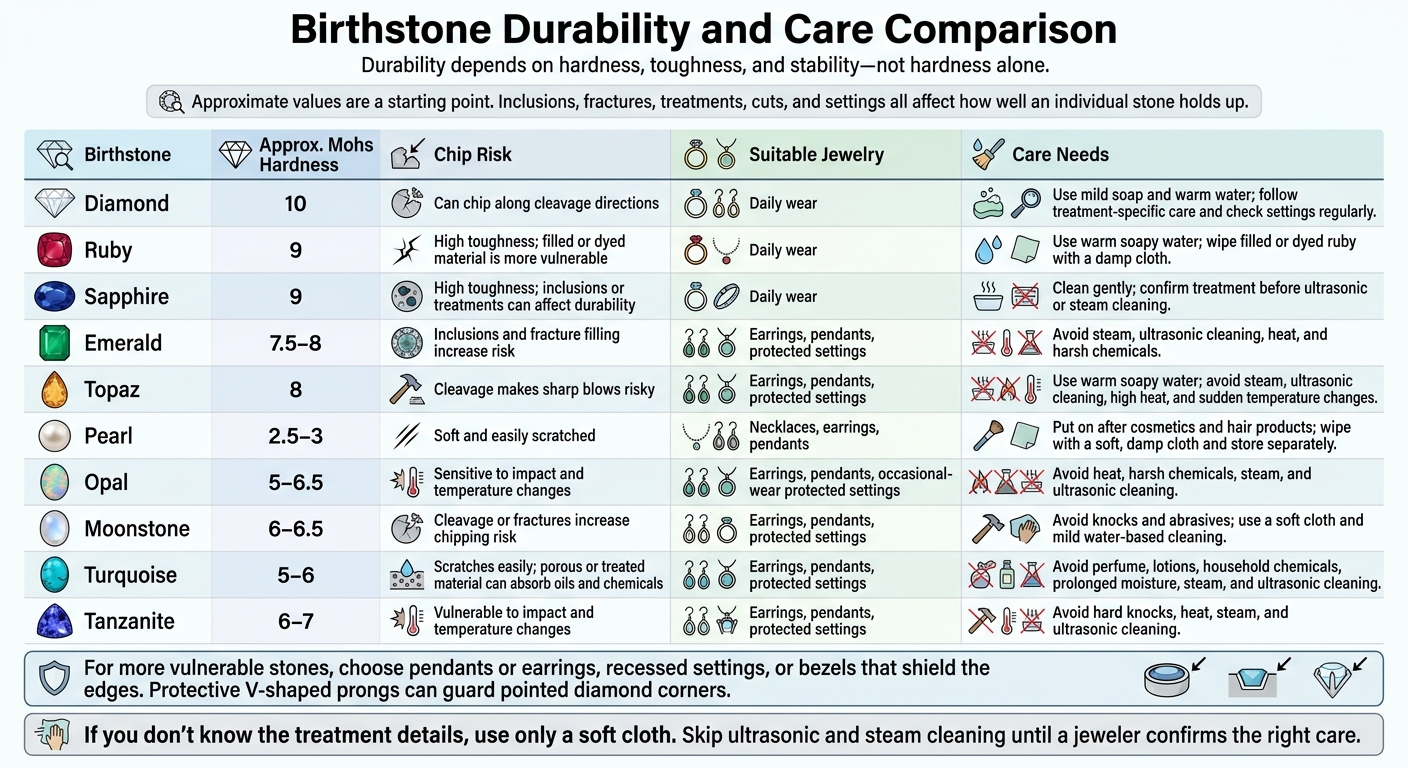
Birthstone Durability and Care Comparison
Match Stone Colors to Metals and Clothing
Start with the metals and clothes you wear most, then choose a stone that works with them.
Warm stones like garnet and citrine suit yellow gold; cool stones like amethyst, aquamarine, sapphire, and tanzanite suit silver-toned metals; mixed metals bridge both.
Your choice should fit the look you want: subtle, bold, or symbolic. Many gemstones come in several colors, so check the actual stone’s color and clarity. Narrow your options by appearance, not just meaning.
Ask whether the stone is natural, lab-grown, treated, or an imitation. The seller should identify its species or variety and disclose any heating, dyeing, filling, coating, or impregnation. Also confirm whether those treatments change how you should care for it.
Choose Stones for Your Wear Routine
Durability depends on hardness, toughness, and stability - not hardness alone.
Use these approximate values as a starting point. Inclusions, fractures, treatments, cuts, and settings all affect how well an individual stone holds up.
| Birthstone | Approx. Mohs hardness | Chip risk | Suitable jewelry | Care needs |
|---|---|---|---|---|
| Diamond | 10 | Can chip along cleavage directions | Daily wear | Use mild soap and warm water; follow treatment-specific care and check settings regularly. |
| Ruby | 9 | High toughness; filled or dyed material is more vulnerable | Daily wear | Use warm soapy water; wipe filled or dyed ruby with a damp cloth. |
| Sapphire | 9 | High toughness; inclusions or treatments can affect durability | Daily wear | Clean gently; confirm treatment before ultrasonic or steam cleaning. |
| Emerald | 7.5–8 | Inclusions and fracture filling increase risk | Earrings, pendants, protected settings | Avoid steam, ultrasonic cleaning, heat, and harsh chemicals. |
| Topaz | 8 | Cleavage makes sharp blows risky | Earrings, pendants, protected settings | Use warm soapy water; avoid steam, ultrasonic cleaning, high heat, and sudden temperature changes. |
| Pearl | 2.5–3 | Soft and easily scratched | Necklaces, earrings, pendants | Put on after cosmetics and hair products; wipe with a soft, damp cloth and store separately. |
| Opal | 5–6.5 | Sensitive to impact and temperature changes | Earrings, pendants, occasional-wear protected settings | Avoid heat, harsh chemicals, steam, and ultrasonic cleaning. |
| Moonstone | 6–6.5 | Cleavage or fractures increase chipping risk | Earrings, pendants, protected settings | Avoid knocks and abrasives; use a soft cloth and mild water-based cleaning. |
| Turquoise | 5–6 | Scratches easily; porous or treated material can absorb oils and chemicals | Earrings, pendants, protected settings | Avoid perfume, lotions, household chemicals, prolonged moisture, steam, and ultrasonic cleaning. |
| Tanzanite | 6–7 | Vulnerable to impact and temperature changes | Earrings, pendants, protected settings | Avoid hard knocks, heat, steam, and ultrasonic cleaning. |
For more vulnerable stones, choose pendants or earrings, recessed settings, or bezels that shield the edges. Protective V-shaped prongs can guard pointed diamond corners.
If you don’t know the treatment details, use only a soft cloth. Skip ultrasonic and steam cleaning until a jeweler confirms the right care. Next, use your wear routine to guide your choice of setting and zodiac jewelry for every astrological sign.
Step 3: Choose Your Jewelry Design
With a shortlist based on birth month, zodiac meaning, and durability, you’re ready to choose a design that fits your daily routine and style.
Select the Jewelry Type and Setting
Choose a jewelry type and setting based on how often you’ll wear it. A bezel or protective-prong setting can give the stone added protection.
Check the details before buying: metal, stone size, chain or bracelet length, closure type, and return and resizing policies. For rings and bracelets, confirm the fit. If you have sensitive skin, check whether the piece contains nickel or cobalt.
Buying a gift? Verify the recipient’s birth month, preferred jewelry type, metal preference, and size.
Once you’ve settled on a form that suits your routine, refine the look with your choice of symbol, chain length, and budget.
Decide on Zodiac Symbols and Accents
Choose one birthstone for a simple look, or add a zodiac symbol and one accent for more detail.
Use a necklace you already wear as a guide to chain length. A shorter chain keeps the design near your collarbone. A longer chain adds movement and can work over sweaters or alongside layered necklaces.
When layering jewelry, let the birthstone be the focal point, with thinner chains or smaller charms supporting it. Set a total budget that covers the chain, customization, shipping, and any size adjustments - not just the stone.
Check LaCkore Couture's Current Options
For a ready-made piece, compare your shortlist with the brand’s live listings.
Browse LaCkore Couture for handcrafted zodiac and tarot jewelry in natural stones, gold, and silver. Check the listed metal composition and stone availability. Before ordering, confirm the exact stone-sign pairing, dimensions, chain length, price, customization options, and care instructions.
Conclusion: Review Your Choice Before Buying
Choose a stone and design from your shortlist based on birth month, zodiac meaning, color, durability, and style. There’s no fixed rule - pick what suits how you’ll wear it, then check the details before buying.
Before you order, confirm:
- Stone: Check the exact stone, any treatments, and whether it’s lab-grown.
- Protection and care: Choose a setting and care routine that suit your wear habits, with extra protection for fragile stones. Check cleaning and storage instructions, plus limits on heat, chemicals, steam, and ultrasonic cleaners.
- Metal: Verify the metal, purity, finish, and construction.
- Fit: Check the size, length, dimensions, or earring weight, as needed, for comfortable wear.
- Budget: Compare the total cost, including tax, resizing, and repairs.
FAQs
Which zodiac stone should I choose if I’m born on a cusp?
Born on a cusp? You can connect with both zodiac signs by choosing gemstones linked to each. Pair them in one custom piece, or switch between them to highlight different sides of your personality. Sources may suggest different stones, so go with what feels right to you.
LaCkore Couture offers handcrafted designs that combine multiple stones to reflect your individuality.
How can I keep layered birthstone jewelry from scratching?
Store each piece in a soft pouch or separate compartment to keep stones and metals from rubbing together. Keep pearls apart from harder stones.
Clean gently. Skip harsh chemicals and abrasive tools, which can wear down surfaces around settings. Remove jewelry before exercise, swimming, or chores to limit bumps and friction that can loosen prongs or make pieces rub together.
How do I balance stone quality and budget?
Put stone quality before size. A smaller gem with rich color, high clarity, and a well-executed cut often stands out more than a larger stone with flaws. To spend less, consider lab-created stones, which have the same physical and chemical properties as natural gems, or lower-cost stones with a similar look.
Budget for the setting, too. Sterling silver costs less than gold, but your choice should also suit how often you plan to wear the piece.