Skip to content




7 Victorian Jewelry Symbols and What They Meant
Victorian jewelry used symbols like a private code. From 1837 to 1901, people used motifs such as the snake, star, crescent, flower, bird, heart, and hand to show love, grief, faith, loyalty, hope, and status.
If I want to read a Victorian piece fast, I look at 3 things first:
- The symbol
- The material and color
- Any inscription or date
That’s because the same motif could mean different things. A heart in gold might point to romance. A heart in jet with hairwork might point to mourning. In many cases, black enamel, jet, onyx, and memorial text push the meaning toward grief, while gold, diamonds, pearls, and colored gems often lean toward courtship, affection, or style.
Here’s the short version of the 7 symbols:
- Snake: eternity, devotion, remembrance
- Star: hope, guidance, constancy
- Crescent: growth, new beginnings, femininity
- Flower: species-based meanings like love, memory, purity, or faithfulness
- Bird: loyalty, return, peace, soul, rebirth
- Heart: love, family feeling, devotion, remembrance
- Hand: fidelity, friendship, betrothal, prayer, mourning
Victorian pieces also mixed symbols to narrow the message. For example, a snake with a heart leans romantic, while a bird with a memorial date leans memorial. In other words, I don’t read the motif alone - I read the whole piece like a sentence.
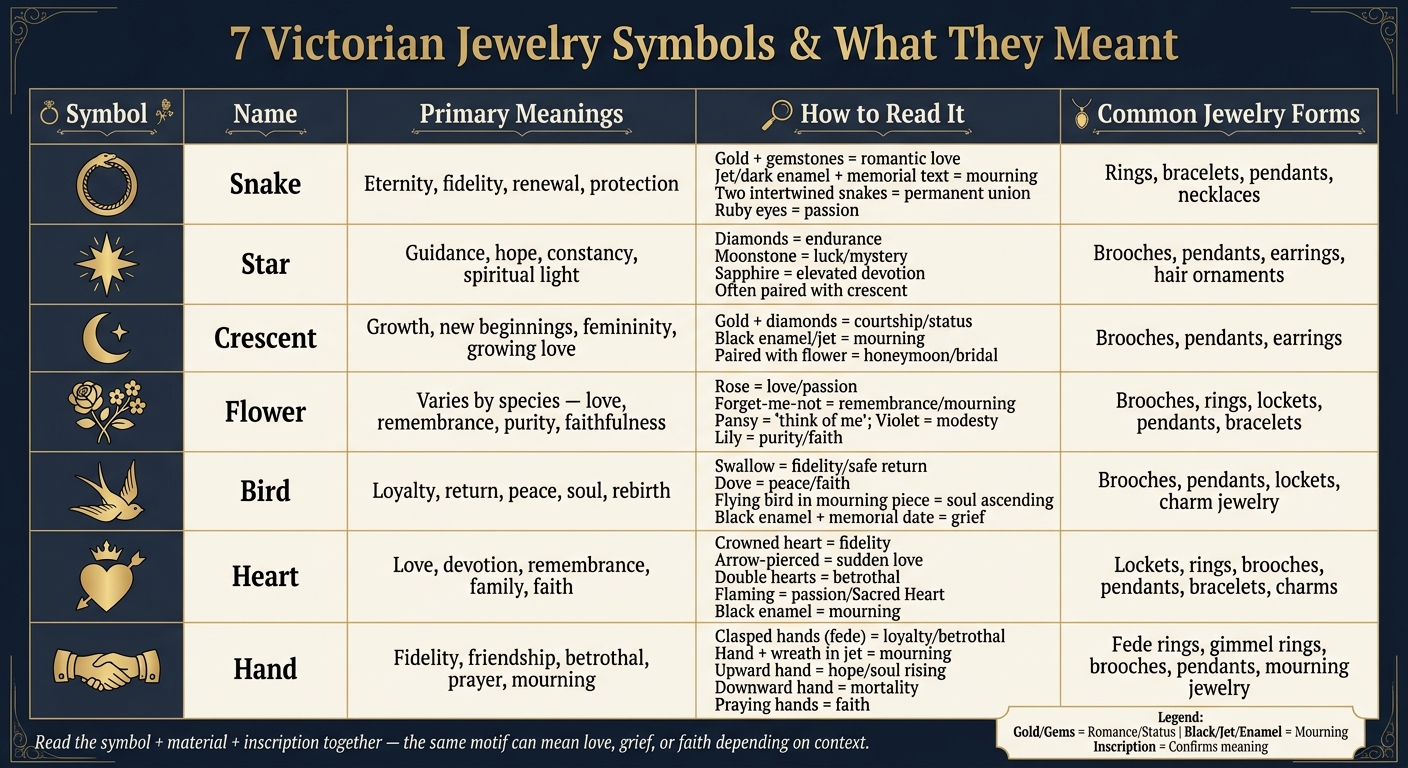
7 Victorian Jewelry Symbols: Meanings, Materials & Messages
Quick Comparison
| Symbol | Main Meaning | Often Reads As |
|---|---|---|
| Snake | Eternity, fidelity, renewal | Love or remembrance |
| Star | Hope, guidance, constancy | Steady affection or spiritual comfort |
| Crescent | Change, growth, new beginnings | Courtship or transition |
| Flower | Varies by bloom and color | Love, grief, purity, memory |
| Bird | Loyalty, peace, return, soul | Romance, faith, or mourning |
| Heart | Love, devotion, remembrance | Romance, family feeling, memorial |
| Hand | Fidelity, friendship, prayer | Betrothal, loyalty, or mourning |
The main point is simple: Victorian jewelry was not just decoration. It often worked like a message, and the meaning came from the symbol + material + inscription + occasion.
How to Read Victorian Jewelry Symbols
Read Victorian jewelry as a system: motif, metal, gemstone, enamel color, inscription, and occasion all shape the message. It helps to read a piece like a sentence. Change one detail, and the meaning shifts.
Motif, Material, and Color
Gold suggested value, permanence, and strong personal ties. Silver felt cooler and more restrained. Black materials - jet, onyx, vulcanite, bog oak, and black enamel - pointed strongly to mourning. White enamel could suggest innocence, purity, or mourning for a child or unmarried person. Seed pearls were linked to tears, while deep red garnets could push the meaning toward passion, blood, or heartbreak.
The same heart design could read as romantic in bright gold with a diamond accent, or memorial in jet with a matte black finish. Color helps narrow the meaning, but inscriptions usually settle it.
Inscriptions and Occasion
Inscriptions often tell you what a piece was for. Check the front, back, clasp, and locket interior. Names, initials, dates, and phrases like In Memory Of turn a symbolic object into a record of a certain person and moment. Acrostic jewelry hid words in gemstone initials; for example, diamond, emerald, amethyst, ruby, emerald, sapphire, and topaz spelled "DEAREST."
A courtship piece and a memorial piece can share the same motif and still mean very different things. If the text is gone, the occasion and materials become your next clues.
Telling Apart Mourning, Love, and Status
Mourning jewelry often brings together black materials, hairwork, and memorial text, but the symbol still needs context. The same motif might point to love, grief, faith, or status. The clues around it decide which meaning fits. Sentimental love jewelry usually leans toward bright gold, gemstones, romantic inscriptions, and motifs like hearts and flowers.
Status showed up through scale, craftsmanship, and material value. Rare gemstones, heavy gold, and fine handwork signaled higher cost. Molded black materials could copy mourning style at a lower price. Read the motif and the workmanship as two separate signals, then use that same approach for the seven symbols below.
1. The Snake
In Victorian jewelry, the snake usually meant romance and protection, not danger. Its best-known form was the ouroboros - a serpent biting its own tail. That unbroken circle stood for eternity, fidelity, and renewal. Because the symbol could carry more than one meaning, it moved easily between love, grief, and renewal depending on the setting. That range helped it move past private feeling and into mainstream fashion.
The motif took off after Prince Albert gave Queen Victoria a snake engagement ring in 1839. That gift helped make serpent jewelry a popular sign of devotion.
The same form also appeared in mourning jewelry, where it marked lasting remembrance. It was often paired with black crosshatched enamel, split pearls, and glazed hairwork panels. The snake’s shedding of its skin added another meaning: renewal and continued life. Small details, like enamel color or the symbols placed beside it, pushed the message in one direction or another.
Design choices made the meaning more precise:
- Two intertwined snakes suggested permanent union.
- A snake with a heart made the love message plain.
- Ruby eyes could hint at passion, while blue enamel on the scales pointed to fidelity.
- A coiled snake in bright gold with colored gemstones likely spoke of love, while that same form in jet or dark enamel with a memorial inscription signaled mourning more clearly.
Rings were a natural fit for the ouroboros because their circular shape echoed the idea of an unbroken bond.
2. The Star
Where the snake pointed to eternal union, the star pushed the message in a different direction: guidance and hope. In Victorian jewelry, the star stood for guidance, hope, protection, and steadfast love. A star’s light in the night sky hinted at direction and comfort. And because stars seemed fixed and dependable, they worked well in sentimental gifts.
You can see stars across many Victorian pieces, including brooches, pendants, rings, earrings, and hair ornaments. Brooches and pendants kept the meaning close and personal. Hair ornaments, by contrast, made that message easier for others to see.
The gemstone could shift the tone. Old-cut diamonds pointed to endurance. Moonstone gave the piece a softer mood, with hints of luck and mystery. Sapphire added a cooler, more elevated feel.
When Victorian jewelers combined symbols, the star most often appeared with the crescent moon. That pairing drew on the star’s links to guidance and constancy, along with the crescent’s ties to change and femininity. Put together, the two suggested devotion, guidance, and a celestial bond.
3. The Crescent
After the star points the way, the crescent pushes the meaning toward growth and becoming. In Victorian jewelry, it stood for hope, growth, and new beginnings: a love still at an early point, but expected to deepen into something lasting. That’s why crescents often appeared in courtship and engagement gifts.
The symbol also carried ties beyond romance. The crescent was linked to femininity, including ancient lunar goddesses and, in Christian tradition, the Virgin Mary.
On its own, the crescent didn’t mark social rank. Status came from the materials and the making: gold, diamonds, pearls, and fine workmanship.
When jewelers paired a crescent with another motif, the message got more exact. One well-known Victorian design was the "honeymoon brooch" - a crescent holding a flower or star - linked to newlywed brides in the late 19th century. A forget-me-not, for instance, added the idea of true love to the crescent’s hopeful form.
The meaning could also turn in a darker direction. Black enamel, jet, or a memorial inscription could place a crescent in a mourning setting.
4. The Flower
Flowers gave Victorian jewelry one of its clearest visual codes. Through floriography - the language of flowers - even a small design could carry a message. De la Tour's 1852 The Language of Flowers helped standardize many of those meanings.
Different blooms signaled different ideas. Roses stood for love and passion, with red roses reading as romantic and white roses leaning toward innocence. Forget-me-nots pointed to remembrance and enduring love, which made them a natural fit for mourning jewelry and memorial lockets. Pansies meant “think of me.” Violets suggested modesty and faithfulness. Lilies, especially white lilies, signaled purity, virtue, and faith.
These floral motifs showed up across Victorian jewelry, including rings, brooches, lockets, earrings, pendants, and bracelets. Lockets and brooches worked especially well for sentimental or mourning pieces because they could hold portraits, hairwork, or inscriptions along with the flower design. Gold, gems, and fine workmanship also turned floral jewelry into a marker of social standing.
Jewelers could make the message more pointed by pairing flowers with other motifs. A rose with ivy suggested love joined with fidelity. Forget-me-nots set in dark enamel or jet read more plainly as mourning pieces. Orange blossoms pointed to bridal or engagement settings and stood for everlasting love.
Still, these meanings weren’t fixed in stone. Victorian flower dictionaries didn’t always match, and color, materials, and surrounding design details could shift how a piece was read.
5. The Bird
If flowers spoke in botanical code, birds added movement, return, and ascent. In Victorian jewelry, a bird’s meaning could shift based on the species, its pose, and what it carried.
A swallow pointed to fidelity and safe return. Victorians linked swallows with mating for life and coming back to the same nest, so swallow brooches and pendants often expressed devotion or the hope that a loved one would make it home safely.
Doves stood for peace, love, purity, and faith. In Christian imagery, a dove with spread wings represented the Holy Spirit. A dove carrying an olive branch was a familiar peace symbol, and some pieces made that message even plainer with the Latin word pax ("peace").
In mourning jewelry, a flying bird could suggest the soul rising to heaven. But context matters. Black enamel, hairwork, jet, memorial dates, or inscriptions are stronger signs that a piece was made for grief rather than romance or faith. Fine enamel and precious materials could also point to higher social standing.
Other birds carried their own messages. A parakeet paired with a forget-me-not or a love letter signaled affection. A peacock suggested immortality. A phoenix pointed to rebirth.
Bird motifs showed up across many jewelry types, including:
- Brooches
- Pendants
- Lockets
- Rings
The safest way to read a bird motif is to look at the full picture: species, posture, and nearby symbols. A swallow with a memorial date, for example, reads as remembrance, not romance.
Birds often felt even more personal when paired with hearts, locks of hair, or memorial dates.
6. The Heart
After birds pointed to movement and return, the heart pulled Victorian symbolism inward, toward feeling itself. In Victorian jewelry, the heart could mean a lot of things at once: love, affection, loyalty, family ties, compassion, and faith. People used heart motifs not just for romance, but also for friendship, family bonds, and, in some pieces, religious devotion.
That range shows up clearly in how these pieces were made. A heart locket holding hair and a memorial inscription could speak to grief. A heart paired with a cross and anchor could point instead to faith and hope. Same basic shape, very different message.
Small design changes could shift the meaning in a big way. A crowned heart often meant fidelity, or a loved one who “ruled” the wearer’s heart. An arrow-pierced heart pointed to Cupid’s dart and sudden love. Entwined or double hearts suggested mutual love and betrothal. A flaming heart could signal passion or, in the form of the Sacred Heart, devotion.
Hearts showed up almost everywhere in Victorian jewelry:
- Lockets
- Rings
- Brooches
- Pendants
- Bracelets
- Charms
Heart-shaped lockets with hairwork also served as memorial pieces. And a heart with a key usually hinted at trust or access to the beloved’s heart, not grief or faith.
So the best way to read a Victorian heart is to look past the shape alone. Its variation, what it’s paired with, and the material all matter. Black enamel or jet pushes the meaning toward mourning, while gold and gemstones lean more sentimental or stylish. In many Victorian pieces, the heart was often paired with the hand, turning feeling into a visible pledge.
7. The Hand
If the heart shows feeling, the hand shows a promise.
In Victorian jewelry, the hand motif could mean a few things. Two clasped hands - often called a fede motif, from the Italian phrase mani in fede, meaning hands of fidelity - might point to friendship, partnership, fidelity, or betrothal, depending on the rest of the design. Most often, it pointed to loyalty or a bond meant to last.
Hands showed up most often on rings, especially fede and gimmel rings, but they also appeared on brooches and lockets. Some gimmel rings used two or more interlocking hoops that opened to reveal one or two hearts. That made the message of union much more direct.
What the hand held usually told the clearest story. A hand holding a wreath, especially in Whitby jet or another black material, marked mourning and remembrance. A hand paired with flowers could suggest affection, remembrance, or a life cut short. The gesture mattered too:
- An upward hand suggested hope or the soul rising.
- A downward-pointing hand could suggest mortality, mourning, or the grave.
- Hands folded in prayer conveyed faith, religious devotion, humility, and acceptance of divine will.
To read this symbol well, look at the gesture, the object, the material, and any inscription. Warm gold with clasped hands suggests betrothal or affection. Whitby jet with a wreath points to grief. Crown details may add rank or loyalty. The meaning gets clearer when the hand appears beside another symbol.
Reading Symbols in Combination
Once you know what each symbol means on its own, the next step is seeing how they work together. Think of these combinations like layers: the main motif sets the core meaning, and the second motif, the material, and the inscription narrow it down. That’s how Victorians made a piece say something more exact.
Common Symbol Pairings
The snake and heart is one of the clearest examples. The heart pushes the snake toward a more direct meaning of romantic devotion. And if the snake forms an ouroboros, the unbroken circle adds the idea of permanence.
The crescent and star work in much the same way. Together, they point to a growing bond guided by constancy or hope for the future.
A bird with a memorial date or a heart enclosing hair shifts a broad symbol of love or the soul into something more personal: a direct record of loss.
How Materials Sharpen the Message
Materials could steer the meaning too. Black enamel and dark materials move a motif toward mourning. Warm gold and bright stones lean more toward affection or social standing.
Engraving makes the message even more exact. Initials name the person, dates mark the occasion, and phrases like In Memory Of state the memorial purpose plainly.
Quick Reference Table: The 7 Symbols
Use this table when you want the short version. Start with the symbol, then check the material and inscription to verify the meaning.
| Symbol | Primary Meanings | Typical Victorian Reading | Common Forms |
|---|---|---|---|
| Snake | Eternal love, eternity, protection | Lasting romantic commitment; in mourning pieces, eternity in the afterlife | Rings, bracelets, pendants, necklaces |
| Star | Guidance, constancy, destiny, spiritual light | Hope, steadiness, affection | Brooches, pendants, earrings |
| Crescent | Change, femininity, new beginnings, growing love | Romantic development, transition, hope for the future | Brooches, pendants, earrings |
| Flower | Species-specific meanings | Love, remembrance, grief, devotion, or faithfulness | Brooches, rings, pendants, bracelets |
| Bird | Love, loyalty, hope, remembrance | Affection and courtship; in mourning pieces, especially with dates or enamel | Brooches, pendants, lockets, charm jewelry |
| Heart | Love, devotion, remembrance | Romance, commitment, or remembrance | Lockets, rings, brooches, pendants, bracelets |
| Hand | Friendship, loyalty, fidelity, partnership | Friendship, betrothal, or mourning when paired with wreaths or prayer gestures | Fede rings, brooches, pendants, mourning jewelry |
Flower meanings shifted with species and color: forget-me-not for remembrance, rose for love, pansy for thoughtfulness, ivy for fidelity, marigold for grief.
These symbols only make sense when you read the motif, material, and inscription together. The same motif could say one thing in a love token and something else in mourning jewelry.
Victorian Symbolism in Modern Jewelry
Why These Motifs Still Appeal Today
These seven motifs still connect with people for a simple reason: they say a lot, fast. Modern wearers use them much like Victorian wearers did - to show feeling in a clear, personal way.
Jewelry can hold identity and memory. That’s why these symbols still land on such a personal level. A heart pendant worn in memory of someone, a star chosen for guidance, or a crescent picked to mark a new chapter follows the same impulse Victorian wearers had more than 150 years ago.
And the feelings behind them haven’t changed. Love, loss, hope, loyalty, and faith still drive people to wear symbolic jewelry, whether they know the Victorian backstory or not.
Choosing Modern Pieces With Victorian-Inspired Symbols
Once you know the meaning, the next step is pairing the motif with the moment. The simplest way to do that is to start with the feeling, then pick the symbol. After that, match the material and size to the message.
- Gold comes across as warm and celebratory.
- Silver feels more understated and easy to wear.
- A small charm or delicate pendant keeps the reference quiet and personal.
- A larger statement piece puts the symbol front and center.
Mixing motifs can make the message more pointed. A star with a crescent, for example, can suggest hope and growth at the same time. LaCkore Couture's handcrafted pieces use mix-and-match symbols to make meaning personal, which makes layering jewelry with Victorian-inspired motifs feel natural: snake for continuity, star for guidance, crescent for change, heart for affection, hand for loyalty.
Historical meaning should help, not box you in. Use it as a starting point, then choose the symbol, metal, and scale that suit the wearer.
Conclusion
Victorian jewelry was never just decoration. It worked like a coded language. A single symbol could change meaning based on the material, the setting, and the moment it was worn. The message came from the way each part worked together.
To understand what a piece meant, you have to read the whole picture: the wearer, the occasion, the motif, the material, and the pairings. A bird brooch in dark enamel with floral detail, for example, could point to grief, remembrance, and hope all at once. That layered code is what made Victorian jewelry feel so personal - and it's also why it still speaks to people today.
FAQs
How can I tell if a Victorian piece is for mourning or romance?
Look at the materials and symbols.
Mourning jewelry often uses dark materials like jet, onyx, black enamel, vulcanite, or gutta-percha. It may also include hair or portraits of the deceased.
Romantic pieces, by contrast, more often feature stones like garnets, amethysts, and pearls.
Motifs can help too. Forget-me-nots often suggest remembrance or fidelity. Lilies often point to mourning. And seed pearls may stand for tears.
Which Victorian jewelry symbols were most common in engagement gifts?
The most common Victorian symbols in engagement gifts were floral motifs. Roses and forget-me-nots showed up again and again, since floriography was often used to express love and remembrance.
Hearts were also a popular choice because they clearly signaled affection. Stars and moons appeared too, often as romantic symbols tied to hope and guidance.
Do Victorian symbols still carry meaning today?
Yes - many Victorian jewelry symbols still carry meaning today, but the “language” tends to feel more personal and style-driven than strictly coded.
For example, flowers still express love, modesty, and remembrance. Stars and crescents often suggest luck, balance, and new beginnings. These symbols have lasted because they’re easy to reinterpret for modern feelings and self-expression.