Skip to content




Victorian Chatelaines: History and Purpose
A chatelaine was a practical yet decorative accessory worn by Victorian women at the waist. Designed to hold essential tools like keys, scissors, and notebooks, it solved the problem of pocketless dresses. Originating from the French word châtelaine, meaning "mistress of the château", it symbolized both authority and functionality. These items varied in design and materials - working-class women used simple steel versions, while aristocrats flaunted ornate gold or silver creations. Popular in the 19th century, chatelaines reflected a woman's role and status but faded as modern handbags and wristwatches emerged.
Key points:
- Purpose: Held household tools for convenience and accessibility.
- Symbolism: Represented authority and social standing.
- Design: Ranged from practical steel to luxurious gold and jeweled versions.
- Decline: Replaced by handbags and wristwatches in the early 20th century.
This blend of utility and style made chatelaines a unique artifact of Victorian life.
Origins and Historical Background
The idea of suspending tools at the waist has roots stretching back thousands of years. In Ancient Rome, small chains were used to carry toiletry tools like ear scoops, nail cleaners, and tweezers. Similar practices were discovered in archaeological finds from the 7th and 8th centuries, including evidence of Viking women attaching chains to apron brooches for carrying tools.
The term chatelaine comes from medieval French and originally referred to a castellan, or the keeper of a castle's keys and essential tools. This role often fell to the mistress of the château, who managed the household and safeguarded its valuables. Before April 1828, these toolsets were commonly called "equipages" and often included small gold tools or watches.
"The word chatelaine derives from the medieval word for a castellan or a keeper of the castle or chateau who wore at his or her waist the key to the castle's various rooms." - Monica F. Cohen, Historian and Author
Design and Practical Purpose
The Victorian chatelaine was a clever blend of form and function. At its core was a decorative medallion or clasp equipped with a metal "tongue" that attached securely to a waistband or belt. From this central piece, several chains, cords, or ribbons - often called "arms" - hung down, each holding a specific tool. This design achieved both aesthetic charm and practical efficiency.
Its hands-free design addressed a common 19th-century problem: pocketless dresses. Instead of fumbling through bags or misplacing small items, women could keep essentials like scissors, keys, or notebooks within easy reach. Most chatelaines carried around five tools, but more elaborate ones could accommodate up to 12 or 13 attachments. This practical solution allowed women to navigate their daily responsibilities with ease.
Interestingly, the chatelaine also served as a subtle status symbol. The jingling sound of its metal chains and tools announced the wearer's presence, symbolizing her authority within the household. For a mistress, carrying keys to locked pantries, desks, and storage cabinets was a visible sign of her control over the home’s valuables. This dual purpose - practical and symbolic - made the chatelaine a fascinating example of functional design meeting social signaling.
Common Attachments and Their Uses
The tools attached to a chatelaine were thoughtfully chosen to fit the wearer’s role and responsibilities. For example, housekeepers and mistresses typically carried keys, household seals, and whistles for summoning servants. Seamstresses, on the other hand, relied on scissors, thimbles, needle cases, and pincushions for quick repairs. Even Victorian nurses adapted their chatelaines, adding thermometers, safety pins, wound ointments, and extra scissors to suit their medical duties.
| Attachment Type | Common Tools | Purpose |
|---|---|---|
| Sewing/Needlework | Scissors, thimbles, needle cases, pincushions | For mending and embroidery tasks |
| Writing/Admin | Notebooks, telescopic pencils, household seals | Recording notes, recipes, and sealing letters |
| Personal Care | Perfume bottles, smelling salts, mirrors, nail tools | Grooming and reviving from fainting spells |
| Household Management | Keys, whistles, coin purses, match safes | Managing security and daily household tasks |
| Timekeeping | Pocket watches | Ensuring punctuality in structured settings |
One standout example comes from American silver maker George W. Schiebler, who created a stunning 7-arm sterling silver chatelaine. It featured a pocket watch, heart locket, notebook, perfume bottle, nail set, telescopic pencil, and a scissor holder. Another notable piece was acquired by Queen Victoria in 1850 - a cut and faceted steel chatelaine with velvet-lined tools.
Customization and Personalization
Chatelaines were often tailored to reflect both the wearer’s practical needs and her social rank. A housekeeper might opt for a simple steel design focused on utility, while an upper-class woman at a ball might choose an ornate gold or silver chatelaine adorned with a fan, dance card, and perfume bottle.
The materials used also conveyed status. Everyday versions were made from steel or brass, while high-end pieces featured sterling silver, gold, or "cut steel" - faceted studs designed to sparkle like diamonds. The "Norwegian Belt", popular among royalty in the late 19th century, showcased interchangeable components crafted from precious metals. Auction records highlight this diversity: one Wedgwood Jasperware and steel-cut chatelaine from around 1800 sold for $2,250, while a Shakuda Victorian chatelaine with a writing pad, mirror, and perfume bottles fetched $6,000.
This adaptability made the chatelaine more than just a practical tool - it became a statement of authority and style, offering a glimpse into the wearer’s role and status.
Chatelaines as Symbols of Status and Class
Beyond their practicality and personalized designs, chatelaines carried significant weight as markers of status and class in Victorian society. These accessories were more than just tools; they were a clear reflection of a woman’s place in the social hierarchy.
For working-class women - such as housekeepers, maids, and nurses - chatelaines were strictly functional. Typically crafted from plain steel or base metals, they were equipped with practical items like keys, scissors, and thimbles. In stark contrast, upper-class women turned chatelaines into luxurious statement pieces. Made from gold, sterling silver, or enamel, these ornate versions often featured diamonds and other precious embellishments. Esteemed jewelers like Tiffany, Fabergé, and Lalique elevated the chatelaine into a piece of fine jewelry.
"While a housekeeper may have had a relatively plain chatelaine design, for the upper classes they could become quite elaborate little things made from gold, silver and could incorporate precious stones and enamel."
– Molly Elizabeth Agnew, Founder, Eternal Goddess
The jingling of the chains wasn’t just decorative; it was a signal of domestic authority. Historian Monica F. Cohen explained, "Having the chatelaine indicated status and power, as this person held authority, had access to the family's valuables, and had the power to supervise the home's servants".
This divide in design and purpose became even more pronounced with time. Take the "Norwegian Belt" style, for instance. Popular during the 1870s and 1880s, these chatelaines were crafted from heavy precious metals and adorned with gemstones, making them exclusive to royalty and the wealthiest circles. Such extravagant designs underscored the chatelaine's role as a symbol of wealth and social standing, even as its prominence began to wane.
Evolution and Decline
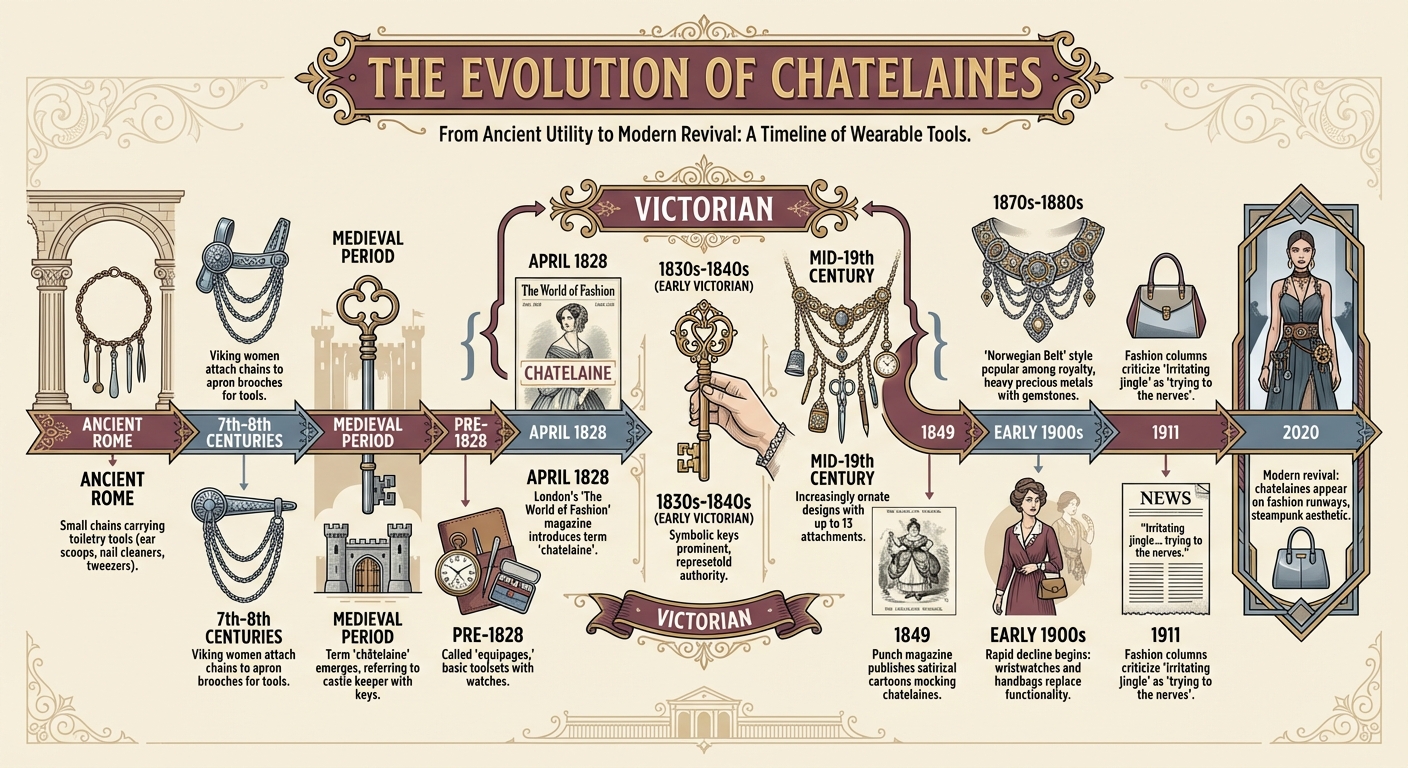
Evolution of Victorian Chatelaines from Ancient Rome to Modern Day
The chatelaine saw a remarkable transformation during the 19th century, shifting from a practical household tool into a decorative fashion accessory before gradually fading into obscurity. In April 1828, the London magazine The World of Fashion introduced the term "chatelaine", linking the item to the romantic image of a medieval castle keeper. This elevated its status beyond the earlier, more utilitarian "equipage".
In the early Victorian era of the 1830s and 1840s, chatelaines prominently featured symbolic keys, reflecting a woman’s authority over her household. By the middle of the century, these accessories became increasingly ornate, with some boasting up to 13 attachments. The 1870s and 1880s brought the "Norwegian belt" style, a high-society trend that extended these mid-century designs. These belts, featuring interchangeable chains, were often so heavy they could weigh down a dress. Attachments became more varied, including items like dance cards, elegant notebooks, and vinaigrettes designed to mask unpleasant urban smells.
However, as lifestyles and technologies evolved, the chatelaine's practicality diminished. By the early 20th century, its decline was swift. Wristwatches replaced one of its primary functions, and larger, more functional handbags provided discreet storage without the constant clinking of chains. Additionally, as women sought greater freedom of movement, the cumbersome and noisy accessory became more of a hindrance. By 1911, fashion columns criticized the "irritating jingle" of chatelaines, calling it "distinctly trying to the nerves".
"The development of the wristwatch and the increasing size of handbags saw the decline of the chatelaine in the early 20th century."
– Research Worcestershire
Even humorists took aim at the accessory. In 1849, Punch magazine published cartoons poking fun at women who supposedly hung oversized household items like kettles and brooms from their chatelaines. What had once symbolized domestic authority and social prestige had become an outdated relic. While certain professions, such as nursing, continued to use simplified versions for carrying tools like thermometers and scissors into the late 19th century, for most women, the chatelaine had outlived its purpose.
Materials and Craftsmanship
The materials and craftsmanship of Victorian chatelaines highlight their dual purpose: practical tools and symbols of luxury.
Victorian chatelaines came in a variety of styles, from simple steel designs to opulent creations that reflected the social standing of their owners. For everyday practicality, plain steel or iron provided durability. In contrast, pieces for the upper class were often crafted from gold or sterling silver and embellished with gemstones like diamonds, rubies, and emeralds.
One material that gained particular popularity was cut steel, especially in England before its appeal spread across Europe. Artisans used rivets with faceted ends to mimic the sparkle of diamonds, creating a subtle yet captivating shimmer. The Victoria and Albert Museum described this effect as a "muted glitter". Queen Victoria herself elevated the status of cut steel when she acquired an elaborate steel chatelaine with faceted detailing in 1850, cementing its place among elite fashion.
The craftsmanship behind these pieces turned them into more than just functional tools - they became high-status accessories. Premier jewelers of the time played a key role in this transformation. Thornhill & Co. of Bond Street, renowned for creating exquisite designs for royal patrons, produced a striking example between 1863 and 1885. This piece, now part of the Victoria and Albert Museum collection, features a hook-plate shaped as a crowned monogram bearing the cypher of Alexandra, Princess of Wales. Across the Atlantic, American silversmith George W. Schiebler crafted sterling silver chatelaines with up to seven arms, adorned with intricate Victorian items like heart lockets, telescopic pencils, and perfume bottles. Luxury brands such as Tiffany, Fabergé, Lalique, and Boucheron also created extravagant designs, described by Genevieve Cummins as "glorious extravagance", often encrusted with diamonds and worn by aristocrats at grand events like fancy dress balls.
Auction records reveal the wide range of these pieces. For example, a Shakudo chatelaine featuring a writing pad, mirror, and perfume bottles was valued at $6,000. A Wedgwood Jasperware and steel-cut chatelaine from around 1800 sold for $2,250, while mid-range cut steel examples from 1860–1875 were priced around $1,120.
Luxury chatelaines often incorporated rare materials and intricate techniques. These included Shakudo (a Japanese alloy of gold and copper), Wedgwood Jasperware ceramic plaques, and Pinchbeck (a gold-imitation alloy made of copper and zinc). Artisans showcased their skill through techniques like engraving, chasing, repoussé, and enamel inlays. Accessories such as ivory writing tablets and finely crafted silver mesh coin purses further demonstrated the extraordinary attention to detail in these creations.
Modern Interest and Collecting
Victorian chatelaines have captured the imagination of today’s collectors, offering a glimpse into the lives of 19th-century women. These pieces, once essential tools and symbols of status, now serve as historical artifacts that reflect domestic roles and social hierarchies of the past.
Several factors contribute to their renewed popularity. Younger collectors are particularly drawn to their steampunk aesthetic and their practicality, especially as a clever solution to the absence of pockets in modern women’s clothing. Even high-fashion runways have embraced the concept, with updated versions of chatelaines making appearances as recently as 2020.
For serious collectors, the focus is on finding complete sets with their original attachments, as these command much higher prices. Sterling silver examples, for instance, typically range between $200 and $1,000, depending on their condition and the number of original pieces. Rare and exceptional chatelaines, such as a 17th-century tapestry example, can fetch astronomical sums - one sold for $22,087.71 at auction in 2008. Items crafted by renowned makers like Tiffany & Co., Fabergé, and George W. Schiebler are particularly prized for their craftsmanship and historical significance.
Interestingly, base metal and steel chatelaines are often found in better condition than their gold or silver counterparts. This is because their lower material value meant they were less likely to be melted down for scrap.
"The original sets that have survived are more likely to be made from base metals because it's not worthwhile for people to break them up into pieces." – Genevieve Cummins, Author
As collectors increasingly view chatelaines as investments, preserving their condition and completeness becomes a top priority.
Preservation and Care
Proper care is essential for maintaining antique chatelaines, especially given their varied materials and intricate construction. Iron and steel pieces are particularly susceptible to rust and should be stored in low-humidity environments. A quick magnet test can help determine if a piece contains these metals. Sterling silver chatelaines, on the other hand, benefit from regular, gentle cleaning with silver polish to prevent tarnish while preserving delicate engravings.
The most important rule for preservation is to keep original sets intact. A complete chatelaine with matching attachments is far more valuable than one with mismatched or missing pieces. When examining potential purchases, look for a small metal circle or "eye" at the top of trinkets - this detail confirms they were designed as chatelaine attachments. Some high-end sets even include velvet-lined cases, which should be protected from moisture and environmental wear.
Modern fabrics may not always support the weight of a chatelaine, especially heavier ones. It’s a good idea to test them on sturdy waistbands and ensure the weight is evenly distributed across multiple chains.
Influence on Modern Jewelry Designs
The enduring appeal of chatelaines has inspired contemporary jewelry designers to reimagine their mix of practicality and elegance. These Victorian creations resonate with modern consumers who value accessories that combine utility with artistic expression. This shift toward functional yet stylish jewelry mirrors the original purpose of chatelaines.
Modern interpretations vary widely. The carabiner jewelry trend, for example, transforms a utilitarian tool into a chic accessory. Similarly, charm bracelets and modular jewelry systems echo the customizable nature of Victorian chatelaines, allowing wearers to tailor their pieces to their personal style and needs.
Brands like LaCkore Couture embrace this legacy by emphasizing handcrafted quality and customization. Their mix-and-match approach reflects the Victorian tradition of creating jewelry that was both beautiful and practical. By combining meticulous craftsmanship with an element of personal expression, today’s designers honor the artisans of the 19th century who turned everyday tools into symbols of individuality and status.
Conclusion
Victorian chatelaines were much more than just decorative trinkets - they were clever solutions to the practical challenges of 19th-century life. In an era when dresses lacked functional pockets, these accessories acted as the ultimate multitool, keeping essential items within easy reach. The name itself, drawn from the French term châtelaine (mistress of the château), reflected the authority and domestic responsibilities these pieces symbolized.
What set chatelaines apart was their ability to merge utility with prestige. While housekeepers used simpler steel versions for daily tasks, aristocrats flaunted extravagant designs crafted in gold and silver by famous jewelers like Tiffany, Fabergé, and Lalique. The soft jingling of their chains was a sound that conveyed both practicality and social standing.
"Chatelaines became a status symbol of the power and responsibility a woman had around the home, after all, if you have the keys to the home on you at all times you must be pretty powerful." - Molly Elizabeth Agnew, Founder of Eternal Goddess
Though chatelaines faded from everyday use with the rise of modern conveniences, their legacy endures. Contemporary designers continue to draw on their unique blend of artistry and function. For instance, LaCkore Couture pays tribute to this heritage with handcrafted, customizable pieces that echo the elegance and practicality of the originals.
These timeless artifacts remind us that the best accessories are those that seamlessly combine beauty, purpose, and lasting significance.
FAQs
How did chatelaines attach to clothing?
Chatelaines were fastened at the waist with an ornate hook or clasp. From this central piece, several chains extended, each holding essential household tools or personal belongings. In the 19th century, they provided both a functional and fashionable solution to the absence of pockets.
How can I tell if a chatelaine is authentic?
To determine if a chatelaine is genuine, pay close attention to its craftsmanship, materials, and markings. Authentic pieces from the Victorian era often feature sterling silver hallmarks or small, uniform stamps that were typical of the time. Additionally, examine the item for wear and tear consistent with its age, as this can provide further evidence of its historical origin. These details are key in verifying its authenticity.
Why did chatelaines fall out of fashion?
As clothing styles changed, the practicality of chatelaines diminished. The rise of pockets and purses made these once-essential tools less necessary, eventually turning them into decorative accessories rather than functional items.