Skip to content




Symbolism of Colors in Gemstone Jewelry
If you want gemstone jewelry to say something, start with the color. In this article, I’d sum it up like this: red points to love and courage, blue to calm and loyalty, green to growth and money, yellow to joy and confidence, purple to intuition and royalty, black to protection and power, and white or clear to purity and new beginnings.
I also see one big takeaway from the piece: color often shapes first impressions more than the gem name itself. The article backs that up with examples from history and psychology, including research that says red can increase heart rate and grab attention, while blue can lower blood pressure and build trust.
If I had to boil the whole article down into a short checklist, it would be this:
- Pick red for romance, bold gifts, and self-belief
- Pick blue for peace, trust, and long-term commitment
- Pick green for growth, luck, and career milestones
- Pick yellow for joy, confidence, and encouragement
- Pick purple for spirituality, intuition, and artistic expression
- Pick black for grounding, contrast, and protection
- Pick white or clear for weddings, milestones, and clean, simple looks
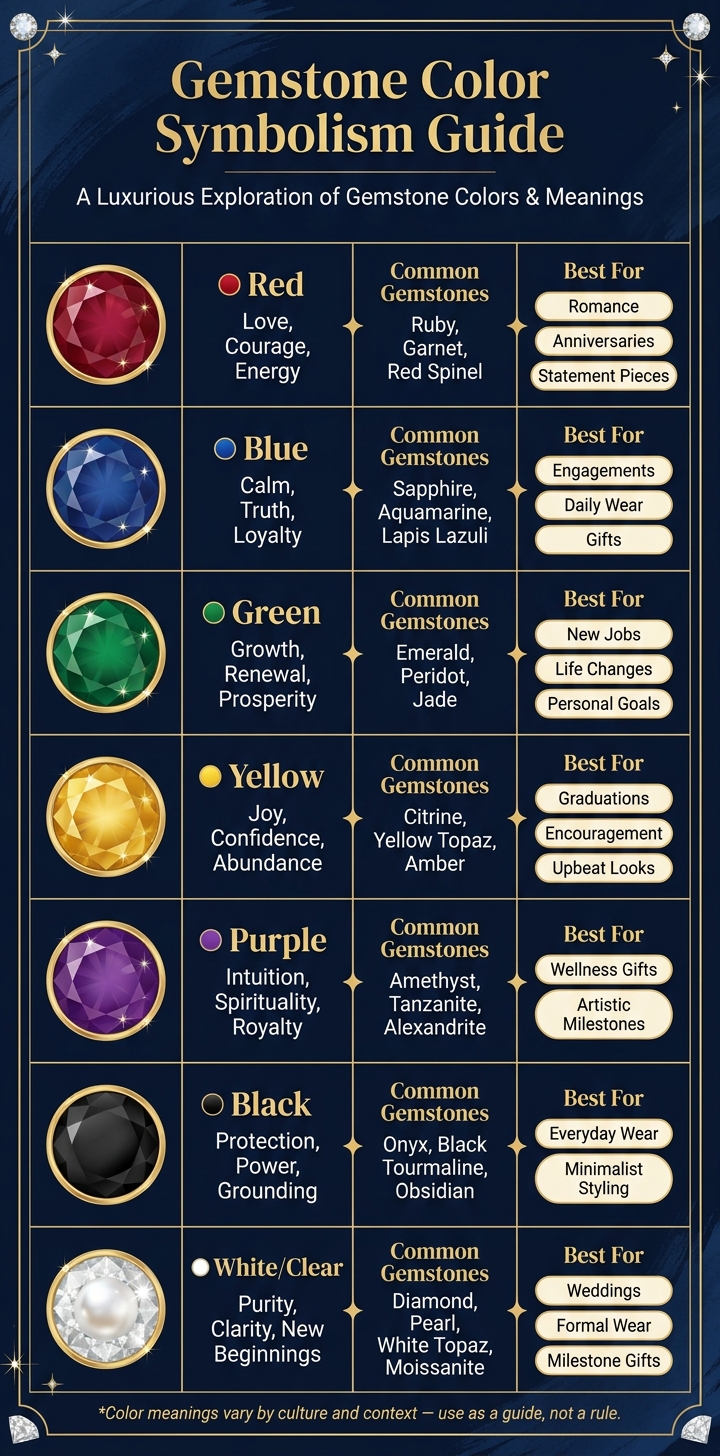
Gemstone Color Symbolism: Meanings, Gems & Best Uses at a Glance
Quick Comparison
| Color | Main meaning | Common gems | Best fit |
|---|---|---|---|
| Red | Love, courage, energy | Ruby, Garnet, Red Spinel | Romance, anniversaries, statement pieces |
| Blue | Calm, truth, loyalty | Sapphire, Aquamarine, Lapis Lazuli | Engagements, daily wear, gifts |
| Green | Growth, renewal, prosperity | Emerald, Peridot, Jade | New jobs, life changes, personal goals |
| Yellow | Joy, confidence, abundance | Citrine, Yellow Topaz, Amber | Graduations, encouragement, upbeat looks |
| Purple | Intuition, spirituality, royalty | Amethyst, Tanzanite, Alexandrite | Wellness gifts, artistic moments |
| Black | Protection, power, grounding | Onyx, Black Tourmaline, Obsidian | Everyday wear, contrast, stress-filled periods |
| White/Clear | Purity, clarity, new beginnings | Diamond, Pearl, White Topaz, Moissanite | Weddings, formal wear, milestone gifts |
One more point matters: these meanings are not fixed. They shift by time, place, religion, trade, and social custom. So when I read this article, the message feels simple: use color meanings as a guide, then choose the stone that fits your story.
The Main Gemstone Color Groups and What They Mean
These are the color meanings most buyers tend to look for when shopping for gemstone jewelry.
Red, Blue, and Green Gemstones
Red stones like ruby and garnet are tied to passion, courage, and vitality. Ruby usually feels more intense and is often linked with power. Garnet, on the other hand, has a warmer feel and is often connected with friendship and loyalty.
Blue stones like sapphire and aquamarine point to calm, truth, loyalty, and wisdom. They often give jewelry a steady, peaceful mood, which helps explain why they show up so often in rings and everyday pieces.
Green stones such as emerald and peridot stand for growth, renewal, prosperity, and harmony. If red feels bold and blue feels calm, green sits somewhere in the middle. It has a grounded, balanced feel that many people love.
Yellow, Purple, and Black Gemstones
Citrine and yellow topaz are linked with abundance and confidence. Yellow topaz also suggests mental clarity. Purple stones, especially amethyst, are tied to intuition, spirituality, and royalty.
Black stones bring depth, contrast, and protection. In simple pieces, they add a clean contrast. In multicolor designs, they help balance the look so it doesn't feel too busy.
White and Clear Gemstones
White and clear stones are often tied to purity, clarity, and new beginnings. That's a big reason they fit so well in milestone jewelry, including engagement rings, anniversary gifts, and graduation pieces.
At a glance:
| Color Group | Key Symbolism | Common Gemstones | Typical Jewelry Use |
|---|---|---|---|
| Red | Passion, courage, vitality | Ruby, Garnet, Red Spinel | Statement rings, heart pendants, bold bracelets |
| Blue | Calm, truth, loyalty, wisdom | Sapphire, Aquamarine, Blue Topaz | Engagement rings, dainty necklaces, earrings |
| Green | Growth, renewal, prosperity | Emerald, Peridot, Jade | Classic rings, birthstone studs, carved charms |
| Yellow tones | Optimism, joy, abundance | Citrine, Yellow Topaz, Amber | Statement rings, sunshine pendants, charms |
| Purple | Intuition, spirituality, royalty | Amethyst, Tanzanite | Beaded bracelets, cocktail rings, spiritual charms |
| Black | Protection, power, grounding | Onyx, Black Tourmaline, Obsidian | Minimalist rings, unisex bracelets, protective amulets |
| White and clear | Purity, clarity, new beginnings | Diamond, Pearl, White Topaz, Moissanite | Engagement rings, classic strands, stud earrings |
These meanings are broad, not fixed. History and culture shape them, and that still affects how people pick colored gemstones today.
The History and Meaning Behind Gemstone Colors
Protection, Status, and Ritual Use Across Traditions
For thousands of years, gemstone color has meant more than simple looks. People tied a stone’s color to its purpose, rank, or use in ritual. Those ideas moved through royalty, religion, trade, and ceremony.
Across many societies, gemstone colors helped signal power, guard the wearer, and mark sacred or social roles.
Blue stones have a long link to ceremony. Lapis lazuli appeared in Sumerian royal burials around 2600 BCE, where it symbolized the night sky and the divine.
Red stones carried another kind of meaning. Ancient Burmese warriors were said to place rubies in their skin before battle because they believed the stones made them invulnerable.
Green stones also played a ritual role. Cleopatra was known to give emeralds engraved with her likeness to foreign dignitaries as a sign of royal favor.
Black stones had their own place in mourning and protection. In Victorian England, jet became the required material for full mourning jewelry after the death of Prince Albert in 1861.
Why Color Meanings Differ Across Cultures and Time
These meanings didn’t stay fixed. Religion, literature, and commerce all changed how people understood color over time.
There’s no single meaning that applies everywhere. Pearls make that plain. In Greek mythology, they were tears of joy from Aphrodite. In Victorian England, seed pearls appeared in mourning jewelry to stand for the tears of the bereaved.
Opal saw one of the sharpest changes in meaning during the 19th century. In Roman and Medieval Europe, it was widely seen as a symbol of hope and creativity. Then its image changed fast after Sir Walter Scott’s 1829 novel Anne of Geierstein tied it to misfortune.
Religious and philosophical systems also pushed meanings in very different directions. In Chinese culture, jade is the supreme symbol of purity and wisdom and was sometimes valued above gold. In Mayan civilization, jade mainly marked the divine right to rule.
Even ideas that now seem fixed are fairly recent. The modern birthstone list was standardized by the American National Association of Jewelers in 1912.
That history still shapes how people shop for and wear jewelry now. Still, color symbolism works more like a guide than a hard rule, and personal meaning often carries the most weight.
How to Use Color Symbolism in Jewelry Today
Matching Gemstone Colors to Mood, Milestones, and Personal Style
Once you know what different colors suggest, picking jewelry gets a lot easier. Color symbolism gives you a simple way to choose a piece with purpose based on your mood, a milestone, or your personal style.
Here’s a simple way to think about it:
- Choose red stones for confidence
- Choose blue stones for calm
- Choose green stones for growth
- Choose purple stones for creativity
- Choose black stones for grounding
- Choose clear or white stones for fresh starts
This works well for gifts too. Green fits a new venture. Blue can send a calmer, steadier message. Clear stones make sense for a milestone. The main idea is simple: pick the color that matches what you want the piece to say.
Once you’ve got that message, you can carry it into the way you wear the jewelry.
Combining Colors in Rings, Necklaces, Bracelets, and Charms
The same idea works well with layering and stacking jewelry sets. Layering and stacking can mean more when you use color on purpose.
Start with one main piece, then build around it with colors that work well together. Red and blue in stacked rings can balance energy and calm. Black with clear stones creates a high-contrast look that feels grounded and polished. Green with gold-toned settings can lean into a prosperity-focused intention. If you want something softer, pink and green can balance warmth with renewal.
How LaCkore Couture Reflects Symbolic Color Choices

LaCkore Couture shows how this can look in practice with handcrafted, customizable pieces made with natural stones. The brand lets color choices do more than add style - they can carry meaning too.
Because LaCkore Couture works across necklaces, earrings, bracelets, rings, and charms, it’s easy to pick a format that fits your intent. You might want a single bold pendant. Or maybe a layered bracelet stack says it better. Either way, the customizable combinations make it simple to build a look that tells a personal story.
Gemstone Color Comparison and How to Choose the Right One
Color Symbolism at a Glance: A Quick-Reference Table
Use this table for a quick side-by-side look at gemstone colors. If you want an easy way to narrow your options, compare each color by meaning and where it fits best.
| Color Family | Representative Gemstones | Best For |
|---|---|---|
| Red | Ruby, Garnet, Red Spinel | Anniversaries, romance, confidence |
| Blue | Sapphire, Aquamarine, Lapis Lazuli | Engagements, calm, loyalty |
| Green | Emerald, Peridot, Jade | New beginnings, career milestones, fresh starts |
| Yellow | Citrine, Yellow Topaz, Amber | Graduations, creative pursuits, encouragement |
| Purple | Amethyst, Alexandrite | Wellness gifts, artistic milestones, meditation |
| Black | Onyx, Black Tourmaline, Obsidian | Minimalist styling, stressful transitions, everyday wear |
| White/Clear | Diamond, White Topaz, Moonstone | Engagements, formal wear, minimalist looks |
Blue, yellow, and white stones tend to work well with most metals, which makes them a safe pick if you're not sure where to start.
Conclusion: Key Points to Remember When Choosing Gemstone Jewelry
Once you match a color to a purpose, the last step is simpler than it sounds: think about the moment, the person, and the meaning behind the piece.
Color symbolism isn't a rulebook. It's more like a guide. Pick the shade that says what you want it to say, whether you're shopping for yourself or for someone else. A blue stone, for example, might suggest calm, trust, or loyalty depending on the setting and the culture. None of those readings is wrong.
LaCkore Couture's handcrafted necklaces, rings, bracelets, and charms make it easy to turn color symbolism into something personal you can wear every day.
FAQs
How do I choose a gemstone color for a gift?
Choose a gemstone color that fits the message or milestone you want to mark, whether that’s confidence, peace, or a new beginning.
You can also look at the recipient’s birthstone, the meaning tied to certain colors, and their personal style. For example, red is often linked with passion, while blue can suggest loyalty or calm. If you’re not sure what to pick, blue is often a safe choice that appeals to a lot of people.
Do gemstone color meanings change by culture?
Yes. Gemstone color meanings can shift a lot from one place to another.
For example, red can stand for passion in many Western settings, luck in China, purity in India, or both love and heartache for the Zulu people.
White changes too. In the West, it often points to purity. In many Asian traditions, it’s linked to mourning instead.
These meanings come from different histories, rituals, and beliefs.
Can I mix gemstone colors in one look?
Yes. Mixing gemstone colors is a great way to show your personal style and build a look that feels lively and your own.
For a bold effect, pair complementary colors. If you want something softer and more balanced, go with analogous tones. You can wear mixed colors through layered necklaces, stacked rings, or statement pieces with more than one gemstone.