Skip to content




10 Sacred Geometry Motifs in Statement Jewelry
My rule for sacred geometry jewelry: choose a motif you can read at arm’s length. For a pendant around 1.5–2.5 inches wide, I look for clear outlines, open space, and stones that support - not hide - the pattern.
These 10 motifs range from simple curves to dense circle-and-line designs. Here’s how I’d compare them before choosing a piece.
Quick Comparison
| Motif | Shape | Best statement format | Common meaning |
|---|---|---|---|
| Mandala | Rings and repeated shapes around a center | Round pendant | Balance and wholeness |
| Flower of Life | 19 overlapping circles | Openwork medallion | Unity and connection |
| Seed of Life | Seven overlapping circles | Pendant or bold ring | Beginnings and growth |
| Vesica Piscis | Almond-shaped overlap of two circles | Long drop earrings | Union and balance |
| Hexagram | Two overlapping triangles | Pendant or signet ring | Meaning depends on faith or context |
| Sri Yantra | Nine interlocking triangles around a center point | Detailed medallion | Union in Hindu sacred practice |
| Metatron’s Cube | 13 circles joined by lines | Openwork pendant | Order and connection |
| Golden Spiral | An outward-growing curve | Sculptural pendant | Growth and motion |
| Hexagon and Honeycomb | Six-sided frames or repeating cells | Wide cuff or linked necklace | Order and community |
| Circle and Triangle Compositions | Curves paired with angles | Pendant or drop earrings | Wholeness and direction |
For dense patterns, I’d choose openwork or contrasting finishes. For simpler shapes, a clean metal outline can be enough. <u>Let one piece lead</u>, keep nearby jewelry quiet, and check the symbol’s background: its meaning can change across faiths and communities.
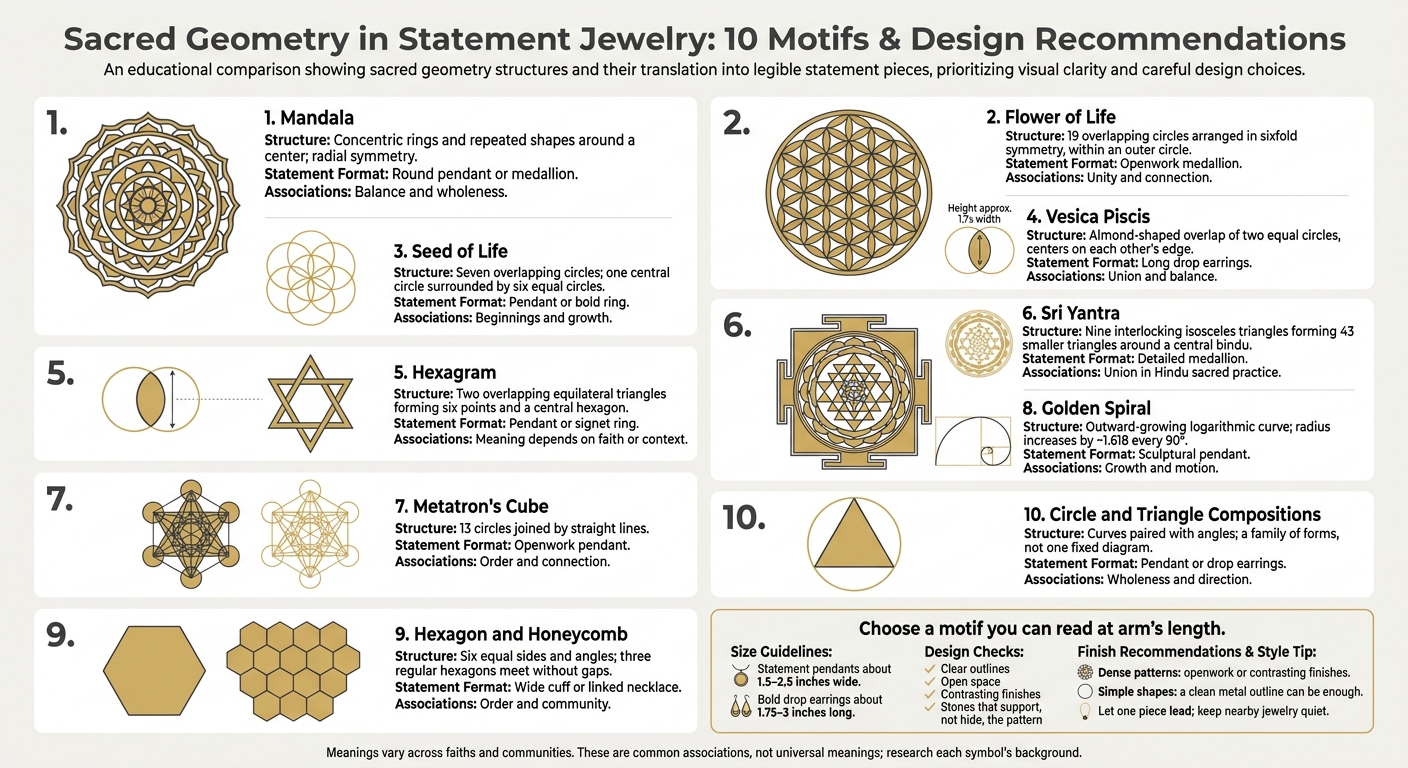
10 Sacred Geometry Jewelry Motifs Compared
What Makes a Sacred Geometry Motif Work in Statement Jewelry
A sacred geometry motif doesn’t turn into a statement piece just because it’s big. It works when the design still reads clearly at a glance. That comes down to scale, symmetry, open space, contrast, and stone placement working as a team. The motifs below use those same ideas in different ways.
Radial symmetry is a big reason motifs like mandalas and Flower of Life patterns work so well in round pendants and medallions. The circular frame mirrors the pattern, which helps keep it clear and easy to read. Statement pendants often measure about 1.5 to 2.5 inches wide, while bold drop earrings usually fall around 1.75 to 3 inches long.
Negative space helps large pieces feel lighter instead of dense or overloaded. Open cutouts fit line-based motifs like hexagrams and Metatron’s Cube - often described as 13 circles linked by straight lines - because they show the pattern without adding extra bulk.
Contrast makes the motif stand out. Think polished metal next to brushed metal, yellow gold paired with oxidized silver, or dark recesses set behind raised lines. Those shifts make the geometry easier to see.
Stone placement should support the shape, not hide it. A center stone can anchor the design. Perimeter stones can trace the outer form. Evenly spaced accents can strengthen symmetry and help the pattern hold together visually.
| Design factor | Everyday jewelry | Statement jewelry |
|---|---|---|
| Symmetry | Subtle detail, visible up close | Strong radial symmetry readable at arm's-length viewing |
| Negative space | Small gaps within a compact design | Larger cutouts that reduce weight and reveal skin or clothing |
| Contrast | Single metal finish | Mixed finishes, darkened recesses, or colored stones |
| Stone placement | Single discreet accent | Center stone, perimeter stones, or stones at geometric vertices |
With those rules in mind, the motifs below show how each shape behaves at statement scale.
1. Mandala
A mandala is a centered, radial design made from concentric rings and repeated shapes. In Hindu, Buddhist, and Jain traditions, mandalas have long been used as cosmic maps and meditation aids. The square often points to the earthly world, while the circle suggests the cosmic. In jewelry, it’s best described as mandala-inspired. The form comes through, but not the ritual setting. That clear structure is what gives mandalas their strong, statement-scale look.
Shape Structure in Jewelry
Mandala designs work well in statement jewelry because each part has a clear job: the center, the middle ring, and the outer edge. That built-in order helps the piece feel bold without turning messy. A 2-inch circular pendant, for example, might feature a bezel-set center stone, an eight-petal middle layer, and a fine outer ring. Each zone stands on its own, and none fights for attention.
Best Formats for Statement Pieces
Pendant necklaces are usually the best fit for mandalas because the circular shape supports the motif and keeps it easy to read. Chandelier and drop earrings can work well too, especially when a smaller mandala appears on each side. Cuff bracelets and brooches also offer enough room for openwork detail. Rings tend to work best with pared-down mandalas, since fine concentric lines can disappear at that size.
How It Reads at Larger Scale
Scale changes how a mandala feels. Contrast helps keep the center separate from the outer rings: polished gold against dark enamel, oxidized silver with bright stone accents, or two metal finishes dividing the inner and outer layers. Open cutouts between the rings tie back to the mandala’s layered build and keep the piece from feeling heavy or flat.
At statement size, symmetry does a lot of the work. Evenly spaced rays or petals give the design a rhythm that still reads from a distance. That same circular logic becomes denser in the Flower of Life.
2. Flower of Life
If the mandala pulls your eye inward, the Flower of Life pushes that symmetry outward through repeated circles. The pattern is made of 19 overlapping circles inside one larger outer circle, which creates repeated vesicae piscis forms. Each circle overlaps six others at equal spacing, forming a sixfold pattern that looks floral at first glance but also has a clear grid underneath. At a larger size, that packed geometry gives it a more structured look.
Shape Structure in Jewelry
One reason this motif works so well in jewelry is that it spreads visual weight across the whole surface. It doesn't depend on one central point to do all the work. Openwork matters here because it keeps the overlapping circles easy to see and stops the design from turning into a flat-looking disk. For pendants, a round piece in the 1.5- to 2-inch range gives the full 19-circle pattern enough space to stay clear from a normal viewing distance.
Common Symbolic Associations
Modern readings often connect the Flower of Life with interconnection, unity, harmony, and creation. Some jewelry descriptions also tie it to protection. That said, these meanings are better framed as current and cultural associations, not fixed historical facts. In plain terms, it's safest to say the motif is often associated with those ideas.
Best Formats for Statement Pieces
The most natural fit is a large round pendant or medallion because the outer shape matches the motif's geometry. Drop earrings can also work well at a slightly smaller size, since the sixfold symmetry still comes through even as the piece moves. Cuffs and wide rings tend to work better with partial versions, because curved surfaces can block or distort the outer circles.
How It Reads at Larger Scale
At statement size, the Flower of Life reads as both floral and grid-like. That mix is part of its appeal. Polished or two-tone finishes help separate the overlapping circles, which matters even more on larger pieces. You end up with a motif that feels organic and architectural at the same time - a rare mix, and a strong one for statement jewelry.
3. Seed of Life
The Seed of Life pares the Flower of Life down to seven overlapping circles: one in the center, with six equal circles around it. The result is a sixfold pattern with vesica piscis overlaps that form a soft, petal-like shape.
Shape Structure in Jewelry
With fewer circles than the Flower of Life, the Seed of Life stays easier to read in small jewelry. The compact seven-circle layout holds up better on pendants and rings, where more crowded geometry can start to look muddy. In solid metal, engraving or raised relief helps keep the pattern from reading as flat.
Common Symbolic Associations
In current sacred-geometry practice, the Seed of Life is tied to creation, beginnings, potential, interconnectedness, and growth. The seven circles are also often connected to the seven days of creation in Genesis. That said, this is a symbolic reading, not a universal historical meaning.
Best Formats for Statement Pieces
This motif tends to work best when it has room to breathe. It fits especially well in:
- Large pendants
- Medallions
- Chandelier earrings
- Wide cuffs
- Oversized rings
A round pendant or medallion gives the seven-circle pattern enough surface area to stay legible. Chandelier earrings can also work well because the design has space to move without being shrunk so much that the circles start to blur together.
How It Reads at Larger Scale
At a larger size, the Seed of Life first reads like a rosette, then reveals itself as a set of overlapping circles when viewed up close. High-contrast finishes can make that geometry easier to see from farther away. Think polished gold or silver with oxidized recesses, or dark enamel placed in the intersections.
At statement scale, the details that matter most are simple: clean intersections and equal diameters.
That overlap-based structure narrows further in Vesica Piscis.
4. Vesica Piscis
After the Seed of Life’s repeating circles, the Vesica Piscis strips the idea down to one overlap. It comes from two equal circles placed so that each center sits on the other circle’s edge, forming a pointed almond shape known as a mandorla. The name comes from Latin and means “fish bladder,” a reference to its long outline. In Italian, it’s also called a mandorla, or almond.
Shape Structure in Jewelry
Its height is about 1.7 times its width, which gives it a tall, architectural silhouette. Even at a larger size, the shape stays easy to read. That plain geometry is a big part of why the motif holds so much symbolic force.
Common Symbolic Associations
The Vesica Piscis is often read as a sign of union, balance, and the meeting point between opposites - the idea that two separate forms can overlap and produce something new. In medieval Christian art, the vertical mandorla also framed sacred figures. These are interpretive associations, not fixed historical meanings, but they give the motif more depth.
Best Formats for Statement Pieces
Its vertical shape makes it a natural match for drop earrings and pendants. The long form works with the body instead of fighting against it. Solid metal gives the piece a sculpted feel, while an openwork version - where only the outlines of the two circles appear - looks lighter.
Showing both circles makes the construction easier to understand at a glance. A gemstone set in the center overlap strengthens the idea of union and gives the eye a clear focal point.
How It Reads at Larger Scale
At a larger scale, the Vesica Piscis feels elongated, symmetrical, and architectural. Its outline is strong enough to stand on its own, even without inner detail. Polished outer circles paired with a darker overlap help the two-circle build stand out. That interlocked form also sets up the line-based geometry of the Hexagram.
5. Hexagram
Where the Vesica Piscis relies on a single overlap, the hexagram pushes that same idea further. It forms a six-pointed star by layering two equilateral triangles, one facing up and one facing down. That overlap creates a central hexagon and a clear six-point outline that holds up well in bold jewelry. In plain terms, it’s one of the easiest line-based motifs to read at statement size.
Shape Structure in Jewelry
The hexagram’s six-way symmetry helps it sit evenly on a pendant, medallion, brooch, or earring. Both triangles need enough space to stay easy to read, which also keeps the central hexagon clear. In smaller pieces, like rings or studs, a thicker outline or a solid silhouette usually works better for keeping the geometry crisp.
Common Symbolic Associations
The hexagram is widely known as the Magen David in Jewish contexts. It also appears as the Shatkona in Hindu tradition, and in other readings it can stand for balance or the union of opposites.
Best Formats for Statement Pieces
Large pendants and medallion necklaces give both triangles enough room to stay legible. A raised two-triangle build can add extra depth you can see right away. A gemstone set at the center can also give the design a clear focal point.
How It Reads at Larger Scale
At a larger scale, the hexagram tends to read first as a bold graphic form, then as two interlocking triangles. The six outer points pull the eye around the edge, while the central hexagon keeps the composition grounded. High-contrast finishes or contrasting enamel help keep the overlapping structure clear at a glance. Its precise geometry leads neatly into the next motif’s more networked structure.
6. Sri Yantra
If the hexagram brings together two triangles, the Sri Yantra takes that same idea and builds it into a much more layered sacred diagram. The Sri Yantra, also called the Sri Chakra, uses nine interlocking isosceles triangles: four point upward and five point downward. Where they cross, they form 43 smaller triangles around a central point known as the bindu. That setup is what gives the motif its dense, layered form.
Shape Structure in Jewelry
A full version can include lotus rings, concentric circles, and a square bhupura with four gates. In jewelry, that full layout works well for a large pendant. If you want a cleaner look, you can strip it back to the triangles and the bindu. The bindu should stay easy to see, whether you mark it with a small gemstone, a polished metal dot, or an enamel accent at the center.
Common Symbolic Associations
In Hindu Tantric and Śrīvidyā tradition, the four upward-pointing triangles are linked with Śiva, while the five downward-pointing triangles are linked with Śakti. Their interlocking form represents the union of paired forces. Since this comes from a living religious tradition, it's better to present these as inherited interpretations, not fixed meanings that apply in every setting - especially in product copy.
Best Formats for Statement Pieces
Large pendants and medallions tend to work best because the full design stays easy to read when viewed straight on. Brooches and cuffs also suit the motif well. For earrings, a reduced triangle-and-bindu version usually makes more sense, since the fine intersections can blur at normal viewing distance.
How It Reads at Larger Scale
At statement size, the Sri Yantra draws the eye from the outer frame inward. The square bhupura creates a boundary, the lotus rings bring a sense of rhythm, the interlocking triangles add tension, and the bindu pulls the whole design to a sharp central point. High-polish metal helps the linework stand out, while cutout openwork or contrasting enamel can help separate the overlapping triangles. It's smart to test the piece at wearing distance. Lines that look crisp on the bench can blend together once the piece is in use. That dense center gives the Sri Yantra more of an architectural feel than the next motif's linear grid.
7. Metatron's Cube
After the layered complexity of the Sri Yantra, Metatron's Cube moves in a cleaner direction. It’s a 13-circle geometric network made from circles linked by straight lines, and it’s often tied to the five Platonic solids within its structure. The result feels more like an architectural framework than a simple symbol.
Shape Structure in Jewelry
Metatron's Cube is not a cube at all. It’s a circle-and-line network: repeating circles joined by straight lines. In smaller jewelry, the outer circle and central geometry are often enough to make the motif recognizable. In larger pieces, the full network becomes easier to read, and that’s when it starts to feel less like decoration and more like built geometry.
Common Symbolic Associations
Modern sacred-geometry sources often link the motif with order, balance, interconnectedness, and creation. Its tie to the five Platonic solids adds ideas of elemental balance and universal proportion, although those meanings come from philosophical and esoteric traditions, not from one settled historical source.
The name comes from Metatron, a figure in Jewish mystical traditions connected with a celestial scribe or divine intermediary. The familiar 13-circle diagram is also a fairly modern attribution, not an ancient artifact.
Best Formats for Statement Pieces
A large pendant or medallion tends to work best because the design can be seen straight on as a complete symmetrical composition. Openwork is especially useful here. It keeps the full line network visible without making the piece feel heavy.
Drop earrings usually need a simplified version, since fewer internal lines make the motif easier to read while the piece moves. Cuff bracelets and bangles can also show it well, especially when the pattern repeats or wraps around the wrist. Wide signet or cocktail rings can hold a central section of the design, but narrow bands usually don’t give the intersections enough room to stay clear.
How It Reads at Larger Scale
At statement size, Metatron's Cube tends to read in stages: first as symmetry, then as circles and lines, and only after that as polygonal forms. That reading order matters. To keep it intact, the design needs a clear outer boundary, even line weight, and enough open space between elements.
Yellow gold softens the grid. Silver or oxidized silver gives the geometry a sharper, more structural feel, and darkened recesses add contrast so the line network stands out from normal wearing distance. That visual order is what helps the motif hold up in oversized jewelry.
8. Golden Spiral
After the rigid line networks of the previous motif, the Golden Spiral feels like geometry in motion. Instead of a grid, you get one continuous curve that opens outward from a tight center. The growth follows a precise rule: the radius increases by about 1.618 with every 90-degree turn. That number is the golden ratio, which gives the form its familiar sense of balance.
Shape Structure in Jewelry
In jewelry, the spiral is often built from golden rectangles connected by quarter-circle arcs. That creates a curve that feels both orderly and natural. A lot of so-called "golden spiral" pieces use a Fibonacci-style layout instead of a mathematically exact logarithmic spiral. The difference matters more than it might seem.
A computer-drawn logarithmic spiral gives you a perfectly smooth curve. A Fibonacci-based layout, by contrast, creates a slightly segmented shape. That can make the piece feel more geometric and intentional, which often works well in metal.
Common Symbolic Associations
This motif is often linked to growth and unfolding motion. The tight center feels like a point of origin, while the outer curve suggests development over time. Those readings are artistic associations, not fixed spiritual meanings.
Part of the draw comes from that push and pull: exact proportion on one side, an organic, shell-like form on the other.
Best Formats for Statement Pieces
A pendant is usually the strongest fit because the eye naturally traces the line from the center outward. Drop earrings also work well, since the spiral’s direction suits a hanging form.
Other strong options include:
- A cuff bracelet, where the curve can run along the wrist for a more architectural look
- A sculptural ring, where the motif can sit as a raised open band
How It Reads at Larger Scale
At a larger size, the Golden Spiral reads less like a diagram and more like a sculptural curve. Wide metal lines make the expanding geometry easier to see, while openwork helps the piece stay light instead of heavy. A gemstone at the center can pin the eye to the origin, and graduated stones or surface texture can track the curve outward.
The main problem at this scale is crowding the inner turns. If the spacing gets too tight, the spiral can lose its character and start to look like a generic swirl.
That flowing motion shifts into the cell-like repetition of hexagons and honeycomb.
9. Hexagon and Honeycomb
After the Golden Spiral, hexagon and honeycomb motifs bring things back to order. Clean lines. Repetition. A pattern you can count on.
A regular hexagon has six equal sides and six equal angles. Each interior angle is exactly 120°, so three hexagons can meet at one point without leaving a gap. That trait is called tessellation, and it allows the pattern to repeat cleanly across a surface. That’s a big part of why these motifs work so well in jewelry: the geometry stays easy to read, even at a larger size.
Shape Structure in Jewelry
A single hexagon works like a crisp architectural frame. It feels neat, controlled, and direct. A honeycomb pattern shifts that idea into a field of repeating cells, which adds rhythm without losing structure.
Designers can keep the look from getting too heavy by changing how the cells are used. Some may be solid, others open. Cell sizes can vary. Negative space also does a lot of work here, giving the eye room to rest so the pattern doesn’t feel packed too tight.
Common Symbolic Associations
The hexagon is often linked with harmony, balance, order, efficiency, and connection. Honeycomb builds on that and points more toward community, cooperation, and shared purpose.
That said, these are modern associations, not fixed meanings that apply everywhere. The motif also carries a mathematical logic. Hexagonal packing is highly efficient, which adds to its sense of order and intent.
Best Formats for Statement Pieces
A large hexagonal pendant is one of the clearest ways to use this motif. One sharp shape with a centered gemstone creates a strong focal point.
Honeycomb patterns tend to work best when the repeated cells have room to show. Good formats include:
- Openwork earrings
- Wide cuffs
- Linked necklaces
As the piece moves, the repeating cells stay visible, and that helps the pattern read from a normal distance.
How It Reads at Larger Scale
At a larger size, a single hexagon can feel bold and architectural. A honeycomb panel is a bit trickier. If the cell walls are too thin, or if there are too many cells, the whole piece can start to look crowded.
The fix is pretty simple: use fewer, larger cells. Keep the boundaries clear. Leave steady negative space between forms. Polished edges paired with dark recessed surfaces can also separate each cell and keep the geometry sharp when someone sees the piece in everyday wear.
10. Circle and Triangle Compositions
Compared with the denser diagrams above, this motif strips sacred geometry down to a simple visual tension: curve against angle. It isn't one locked-in pattern. It's a whole family of forms built from circles and triangles.
Your eye usually lands on the curve first. Then it follows the triangle's point or direction. That push and pull between something soft and something sharp gives the design its spark.
Shape Structure in Jewelry
You’ll see a few layouts again and again:
- A triangle inside a circle
- A triangle set within a circular border
- Three circles placed at the triangle’s points
Each version keeps the same core idea, but the mood shifts a bit depending on which shape takes the lead.
Common Symbolic Associations
The circle is often linked with wholeness and continuity, while the triangle can suggest balance, stability, or a three-part relationship such as mind-body-spirit. Put together, the forms can feel like completeness meeting direction.
In modern use, the triangle-in-circle form also appears in recovery symbolism.
Best Formats for Statement Pieces
This motif fits especially well in pendants, medallion necklaces, drop earrings, brooches, cuff bracelets, and statement rings.
A circle gives the triangle a clean frame, which is part of why pendants and medallions work so well. In earrings, the triangle can also serve as the pointed drop, giving the piece a sharper silhouette. For rings and cuffs, simpler outlines, engraved lines, or bezel-set stones usually keep the geometry clear on a curved surface.
How It Reads at Larger Scale
At a larger size, clear outlines and strong negative space matter more than tiny detail. A bold outer circle around a thinner triangle, or a heavy triangle inside a lighter circular outline, helps the eye read the hierarchy fast.
High contrast from mixing metals, finish, or stone placement also makes the composition easier to read from a distance. That’s what keeps bold geometry legible once the piece is worn.
How to Wear Bold Sacred Geometry Jewelry Without Losing the Motif
Bold geometry looks best when one piece takes the lead. Pick the motif first, then let the rest of the outfit support it instead of fighting for attention. A Flower of Life pendant or a Sri Yantra medallion already carries a lot of visual detail, so it helps to build the look around that single item.
Keep necklace layers spaced out, and let earrings echo the pendant instead of trying to outshine it. A slim chain with at least 1.5 inches of space from the focal pendant gives the motif room to breathe without hiding its inner lines. If the pendant is the star, go quieter with the earrings - small studs or narrow hoops in the same metal tone usually work best.
Finish matters too. High polish helps outlines look sharp and clean. Brushed or oxidized finishes tend to suit denser linework better. If you want to mix gold and silver, choose one as the main metal and use the other on purpose as a small accent.
Clothing plays a part here as well. A solid top or an open neckline gives a bold pendant the negative space it needs. Busy prints behind an intricate motif make both harder to read. When the background stays simple, the motif stays clear from far away and still shows its detail up close.
For a stacking and mix-and-match look, LaCkore Couture's Link Lock Charm Necklace follows the same idea: wear one focal piece, then add only one small accent. That bit of restraint keeps the motif clear.
Side-by-Side Look at the 10 Motifs
Here’s the quick comparison view. A motif’s structure has a big impact on how well it reads at statement size. Use the table below to compare each motif’s geometry, common symbolism, and the type of statement jewelry it tends to suit best. Meanings vary by culture, so these are common associations, not fixed rules.
| Motif | Defining Geometry | Common Associations | Best Jewelry Fit |
|---|---|---|---|
| Mandala | Concentric rings with radial symmetry; may incorporate petals, triangles, or squares | Balance, harmony, wholeness, mindfulness | Large pendant or medallion; radial cuff |
| Flower of Life | Overlapping circles arranged in sixfold symmetry; commonly shown as 19 circles | Creation, unity, interconnectedness | Openwork pendant or broad cuff |
| Seed of Life | Seven interlocking circles: one central circle surrounded by six | Beginnings, growth, potential | Ring face, charm, or clustered earrings |
| Vesica Piscis | Almond-shaped intersection of two equal circles | Duality, union, balance | Vertical drop pendant or elongated earrings |
| Hexagram | Two interlocking equilateral triangles, one pointing up and one down | Harmony, integration of opposites; meaning varies by tradition | Bold pendant, signet-style ring, or geometric earrings |
| Sri Yantra | Nine interlocking triangles - four upward and five downward - around a central bindu, framed by circles and a square | Meditation, cosmic union; rooted in Hindu tantric tradition | Detailed pendant or medallion where the full diagram stays visible |
| Metatron's Cube | 13 circles connected by straight lines; commonly explained as encoding the five Platonic solids | Order, interconnection, structural completeness | Openwork pendant, geometric cuff, or large statement earrings |
| Golden Spiral | Logarithmic spiral based on golden-ratio proportions | Growth, natural proportion, movement | Sculptural pendant |
| Hexagon and Honeycomb | Repeating hexagons in sixfold, tessellating symmetry | Efficiency, community, natural order | Cuff, linked necklace, or clustered earrings |
| Circle and Triangle Compositions | Rounded form combined with a three-sided directional shape | Unity paired with balance or direction; contrast between soft and angular | Bold pendant, layered necklace focal point, or oversized earrings |
Some motifs are hard to read once they’re cast in metal. Sri Yantra, Metatron's Cube, and finely detailed mandalas usually need openwork or cutout treatment so the lines don’t blur together. Simpler shapes like Vesica Piscis, the hexagram, and circle-triangle compositions tend to hold up well in solid metal.
Conclusion
Sacred geometry gives statement jewelry structure and meaning. Choose circular motifs for softness, angular motifs for structure, and layered diagrams for the most detail. The design should remain easy to read at wearing distance.
These symbols carry history tied to the communities that use them, so research their backgrounds before using them as fashion graphics. Pick a motif that feels true to you and works clearly with your style.
FAQs
Can I wear sacred geometry jewelry without religious beliefs?
Yes, you can wear sacred geometry jewelry without holding specific religious beliefs. Modern jewelry designs often use these motifs for self-expression, personal growth, and beauty - not just religious meaning.
Patterns like the Seed of Life or Metatron’s Cube appeal to many people for their appearance and perceived harmonizing qualities. Choose a piece that reflects your personal journey, represents mindfulness or resilience, or simply fits your style.
How can I check a motif’s geometric accuracy?
Study the motif’s origins and shape using reliable scholarly articles, specialized jewelry guides, and detailed historical websites.
To judge craftsmanship, look for precise, hand-finished details, smooth edges, and secure stone settings. Check the metal’s stated purity against standard hallmarks, such as .925 for sterling silver or karat markings for gold.
How do I choose a comfortable statement pendant?
Choose a pendant that fits your style and your daily routine. For everyday wear, look for a lightweight design with smooth edges and secure settings to help prevent irritation. A pendant measuring 0.5–1.0 inch often offers a good balance of visibility and comfort, but make sure the chain can support its weight. High-quality materials, such as sterling silver or gold, help your piece stay durable and comfortable while reflecting your personal story for years to come.