Skip to content




Symbolism of Protective Jewelry
Protective jewelry has been part of human history for over 40,000 years, serving as more than mere decoration. From ancient Egyptian amulets to modern evil eye pendants, these pieces symbolize protection, resilience, and personal identity. Here's what you need to know:
- Symbols and Meanings: Iconic symbols like the Eye of Horus, Hamsa, and Evil Eye have evolved but continue to represent safety, healing, and positivity.
- Materials: Gold, lapis lazuli, carnelian, and silver have historically been used for their symbolic and protective qualities, and they remain popular in modern designs.
- Modern Trends: Today’s protective jewelry is subtle, versatile, and often blends multiple symbols, allowing wearers to express personal meaning while staying stylish.
- Why It Matters: These pieces offer emotional reassurance, grounding, and a connection to ancient traditions, making them relevant in today’s uncertain world.
Modern brands, like LaCkore Couture, merge ancient symbolism with contemporary design, creating personalized, meaningful jewelry that honors history while fitting into everyday life. Protective jewelry remains a timeless way to express identity and seek comfort in a chaotic world.
Symbolism Across Time Periods
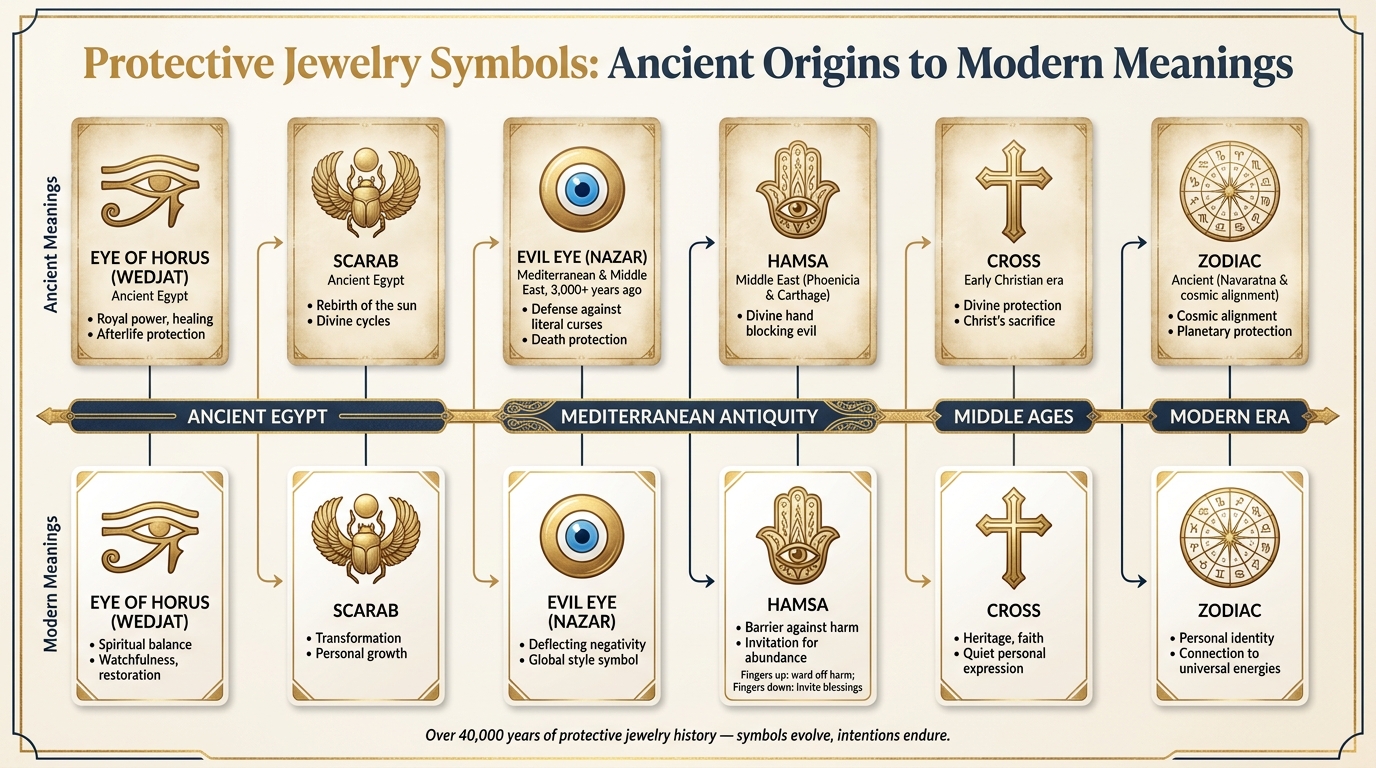
Protective Jewelry Symbols: Ancient Origins to Modern Meanings
Protective symbols in jewelry didn’t just appear out of nowhere - they grew out of specific fears, beliefs, and societal needs. What’s fascinating is how many of these symbols have endured, even as their forms and meanings have shifted over time.
Take the Eye of Horus (Wedjat), for example. In ancient Egypt, it represented healing and restoration. The myth of the eye being lost and then restored made it a powerful emblem of health and royal protection. Meanwhile, the Evil Eye (Nazar) has been a staple across the Mediterranean and Middle East for over 3,000 years. Its purpose? To reflect harmful intent back to its source, acting as a shield against negativity.
The Hamsa is another symbol with deep roots. Originating in the Middle East, this open-palm design has dual meanings: fingers pointing upward are thought to ward off harm, while pointing downward invites blessings. Similarly, the scarab in ancient Egypt connected wearers to divine cycles, symbolizing rebirth and offering protection both in life and the afterlife.
Here’s a snapshot of how these symbols have evolved:
| Symbol | Ancient Meaning | Modern Meaning |
|---|---|---|
| Eye of Horus | Royal power, healing, afterlife protection | Spiritual balance, watchfulness, restoration |
| Scarab | Rebirth of the sun, divine cycles | Transformation and personal growth |
| Evil Eye | Defense against literal curses and death | Deflecting negativity, global style symbol |
| Hamsa | Divine hand blocking evil in Phoenicia and Carthage | Barrier against harm, invitation for abundance |
| Cross | Divine protection, Christ's sacrifice | Heritage, faith, quiet personal expression |
| Zodiac | Cosmic alignment, planetary protection | Personal identity, connection to universal energies |
Modern zodiac jewelry, for instance, continues the ancient tradition of aligning wearers with cosmic forces, much like Navaratna amulets did. Today, brands such as LaCkore Couture incorporate these timeless motifs into pieces like zodiac and tarot-inspired necklaces, as well as evil eye designs. This keeps the deeper intention of these symbols alive, blending history with contemporary style.
"The shapes change. The intention behind them does not." - Kate Collins
Materials and Craftsmanship Then and Now
The materials used in protective jewelry have always carried meanings that go beyond their physical properties. Take lapis lazuli, for example. Ancient Egyptian artisans treasured it because, as historian Kate Collins explains, "Lapis lazuli in particular was associated with the protective power of the heavens". Similarly, carnelian was linked to the life force and symbolized the blood of Isis, while gold - viewed as the flesh of the gods and a representation of eternal life - was a cornerstone material across many ancient cultures.
Gold continues to hold its place as a key material in protective jewelry today. Meanwhile, silver, once celebrated for its lunar connections, became especially popular in the 18th century as a setting for diamonds. Even now, silver is admired for its ties to the moon and its ability to adapt to both intricate and bold designs.
The way gemstones are treated has also shifted over time. Ancient craftsmen focused on polishing stones to enhance their natural beauty, emphasizing their color and texture. Modern techniques, like faceting, take it a step further by maximizing a stone's sparkle. The art of gem cutting began in the 14th century, and by the 17th century, the brilliant-cut was developed to elevate the brilliance of gemstones. Today’s handcrafted jewelry often blends these approaches: some pieces feature raw, unpolished stones that reflect ancient aesthetics, while others use precise cuts for a more modern appeal.
Jewelry-making methods have evolved alongside material use. A major shift came with the Arts and Crafts movement in the late 19th century, which rejected mass production in favor of handcrafted artistry. This movement championed the idea that handcrafting enriched not only the object but also "the soul of the workman". That spirit remains alive today. For instance, LaCkore Couture embraces this philosophy, creating handcrafted pieces in the USA using gold, silver, and natural stones. Their customization options allow wearers to choose materials that align with their personal intentions - echoing the ancient practice of selecting stones like carnelian for vitality or black onyx for grounding.
| Material | Historical Role | Modern Use |
|---|---|---|
| Gold | Flesh of the gods; eternal life | Fine jewelry base; durable for daily wear |
| Lapis Lazuli | Divine protection; association with the heavens | High-end pendants; connection to ancient traditions |
| Carnelian | Life force; blood of Isis | Vitality and transformation talismans |
| Silver | Lunar energy; intuition | Versatile setting; spiritual reflection |
| Black Onyx | Grounding; resilience | Deflecting negativity; modern signet rings |
| Turquoise | Sky and fertility | Deflecting external stress and negativity |
These shifts in materials and techniques highlight how protective jewelry has adapted over time. By blending ancient traditions with modern craftsmanship, today’s designs continue to honor the rich history of these meaningful pieces while offering new ways to connect with their symbolism.
How Protective Jewelry Design Has Changed
Protective jewelry design has gone through a remarkable transformation over time. In ancient times, these pieces made their purpose crystal clear. Take Roman "bulla" lockets, for example - these were large, ceremonial items meant to openly signal their protective role. Back then, wearing such jewelry was like making a bold public statement about protection.
Today, the approach is much more understated and personal. Modern protective jewelry leans toward subtlety, blending seamlessly with everyday fashion. A simple 14-karat gold cornicello charm on a delicate chain or a minimalist evil eye pendant can offer protection while also serving as a stylish accessory.
Another noticeable shift is in how people layer meanings by combining different symbols. Instead of relying on one powerful amulet, many wearers now stack pieces like a nazar, hamsa, and cross. This layering isn’t entirely new - Southern Italy has long embraced the tradition of wearing a cornicello, a saint’s medal, and a cross together. What was once a regional custom has evolved into a modern fashion statement.
Brands like LaCkore Couture have embraced this trend by offering customizable charms and stackable bracelets. These designs let wearers mix traditional symbols, such as the evil eye, with more contemporary elements like zodiac or tarot motifs. The result is a blend of historical significance and everyday elegance.
The enduring appeal of these symbols lies in their ability to make abstract concepts tangible. As researcher Kate Collins explains:
"Protection symbols persist today for the same reason they began. They give the abstract a shape. They make the wish to be kept safe something a person can hold."
While the designs may have changed, the desire for protection remains timeless.
Why Protective Jewelry Still Matters Today
Protective jewelry has evolved over centuries, but its emotional resonance remains just as strong. In a world full of uncertainties, these pieces offer a sense of reassurance through ancient symbols and personal meaning.
Art historian Suzanne Ramljak captures this idea perfectly:
"The potential of jewelry to serve as a psychological aid, bolstering our courage and self-confidence, cannot be overestimated."
Wearing such jewelry often feels like a grounding practice. It works much like a "placebo effect", calming anxieties and fostering a sense of control. This isn't about superstition - it's about wearing something intentional, something that connects you to a deeper sense of purpose. This fusion of historical meaning and modern mindfulness ensures protective jewelry remains relevant.
Today's stressors have sparked a renewed interest in resilient symbols like obsidian and onyx, which are thought to provide grounding and protection. These pieces also serve as a quiet nod to personal identity. For example, wearing a hamsa or Tree of Life can reflect your values and cultural ties. Kate Collins, Founder of Kate Collins Jewelry, sums it up well:
"The symbol is no longer abstract. It is yours."
Brands like LaCkore Couture have embraced this timeless appeal, creating handcrafted designs that blend heritage with individuality. Their collections include evil eye charms, natural stone accents, and customizable bracelet stacks, all crafted with gold and sterling silver. These pieces honor ancient traditions while seamlessly fitting into modern American fashion. With personalization at the forefront, protective jewelry now goes beyond symbolism - it becomes a reflection of your unique journey, serving as both a grounding presence and a stylish accessory.
Pros and Cons
Jewelry has always been more than just decoration - it’s a way to connect with history or showcase individuality. Historical pieces, like scarabs or hematite designs, carry centuries of tradition and ritual. Meanwhile, modern jewelry focuses on personal expression and practicality, making it suitable for daily wear. Each style has its own strengths and challenges.
One of the key benefits of historical-inspired jewelry is its rich meaning. These pieces are steeped in cultural and historical significance. Take the cornicello horn pendant, for example - it reflects pre-Roman traditions and symbolism. However, the very intricacy and cultural specificity of such designs can sometimes make them less relatable to modern, diverse audiences or harder to incorporate into contemporary wardrobes.
On the other hand, modern handcrafted jewelry is all about versatility. Brands like LaCkore Couture create pieces from 14k gold and sterling silver, blending protective symbols like evil eye charms with natural stone details. These designs balance symbolism with a clean, wearable look. That said, some modern interpretations may lean more toward decoration, losing some of the deeper symbolic meaning found in their historical counterparts. The following table highlights these contrasts.
"Amulets and talismans are more than ornaments; they are part of humanity's oldest language." - Common Era
Comparison Table
| Aspect | Historical Jewelry | Contemporary Jewelry |
|---|---|---|
| Symbolism | Deeply rooted in ancient beliefs and cultural practices | Flexible reinterpretations for a global audience |
| Materials | Gold, faience, hematite, lapis lazuli, carnelian | 14k gold, gold vermeil, lab-grown diamonds, sustainable options |
| Craftsmanship | Intricate hand-carved techniques like granulation | Modern tools allow for customization and consistent quality |
| Accessibility | Traditionally exclusive to certain classes and regions | Available at various price points, including LaCkore Couture |
| Aesthetic Appeal | Ornate and tradition-bound | Styles range from minimalist to bold, fashion-forward designs |
| Durability | Softer stones and ceramics may wear over time | Modern alloys and plating enhance durability |
Conclusion
Protective jewelry has been a part of human history for thousands of years, from the clay amulets of ancient Mesopotamia to today’s meticulously crafted gold and silver designs. What remains constant is the human need to feel secure, connected, and rooted in something greater than ourselves.
"Jewelry is still a guardian, a bridge between belief and identity, and a reminder that across civilizations, the quest for protection is as enduring as the jewelry itself." - jqnfteam, Jewelry Heritage & Culture
Symbols like the Hamsa and the evil eye continue to resonate, offering quiet reminders of protection and inner strength. Their journey from practical tools of safety to symbolic emblems ties the past to the present in a way that feels both timeless and relevant.
Modern designers have embraced this evolution, blending tradition with contemporary aesthetics. Brands like LaCkore Couture highlight this balance beautifully, incorporating protective symbols and natural stones into stylish, wearable designs. These pieces honor centuries of tradition while fitting seamlessly into modern life, making their significance accessible without requiring deep historical knowledge.
Whether you’re drawn to protective jewelry for its history, symbolism, or simply its beauty, it remains a powerful way to transform ancient ideas of safety into personal expressions of resilience and style.
FAQs
How do I choose a protection symbol that fits me?
Choosing a protection symbol is a deeply personal decision that begins with understanding what you’re seeking. For warding off negativity, the Evil Eye or Nazar has been a classic go-to for centuries. If you’re looking for something to shield you in emotionally charged spaces, the Hamsa not only provides protection but also invites blessings into your life. At LaCkore Couture, you’ll find designs that not only align with your personal style but also honor the rich history behind these meaningful symbols.
Can I wear multiple protective symbols together?
Yes, you can absolutely layer symbols like the Hamsa hand and Nazar eye to amplify your sense of protection. Pairing these symbols can help strengthen your intention, but be mindful not to overdo it - wearing too many at once might scatter your focus. LaCkore Couture features handcrafted jewelry that allows you to mix and match, helping you curate a meaningful and stylish collection that aligns with your personal values.
Does the jewelry material change the meaning?
Jewelry materials have always carried deep protective symbolism. For instance, gold was historically associated with eternal life, while gemstones like amethyst were thought to provide protection. Hematite, known for its strength, often served as a protective amulet. At LaCkore Couture, we embrace these rich traditions by using premium gold, silver, and natural stones in our designs, merging age-old meanings with contemporary style.