Skip to content




Prong vs Bezel Setting: Custom Ring Guide
If you want more sparkle, go with prongs. If you want more protection and a smoother fit, go with a bezel. That’s the short answer.
When I compare these two ring settings, I look at the same things most buyers care about: stone visibility, protection, snagging, comfort, cleaning, upkeep, stone shape, metal choice, and daily wear. Prongs usually show more of the gem because only 4 or 6 small claws hold it in place. A bezel uses a metal rim around the stone, which gives more cover and often sits lower on the finger.
Before I approve a custom ring design, I’d keep these points in mind:
- Choose prongs if sparkle and a more open look matter most
- Choose a bezel if you wear your ring all day and want more edge protection
- Pick extra protection for pointed shapes like pear and emerald cut
- Check stone type, because softer gems like opal, pearl, turquoise, and moonstone often do better with more coverage
- Ask about height, since lower settings usually catch less on clothes
- Plan for upkeep, because prongs need checks for wear, while bezels need checks for dents, lifted edges, and buildup
- Think about metal, since 14K gold is a common U.S. pick for everyday wear, while 18K gold is softer and platinum holds shape well
Quick Comparison
| Factor | Prong Setting | Bezel Setting |
|---|---|---|
| Stone visibility | More | Less |
| Sparkle look | More open | More framed |
| Edge protection | Less | More |
| Snagging risk | Higher | Lower |
| Daily comfort | Depends on height | Often smoother |
| Cleaning access | Easier under stone | Harder at rim seam |
| Best for | Showcasing the stone | Active daily wear |
My rule of thumb is simple: if the ring is mostly for looks, prongs often make sense. If the ring is for constant wear, a bezel is often the safer call. From there, the final pick comes down to the gem, its shape, and how the ring will fit into your day.
Prong vs Bezel: Side-by-Side Comparison for Custom Rings
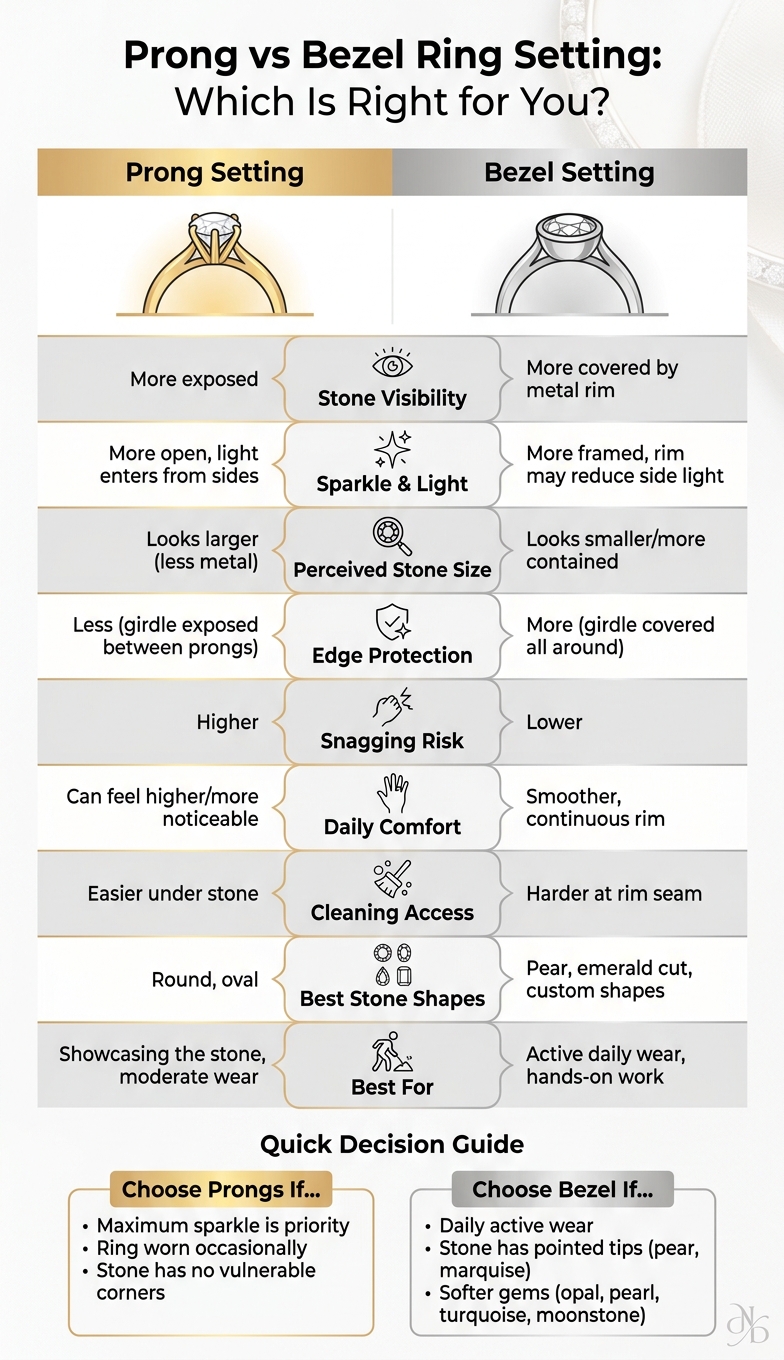
Prong vs Bezel Ring Setting: Side-by-Side Comparison
The biggest differences come down to three things: how much of the stone you see, how the ring wears day to day, and what kind of upkeep it needs.
| Factor | Prong Setting | Bezel Setting |
|---|---|---|
| Stone visibility | Shows more of the stone | Shows less of the stone; partial bezels reveal more than full bezels |
| Light return | Allows more light in from the sides and underside, creating a more open look | May reduce side light due to the metal rim; cut still matters most for sparkle |
| Perceived stone size | Less metal around the stone can make it look larger | The rim can make the stone look smaller and more framed |
| Edge protection | Protects at separate contact points; more of the girdle stays exposed | Covers much or all of the girdle, offering stronger protection against edge impacts |
| Snagging risk | Higher when prongs sit above the band or catch on fabric | Lower when the bezel has a smooth, low profile |
| Comfort | Can feel more noticeable when the setting sits high, though low-profile engagement rings reduce this | Often feels smoother against fabric and nearby fingers because the rim is smooth and continuous |
| Cleaning access | Open spaces make it easier to reach beneath the stone with a soft brush | The rim can trap buildup where it meets the stone |
| Inspection needs | Check for bent, thinning, or loose prongs; re-tip worn tips | Check for lifted edges, dents, looseness, or buildup along the bezel rim |
| Ring profile | Often higher, especially when designed to maximize light access or accommodate a deep stone | Can be designed with a low, streamlined profile, though stone depth and band design still determine the final height |
| Style direction | Open, classic, traditional, and often engagement-ring focused | Sleek, modern, architectural, minimalist, or vintage-inspired depending on the rim and metalwork |
The main tradeoff is pretty simple: prong settings give you a more open, classic look with more stone exposure, while bezel settings give you more coverage and a smoother fit for daily wear.
Visibility, Sparkle, and Stone Size
Prongs leave more of the gemstone exposed because the metal touches it at only a few points. That open build lets light reach the crown and sides more easily, which can give the stone a more open look, especially with diamonds and transparent colored stones. It can also make the gem seem larger, since less metal outlines the shape.
A bezel does the opposite. It puts a visible metal border around the stone’s edge, so the gem can look more contained even when the carat size is exactly the same. You’ll usually notice this more with a full bezel than a partial bezel. Rim thickness and how deep the stone sits also change the effect. If the stone is the star of the ring, this tradeoff tends to stand out fast.
Protection, Snagging, and Daily Comfort
A full bezel wraps around the stone’s girdle all the way around, which helps guard it from direct edge hits. Prongs hold the stone at separate points, so more of the girdle stays exposed between them. Six-prong settings add a backup of sorts if one prong gets damaged.
For everyday wear, bezels usually feel easier to live with. The smooth rim is less likely to catch on sweaters, gloves, or bedding. Prongs, mainly taller ones, need more care during hands-on tasks, workouts, or anything that puts the ring in regular contact with fabric or gear. Once a ring becomes part of your daily routine, those small differences can feel pretty big.
Cleaning, Inspection, and Long-Term Upkeep
Prong settings are often easier to clean around and under the stone because the open gaps let a soft brush reach the underside. But there’s a flip side: those same gaps can collect skin oils and debris near the prong bases. With bezel settings, the outside rim is easy to wipe clean, but the narrow seam where the bezel meets the stone can hold buildup and may need more careful brushing.
Both styles need regular checks. With prong rings, look for prongs that are bent, thinning, or loose. Worn prongs may need re-tipping to keep the stone secure. With bezel rings, inspect the rim for spots that look lifted, dented, or no longer flush against the stone. A professional inspection at least once a year is a reasonable starting point for a ring that gets frequent wear. Stone type and your day-to-day habits play a big part in which setting makes more sense.
Choosing a Setting Based on Your Gemstone and Lifestyle
Once you understand the basic tradeoffs, the stone itself should help make the call. The best setting depends on the gem, the cut, and how you’ll wear the ring day to day.
Setting Options for Diamonds, Sapphires, Rubies, and Softer Stones
Diamonds, sapphires, and rubies can all work well in either style if the setting is made well. Sapphires and rubies are corundum, which ranks 9 on the Mohs scale, while diamonds rank 10. But hardness isn’t the whole story. A hard stone can still chip if it takes a sharp hit.
That’s why toughness, cleavage, and inclusions matter just as much. A diamond, for example, can still fracture from impact, especially at a corner or along a cleavage plane. Softer or more delicate stones - like opal, pearl, turquoise, moonstone, or some emeralds - usually do better with a well-fitted bezel. It gives the edges more cover and helps protect the girdle and outer edge from bumps and snags.
Setting Options by Stone Shape: Round, Oval, Emerald, Pear, and Custom Cuts
Round and oval stones usually work nicely in either setting. Since they don’t have sharp corners, they’re less likely to chip from everyday knocks. Emerald-cut stones need more care. Their corners are exposed, which makes them easier to damage on direct impact, so corner prongs, a partial bezel, or a full bezel are smart options. Pear-shaped stones have the same issue at the tip. A V-prong or a bezel that covers the point can help guard against chips during daily wear.
Custom or unusual cuts are where a bezel often shines. The metal rim can follow the exact outline of the stone, which helps when the gem has a nonstandard shape or thin, delicate edges that don’t sit well in a basic prong layout. If you like the look of more open light exposure, a partial bezel or corner prongs can protect the weak spots while still showing more of the stone.
Choosing by Daily Wear Habits
A simple rule of thumb: go with prongs if you take the ring off for most activity, and lean toward a bezel if you plan to wear it most of the day.
| Priority | Better Choice |
|---|---|
| Maximum sparkle and face-up visibility | Prong setting |
| Active daily wear, hands-on work | Full bezel |
| Vulnerable tip or corner (pear, emerald cut) | V-prong or partial bezel |
| Unusual or custom stone shape | Custom-fitted bezel |
| Balance of visibility and protection | Partial bezel or protective prongs |
After that, the finer details matter: prong count, bezel thickness, and setting height all help dial in the final fit.
Custom Design Details That Affect the Final Result
Prongs and bezels are just the starting point. The small build choices - prong count, rim thickness, setting height, and metal type - shape how secure, comfortable, and visible a ring feels. They also affect the overall look in day-to-day wear, whether that look feels open, protective, or somewhere in the middle.
Prong Count, Bezel Thickness, and Setting Height
Prong count changes both appearance and support. Four prongs usually look lighter and more open. Six prongs add more support. GIA notes that if one prong gets damaged, a four-prong ring can become less secure than a six-prong design. For round stones, four prongs often suit smaller stones, while larger stones are often set with six.
Bezel thickness matters too. The rim needs enough thickness to keep its shape, but it shouldn't feel so heavy that it overpowers a small stone. A partial bezel protects certain parts of the edge while leaving more of the stone's perimeter open than a full bezel.
Setting height changes how the ring wears and how much of the stone you see. A lower profile tends to snag less. A higher profile gives the ring more visual presence and exposes more of the stone from the side. GIA's bench-set guidance puts finished prong height at about 75%–85% of the stone's table height.
Once the height is locked in, metal color and strength play a big part in how the ring looks over time.
Metal Choice and Ring Style
Metal color can shift the whole feel of the setting. Yellow gold adds warm contrast around diamonds or colored stones. White gold can blend in with a diamond, which makes the setting look lighter. Silver gives a bright, cool look at a lower price point.
Looks are only part of it. Hardness affects how well the ring holds up. Platinum keeps its shape well over time, which makes it a strong pick for fine-detail work. 14K gold is a common choice in the U.S. for everyday rings because it balances durability, color options, and cost. 18K gold has a richer color, but it's softer than 14K and may show wear faster with frequent use. So metal choice isn't just about color. The alloy and hardness help decide how the setting ages.
Band width matters for balance, too. It should support the setting without making the ring feel awkward or top-heavy.
A custom design process can line up the setting, metal, and band with both the stone and the wearer's routine. From there, the next move is approving the final design details before the ring is made.
Final Checklist and Conclusion
Prongs put openness and brilliance first. Bezels put protection and smooth day-to-day wear first. The best pick comes down to the stone, the wearer’s routine, and the look you want.
| Choose a prong setting when… | Choose a bezel setting when… |
|---|---|
| Maximum stone visibility and sparkle are the priority. | Edge protection and a secure metal rim are the priority. |
| The ring will receive moderate wear and regular inspections are acceptable. | The ring will be worn daily during active work or frequent hand use. |
| The gemstone and cut can safely tolerate greater edge exposure. | The stone benefits from additional girdle and perimeter protection. |
Use those tradeoffs as a final check before the ring goes into production.
Questions to Ask Before You Approve the Design
Start with wear. Is this an everyday ring? Will the wearer use their hands a lot at work, during exercise, or around clothing and equipment? And if snagging would be a headache, that should factor into the setting choice.
Then look at the stone itself. Does the gem’s hardness, toughness, cleavage, and girdle shape fit the proposed setting? If the stone has pointed corners - like a pear, marquise, emerald-cut, or a custom shape - ask how those points will be protected.
Next, check the build. How high will the center stone sit above the finger, and will it clear a wedding band or other rings? Ask for top, side, and profile renderings before production. Then confirm the core specs:
- Gemstone identity and measurements
- Setting type
- Gold metal and finish
- Ring height
- Band width
- Prong or bezel specs
- Ring size
- Comfort details
One last thing: confirm the cleaning method, inspection schedule, and repair policy.
When the answers keep leaning the same way, the choice usually makes itself. Pick prongs if maximum openness is the goal. Pick a bezel if you want more protection and easier daily wear.
FAQs
Which setting is best for everyday wear?
For everyday wear, a bezel setting is usually the best pick. It wraps all the way around the stone, which helps shield it from chips and makes it less likely to catch on clothing, hair, or gloves.
A prong setting can still work well for an active lifestyle if it’s made properly. But in most cases, a bezel gives the stone more protection and a more secure feel for daily wear.
Can a bezel make my stone look smaller?
Yes. A bezel setting can make a stone look a bit smaller because the metal rim wraps around the gem and hides its outer edge.
The upside is that a bezel setting gives the stone a snug, protective fit. The tradeoff is visual: it doesn’t create the same bigger-looking effect that you get from a halo setting. If your main goal is to make the stone appear larger, a halo or cluster style is often a better pick.
How often should I inspect prongs or a bezel?
Check your prongs or bezel every week for signs of wear. Look for bent or thinning prongs, and make sure the stone still feels secure.
It’s also smart to book a professional inspection every 6 to 12 months. A jeweler can catch weak settings or other wear that may need expert repair.