Skip to content




Mixed Metal Floral Engagement Rings
I’d choose a mixed metal floral engagement ring for comfort first, looks second. These rings combine flower, leaf, or vine details with two or more metals. Before buying, I’d check for smooth edges, protected stones, and enough room for a wedding band.
Here’s my buying checklist:
- Design: Choose the bloom or botanical detail, then use metal contrast to make it stand out.
- Materials: Confirm each metal’s type and purity - and whether its color comes from solid metal or plating.
- Fit: Compare band width, setting height, and stone protection. A 2.0–3.0 mm band is worth trying, but width alone doesn’t tell me how strong it is.
- Price and styling: Get an itemized quote in U.S. dollars, written purchase terms, and a wedding-band fit check.
- Care: Ask for cleaning instructions that suit every metal, stone, and finish.
My rule: <u>try the ring and wedding band together before ordering</u>. A flower design should look good without catching on clothing or rubbing against nearby fingers.
Flower Motifs and Metal Pairings
Mixed Metal Floral Engagement Ring Pairings
Petals, Leaves, Vines, and Flower Shapes
Start with the motif, then use contrasting metals to give it a soft or sharp look.
Petal shape sets the ring’s outline. Engraved lines keep the flower understated, while sculpted petals add depth and sparkle. Check the design at its actual size - not just in enlarged photos - to see whether each petal looks clear or crowded.
| Motif | Brief meaning/effect |
|---|---|
| Rose petals | Romance; contrasting metals define layered edges. |
| Daisy forms | Simplicity; contrast emphasizes evenly spaced petals. |
| Lily or tulip shapes | Elegance or renewal; contrasting edges highlight elongated petals. |
| Leaves | Growth; accent metal defines leaf outlines around the stone. |
| Vines | Connection; contrasting stems emphasize flow along the band. |
| Uneven wildflower clusters | Individuality; accent metal draws attention to varied blooms. |
These meanings are optional and vary by culture and family.
Use botanical for plant-based forms. Use vintage, pavé, and cluster only to describe structure.
Engraved vines give the ring a restrained look. Symmetrical blooms add balance, while sculpted petals create more dimension. Strong metal contrast sharpens the petals; similar metals soften them.
Gold, Silver, and Two-Tone Construction
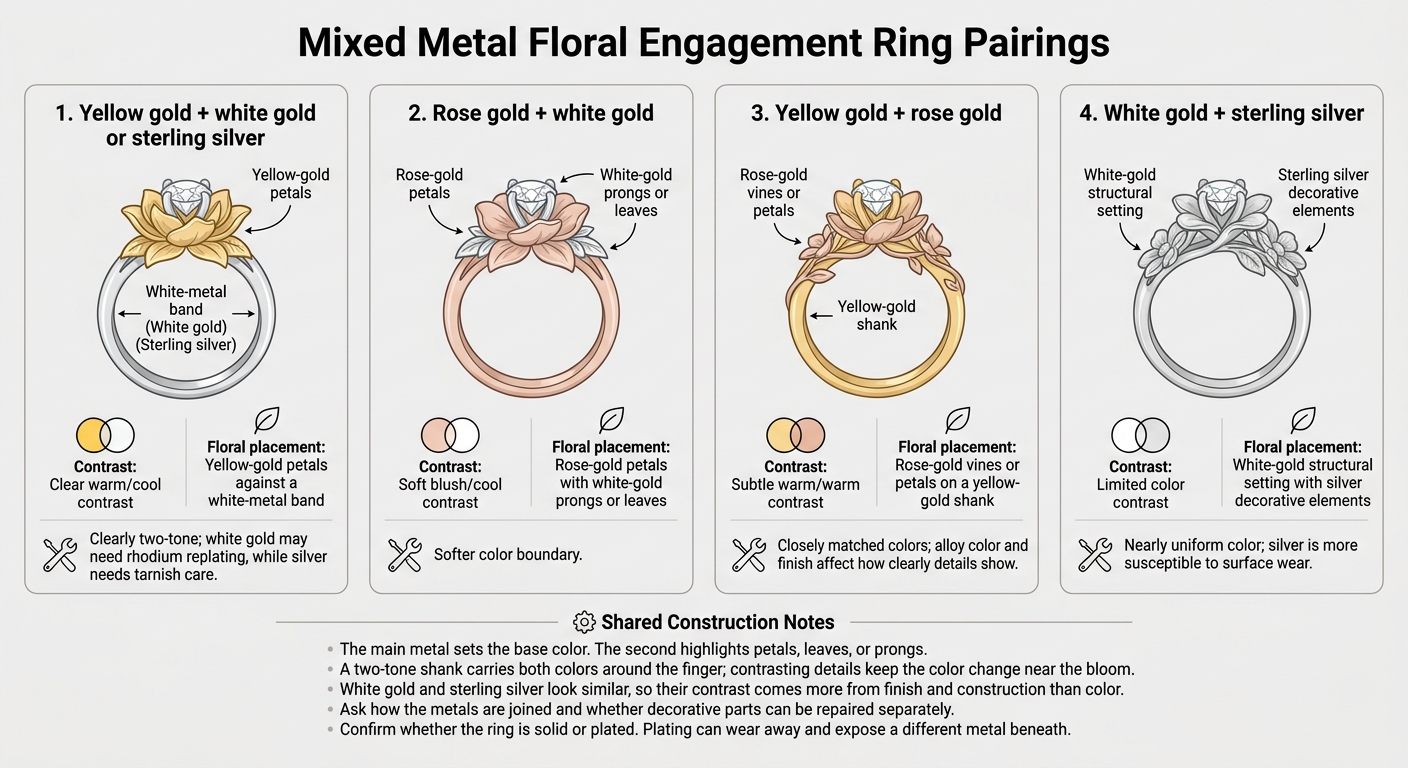
The main metal sets the base color. The second highlights petals, leaves, or prongs. A two-tone shank carries both colors around the finger; contrasting details keep the color change near the bloom.
White gold and sterling silver look similar, so their contrast comes more from finish and construction than color. The second metal works best when it frames the bloom or makes it the focal point.
| Metal pairing | Contrast | Floral placement | Maintenance and style |
|---|---|---|---|
| Yellow gold + white gold or sterling silver | Clear warm/cool contrast | Yellow-gold petals against a white-metal band | Clearly two-tone; white gold may need rhodium replating, while silver needs tarnish care. |
| Rose gold + white gold | Soft blush/cool contrast | Rose-gold petals with white-gold prongs or leaves | Softer color boundary. |
| Yellow gold + rose gold | Subtle warm/warm contrast | Rose-gold vines or petals on a yellow-gold shank | Closely matched colors; alloy color and finish affect how clearly details show. |
| White gold + sterling silver | Limited color contrast | White-gold structural setting with silver decorative elements | Nearly uniform color; silver is more susceptible to surface wear. |
Ask how the metals are joined and whether decorative parts can be repaired separately. Confirm whether the ring is solid or plated. Plating can wear away and expose a different metal beneath.
Stones, Settings, and Daily Wear
Center Stone Shapes and Leaf Accents
Round stones work well with symmetrical floral halos. Oval and pear centers lengthen the design along the finger, especially when paired with tapered leaves or graduated petals. Marquise accents resemble leaves, while emerald cuts bring straight lines to curved petals.
Metal color should frame the stone, not compete with it. Look at the ring in daylight and indoors. White metal creates a crisper look; warm gold adds warmth.
Hardness alone doesn’t tell you how a stone will handle daily contact, cleaning, or impact. Toughness and resistance to heat, light, and chemicals also matter. Diamond, ruby, and sapphire are strong choices for daily wear, but none is impact-proof.
Ask what the stone is, whether it’s natural or lab-grown, what treatments it has received, and how to clean it. Natural origin doesn’t guarantee durability. Fractures, cleavage, inclusions, and sensitivity to heat or chemicals all affect care.
Pear and marquise tips need V-prongs or bezels for protection. Emerald-cut corners also need shielding from impact. Once you’ve chosen the center shape, look for a setting that protects its exposed points.
Floral Halos, Clusters, Bezels, and Galleries
The setting shapes both the ring’s floral look and how it holds up to wear. Halos emphasize the bloom from above, clusters suggest a softer flower head, and galleries show petals from the side.
Pavé adds sparkle; milgrain adds beaded texture. How securely stones stay in place depends on construction and maintenance. Prongs let in light and make cleaning easier, but they can catch on fabric. Inspect them regularly and have worn points retipped.
| Setting or detail | Appearance and floral visibility | Security considerations | Cleaning access |
|---|---|---|---|
| Floral halo | Petal outline; strong bloom from above | Each accent needs support | Small gaps trap residue |
| Cluster | Grouped stones suggest a bloom; petals may blend | Small settings need inspection | Tight junctions limit access |
| Full bezel | Continuous rim; surrounding metal supplies floral detail | Protects the stone’s perimeter | Covered edges limit access |
| Partial bezel | Open framing leaves room for botanical accents | Protects selected edges | Open sections improve access |
| Prong setting | Open and light-catching; halo or gallery supplies floral detail | Tips and corners need protection | Generally good |
| Tulip gallery | Curved supports form a flower beneath the center | Basket and joints must be sound | Recesses need gentle brushing |
| Pavé | Surface sparkle, not a flower shape | Tiny beads or prongs secure stones | Limited access between stones |
| Milgrain | Beaded border, not a flower shape | Does not secure stones | Fine recesses collect buildup |
Band Width, Setting Height, and Surface Finish
Check the band profile for comfort, balance, and snagging after choosing the head and halo. Band width tells you about scale, not strength. Alloy, thickness, profile, and construction matter more.
Ask for the setting height in millimeters and look at the ring from the side. Metals and finishes wear differently: projecting tips can flatten, polished surfaces show scratches, and repeated polishing can soften engraving.
| Feature | Visual effect | Comfort and snagging | Maintenance |
|---|---|---|---|
| Band: 1.5–2.0 mm | Delicate | Light; may feel less solid | Inspect thin areas |
| Band: 2.0–3.0 mm | Balanced | Often suitable for everyday wear | Inspect shoulders and joins |
| Band: above 3.0 mm | Bold; room for botanical detail | More noticeable between fingers | More surface area shows wear |
| Low setting | Close to the finger | Fewer catches; may block a straight wedding band | Inspect beneath the center |
| Medium setting | Noticeable center; moderate profile | Balanced | Inspect prongs and gallery |
| High setting | Prominent center and gallery | More exposed to catches and impact | Check prongs and gallery |
| Polished finish | Bright and reflective | Smooth when properly finished | Scratches show clearly |
| Brushed or satin finish | Soft, muted appearance | Smooth when properly finished | Directional wear; refinishing may alter texture |
| Sculpted detail | Three-dimensional petals, leaves, or vines | May feel pronounced at sides or underside | Clean recesses carefully; projecting tips wear first |
| Engraved detail | Refined pattern; flatter profile | Usually comfortable | Polishing can soften lines; grooves collect residue |
Use the final try-on to check comfort, movement, and band clearance - not just appearance.
Try-on checklist: Put on the ring in your measured U.S. size. Make a fist, bend your finger, test it against fabric and gloves, and try it with the wedding band. Ask the jeweler to check stone seating and protective tips. A stone that makes no sound isn’t necessarily secure.
Buying, Styling, and Ring Care
Once you’ve chosen the floral form and metal mix, compare price, fit, styling, and care before you buy.
Check Materials, Customization, and Price
Before ordering, write down the ring’s specifications: motif, dominant metal, secondary-metal placement, center-stone shape, band width, setting height, finish, size range, and any plating or treatments. Use those details to assess daily wear. Raised petals, thin joins, pavé, and projecting details may make the ring too fragile for everyday use.
Confirm each metal’s type, karat or fineness, and whether the color contrast comes from solid metal, bonded layers, or plating. Also check gemstone identity, origin (natural, lab-grown, or imitation), treatments, resizing limits, warranty, return terms, and itemized pricing in U.S. dollars.
Ask for a quote that separates stones, metal construction, labor, customization, engraving, plating, shipping, taxes, and resizing or insurance-related services. Check whether future plating or maintenance is included and how custom changes affect cost or delivery. Confirm whether the carat weight describes the center stone or all stones combined.
LaCkore Couture offers handcrafted jewelry featuring gold, silver, and natural stones. Confirm its current custom floral-ring options before ordering.
With the ring’s construction clear, you can choose bands and accessories that work with it.
Pair the Ring With Wedding Bands and Jewelry
Repeat one visual element, not the entire design. Echo a metal color, finish, or botanical curve in your other jewelry. Keep nearby pieces simpler so the floral ring stays the focal point. Match the scale, too: a delicate floral ring pairs best with slim bands and small earrings.
For a wedding band, put clearance ahead of a gap-free fit. A deliberate gap can protect delicate details and make cleaning easier.
| Wedding-band choice | Fit and clearance | Styling | Possible contact |
|---|---|---|---|
| Straight | May leave a gap beside a low or projecting floral setting | Clean, graphic contrast; easy to wear alone | May press against petals, prongs, a gallery, or accent stones without a flush-fit design |
| Contoured or curved | Follows the center or side leaves to reduce gaps | Creates a coordinated nest without matching every detail | A curve can still rub against petals, pavé, or joins |
| Mixed-metal band | Fit depends on its profile, not its metal colors | Connects warm- and cool-metal elements | Finishes may wear differently; verify whether each color is solid metal or plating |
Try both rings together, rotate them, and check for rubbing. If they touch, ask about a spacer, contour adjustment, or custom band. Give those same details close attention during cleaning and inspection.
Clean and Inspect Floral Details
Choose cleaning methods based on the ring’s most delicate metal, stone, and floral detail.
Remove the ring before impact, abrasion, water exposure, or contact with chemicals. Use mild soap and a soft brush only if they’re safe for every material, treatment, and finish. Don’t assume ultrasonic machines, steam, or silver cleaners are safe.
Get a professional inspection after an impact or if a stone moves, a prong catches, a petal bends, or a join cracks. Arrange professional cleaning at least once a year using a suitable method. Store the ring separately in a lined compartment or soft pouch.
| Material or detail | Care limits |
|---|---|
| Polished metals | Use warm water, mild soap when appropriate, and a soft brush or lint-free cloth; dry thoroughly. |
| Sterling silver | Follow the jeweler’s instructions; silver dips may damage stones, plating, or intentionally darkened details. |
| Plated surfaces | Avoid abrasive cloths, polishing compounds, and repeated rubbing that can remove plating; ask about replating worn areas. |
| Natural gemstones | Stone identity and treatments determine whether heat, steam, chemicals, or ultrasonic cleaning are safe. Rinse in a bowl or glass rather than over a drain. |
| Pavé accents | Avoid vigorous brushing and unapproved ultrasonic cleaning, which may loosen small stones or setting beads. Stop wearing the ring if a stone moves. |
| Sculpted floral details | If brushing is safe, don’t force bristles into seams around petals, leaves, vines, or the gallery. Check thin stems, tips, and joins for bending, cracks, or wear. |
Keep the written care instructions with the ring’s specifications so future cleaning and repairs account for every metal, stone, and finish.
Conclusion: Choose a Floral Ring That Suits Daily Wear
Let the floral motif reflect your style, but make comfort and durability the deciding factors. For daily wear, low-profile single blooms offer a quieter look, while layered flowers and vines make a stronger statement. Yellow or rose gold contrasts with white metal. Round and oval stones suit symmetrical petals; pear and marquise shapes echo leaves.
Once you’ve settled on the look, check the construction. Before ordering, ask the jeweler to review stone security, metal joins, comfort, and wedding-band clearance. For a custom design, request front, side, and profile views.
Get the purchase terms in writing, including specifications, an itemized U.S. price, revision limits, production timing, returns, and warranty terms. Daily wear doesn’t mean constant wear: take off even a well-built floral ring for gardening, workouts, and heavy work.
FAQs
Can a mixed metal floral ring be resized?
It depends on how the ring is made. Mixed-metal floral rings often need resetting or restyling, not just a simple resize. Floral or cluster settings can be tricky to resize because small stones may chip or loosen.
Ask whether the band can be resized without disturbing the floral metalwork or stones - or whether the ring needs recasting or resetting.
Which metal pairings suit sensitive skin?
For sensitive skin, choose high-karat gold. It contains more pure gold and fewer base metals that may cause reactions. Gold is often mixed with nickel, copper, or zinc to make it more durable, but these metals can trigger sensitivities.
Sterling silver is an alloy, too, and can cause reactions in some people. Keep your specific metal sensitivities in mind when choosing gold, silver, or mixed-metal combinations.
Can damaged floral details be repaired?
Damaged floral details on engagement rings can often be repaired or modified. Depending on the damage, a jeweler can secure settings, replace loose stones, or recast the ring with a new design.
Delicate petals and leaves can snag or loosen, so have a professional check your ring regularly. Repairs cost $75.00 to $5,000.00 and generally take four to six weeks.