Skip to content




How Custom Crest Rings Honor Family Legacy
I’d start a custom crest ring with the family story - not the metal. Check the family line before using existing arms: a shared surname alone isn’t proof. If the records don’t support that link, choose a new family emblem and label it clearly.
Here’s the checklist I’d use to turn that story into a ring you can wear and pass down:
- Design and fit: Check the face shape, U.S. ring size, and artwork at actual size.
- Metal: Compare gold, sterling silver, and platinum for cost, comfort, and care. For reference, 14K gold is 58.3% gold; 18K is 75%.
- Engraving: Choose display engraving or reversed engraving for wax sealing, then proofread every inscription.
- Ordering and gifting: Get the total price in U.S. dollars, delivery schedule, and resizing terms in writing.
- Wear and care: Choose a comfortable finger, remove the ring for rough work, and clean it as directed.
My final step: <u>keep the research, approved artwork, receipt, and care instructions together</u>. That gives future owners both the ring and the story behind it.
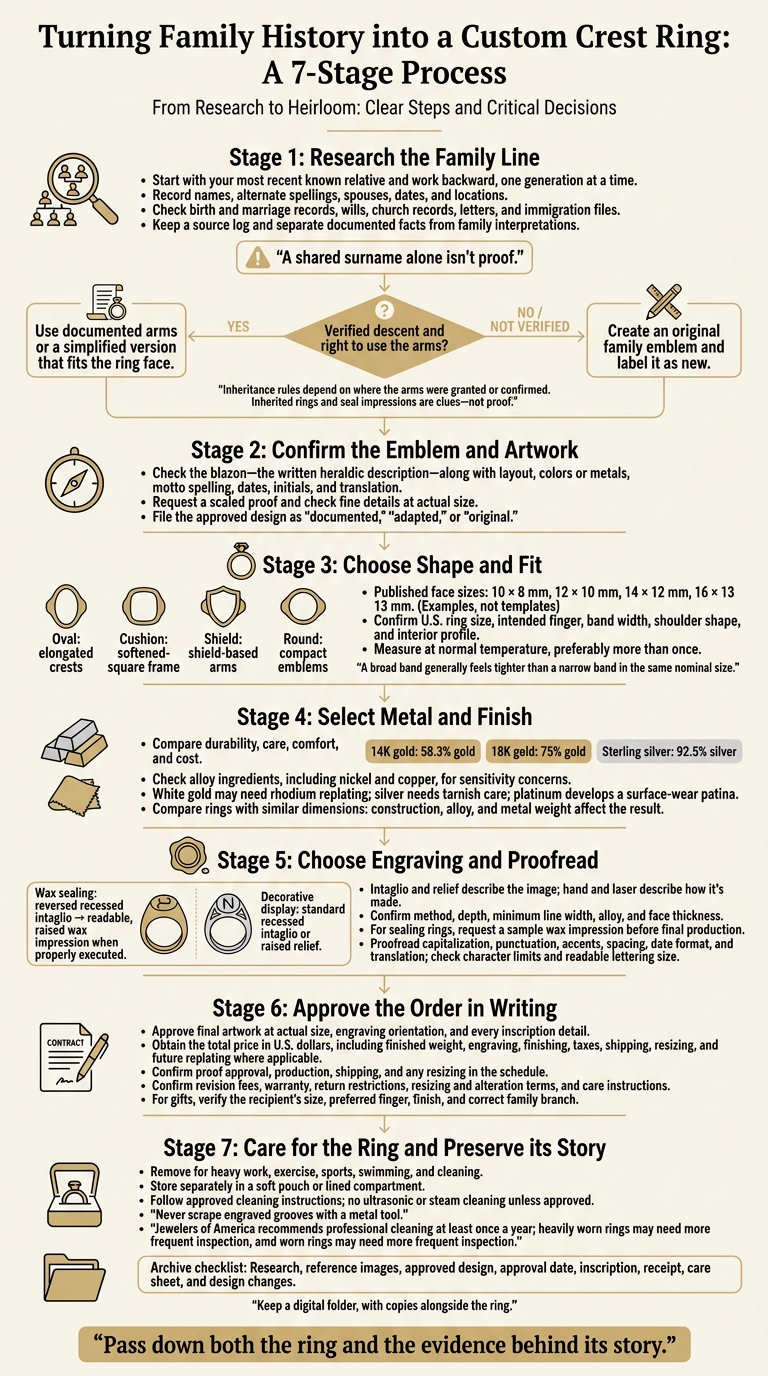
Custom Crest Ring: From Family Research to Heirloom
Research Your Family's Heraldry
Identify the ancestor named in the arms, then trace your family line to that person. Inheritance rules depend on where the arms were granted or confirmed. U.S. family tradition does not replace those rules. A heraldic authority, archive, or genealogist can help check your lineage and official records. This research determines what you can use on the ring face.
Check Family Records and Heraldic Sources
Begin with your most recent known relative and work backward, one generation at a time. Record names, alternate spellings, spouses, dates, and locations. Start with birth and marriage records, then add wills, church records, letters, and immigration files. Passenger records can support your research, but they aren't proof on their own.
Photograph inherited rings and seal impressions from several angles. Note their owners, inscriptions, approximate dates, locations, and ownership history. Treat these objects as clues - not proof of the right to use the arms.
Keep a source log with record titles, repositories, reference numbers, access dates, and the relationships each record supports. Separate documented facts from family interpretations of symbols. If records conflict or your family moved between countries, ask an archive, genealogist, or relevant heraldic authority for help.
Choose Documented Arms or a New Emblem
If you've verified your descent and right to use the arms, use the documented arms or a simplified version that fits the ring face. Otherwise, create an original family emblem and label it as new.
Before production, confirm the blazon - the written heraldic description - along with the layout, colors or metals, motto spelling, dates, initials, and translation. Request a scaled proof to check that fine details remain readable. Approve the final proof in writing and file it as documented, adapted, or original.
Once you've approved the design, move to the ring shape, metal, and engraving.
Select the Ring Shape, Metal, and Engraving
Match the Ring Face to the Design
With the arms verified, choose a face shape that keeps the symbol clear at ring size. An oval suits elongated crests, a cushion gives a softened-square frame, a shield fits shield-based arms, and a round face works for compact emblems.
Ask for face dimensions in millimeters. Published sizes include 10 × 8 mm, 12 × 10 mm, 14 × 12 mm, and 16 × 13 mm. Check the smallest lettering at actual size - not zoomed in.
Confirm your U.S. ring size, intended finger, band width, shoulder shape, and interior profile. Have your finger measured at normal temperature, preferably more than once. A broad band generally feels tighter than a narrow band in the same nominal size. Ask whether comfort fit or resizing would work better for your chosen width, and confirm resizing terms before ordering, especially for a gift.
Compare Gold, Sterling Silver, and Platinum
Start with durability, care, and comfort, then compare costs. Karat tells you the gold content: 14K is 58.3% gold, and 18K is 75%. The other metals in the alloy affect color, hardness, and skin sensitivity. Ask about nickel, copper, and any other ingredients.
Request an itemized quote in U.S. dollars. It should cover finished weight, engraving, finishing, taxes, shipping, resizing, and future replating - not just the ring’s base price.
| Metal | Color, durability, and maintenance | Cost |
|---|---|---|
| 14K yellow gold | Warm yellow gold balances hardness with resistance to everyday wear. Routine cleaning and alloy checks help with care and comfort. | Moderate to high |
| 18K yellow gold | Richer yellow gold is softer than 14K. Clean it gently and check fine details for worn edges. | High |
| White gold | White or gray-white gold varies in durability by alloy and construction. Rhodium plating may need renewal, and nickel may cause sensitivity. | Moderate to high |
| Rose gold | Pink or blush gold varies in hardness by karat. Copper may cause sensitivity; follow the jeweler’s cleaning instructions. | Moderate to high |
| Sterling silver | Bright white when polished, silver is lighter and softer than gold or platinum. Engraving can wear sooner, and tarnish calls for regular polishing and dry storage. | Lower |
| Platinum | Naturally white-gray, dense platinum feels heavier than gold and develops a patina. Polishing restores brightness; alloy checks help identify sensitivity concerns. | High to very high |
Compare rings with similar dimensions: construction, alloy, and metal weight affect the result. Sterling silver contains 92.5% silver. Platinum’s patina comes from surface wear, not conventional tarnish.
Choose Engraving for Display or Wax Sealing
Choose display engraving unless you need the ring to work as a wax-sealing signet. Intaglio and relief describe the image; hand and laser describe how it’s made. Hand engraving can give lines more variation, while laser engraving offers repeatable detail.
Confirm the method, depth, minimum line width, alloy, and face thickness. For a sealing ring, request a sample wax impression before final production.
| Engraving format | Visual effect | Sealing suitability | Detail considerations | Wear considerations | Best use |
|---|---|---|---|---|---|
| Reversed recessed intaglio | Mirrored design cut below the face | Produces a readable, raised impression when properly executed | Needs enough depth and open spacing | Recesses protect details, though edges can soften | Wax sealing |
| Standard recessed intaglio | Design cut below the face in normal orientation | Does not produce a correctly oriented traditional seal | Bold shapes and short lettering work well | Recesses can collect residue | Decorative display |
| Raised relief | Design stands above the face | Generally unsuitable for a traditional raised seal | Raised elements need support | Exposed details can catch and wear | Dimensional display |
Personalize With a Motto, Date, or Inscription
Leave the face for the crest and put text on the border or inside the band. Ask for the character limit and readable lettering size. Before production, check capitalization, punctuation, accents, spacing, and date format.
Get turnaround time, revision fees, warranty terms, and return limits in writing before ordering.
Wear, Gift, and Care for Your Crest Ring
Once you approve the design, the ring’s meaning carries into how you wear it, give it, and care for it.
Style Your Crest Ring for Daily Wear
Wear your crest ring on its own or with simple, coordinated jewelry that keeps the crest visible. Matching metals create a uniform look. Mixed metals work when you repeat warm and cool tones across your accessories.
A brushed finish looks softer, while polished metal adds contrast. Choose the finger that fits best. The pinky is a customary choice, but it isn’t required. For a gift, keep the style simple and check the size carefully.
Give a Crest Ring as a Family Gift
A crest ring can mark a graduation, milestone birthday, wedding, anniversary, family reunion, or remembrance. Before ordering, confirm the recipient’s ring size, preferred finger, and finish. Check that the crest represents the correct family branch.
For a fixed event date, ask for a written schedule that covers proof approval, production, shipping, and any resizing. Check the return restrictions for personalized items before committing.
Include the emblem’s source and meaning with the gift. Name the ancestor or family branch it represents, and explain its symbols and motto. For a remembrance gift, add a copy of the relevant family record.
Care for the Metal and Engraving
Treat the ring as a piece you may one day pass down. Remove it for heavy work, exercise, sports, swimming, and cleaning to limit impacts, snagging, chemical exposure, and accidental loss.
Store it in its own soft pouch or lined compartment. Follow its care instructions. If approved, clean it with lukewarm water, mild soap, and a soft brush, then rinse and dry. Don’t use ultrasonic or steam cleaning unless approved.
Clean engraved grooves gently - never scrape them with a metal tool. Too much polishing can soften the crest’s edges and change the finish. If you notice a bent band, cracks, loose stones, deep scratches, or fading detail, get a professional assessment rather than trying to repair it yourself.
Jewelers of America recommends professional cleaning at least once a year; heavily worn rings may need more frequent inspection.
Conclusion: Approve the Design and Keep Its Story
Approve the ring and the family legacy it represents - but don’t treat a shared surname as proof of a right to existing arms. Document the family connection, or clearly label the emblem as a new family symbol.
Before production, complete a written approval checklist covering:
- Research sources and whether the emblem is documented or original.
- Professionally measured ring size, band width, and face dimensions.
- Metal, finish, artwork shown at actual size, engraving orientation, and every inscription detail.
If you plan to seal wax, confirm that the ring produces a readable impression. Include the final artwork or proof, total price, and production timeline in the written approval. Also confirm resizing and alteration terms, along with care instructions for the chosen metal and engraving. This review makes the custom jewelry options a documented family object.
Keep the research, reference images, approved design, approval date, inscription, receipt, and care sheet in a digital folder, with copies alongside the ring. Record any design changes so later generations can tell verified family history apart from personal interpretation. Future owners should be able to trace the emblem, its source, and the approval date in one place.
FAQs
Can I combine symbols from both sides of my family?
Yes, you can combine symbols from both sides of your family in one piece of jewelry. Modern jewelry design lets you blend initials, motifs, and heritage symbols based on what they mean to you, without following rigid historical codes.
At LaCkore Couture, you can mix family crests, birthstones representing different lineages, or interwoven initials to honor your family history in one meaningful piece.
How can I simplify a crest without losing its meaning?
Focus on what defines your family identity, such as a main symbol or family motto. For a cleaner look, use just the crest rather than the full coat of arms. Keeping the central motif - an animal or emblem, for example - preserves its historical meaning while creating a simple design suited to everyday wear.
Can worn crest engraving be restored?
The available information does not confirm whether worn crest engraving can be restored. Hand engraving, however, creates deep, pronounced cuts designed to last for generations. Regular cleaning and careful storage can help preserve engraved jewelry.