Skip to content




7 Classic Hollywood Ring Styles
My rule for Hollywood-inspired rings: choose one focal ring and keep the rest slim. You don’t need a huge stone - color, shape, and shine can give a simple outfit that classic look.
I group the options into 7 styles:
- Cocktail rings: Large stones or bold shapes for drama.
- Halo rings: Small stones frame a center gem for added sparkle.
- Art Deco rings: Geometric lines and stepped shapes drawn from the 1920s–1930s.
- Bold gold bands: Polished metal makes the statement.
- Gemstone statement rings: One colored stone leads the look.
- Pavé and cluster rings: Small stones create dense sparkle or a shaped focal point.
- Stacked rings: Slim bands layer around a lead ring.
Quick Comparison
| Style | Best outfit match | What I’d check before buying |
|---|---|---|
| Cocktail | Simple dresses or tailoring | Height, snagging, and whether it spins |
| Halo | Jeans, shirts, or eveningwear | Loose accent stones and band clearance |
| Art Deco | Monochrome outfits or suits | Protection around stone corners |
| Bold gold band | Denim, knits, or blazers | Width and finger movement |
| Gemstone statement | Neutral clothing | Stone care and protected edges |
| Pavé and cluster | Plain daytime looks or cocktail attire | Small settings and resizing limits |
| Stacked | Casual or office outfits | Fit and rubbing between bands |
I’d match the ring to what you wear most, then try it with your sleeves and nearby bands. <u>Fit and stone care come before style</u>: a low setting may be easier to wear, but the stone, metal, and setting still determine how much care it needs.
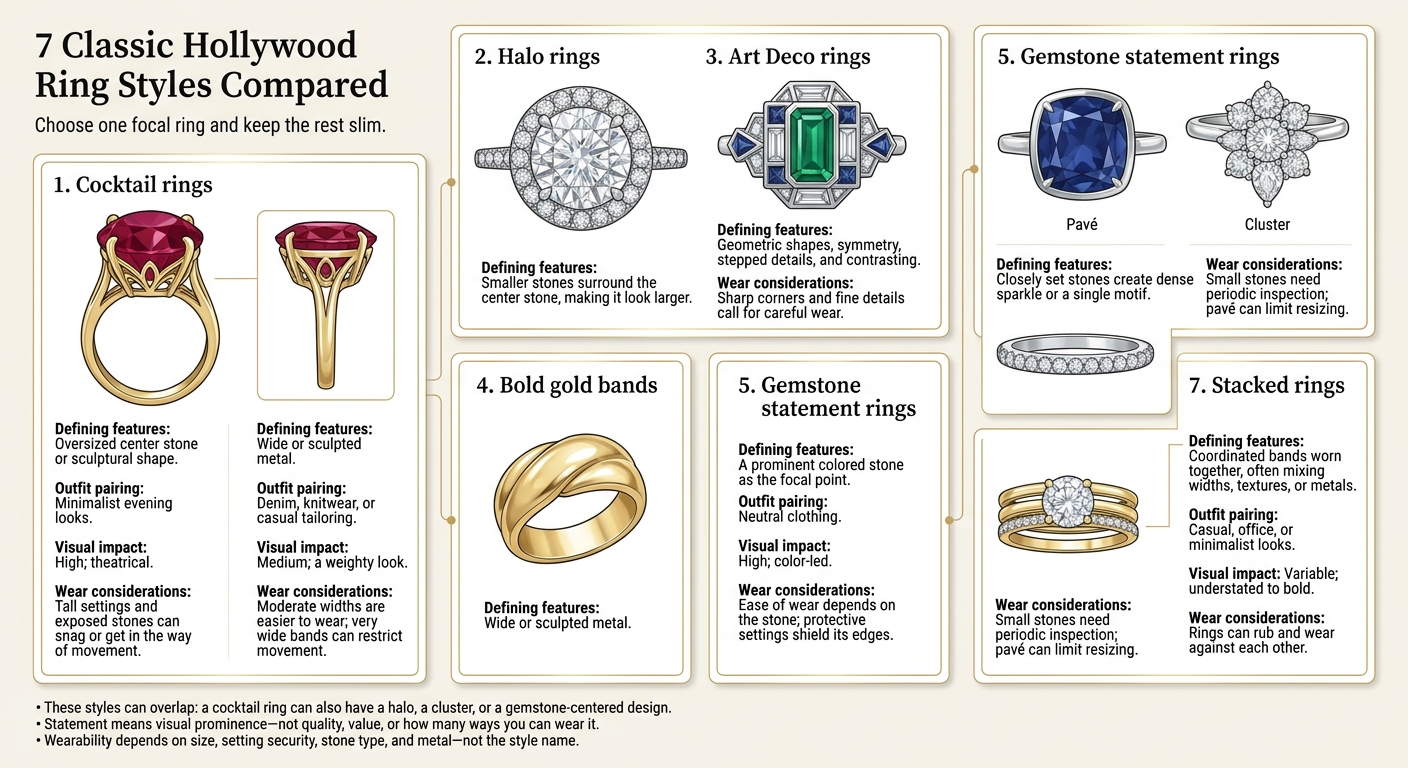
7 Classic Hollywood Ring Styles Compared
What Defines Classic Hollywood Ring Style
Statement scale is about impact, not just size. A wide band, a large center stone, or a cluster of stones can make a ring bold without making it hard to wear. For everyday use, check both height and width: tall settings can snag or crowd nearby rings.
Color and metal work together. Emerald green, sapphire blue, ruby red, and amethyst purple bring classic Hollywood jewel tones to a ring. Yellow gold adds warmth, while white gold, platinum, and silver give those colors a cooler contrast. Stick with one strong gemstone color to keep the ring easy to wear.
The setting shapes the look, too. A halo frames the center stone with smaller stones, while pavé places small stones close together on the band. Milgrain, the tiny beaded edging on some vintage-inspired designs, adds texture. These styles can overlap: a cocktail ring can also have a halo, a cluster, or a gemstone-centered design.
Art Deco is a 1920s–1930s style marked by geometric symmetry, stepped outlines, angular cuts, and strong linear details associated with Hollywood-era jewelry. A newly made ring with these features is Art Deco-inspired, not necessarily a period piece.
For everyday outfits, let one focal ring set the Hollywood tone, with stacking jewelry with slimmer bands playing a supporting role. Mix band widths and textures, but keep a shared detail, such as metal color or finish. Leave room around tall settings for comfort. The seven styles below show how these details take shape in different classic Hollywood rings.
1. Cocktail Rings
Design Features
A cocktail ring puts one oversized stone, a bold gemstone, or a clustered top in a high setting. Amethyst, aquamarine, and citrine are classic choices. Filigree, sculptural metalwork, halo accents, and small diamond details add sparkle.
These details define the style, though the look shifted across Hollywood eras.
Hollywood-Inspired Details
Cocktail rings emerged in the 1920s and remained popular through the 1960s. People often wore them on the right hand to set them apart from bridal jewelry. Today, either hand works.
Modern Outfit Pairings
Pair a cocktail ring with dark denim and a crisp shirt, a blazer, neutral tailoring, or a solid-color dress. Let the ring take center stage: keep earrings small and skip a statement necklace. Choose a moderately scaled design for work, and save taller, more dramatic settings for dinners and receptions.
LaCkore Couture’s handcrafted gold, silver, and natural-stone rings suit this look, with options for customization and mix-and-match styling.
Comfort and Daily Wear
High settings can snag clothing or feel unstable during hands-on tasks. Before buying, check whether the ring spins, pinches, or limits finger movement. Ruby and sapphire rate 9 on the Mohs scale, but scratch resistance isn’t the same as impact resistance. Inspect the prongs regularly, and take the ring off before exercise, cleaning, or swimming.
For the same drama with a softer outline, halo rings are the next step.
2. Halo Rings
Design Features
A halo surrounds the center gem with smaller stones, adding sparkle and making the gem look larger. Pavé accents form a nearly continuous line of sparkle. Bezel-set accents give the ring a smoother edge with more protection.
Hollywood-Inspired Details
Square halos give cushion cuts a geometric edge, while white diamonds around a sapphire or ruby bring out richer color. A double halo adds drama with two rows of accent stones. Pairing a yellow-gold band with a white-metal halo gives the vintage shape a modern contrast.
Modern Outfit Pairings
Pair a single halo with a white button-down and straight-leg jeans or a simple knit dress. Save a double halo for a solid-color cocktail dress or structured jumpsuit, and let the ring provide the only major sparkle.
Comfort and Daily Wear
A low-profile setting keeps the halo closer to your finger and helps prevent snagging on sleeves. Before buying, try the ring with fitted cuffs and any band you’ll wear beside it - the halo may stop the bands from sitting flush.
Dirt can collect in recessed areas. Follow your jeweler’s cleaning instructions and schedule periodic checks for loose accent stones.
For a sharper, more geometric look, the next style turns to Art Deco lines.
3. Art Deco Rings
Art Deco takes Hollywood style from sparkle to structure, putting clean lines at the center of the look.
Design Features
Art Deco rings feature straight lines, symmetry, and stepped shapes inspired by skyscrapers and staircases. Emerald, Asscher, and baguette cuts bring that crisp geometry to the stones.
Hollywood-Inspired Details
Black onyx creates a sharp contrast with diamonds. Stepped borders add drama without needing an oversized center stone.
Modern Outfit Pairings
Wear an Art Deco ring with monochrome clothing or satin. Keep other jewelry minimal so the ring remains the outfit’s sharpest detail.
Comfort and Daily Wear
Choose a low-profile setting, with prongs or a bezel that protect the stone’s corners.
Take the ring off before rough activities or exposure to chemicals. Follow the jeweler’s care instructions, especially if it includes antique diamonds, enamel, treated, or glued components.
For a simpler silhouette with the same polished presence, the next style pares the design back to the band itself.
4. Bold Gold Bands
Design Features
After Art Deco’s angles, bold gold bands bring the focus back to metal and shape.
A high-polish finish and sculptural profile make an impact without a center stone. Waves, soft domes, and tapered shoulders add depth, while rounded outer edges keep a broad band from looking bulky.
Hollywood-Inspired Details
Polished yellow gold gives Old Hollywood glamour a restrained look, trading stone weight for shine. Smooth, flat surfaces work well for engraved initials, dates, or a simple motif. Fine details can be harder to see on strongly curved or textured bands.
Modern Outfit Pairings
Wear a polished band alone with a black dress or tailored blazer for clean lines and little layering. Brushed or hammered finishes suit casual denim and knitwear. Keep extra bands slim and simple.
Comfort and Daily Wear
Start with 4–5 mm for a solo band, or pair a 3.5 mm band with a slim 1.5 mm band. Choose a comfort-fit interior and try it at different times of day, since broad bands can feel tighter. Have a professional check the size.
For more color, the next style shifts the focus from metal-only shine to gemstones.
5. Gemstone Statement Rings
Bold gold bands put metal front and center. Gemstone rings turn the focus back to color.
Design Features
Cocktail and halo rings lean into drama. Gemstone statement rings let color do the work. One stone sets the tone, making its cut and shape key. Instead of a cluster of gems, this style pairs a single stone with a clean frame.
Oval, cushion, pear, and marquise stones each create a different silhouette. Emerald cuts use step facets for an architectural look, while cabochons trade facets for a smooth, polished dome that highlights color and texture.
Hollywood-Inspired Details
For a classic Hollywood look, choose one saturated stone on a slim band with few accents. A bezel setting sharpens the outline; prongs leave the gem visually open. This restrained shape works well with simple clothes.
Modern Outfit Pairings
Let one bold stone carry the look. Wear saturated gems with neutrals, or pair softer cabochons with white cotton or linen. Keep your other jewelry minimal.
Comfort and Daily Wear
Pear and marquise stones need settings that protect their points. Diamonds and sapphires resist scratches, but opal, pearl, turquoise, and some emeralds need more care. Ask about the stone’s durability and care requirements, avoid chemicals, and don’t assume ultrasonic or steam cleaning is safe.
6. Pavé and Cluster Rings
Design Features
Gemstone statement rings put one stone in the spotlight. Pavé and cluster styles shift the focus to surface sparkle.
Pavé uses closely set stones for dense sparkle, while cluster rings group several stones into a shaped focal point.
Hollywood-Inspired Details
Milgrain edges and elongated clusters add vintage texture. Diamond-lined ribbons and bows recall 1930s glamour, turning small stones into the high-impact shine of classic Hollywood.
For a modern twist, try an off-center cluster or mixed-color stones. Keep one detail consistent - metal color, stone shape, or setting style - to make the uneven layout look intentional.
Modern Outfit Pairings
Wear a narrow pavé band with denim and a button-down, or let a colorful cluster stand out against a monochrome suit. Add one plain band, but try both rings together before buying: a high-set cluster may keep a straight band from sitting flush.
Comfort and Daily Wear
Look for a smooth interior, secure prongs, and edges that won't catch. Remove these rings before weightlifting or gardening, since impacts can damage their small settings.
Check monthly for bent prongs or snagging, and have a jeweler inspect the ring annually. Before purchasing a pavé band, ask about resizing limits.
For a similar layered effect with less surface sparkle, stacked rings are the next step.
7. Stacked Rings
Design Features
Stacking makes Hollywood glamour easier to wear every day. Start with a Hollywood-inspired anchor ring, then add slim, low-profile bands. Keep the visual weight on one or two fingers.
Hollywood-Inspired Details
Use the same metal tone or finish for the supporting bands. Add one classic Hollywood detail, like Art Deco engraving or milgrain.
Modern Outfit Pairings
Wear a mixed-texture stack with jeans, a white shirt, and a blazer. Choose two or three low-profile bands for the office. Try a gemstone-centered stack for evening.
Comfort and Daily Wear
Size the full stack together. Several bands can feel tighter than a single ring, and some combinations need a slightly larger fit. Check the fit at the end of the day by typing, gripping a mug, and making a fist. If the stack pinches, remove a band or divide the rings between both hands.
Compare the 7 Ring Styles
Use this quick comparison to choose a look before pairing it with your wardrobe. All seven styles aim for the same Hollywood effect: strong visual impact with a polished finish.
Here, statement means visual prominence - not quality, value, or how many ways you can wear it.
| Ring style | Defining features | Modern outfit pairing | Visual impact | Everyday-wear considerations |
|---|---|---|---|---|
| Cocktail rings | Oversized center stone or sculptural shape. | Minimalist evening looks. | High; theatrical. | Tall settings and exposed stones can snag or get in the way of movement. |
| Halo rings | Smaller stones surround the center stone, making it look larger. | Office-to-evening looks. | Medium to high; glamorous. | Lower profiles are easier to wear; small crevices need regular cleaning. |
| Art Deco rings | Geometric shapes, symmetry, stepped details, and contrasting colors. | Clean-lined tailoring or monochrome outfits. | Medium to high; graphic. | Sharp corners and fine details call for careful wear. |
| Bold gold bands | Wide or sculpted metal. | Denim, knitwear, or casual tailoring. | Medium; a weighty look. | Moderate widths are easier to wear; very wide bands can restrict movement. |
| Gemstone statement rings | A prominent colored stone as the focal point. | Neutral clothing. | High; color-led. | Ease of wear depends on the stone; protective settings shield its edges. |
| Pavé and cluster rings | Closely set stones create dense sparkle or a single motif. | Cocktail attire or simple daytime looks. | Medium to high; glittering. | Small stones need periodic inspection; pavé can limit resizing. |
| Stacked rings | Coordinated bands worn together, often mixing widths, textures, or metals. | Casual, office, or minimalist looks. | Variable; understated to bold. | Rings can rub and wear against each other. |
Match the ring’s scale and finish to the clothes you wear most.
Wearability depends on size, setting security, stone type, and metal - not the style name. A compact ring with a protective setting may suit daily wear. A tall profile, thin shank, fragile stone, or exposed pavé may need more care.
Match Rings to Your Wardrobe
Once you’ve chosen a ring style, match its size to the clothes you wear most. For classic Hollywood polish, pair one dramatic focal ring with simple clothing and clean supporting pieces. Sheath dresses, tailored suits, and monochrome eveningwear give high-drama rings room to shine. With patterns or embellished fabrics, opt for a lower-profile band, geometric ring, or single-stone ring. Keep other jewelry minimal.
Use gemstone color to add contrast or echo a shade in your outfit.
Sapphire and blue topaz suit denim, navy, gray, and white; emerald stones work with cream, brown, black, and jewel tones; ruby and garnet pop against black, ivory, camel, and deep green.
Repeat the stone’s color in one small accessory, or let it stand out against neutrals.
Choose your metal first, then match its finish to your wardrobe.
Yellow gold warms rust, camel, and olive; white metals look sharp with gray, navy, and cool tones; rose gold suits blush and burgundy.
Mixing metals? Repeat the secondary metal elsewhere so the pairing feels deliberate.
If the ring is the focus, keep the rest of your hand simple. Wear one statement ring or a slim stack, rather than competing focal points. Give ornate rings their own finger, and save slim stacks for understated outfits.
Try the full outfit before wearing it all day. Check how your sleeves and stacked bands sit together. If the ring clashes with a cuff or wedding band, move it to the other hand.
Conclusion: Bring Hollywood Style to Everyday Wear
Classic Hollywood glamour comes from visual impact, not formalwear. Across all seven styles, balanced proportions and a polished finish make a strong impression while staying easy to wear every day.
Stacking builds on that look without throwing off the balance. Let one ring take the lead, with slimmer bands playing a supporting role. Choose a Hollywood-inspired ring you’ll wear often - not one that stays in its box.
FAQs
How can I tell if an Art Deco ring is authentic?
Check the metal: Art Deco rings (1913–1930) typically used platinum, unlike the rose or yellow gold common in earlier Victorian pieces. Look for geometric shapes, off-center patterns, and angular gemstones rather than floral motifs.
Check the stone settings: Stones should sit securely in their mounts without rattling when you gently shake the ring. Poorly set gems may point to a lower-quality ring or a modern reproduction.
How do I keep a statement ring from spinning?
The search results don’t explain how to stop a statement ring from spinning on your finger.
How can I stack rings without damaging them?
To stack rings without damaging them, check gemstone settings regularly. Stones shouldn’t rattle or move in their settings - loose stones can fall out during daily wear.
When you’re not wearing your rings, store each one separately in a soft pouch or fabric-lined jewelry box to prevent scratches.
Clean small crevices often, especially in cluster rings. Debris can collect in these spaces and weaken settings over time.