Skip to content




How to Choose Multicolored Gemstone Jewelry
Choosing multicolored gemstone jewelry isn't just about aesthetics - it's about finding pieces that align with your personal style, lifestyle, and the meaning you want to convey. Here's a quick guide to help you make the right choice:
- Define Your Style: Pick colors and metals that suit your personality and skin tone. Use the vein test to determine your undertone: blue veins suggest cool tones (silver, platinum), while green veins align with warm tones (gold, rose gold).
- Consider Durability: For daily wear, choose gemstones with a Mohs hardness of 7 or higher (e.g., sapphire, garnet). Softer stones like opals are better for occasional use.
- Symbolism Matters: Gemstones carry meanings. For example, blue stones (sapphire) symbolize calmness, while red stones (ruby) represent passion.
- Match the Occasion: Bold, vibrant pieces work for formal events, while simpler styles suit professional or casual settings.
- Set a Budget: Use the 60/40 rule - 60% of your budget for durable, versatile pieces and 40% for accents.
Quick Tip: Always check for quality hallmarks (e.g., 14k gold, 925 silver) and request a lab certificate for stones over $500. Proper care, like cleaning with mild soap and storing separately, ensures your jewelry lasts for years.
Your collection should reflect your story and be practical for your lifestyle. Let your jewelry be an extension of who you are, not just a trend.
Define Your Personal Style and Comfort
Identify Your Jewelry Style
Start by paying attention to the colors that naturally catch your eye. Are you drawn to cool shades like blues and greens, or do warm hues like reds and yellows feel more in tune with your personality? Trust those instincts - they’re often a great guide.
Next, think about whether you prefer a bold, standout piece or a layered combination that creates visual interest. Bold jewelry pairs beautifully with simple outfits, while dainty, minimalist pieces are perfect for balancing busier patterns without overwhelming them.
"My own collection did not start with a plan. It started with a tourmaline I could not stop looking at..." - Ulka, Curator, Ulka Rocks
Here’s a simple test to see if a piece is truly “you”: ask yourself if you’d wear it on a regular Tuesday. If the answer is yes, it’s likely a perfect fit.
Finally, choose metals that complement your personal tone to elevate your overall look.
Pick Metals That Work for You
Once you’ve defined your style, it’s time to figure out which metals suit your skin tone. A quick trick is the vein test: look at the veins on the inside of your wrist in natural light. If they appear blue or purple, you likely have cool undertones. Green veins suggest warm undertones.
| Skin Undertone | Recommended Metals | Flattering Gemstones |
|---|---|---|
| Cool | Silver, Platinum, White Gold | Sapphire, Amethyst, Aquamarine |
| Warm | Yellow Gold, Rose Gold | Ruby, Citrine, Garnet, Peridot |
| Neutral | All metals; Mixed metals | Opals, Pearls, Tanzanite |
For those with neutral undertones or a preference for versatility, mixed-metal or two-tone jewelry is a great option. Interestingly, in 2025, about 28% of custom jewelry pieces were designed as two-tone, reflecting a move away from strict matching rules. Rose gold, in particular, has become a favorite because it complements both warm and cool tones.
Consider Comfort and Wearability
Style is important, but comfort should never take a backseat. For example, gemstone hardness is a practical detail that’s often overlooked. Stones rated above 7 on the Mohs scale, like sapphires (9) and garnets (6.5–7.5), are durable enough for rings and bracelets. Softer stones, such as opals (5.5–6.5) or moonstones (6–6.5), are better suited for earrings or pendants where they’re less likely to experience wear and tear.
"If you work with your hands or chase kids around, a delicate opal ring is going to stress you out. But a pair of sapphire studs or a spinel pendant will go everywhere with you without a second thought." - Ulka, Expert Gemstone Curator
If you have sensitive skin, check for nickel-free options. Materials like sterling silver, 14k gold, or platinum are safer choices. And don’t overlook proper sizing - especially for rings. A loose fit isn’t just uncomfortable; it increases the risk of losing your jewelry. By keeping these factors in mind, you can ensure your pieces are as practical as they are expressive.
Color Symbolism and Gemstone Meaning
When choosing gemstones, you're not just picking a piece of jewelry - you're connecting with the deeper symbolism tied to each stone. Gemstone colors often reflect traits and emotions, adding a layer of personal meaning to your style, often achieved by stacking jewelry to create a custom look.
What Individual Colors and Stones Represent
Every gemstone color carries its own energy and symbolism. Here's a breakdown of what some popular colors and stones represent:
- Blue stones (e.g., sapphire, aquamarine): These symbolize calmness, wisdom, and loyalty.
- Red stones (e.g., ruby, garnet): Often linked to passion, courage, and vitality.
- Green stones (e.g., emerald, peridot): Represent growth, renewal, and prosperity.
- Yellow stones (e.g., citrine): Convey optimism, confidence, and abundance.
- Pink stones (e.g., rose quartz, morganite): Associated with love and compassion.
- Purple stones (e.g., amethyst): Known for their connection to spirituality and inner peace.
- Black stones (e.g., onyx): Represent protection, grounding, and strength.
If you find yourself drawn to a specific stone, it might mirror your current emotions or aspirations.
"Your collection should start... with a stone that stops you in your tracks and tells you something about yourself." - Ulka, Curator, Ulka Rocks
Now, let’s look at what happens when you pair different stones together.
What Multicolor and Rainbow Combinations Mean
Pairing gemstones brings together their unique energies, creating layered meanings. For instance:
- Combining amethyst and rose quartz blends calmness with love, often symbolizing emotional healing.
- Pairing citrine and garnet merges confidence with passion, representing a driven and ambitious spirit.
In 2026, multicolor gemstone designs - like "bouquet" styles featuring sapphires, rubies, and emeralds - became a trend. These combinations celebrate individuality, creativity, and the harmony of diverse energies. As Jack Weir & Sons noted, "In 2026, color is more than a palette - it's a statement of individuality."
Personal milestones can add even more depth to these choices.
Using Personal Milestones to Guide Your Choice
Selecting gemstones tied to personal milestones can make your jewelry even more meaningful. The modern birthstone list, established in 1912 by the American National Retail Jewelers Association, provides a great starting point. For example:
- Choose garnet (January’s birthstone) for protection and devotion.
- Opt for sapphire (September’s birthstone) to symbolize wisdom and loyalty.
Gemstones can also mark relationship milestones. For example, garnet is often chosen for a 2nd anniversary, while aquamarine is perfect for the 19th.
Certain stones are ideal for celebrating life transitions, too. Moonstone, linked to new beginnings, is perfect for major changes like starting a new job or moving. Similarly, citrine, nicknamed the "Merchant's Stone", is often chosen to honor career achievements.
| Life Event | Recommended Gemstone | What It Represents |
|---|---|---|
| New Baby | Moonstone, Jade | New beginnings, protection |
| Graduation | Aquamarine, Citrine | Courage, abundance |
| 2nd Anniversary | Garnet | Enduring passion and devotion |
| Career Milestone | Citrine, Emerald | Confidence, prosperity |
| Grief or Healing | Rose Quartz | Emotional healing, compassion |
Whether you're celebrating a milestone or simply drawn to a stone's energy, gemstones offer a meaningful way to express your story.
Match Jewelry to Occasion and Lifestyle
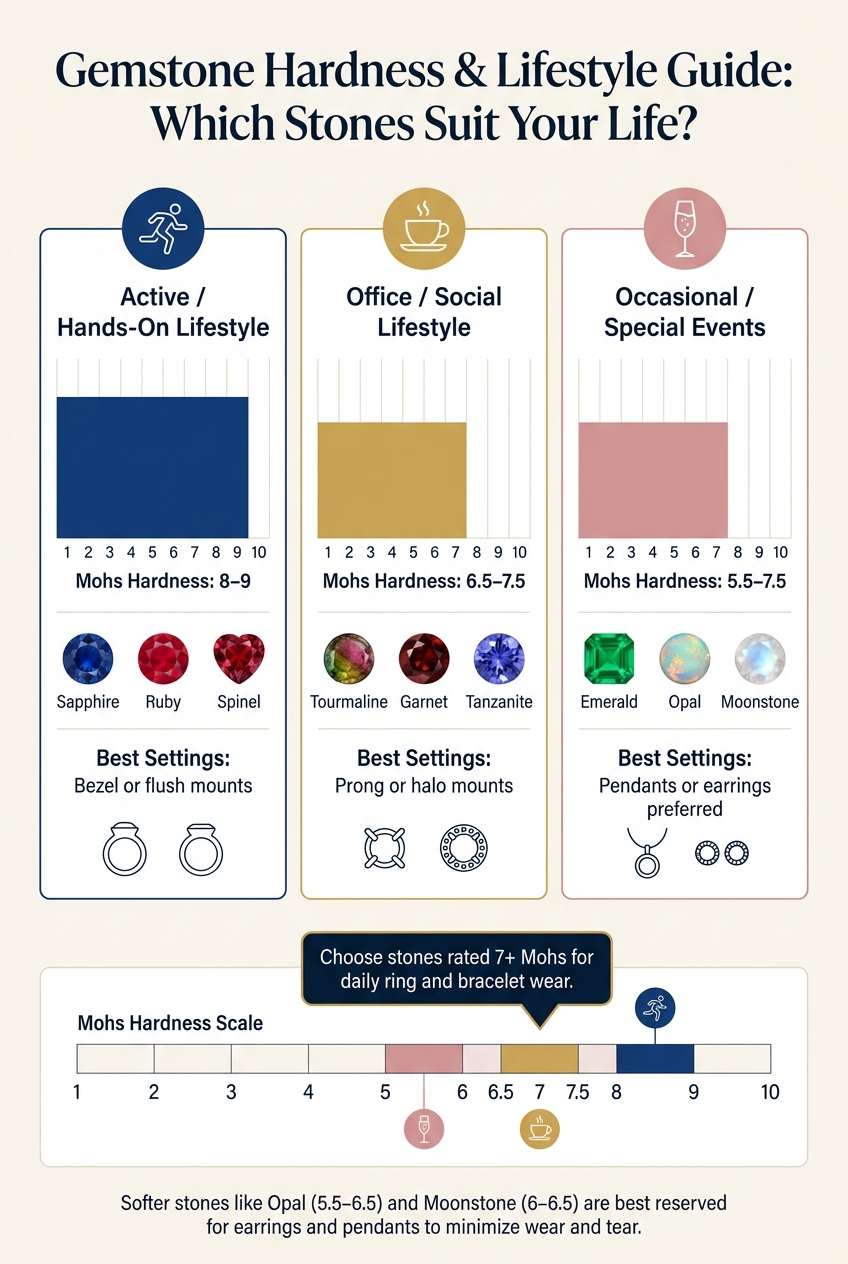
Gemstone Hardness & Lifestyle Guide: Which Stones Suit Your Life?
Choosing the right jewelry isn't just about style - it's about making sure your pieces fit your lifestyle, whether you're dressing for a formal event, a professional setting, or a casual day out.
Jewelry Styles for Different Occasions
The setting matters just as much as the jewelry itself. For formal events, bold pieces like tanzanite cocktail rings, multi-stone necklaces, or chandelier earrings with vibrant gemstones can make a statement. Pair these dramatic pieces with simple outfits for balance, or opt for more understated jewelry if your attire is already elaborate.
In a professional environment, the aim is to look polished without being distracting. Sapphire or spinel drop earrings, a structured gemstone bracelet, or a small pendant are excellent choices. For conservative workplaces, such as schools or hospitals, stick to classic options like gemstone solitaire studs or a single bangle for a refined yet subtle look.
When it comes to casual wear, you have the most room to experiment. Long dangle earrings, stacked rings, or tiered necklaces can bring a touch of flair to a relaxed outfit. For laid-back settings like the beach, opt for chunky beads or simple chains - they’re more durable than delicate pieces. If your outfit is plain, such as a white tee or solid-colored jeans, colorful gemstone jewelry can add a pop of personality. On the other hand, if your outfit features bold prints or patterns, keep your jewelry simple to avoid clashing.
"A collection you never wear is not a collection. It is storage." - Ulka, Curator, Ulka Rocks
Take a moment to reflect on how these choices fit into your everyday life.
Dress Code and Activity Level
Beyond occasions, it’s essential to consider how your jewelry holds up to your daily activities. Sapphire and ruby (Mohs 9) and spinel (Mohs 8) are durable options for rings and bracelets that see frequent wear. On the flip side, softer stones like opal (Mohs 5.5–6.5) and moonstone (Mohs 6–6.5) are better suited for earrings or pendants, where they’re less likely to encounter wear and tear. For active lifestyles, secure settings like bezel or flush mounts help prevent snagging and damage.
| Lifestyle | Recommended Gemstones | Mohs Hardness |
|---|---|---|
| Active / Hands-on | Sapphire, Ruby, Spinel | 8–9 |
| Office / Social | Tourmaline, Garnet, Tanzanite | 6.5–7.5 |
| Occasional / Special Events | Emerald, Opal, Moonstone | 5.5–7.5 |
Take stock of your daily routine and ensure your jewelry choices align with your activities. Your pieces should not only complement your style but also reflect the personal meaning you find in each gemstone.
Quality, Materials, and Budget
How to Check Material and Craftsmanship
Start by examining the metal quality. Look for hallmarks stamped directly onto the jewelry - these might include indicators like 14k or 18k gold, platinum, or 925 sterling silver, all of which signal reliable quality. When it comes to gemstones, prioritize those that are eye-clean, meaning they lack visible inclusions or uneven color zoning. To ensure the stone is securely set, gently wiggle it; the prongs should feel smooth and hold the stone firmly in place.
Independent jewelers, such as LaCkore Couture, often provide exceptional craftsmanship and unique designs compared to mass-market options. Interestingly, brand-name jewelry can cost up to 80% more than similar-quality pieces from independent makers, with much of that markup tied to the branding rather than the materials themselves.
"The cost of a GIA or AGL report is trivial compared to overpaying for a treated stone sold as untreated." - Ulka, Curator and Expert, Ulka Rocks
If you're purchasing a gemstone that costs more than $500, always request a certificate from a trusted independent lab like the GIA or AGL. These reports confirm whether the gemstone has undergone treatments like heat, irradiation, or fracture-filling and provide details about its origin. Once you've verified the materials and craftsmanship, make sure the piece aligns with your financial goals.
Setting a Budget for Multicolored Jewelry
After confirming quality, it's time to consider your budget. A practical approach is the 60/40 rule: allocate about 60% of your budget to high-quality "anchor" pieces - durable stones set in gold or platinum that you'll wear often - and use the remaining 40% for "building" pieces that add variety and color to your collection.
"I tell my customers to spend about 60% of their jewelry budget on anchor pieces and 40% on building and diversifying." - Ulka, Curator and Expert, Ulka Rocks
Here’s a general guide to what you can expect at different price points:
| Budget Tier | Price per Piece | Common Materials |
|---|---|---|
| Accessible | $150 – $500 | Sterling silver, garnet, amethyst, blue topaz, citrine |
| Mid-Range | $500 – $2,000 | 14k gold, sapphire, spinel, tourmaline |
| Investment | $2,000 – $7,500+ | 18k gold or platinum, fine ruby, emerald, Paraiba tourmaline |
Choose pieces that reflect your personal style. Avoid being swayed by sales on items that don’t genuinely appeal to you - buying something just because it’s discounted rarely ends up being a worthwhile purchase. Focus on finding jewelry that feels like it belongs in your collection.
Personalization, Styling, and Care
Layering, Stacking, and Customization Options
Once you’ve chosen high-quality pieces, the next step is to make them your own through layering and stacking. A great way to start is by following the Rule of Three - layering three necklaces or bracelets at a time creates a balanced and eye-catching look. Play with varying lengths to achieve a cascading effect that not only highlights each piece but also helps prevent tangling.
When stacking, let a bold gemstone anchor your look, and surround it with subtler, complementary pieces. For inspiration, here’s a quick guide to color pairings:
| Anchor Gemstone | Complementary Pairing | Visual Effect |
|---|---|---|
| Blue (Sapphire, Tanzanite) | Peach Moonstone, Citrine | Adds warmth to balance cool tones |
| Green (Emerald, Tourmaline) | Ruby, Pink Sapphire | Creates a timeless and elegant contrast |
| Pink/Red (Ruby, Spinel) | Aquamarine, Peridot | Offers a fresh, vibrant pop of color |
| Purple (Amethyst) | Yellow Sapphire, Citrine | Achieves a rich balance of warm and cool hues |
For bracelets, wearing 3–5 per wrist creates a polished, curated vibe. When stacking rings, leaving at least one finger bare helps maintain a cohesive and uncluttered style. If mixing and matching feels overwhelming, brands like LaCkore Couture offer pre-styled options like the "Staycation Stack", making it easier to pull off a layered look. You can also add a personal touch with charms that celebrate milestones, zodiac signs, or birthstones.
Once your look is set, it’s crucial to focus on proper cleaning and storage to keep your jewelry in pristine condition.
How to Clean and Store Your Jewelry
Taking care of your jewelry is just as important as styling it, especially when dealing with multicolored pieces. Different gemstones require different cleaning methods. For harder stones like sapphires and rubies (Mohs hardness 9), a simple solution of warm water, mild dish soap, and a soft brush does the trick. However, porous or treated stones - like opals, pearls, turquoise, and emeralds - should never be soaked. Instead, gently wipe them down with a damp cloth.
"A loose stone caught in time costs $50 to retighten. The same stone after it falls out costs whatever the stone costs to replace." - L'Heritage Jewelry
Storage matters just as much as cleaning. To avoid scratches, store each piece separately in soft pouches or lined compartments, especially when harder stones like diamonds or sapphires are involved. As noted by L'Heritage Jewelry:
"Most damage I see isn't from wear - it's from pieces banging against each other in a single drawer or pouch."
Here are additional care tips to ensure your jewelry stays beautiful:
- Always put on your jewelry after applying lotion, perfume, or hairspray.
- Remove your pieces before swimming, working out, or using household cleaners.
- Place a silica packet in your jewelry box to reduce moisture and slow silver tarnishing.
- Schedule a professional inspection annually to catch issues like loose prongs or weak clasps before they lead to expensive repairs.
Conclusion: Key Points for Choosing Multicolored Gemstone Jewelry
Choosing multicolored gemstone jewelry boils down to a few essential guidelines. Begin with what speaks to you - a gemstone that resonates with your personality rather than chasing the latest trends. As Ulka, Expert Gemstone Curator at Ulka Rocks, advises:
"Your collection should start... with a stone that stops you in your tracks and tells you something about yourself."
Your jewelry collections should reflect both your individuality and practical needs. Match your choices to your lifestyle - opt for stones with a Mohs hardness above 7 if you plan to wear them daily, while softer gems are better reserved for special occasions. Consider the symbolism of gemstones to add a personal touch, whether it’s the tranquility of a blue sapphire, the sense of renewal from a green emerald, or the positivity of a yellow citrine.
When budgeting, the 60/40 rule can help guide your decisions: allocate 60% of your budget for durable, versatile pieces and 40% for accent pieces. For any purchase over $500, ensure authenticity by requesting a lab certificate.
Most importantly, your collection should be worn and enjoyed. As Ulka succinctly puts it: "A collection you never wear is not a collection. It is storage." To preserve the beauty of your pieces, prioritize proper care and select items that fit seamlessly into your everyday life. This thoughtful approach ensures your collection remains both meaningful and stylish for years to come.
FAQs
How do I choose multicolored gemstones that won’t clash with my wardrobe?
To make your multicolored gemstone jewelry stand out, pair it with neutral or understated outfits. This approach allows the vibrant colors of the gemstones to take center stage. A color wheel can be a helpful tool for finding combinations that work well together, such as analogous or complementary shades. If you prefer a more subdued look, stick to monochromatic tones for a refined effect. Neutral gemstones, like moonstone, work beautifully to balance brighter colors in your wardrobe. Adding layered pieces can also bring a personal flair to your outfit while maintaining a polished and unified appearance.
What’s the safest multicolor gemstone combo for an everyday ring?
For an everyday ring, opt for durable gemstones such as citrine, topaz, or moonstone. These stones are not only beautiful but also practical for daily wear. Consider smaller stones set in a flush style - this combination ensures comfort, durability, and versatility. LaCkore Couture’s handcrafted jewelry showcases exceptional craftsmanship, offering a wide range of designs to complement your unique style and personality.
Do I really need a lab certificate for a gemstone purchase?
A lab certificate plays an important role in confirming a gemstone’s authenticity, quality, and any treatments it might have received. It ensures clarity and safeguards buyers from paying too much for stones that may be misrepresented. While not required in every case, it’s highly advised for larger investments. Opt for certificates from trusted labs like GIA or SSEF, and always verify that the details align with the gemstone in question.