Skip to content




Victorian Jewelry Symbols: Meaning Guide
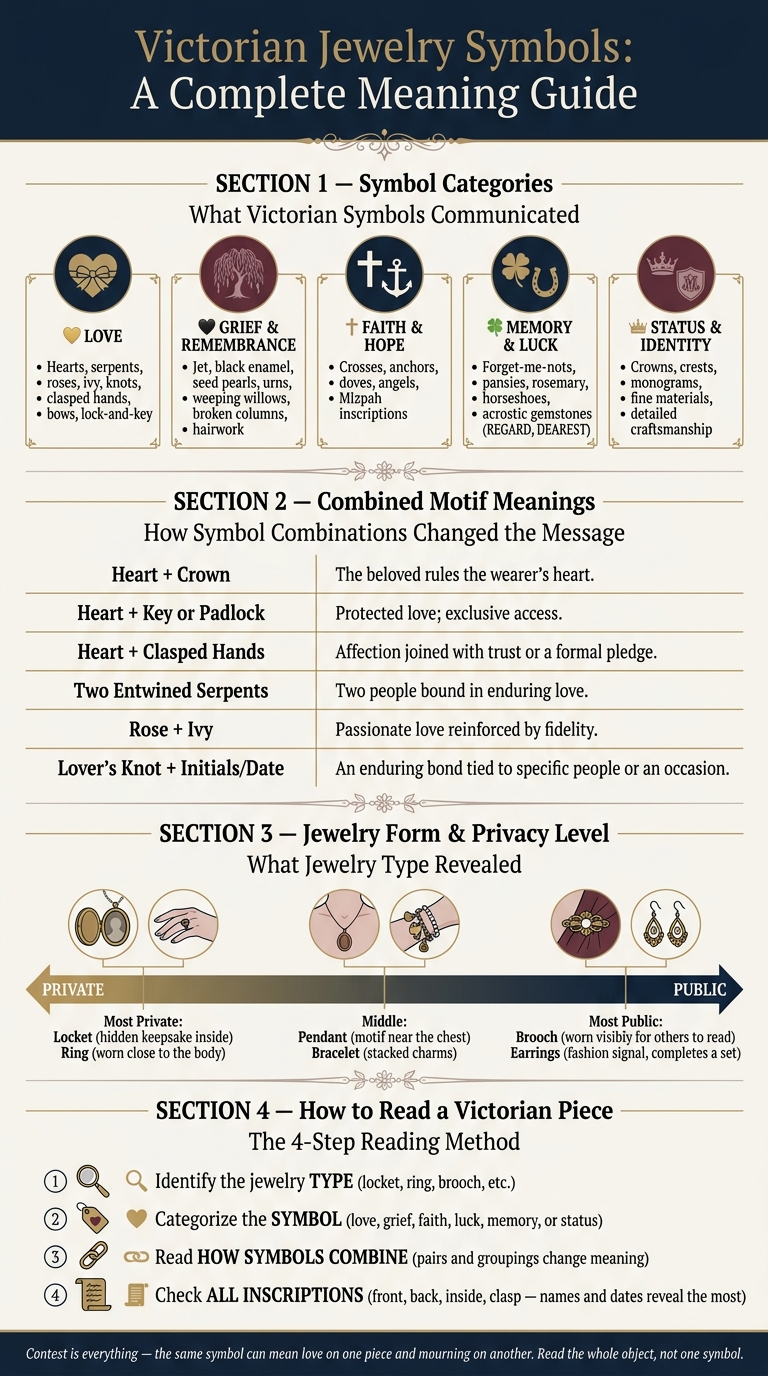
Victorian jewelry was a message system in metal and stone. If I want to read a piece fast, I look at 4 things first: the symbol, the jewelry type, the material, and any hidden detail like initials, hairwork, or a date.
In plain terms, here’s what most Victorian pieces were saying:
- Love: hearts, serpents, roses, ivy, knots, clasped hands, bows, lock-and-key designs
- Grief and remembrance: jet, black enamel, seed pearls, urns, weeping willows, broken columns, hairwork
- Faith and hope: crosses, anchors, doves, angels, Mizpah inscriptions
- Memory and luck: forget-me-nots, pansies, rosemary, horseshoes, acrostic gemstone words like REGARD or DEAREST
- Status and identity: crowns, crests, monograms, gold and other fine materials, and detailed workmanship
Here’s the part I’d keep in mind: the same symbol could mean different things depending on context. A serpent could point to eternal love on an engagement ring, but to eternity after death on a mourning piece. A forget-me-not in turquoise might suggest affection, while the same flower in black could mark loss. During Queen Victoria’s reign from 1837 to 1901 - a span of 64 years - these meanings shifted with fashion, grief customs, and the type of item being worn.
If I had to sum up the whole guide in one line, it would be this: <u>don’t read one symbol by itself - read the whole object.</u>
| What to check | What it can tell you |
|---|---|
| Motif | Love, grief, faith, luck, memory, or rank |
| Jewelry type | Whether the message was private or public |
| Material | Mourning, affection, wealth, or sentiment |
| Inscription/hidden feature | The most direct clue about the piece |
That’s the basic code the article explains.
Victorian Jewelry Symbols: What Every Motif, Material & Form Means
Love, Devotion, and Personal Attachment Symbols
Victorian love symbols were almost never blunt or obvious. Their meaning often came from the way motifs were paired, where they were placed, and what material carried them.
Hearts, Serpents, Roses, and Ivy
The heart stood for love, devotion, or attachment. A crowned heart meant the beloved ruled the wearer's heart. A heart with a flame pointed to passion. Double hearts showed two people joined together. Hearts appeared on rings, pendants, lockets, brooches, and bracelet clasps.
The serpent stood for eternity and lasting commitment. A snake biting its own tail - the ouroboros - made a circle with no beginning or end. Queen Victoria's serpent engagement ring helped make the motif popular. Snake rings and bracelets strengthened that meaning even more.
Roses spoke of love and passion. Ivy pointed to fidelity and lasting attachment. An ivy-bordered locket could add another layer, mixing fidelity with private memory, especially if it held a photograph or a lock of hair inside.
These symbols became more precise when they appeared with knots, hands, or locked motifs.
Lover's Knots, Clasped Hands, Bows, and Lock-and-Key Designs
Lover's knots meant an unbroken bond. Add initials or a date, and that bond became tied to named people or a set occasion.
Clasped hands, from the fede tradition, stood for loyalty, trust, or union. Inscriptions and paired motifs helped show whether the meaning was romantic or more about kinship. When the hands held a heart, the message leaned much more openly toward affection.
Bows and ribbons pushed the idea of connection a step further. A bow above two hearts suggested those hearts were tied together.
Lock-and-key imagery gave trust a physical form: a heart-shaped padlock suggested protected fidelity, while a key hinted at exclusive access. Matching lock-and-key pieces could also be worn as a pair.
Put together, these motifs could turn a broad message of affection into something much more pointed.
How Combined Motifs Created Layered Meaning
Victorian sentimental jewelry often used combinations to narrow the message. A heart with a crown did not say the same thing as a heart with a key. And that, in turn, did not mean the same thing as a heart held by clasped hands.
| Combination | What it communicated |
|---|---|
| Heart + crown | The beloved rules the wearer's heart |
| Heart + key or padlock | Protected love; exclusive access |
| Heart + clasped hands | Affection joined with trust or a formal pledge |
| Two entwined serpents | Two people bound together in enduring love |
| Rose + ivy | Passionate love reinforced by fidelity |
| Lover's knot + initials or date | An enduring bond tied to specific people or an occasion |
The same motifs could also shift in mourning jewelry, where black materials and memorial symbols changed the tone.
Grief, Faith, Luck, and Memory Symbols
The very same symbol that meant love in one piece could point to grief, faith, or remembrance in another. That’s part of what makes Victorian jewelry so layered. It didn’t just say I love you. It could also mark loss, prayer, hope, or memory. And once names, dates, or hidden compartments were added, the message became even more personal.
Mourning Motifs: Black Enamel, Jet, Urns, and Weeping Willows
Jet - especially Whitby jet - became one of the clearest mourning materials of the period. Black enamel carried a similar visual message. Queen Victoria’s use of jet after Prince Albert’s death helped link it even more strongly with grief. Still, black jewelry by itself doesn’t prove a mourning purpose; the motifs and inscriptions matter too.
Seed pearls often stood for tears or a child’s mourning. Urns pointed to death or memorialization. Weeping willows expressed sorrow. A broken column suggested a life cut short. Then there was hairwork: human hair placed under glass or woven into bracelets and brooches. That turned the piece into a direct link to one specific person.
| Symbol | Common Meaning | Typical Material | Jewelry Form |
|---|---|---|---|
| Jet | Mourning, remembrance | Whitby jet | Necklace, brooch, earrings, ring |
| Black enamel | Bereavement, formal mourning | Enamel over metal | Brooch, locket, ring, pendant |
| Seed pearls | Tears; remembrance of a child or young person | Small pearls as borders or accents | Ring, brooch, locket, pendant |
| Urn | Death, memorialization | Gold, enamel, jet | Brooch, pendant, ring |
| Weeping willow | Grief and sorrow | Enamel, engraving, hairwork | Brooch, locket, pendant |
| Broken column | A life cut short | Enamel or engraved motif | Ring, brooch, pendant |
| Hairwork | Direct personal remembrance | Human hair under glass or woven | Brooch, locket, bracelet, ring |
Faith symbols often gave mourning jewelry a gentler note by adding hope.
Crosses, Anchors, Doves, Angels, Eyes, and Mizpah Inscriptions
A cross could mean faith, salvation, or remembrance. The surrounding details decide how to read it. Add dates, black enamel, or memorial imagery, and the symbol leans toward mourning. Anchors suggested hope. Doves and angels pointed to peace and protection. The lover's eye - a miniature painted eye in a brooch or ring - worked as a private keepsake tied to one person.
Mizpah inscriptions came from the Bible and expressed a bond between people separated by distance. In Victorian jewelry, the word carried the idea of protection and the hope of reunion. It could mark a parting, not only a death, so names, dates, and nearby imagery help sort out the meaning.
Other motifs were quieter. They held on to memory or hinted at good luck.
Forget-Me-Nots, Pansies, Rosemary, Horseshoes, and Acrostic Gemstones
Floral motifs often carried coded messages. Forget-me-nots meant remembrance and the plea not to be forgotten. Pansies conveyed loving thoughts or reflection. Rosemary was linked to remembrance and fidelity, and it showed up as engraved botanical detail or enamel decoration on lockets and brooches.
Horseshoes were common luck symbols. They were often shown upright, as if to hold luck in place, though the rest of the design could shift that meaning. Acrostic jewelry used the first letters of gemstones in sequence to spell a hidden word. REGARD used ruby, emerald, garnet, amethyst, ruby, and diamond. DEAREST and ADORE were common too. To anyone who didn’t know the code, the piece could look almost ordinary.
Status, Identity, and What Jewelry Type Revealed
Victorian jewelry did more than express feeling. It also signaled status, identity, and taste. The number of pieces someone wore, the materials used, and the level of detail in the design could hint at social rank, the event, and how closely the wearer followed fashion. Newly wealthy families often turned to ornate jewels to show prosperity. Aristocratic households, by contrast, leaned on inherited pieces, crests, and family marks. The best way to read these clues is the same way you read symbols: look at the full picture, not one detail by itself.
Crowns, Crests, Monograms, Materials, and Craftsmanship
A crown or coronet could point to honor, authority, rank, or special affection, but context changes the meaning. A crown above a heart said something very different from a crown used inside a heraldic family crest. The first leaned toward romance. The second pointed to family identity or rank. Neither, on its own, proved that the wearer had a title.
Crests and monograms made ownership and connection visible. An engraved monogram on a locket or brooch could mark an individual, a couple, or a family member. Names and dates added even more detail, turning a piece into a wearable record of a birth, marriage, or death. When you're looking at a piece with an unclear meaning, those personal marks often tell you more than the decorative motifs.
Materials shaped that message too. Metal, stones, and workmanship all affected how a piece was read in public.
| Material | What it could suggest | Key qualification |
|---|---|---|
| Gold | Value, durability, economic means | Karat varied widely; lower karat did not necessarily mean lower quality. |
| Silver | A bright finish, detailed work | Setting choice often reflected design intent rather than budget. |
| Dark materials | Mourning or formality | Read with motifs and inscriptions, not color alone. |
| Pearls | Refinement, luxury, or mourning | Meaning depended on context. |
| Natural stones | Personal taste and color preference | Budget and sentiment also shaped choice. |
Craftsmanship mattered too. Hand engraving, filigree, enamel, hairwork, and careful stone setting could make a piece look more costly and more important. Earlier hand-built pieces usually point to more labor and expense than later machine-assisted work.
What Lockets, Rings, Brooches, Bracelets, Pendants, and Earrings Communicated
Form mattered just as much as motif, because each jewelry type offered a different mix of visibility and privacy.
A locket, for example, could hold a keepsake hidden from view. A ring stayed close to the body, which made it well suited to commitment and remembrance. A brooch was much more public, worn where other people could easily see and read it. Bracelets could collect charms or keepsakes as linked parts. Pendants placed a motif near the chest. Earrings worked a bit differently, often signaling fashion through matching pairs and helping complete a larger ensemble or set.
These patterns are useful, but they aren't fixed rules. The same heart, cross, or gemstone could mean different things depending on who gave the piece, how it was worn, and what other details appeared alongside it.
How to Read Victorian Jewelry Accurately Today
No single symbol tells the whole story. A heart, a cross, or a weeping willow only starts to mean something when you read it with the material, the jewelry form, any inscription, the date, and the history around it.
A Checklist for Reading Symbols
Before you settle on a meaning, go through the piece step by step. Start with the jewelry type - locket, ring, brooch, bracelet, pendant, or earring - because the form helps shape the message. Then place it in the category that fits best: love, grief, faith, luck, memory, or status.
After that, look at how symbols work together. A heart paired with a cross and anchor, for example, can point to love joined with faith and hope, especially if the piece also uses black enamel or hairwork. Then read every inscription - front, back, inside, clasp, and underside. A name, date, or short phrase usually tells you more than a decorative motif on its own.
Materials matter too. Jet, onyx, black enamel, pearls, and human hair can point to mourning or remembrance, but none of them prove it by themselves. It’s better to treat common symbol meanings as smart guides, not hard rules.
That same approach still makes sense now, even when the symbols are personal instead of Victorian.
A Modern Take on Personal Symbolism
Today, the same method still works. People mix initials, stones, and motifs to build personal meaning instead of following a shared Victorian code.
Conclusion: The Main Meanings to Remember
Victorian jewelry expressed love, grief, faith, luck, memory, and status - and the meaning always changed with context. Lockets and pendants often leaned toward private remembrance. Rings marked lasting bonds or memorial ties. Brooches carried emotional or social messages in public. Bracelets and charms could stack several personal references at once.
Read the whole object, not one symbol.
FAQs
How can I tell if a piece is mourning jewelry?
Look for dark materials like jet, onyx, black enamel, vulcanite, or gutta-percha. Victorian mourning jewelry often includes small symbolic touches too, like seed pearls, floral motifs such as lilies, portraits, or even locks of hair.
If you're looking at brooches and pins, check the clasp. A simple C-clasp can be a useful clue, since safety catches didn’t become common until the 20th century.
Why can one Victorian symbol have multiple meanings?
In Victorian jewelry, one symbol could carry more than one meaning because the message depended on context. Color, arrangement, and social custom could all shape how someone read it.
Take the red rose. On its own, it pointed to passionate love. But when it appeared with white roses, the message could feel more layered and subtle. Meaning also changed through shared social codes and the way jewelry was worn, paired, or stacked with other pieces.
Which hidden details matter most when reading a piece?
Focus on symbolic motifs and how they work together. Floral designs often carry layered meaning: roses suggest love, violets suggest modesty, and forget-me-nots point to remembrance.
It also helps to look closely at craftsmanship details, like tool marks or hallmarks, and to think about the type of piece itself. Lockets often held private mementos. Brooches and bracelets, by contrast, tended to show emotion or social status more openly.