Skip to content




Top 7 Vegan Engagement Ring Materials
Vegan engagement rings prioritize ethical and eco-friendly practices by avoiding materials tied to mining and exploitation. They feature lab-grown diamonds, moissanite, and recycled metals like gold, platinum, and silver. These options are durable, cost-effective, and free from the environmental harm and human rights issues linked to traditional mining. Here's a quick look at the top materials:
- Lab-Grown Diamonds: Identical to mined diamonds but 20–50% cheaper and more energy-efficient.
- Moissanite: A brilliant, affordable alternative costing 10% of a diamond's price.
- Recycled Gold, Platinum, and Silver: Repurposed metals that reduce waste and pollution.
- Ethically Sourced Sapphires: Durable and colorful gems mined responsibly or lab-created.
- Ethically Sourced Gemstones: Includes emeralds, rubies, and more, ensuring fair labor practices.
These materials offer a stylish way to honor your values without compromising quality or beauty.
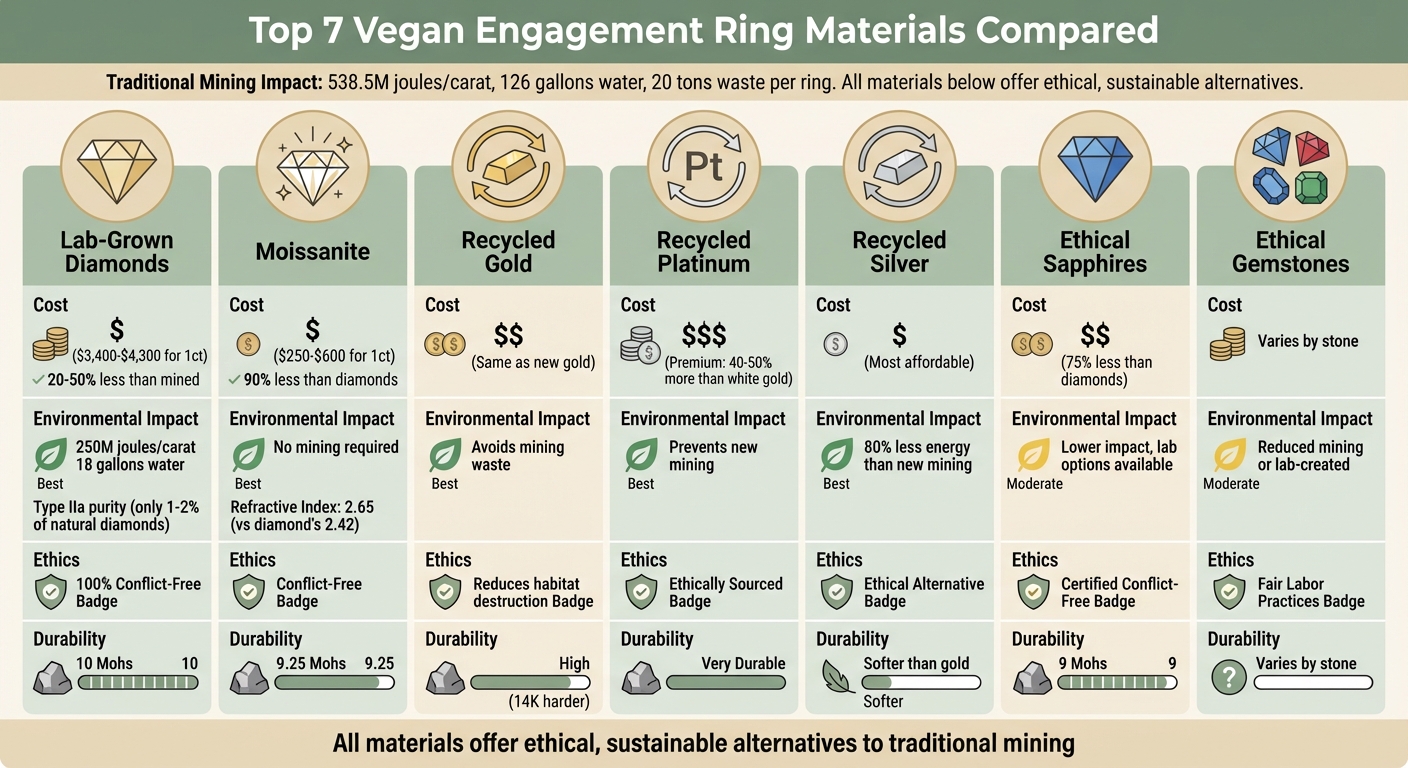
Vegan Engagement Ring Materials: Cost, Sustainability & Durability Comparison
Quick Comparison
| Material | Cost (Relative) | Environmental Impact | Ethical Considerations | Durability |
|---|---|---|---|---|
| Lab-Grown Diamonds | 20–50% less than mined | Lower energy and water use | 100% conflict-free | 10 (Mohs scale) |
| Moissanite | 90% less than diamonds | No mining required | Conflict-free | 9.25 (Mohs scale) |
| Recycled Gold | Same as new gold | Avoids mining and waste | Reduces habitat destruction | High (14K harder) |
| Recycled Platinum | Premium pricing | Prevents new mining | Ethically sourced | Very durable |
| Recycled Silver | Most affordable | Reduces mining waste | Ethical alternative | Softer than gold |
| Ethical Sapphires | Moderately priced | Lower impact, lab-grown options | Certified conflict-free | 9 (Mohs scale) |
| Ethical Gemstones | Varies | Reduced mining or lab-created | Fair labor practices | Varies by stone |
Choosing these materials ensures your ring is a symbol of love and responsibility.
1. Lab-Grown Diamonds
Sustainability
Lab-grown diamonds are a game-changer when it comes to resource efficiency. They use less than half the energy required for mined diamonds - 250 million joules per carat compared to 538.5 million - and need only 18 gallons of water per carat, a stark contrast to the 126 gallons used for mined stones. This dramatic reduction in energy and water consumption highlights their eco-friendly edge.
Unlike traditional mining, which often leads to deforestation, soil erosion, and the destruction of ecosystems, lab-grown diamonds skip these environmentally damaging steps entirely. Some labs are even powered by 100% renewable energy, such as solar power in Belgium or a mix of hydro and solar energy in the United States, further cutting their environmental impact. A few producers have gone a step further, creating "carbon-negative" diamonds by capturing carbon directly from the atmosphere.
This efficient production process not only minimizes harm to the planet but also aligns with ethical practices, offering a more responsible alternative to traditional mining.
Ethical Sourcing
One of the standout features of lab-grown diamonds is their 100% conflict-free origin. Produced in controlled lab environments, these diamonds are fully traceable from start to finish. This eliminates the risk of funding civil wars or human rights abuses, issues often associated with mined diamonds.
"There is no fear of mining, smuggling, or civil war when it comes to lab-grown diamonds." – Priyanka Mehta, Designer and Founder, Nue
In 2018, the Federal Trade Commission clarified that lab-grown diamonds are real diamonds, removing the term "natural" from the definition. Chemically, they are identical to mined diamonds, with the only difference being their origin. They are graded by the same standards - Cut, Color, Clarity, and Carat - by reputable institutions like GIA, IGI, and GCAL.
Affordability
Lab-grown diamonds are not just better for the planet - they're easier on the wallet too. On average, they cost 20% to 50% less than mined diamonds of similar quality. For example, a 1.00-carat lab-grown diamond is priced between $3,400 and $4,300, while a 2-carat halo engagement ring made with lab-grown diamonds costs around $6,000. In comparison, a similar ring with a mined diamond would set you back approximately $23,000.
This affordability gives buyers more flexibility. For instance, with a $6,000 budget, you could opt for a stunning 3-carat lab-grown diamond rather than a 1-carat mined stone.
Aesthetic Appeal
Lab-grown diamonds don’t just match the beauty of mined diamonds - they often surpass it. These diamonds are chemically, physically, and optically identical to their mined counterparts, made of pure crystallized carbon and boasting a hardness of 10 on the Mohs scale. They deliver the same brilliance, fire, and sparkle that diamonds are known for.
Interestingly, many lab-grown diamonds fall into the Type IIa category, the purest form of diamond with no nitrogen impurities. This category represents only 1–2% of mined diamonds but is common among lab-grown stones. As a result, lab-grown diamonds can appear even brighter and more radiant than most mined diamonds.
"Think of it as making ice in your modern-day freezer versus getting it from a glacier. Both are frozen H2O regardless of the origin." – MiaDonna
2. Moissanite
Moissanite stands out as a gem that aligns beautifully with the ethical and eco-conscious values behind vegan engagement rings, offering a compelling alternative to traditional diamonds.
Sustainability
Moissanite is created in labs from silicon carbide, requiring about 250 million joules of energy per carat, which is significantly less than the 538.5 million joules needed for mined diamonds. This energy efficiency eliminates the environmental damage caused by mining, such as deforestation, soil erosion, and habitat destruction.
With a Mohs hardness of 9.25, moissanite ranks as the second-hardest gemstone used in jewelry. Its durability ensures it withstands daily wear, reducing the need for frequent replacements and contributing to less waste over time.
This eco-friendly production process naturally goes hand in hand with ethical sourcing practices.
Ethical Sourcing
Because moissanite is entirely lab-created, it is 100% conflict-free and fully traceable from its creation to purchase. Unlike mined diamonds, it poses no risk of funding civil wars or contributing to human rights abuses.
Moreover, its lab-grown origin avoids the destruction of natural habitats and ecosystems, aligning perfectly with vegan principles that prioritize the protection of animals and the planet.
Affordability
Moissanite offers an incredible balance of quality and cost, typically priced at just 10% of the cost of a mined diamond of similar size and quality. For example, a 1-carat moissanite ranges between $250 and $600, whereas a comparable natural diamond can cost anywhere from $2,000 to $6,000. For a 2-carat stone, moissanite costs about $600 to $1,000, compared to $8,000 to $20,000 for a mined diamond.
This affordability allows for larger, more dazzling stones within the same budget. Additionally, moissanite is consistently produced to high clarity standards, meaning you won’t pay a premium for flawless stones, as is often the case with natural diamonds.
Aesthetic Appeal
Moissanite dazzles with a refractive index of 2.65, which surpasses diamond’s 2.42. Its dispersion, or “fire,” measures 0.104, more than double that of a diamond’s 0.044, resulting in vibrant rainbow flashes of light.
"With a high refractive index of 2.65, moissanite is the world's most brilliant gem™." – Charles & Colvard
Visually, moissanite closely resembles diamonds but offers an extra brilliance that sets it apart. Available in colorless and near-colorless grades, it retains its sparkle over time. Additionally, moissanite is about 15% lighter than a diamond of the same size due to its lower density. Charles & Colvard, a leading moissanite brand, has received glowing reviews, averaging 4.5 out of 5 stars from nearly 3,000 customers, who often highlight the “flawless and colorless” quality of their stones.
Moissanite’s dazzling appearance and ethical production make it a shining example of beauty without compromise - an essential value in vegan engagement jewelry. Up next, we’ll delve into the use of recycled metals, another key element of sustainable jewelry design.
3. Recycled Gold
Recycled gold transforms old jewelry, electronics, and industrial scrap into beautiful engagement rings, offering an ethical alternative to traditional mining. It’s a thoughtful choice for those seeking jewelry with a lower environmental footprint.
Sustainability
Traditional gold mining is notorious for its environmental toll, generating about 20 tons of waste per ring and consuming a staggering 182,000 tons of cyanide annually. Recycled gold sidesteps these issues by repurposing materials like discarded jewelry - making up roughly 90% of its supply - and industrial scrap. This process uses significantly less water and energy while emitting fewer greenhouse gases compared to mining new gold. Plus, gold’s unique property of being endlessly refinable ensures recycled gold matches the purity and quality of newly mined gold.
"By choosing recycled gold, we help reduce the massive environmental disruption often associated with gold mining." – Melissa Tyson, Founder, Melissa Tyson Designs
Ethical Sourcing
Recycled gold offers a cleaner, more humane alternative to traditional mining, which is often linked to human rights violations and habitat destruction. It eliminates the need for harmful chemicals like cyanide and mercury, which frequently pollute groundwater near mining operations. For added assurance, look for metals certified by the Responsible Jewellery Council (RJC).
Affordability
Recycled gold is priced on par with mined gold. For example, 14K gold is the most budget-friendly option, while 18K gold, containing 75% pure gold, costs slightly more - typically a few hundred dollars extra. A simple solitaire setting might start at around $550, while more intricate designs can range upwards of $2,000.
"Recycled gold is exactly the same as mined gold in price and performance, so recycled gold rings are a perfect and eco-friendly choice." – Lahela Jewelry
Aesthetic Appeal
Recycled gold doesn’t sacrifice beauty for ethics. It can be polished, finished, or rhodium-plated (for white gold) to achieve a dazzling shine. Available in yellow, white, and rose gold, it delivers the same timeless elegance as traditional gold, allowing you to wear stunning jewelry that aligns with your values.
4. Recycled Platinum
Recycled platinum is sourced from previously used materials like jewelry, industrial waste, and electronics. Refined to a purity level of 90%–95%, it mirrors the chemical properties of newly mined platinum, offering a luxurious yet more environmentally conscious alternative. Given platinum’s rarity, especially when compared to gold, its recycled form carries an extra layer of exclusivity and responsibility.
Sustainability
Traditional platinum mining has a heavy environmental impact, something recycled platinum avoids entirely. With only about 130 tons of platinum mined annually worldwide - compared to the 2,500–3,000 tons of gold produced each year - choosing recycled platinum helps protect natural landscapes and ecosystems.
"Recycling existing metal avoids the need to produce virgin metal. In turn, minimising mining activity preserves landscapes, natural habitats and precious natural resources." – Lebrusan Studio
This process not only conserves resources but also sets a standard for ethical and eco-conscious sourcing.
Ethical Sourcing
Recycled platinum supports ethical practices by sidestepping the harmful effects of traditional mining, such as hazardous working conditions and displacement of communities. Opting for recycled metals certified by the Responsible Jewellery Council ensures adherence to stringent ethical guidelines.
Affordability
Recycled platinum matches the purity of newly mined platinum, and its price remains comparable to its freshly mined counterpart. That said, platinum is the most expensive metal for engagement rings - typically 40% to 50% pricier than white gold. For instance, a simple platinum solitaire setting might cost around $1,000, whereas a similar 14K white gold setting would be about $550. More intricate platinum designs can easily exceed $3,000. On the upside, platinum doesn’t require routine rhodium re-plating, which reduces maintenance costs over time. This combination of longevity and lower upkeep adds to the value of recycled platinum.
Aesthetic Appeal
Naturally white and hypoallergenic, recycled platinum is an excellent option for individuals with sensitive skin. Unlike white gold, it retains its color without needing chemical plating. Over time, it develops a soft patina - a subtle, satiny finish created by daily wear - that many consider an attractive feature. If desired, the ring can be polished back to its original shine. Thanks to its density, platinum resists wear differently; scratches shift the metal rather than removing it, ensuring the piece can endure for generations.
5. Recycled Silver
Recycled silver, much like recycled gold and platinum, provides a sophisticated and environmentally conscious choice without sacrificing elegance. This silver is reclaimed from sources like old jewelry, industrial byproducts, and manufacturing remnants. Through a process of melting and purification, it achieves the same high quality as newly mined silver, but without the environmental toll. Since silver is an element, it can be recycled endlessly without losing its strength or its signature radiant finish.
Sustainability
Traditional silver mining is notorious for producing vast amounts of waste. In contrast, recycled silver requires only 20% of the energy needed to extract new ore. It also avoids the use of harmful chemicals like cyanide and mercury, which are known to pollute groundwater. To put it into perspective, gold and silver mines globally use about 182,000 tons of cyanide each year to separate metals from rock.
"Rather than mining new materials, recycled metals reduce the need for environmental destruction and minimize waste." – Soha Diamond Co.
Ethical Sourcing
Choosing recycled silver helps bypass the labor exploitation and displacement of communities often tied to traditional mining practices. To ensure authenticity, look for jewelers certified by the Responsible Jewelry Council (RJC), which guarantees that the silver comes from post-consumer or industrial scrap. This transparent sourcing supports a circular economy, keeping materials in use and reducing the strain on finite natural resources.
Affordability
Recycled silver is a budget-friendly option, offering the same market value and quality as newly mined silver while being significantly less expensive than gold or platinum. For instance, a simple silver solitaire ring might start at around $550, making it an appealing choice for those who want a sustainable yet economical option.
Aesthetic Appeal
Recycled silver boasts the same bright white, high-luster finish as newly mined silver. However, because silver is softer than gold or platinum, it may be more susceptible to scratches or bending over time. To maintain its shine and prevent tarnishing, occasional polishing is recommended. Additionally, ensure the setting is durable enough to securely hold harder stones like moissanite or lab-grown diamonds. This balance of beauty, affordability, and sustainability makes recycled silver an essential part of any eco-friendly jewelry collection.
At LaCkore Couture, our recycled silver engagement rings blend ethical sourcing with timeless designs, offering a way to celebrate your love while honoring both style and environmental responsibility.
6. Ethically Sourced Sapphires
Ethically sourced sapphires are a thoughtful alternative to traditional diamonds, offering stunning colors while prioritizing responsible sourcing. These gemstones are mined under humane conditions, ensuring fair wages and safe environments for workers, all while protecting human rights. Unlike conventional mining, which can cause significant environmental damage like deforestation and large-scale rock displacement, ethical sapphire sourcing focuses on reducing environmental impact and often includes efforts to restore the land.
Sustainability
Sapphires from regions like Montana, Australia, and Sri Lanka set an example of responsible mining practices. These areas emphasize minimal environmental disturbance and land restoration efforts. With a hardness of 9 on the Mohs scale, sapphires are not only beautiful but also incredibly durable, making them a long-lasting choice.
For those seeking an even more eco-friendly option, lab-grown sapphires are a perfect match. They share the same chemical and physical properties as natural sapphires but are created with significantly less energy and entirely avoid the environmental toll of mining.
Ethical Sourcing
When purchasing sapphires, you can ensure their origin and ethical status by requesting a GIA Colored Stone Identification & Origin Report. Trustworthy suppliers provide full traceability and certification, adhering to strict labor and environmental standards. Countries like the United States, Australia, and Canada are known for their rigorous regulations, making them reliable sources for conflict-free gems.
This level of transparency ensures that ethically sourced sapphires align with your values, making them an excellent choice for engagement rings and other meaningful jewelry.
Affordability
In addition to their ethical benefits, sapphires are a budget-friendly alternative to diamonds. Ethically sourced sapphires often cost about one-quarter the price of mined diamonds, with lab-grown options offering an additional 20–40% in savings.
Aesthetic Appeal
Sapphires come in a stunning array of colors, from classic blues and violets to greens, yellows, and even color-changing varieties. Some sapphires feature a unique "silk" effect caused by intersecting rutile needles, giving them a soft, glowing appearance. White sapphires, in particular, offer a sleek, colorless option with a subtle sparkle, providing a beautiful alternative to diamonds. Thanks to their exceptional hardness, sapphires resist scratches and maintain their polish for decades, making them a practical choice for everyday wear.
"Ethically sourced and sustainably mined with minimal environmental impact, even the trees are replanted." – Gemfix
At LaCkore Couture, we embrace the timeless beauty of ethically sourced sapphires, offering jewelry that reflects both your style and your values.
7. Ethically Sourced Gemstones
When it comes to engagement rings, there’s more than just sapphires to consider. Ethically sourced gemstones like emeralds, rubies, alexandrite, and padparadscha sapphires offer stunning colors and distinct features while adhering to responsible sourcing practices.
Sustainability
Ethically sourced gemstones are a natural extension of sustainable practices in jewelry. Whether mined under strict regulations or created in a lab, these gemstones aim to reduce environmental harm and waste compared to traditional mining methods. This makes them a thoughtful choice for those who value eco-friendly options.
Ethical Sourcing
Ethical sourcing goes beyond the gemstones themselves - it’s about ensuring fair labor practices and safe working conditions. Look for certifications from organizations like the Responsible Jewellery Council or B Corp to confirm responsible sourcing. Additionally, gemstones from regulated regions, such as Canada, often meet high ethical standards. For added transparency, blockchain technology is increasingly being used to track the journey of gemstones from their origin to the final product .
"An ethical diamond or gemstone actually considers the well-being of people and the planet, not just war funding." – Lahela Jewelry
Aesthetic Appeal
Ethically sourced gemstones aren’t just a responsible choice - they’re also breathtakingly beautiful. These stones bring vibrant colors and unique characteristics to engagement rings. For example:
- Emeralds: Known for their rich green hues and a mesmerizing "hall of mirrors" effect.
- Rubies: Featuring deep red tones and a remarkable hardness of 9 on the Mohs scale.
- Alexandrite: Famous for its dramatic color-shifting properties.
- Padparadscha sapphires: Coveted for their rare pink-orange glow.
White sapphires also serve as a natural alternative to diamonds, offering brilliance without compromising on ethics. At LaCkore Couture, we embrace the diversity of ethically sourced gemstones, creating pieces that resonate with your personal style and values.
Material Comparison Table
Compare the key factors to find the best material for your vegan engagement ring.
| Material | Cost (Relative) | Environmental Impact | Ethical Considerations | Durability |
|---|---|---|---|---|
| Lab-Grown Diamonds | 70%–90% less than mined diamonds; a 1 ct round (F, VVS2) costs about $1,440 vs. $8,710 for natural | Uses 250 million joules and 18 gallons of water per carat vs. 538.5 million joules and 126 gallons for mined diamonds | 100% conflict-free and fully traceable from lab to consumer | 10 on Mohs scale - same as mined diamonds |
| Moissanite | Much lower; a 1 ct stone costs between $250–$600 | Minimal impact; lab-created with no mining required | Conflict-free and traceable, with no labor exploitation | 9.25 on Mohs scale |
| Recycled Gold | Comparable to new gold but avoids the environmental toll of mining | Made from existing jewelry and electronics; avoids new mining | Reduces risks tied to labor exploitation and habitat destruction | 14k is harder than 18k due to higher alloy content |
| Recycled Platinum | Premium pricing; typically 90%–95% pure platinum | Prevents destructive new mining while maintaining the same quality as new metals | Ethically sourced from existing materials | The strongest and most durable metal option |
| Recycled Silver | The most affordable metal option | Reduces mining waste; mining for precious metals can produce up to 6,000 lbs of waste per 1 ct | An ethical alternative to newly mined silver | Softer than gold or platinum; requires extra care |
| Ethically Sourced Sapphires | Moderately priced, generally less expensive than diamonds | Lower impact compared to diamond mining when responsibly sourced | Look for certifications from the Responsible Jewellery Council | 9 on Mohs scale |
| Mined Diamonds | Premium pricing; for instance, a 2 ct halo ring costs about $23,000 vs. $6,000 for a lab-grown version | Requires moving approximately 100,000 tons of rock per 1 ct flawless diamond | Risks include "blood diamonds" and unsafe labor practices | 10 on Mohs scale |
Each material offers its own blend of sustainability, ethics, and cost. Browse LaCkore Couture's vegan engagement ring collection to find the perfect, ethically crafted symbol of your love.
Conclusion
Opting for vegan engagement ring materials is a thoughtful way to protect the planet, uphold human rights, and enjoy exceptional craftsmanship. Choosing lab-grown diamonds or moissanite means avoiding the harmful environmental impact of traditional mining, which often damages ecosystems and contaminates water supplies. Similarly, recycled metals like gold and platinum offer a sustainable option, as they can be endlessly refined without losing their quality.
Lab-grown diamonds are not only eco-conscious but also budget-friendly, costing 50% to 70% less than their mined counterparts. Many of these diamonds are Type IIa, the purest classification, which accounts for only 1% to 2% of natural diamonds. For even more affordability, moissanite provides dazzling brilliance at a fraction of the price - around $599 for a 1.00ct stone compared to $3,400–$4,300 for a lab-grown diamond.
This blend of ethical sourcing, affordability, and quality reflects a growing commitment to responsible craftsmanship.
"Genuine materials. Handcrafted expertise. We design our jewelry to bring out your best side without sacrificing durability, personal values, or style." - LaCkore Couture
LaCkore Couture exemplifies these values with their handcrafted, USA-made rings. Their collections feature gold, silver, and responsibly sourced gemstones, offering a range of options that allow you to honor your love with integrity. Whether you choose lab-grown diamonds or ethically sourced stones set in recycled metals, you’ll find a ring that’s as meaningful and unique as your relationship. These choices reflect the modern shift toward love tokens that align with ethical and sustainable values.
An engagement ring should not only celebrate your love but also symbolize your commitment to a better, more ethical future - one that mirrors the world you wish to build together.
FAQs
Why are lab-grown diamonds considered a more sustainable option than mined diamonds?
Lab-grown diamonds stand out as a resource-efficient alternative, requiring far less energy and fewer materials to create compared to mined diamonds. Traditional diamond mining often disrupts ecosystems and can lead to social issues, but lab-grown diamonds are produced in controlled settings, significantly reducing these concerns.
Another key advantage is their reduced carbon footprint. With fewer emissions involved, lab-grown diamonds offer an eco-conscious option for anyone looking for a stunning and ethically sourced engagement ring.
How do recycled metals help protect the environment?
Recycled metals - like gold, silver, platinum, and other precious materials - help protect the planet by cutting down the demand for new mining operations. Mining fresh metals consumes massive amounts of energy and water, disrupts delicate ecosystems, and releases a significant amount of greenhouse gases. By reusing metals from sources like old jewelry and electronics, we can sidestep these environmental damages and keep these valuable resources in use.
What’s more, processing recycled metals uses significantly less energy compared to mining raw materials, which means a smaller carbon footprint overall. It also helps tackle waste by keeping materials out of landfills and reducing industrial by-products. Opting for a recycled metal engagement ring is not just a meaningful choice - it’s a stylish and eco-conscious way to help conserve natural resources and reduce environmental harm.
What makes moissanite an ethical and eco-friendly choice for engagement rings?
Moissanite is a gemstone crafted in a lab using silicon carbide, known for its dazzling brilliance and diamond-like sparkle. Unlike natural diamonds, moissanite is created without causing harm to the environment or relying on unethical labor practices, making it a more responsible and thoughtful choice.
By opting for moissanite, you get to enjoy a stunning, high-quality gem while aligning with ethical and environmentally conscious values.