Skip to content




Turquoise in Native American Rituals
Turquoise has been a symbol of spiritual connection and protection in Native American cultures for over 7,000 years. Known as the "Sky Stone", it represents the bond between the heavens and the earth. This stone was used in ceremonies, healing practices, and as a protective talisman across tribes like the Navajo, Zuni, Hopi, and Apache.
Key points:
- Protection and Healing: Turquoise was believed to absorb negative energy and shield wearers from harm. Cracked turquoise was seen as taking on misfortune intended for its owner.
- Sky and Earth Connection: Navajo myths tie turquoise to creation, while Zuni traditions associate blue with the sky and green with the earth, symbolizing harmony.
- Ceremonial Use: Tribes used turquoise in rain-making rituals, hunting ceremonies, and spiritual offerings. It was embedded in sacred spaces like kivas and sipapu openings.
- Healing Practices: Medicine men used turquoise in sacred bundles for vitality and balance. It was also incorporated into sand paintings and ritual art to connect with spiritual forces.
- Modern Jewelry: Indigenous artisans continue to honor their heritage by crafting turquoise jewelry, blending ancestral techniques with contemporary designs.
Turquoise remains a powerful symbol of protection, balance, and spirituality, bridging ancient traditions with modern artistry.
Spiritual and Symbolic Meanings of Turquoise
Protection and Healing Properties
For Native Americans, turquoise was much more than just a beautiful stone - it was a living protector. It was believed to absorb negative energy and even physical harm, shielding the wearer from misfortune. As Indians.org describes:
"If you're wearing a turquoise ring and you look down and see a crack in your stone, the Native Americans would say 'the stone took it,' meaning the stone took the blow that you would have received."
Turquoise wasn’t just worn; it was woven into daily life for its protective powers. People hung it in their homes to keep evil spirits at bay, and warriors carried it into battle, attaching it to weapons to boost their strength and precision. Apache and Navajo hunters even tied turquoise to their bows or firearms, believing it would improve their accuracy and success during hunts.
Medicine men also held turquoise in high regard, using it in sacred bundles to restore vitality, bring clarity, and combat illness. To them, the stone wasn’t just protective; it was a source of life force and healing energy.
But turquoise’s significance went beyond physical and spiritual protection - it also symbolized a deep connection between the realms of sky and earth.
Sky and Earth Symbolism
Turquoise is often described as the bridge between heaven and earth. Known as the "fallen sky stone", it was seen as a piece of the heavens that had gently settled on the earth. According to Navajo legends, turquoise was born when tears of joy - shed during rain celebrations - mixed with water and seeped into the ground. This story beautifully ties human emotion, celestial blessings, and the nurturing land together.
In Zuni culture, the symbolism of turquoise went even deeper. Blue turquoise was associated with the male sky, while green turquoise represented the female earth. This duality highlighted the stone’s role in rituals seeking balance between cosmic forces. As author Judy Gonyeau explains:
"Blue turquoise was considered male and symbolized the sky, while green was female and symbolized the earth."
Medicine men often turned to turquoise in their rituals to connect with sky spirits, summon rain, and address spiritual imbalances. It acted as an anchor, linking participants to the vastness of the sky and the life-giving essence of water, making it a powerful tool for harmony and renewal.
Turquoise in Native American Ceremonies by Tribe
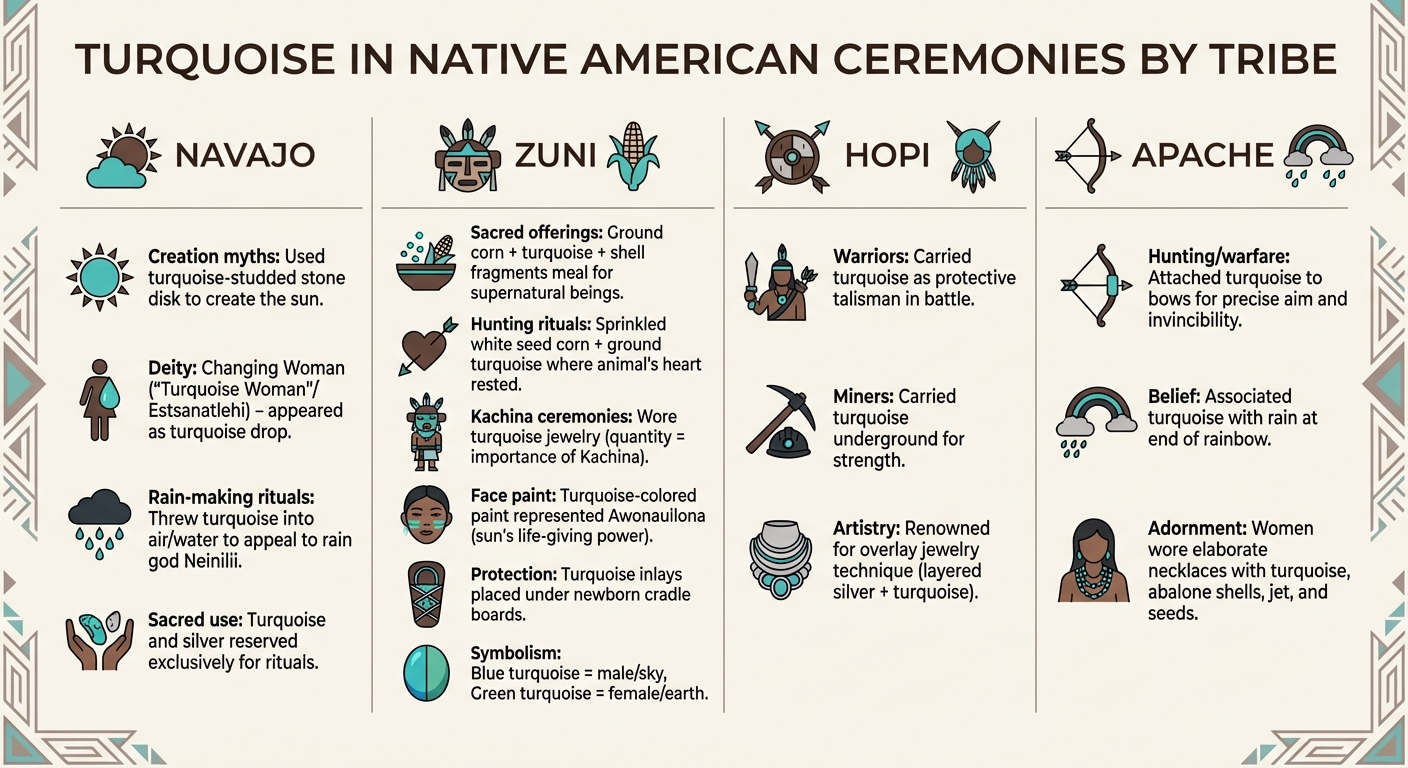
Turquoise Symbolism and Ceremonial Uses Across Native American Tribes
Navajo Creation Stories and Ceremonial Practices
In Navajo creation myths, turquoise holds a deeply symbolic role. According to these stories, the first humans used a turquoise-studded stone disk to create the sun, marking the stone as a life-giving force from the very beginning.
Central to Navajo spiritual beliefs is Changing Woman, also known as "Turquoise Woman" or Estsanatlehi. In some versions of the creation story, she first appeared as a drop of turquoise or a figure made entirely of the stone. Her connection to turquoise cemented its sacred status in Navajo culture.
Turquoise also played a role in Navajo ceremonies, particularly those involving rain-making. Medicine men would throw turquoise into the air or water to appeal to the rain god, Neinilii, or the Wind Spirits. Historically, turquoise and silver pieces were reserved exclusively for these sacred rituals.
Zuni Ceremonial Applications
For the Zuni people, turquoise was woven into life's significant moments. One important tradition involved a sacred meal made of ground corn, turquoise, and shell fragments, offered to supernatural beings during ceremonies. This offering was believed to nourish the spirit world.
Hunting rituals also reflected the Zuni's spiritual connection to turquoise. After a successful hunt, they would sprinkle a mixture of white seed corn and finely ground turquoise where the animal's heart had rested, leaving beads or turquoise dust at the site to ensure an abundance of future game. Professor Meldan Tanrisal highlights this connection:
"The blue-green stone has occupied an important place almost in every aspect of the lives of most Southwestern Indians, both prehistoric and modern."
Turquoise was also prominent in Zuni Kachina ceremonies, which honored deities linked to rain and the afterlife. Participants wore turquoise necklaces, bracelets, and earrings, with the quantity of turquoise symbolizing the importance of the specific Kachina. Turquoise-colored face and body paint represented Awonauilona, the supreme life-giving power of the sun. Even newborns were protected spiritually by placing turquoise inlays under their cradle boards.
Hopi and Apache Ceremonial Uses
The Hopi and Apache tribes had their own unique ways of integrating turquoise into their spiritual practices. For Hopi warriors, turquoise served as a protective talisman during battles, while miners carried the stone underground for strength.
Among the Apache, turquoise was closely tied to hunting and warfare. Hunters and warriors attached pieces of turquoise to their bows, believing it would sharpen their aim and enhance their abilities. As T. Skies describes:
"The Apaches associated turquoise with rain at the end of the rainbow. They attached pieces to their bows to become precise and invincible hunters and warriors."
Apache women often adorned themselves with elaborate necklaces featuring strands of turquoise combined with abalone shells, jet, and seeds. Meanwhile, the Hopi became renowned for their overlay jewelry technique, layering silver and turquoise to create intricate ceremonial designs that were as much spiritual as they were artistic.
These varied ceremonial uses highlight turquoise's deep spiritual meaning across different tribes, setting the stage for its role in healing and sacred art.
Turquoise in Healing Practices and Sacred Art
Healing Ceremonies and Energy Restoration
Among Southwestern tribes, medicine men often carried turquoise in sacred bundles, believing it held powerful healing energy. Referred to as the "living stone", turquoise was thought to enhance strength and vitality, helping individuals regain their natural balance and well-being.
The Pima Indians believed turquoise had the power to provide the strength needed to combat diseases. Similarly, Zuni healers crafted animal fetishes adorned with turquoise inlays, which were believed to offer protection, bring luck, and aid in curing illnesses. These small carvings were seen as spiritual tools, channeling the stone's energy to those in need of healing.
Sand Paintings and Ritual Art
Turquoise wasn’t just used for direct healing; it also played a significant role in sacred art, serving as a link between the physical and spiritual worlds.
In Navajo healing ceremonies, medicine men used turquoise in sand paintings to symbolize the spiritual realm. As M. Ali Zaid notes:
"These paintings, created by medicine men, are believed to attract spiritual powers and aid in healing"
. The inclusion of turquoise in these intricate, temporary works of art was believed to establish a connection with ancestors and higher powers, facilitating spiritual communication.
Beyond sand paintings, turquoise was integral to other ceremonial objects like prayer sticks, which were used to channel spiritual blessings. Zuni artisans became particularly skilled in incorporating turquoise into their ritual art, adorning limestone figures and carving amulets. They used blue turquoise to represent male or sky energy and green turquoise to symbolize female or earth energy. These objects weren’t merely decorative; they played active roles in ceremonies. For instance, turquoise-inlaid cups filled with a mixture of turquoise and cornmeal were used as sacred offerings.
Turquoise in Contemporary Native American Jewelry
Connecting Heritage with Modern Design
Contemporary Native American jewelry masterfully blends centuries-old traditions with modern design elements. Navajo and Zuni artisans continue to refine techniques like needlepoint, sand casting, and mosaic inlay, turning ancestral practices into wearable works of art.
A striking example of this evolution is the work of Navajo artist Raymond C. Yazzie. In 2012, he created a stunning ring featuring coral, Lone Mountain and Orvil Jack turquoise, opal, and sugilite, all set in 14-karat gold. This piece was displayed at the "Glittering World" exhibition (2014–2016) at the National Museum of the American Indian in New York. It serves as a testament to how traditional materials can be reimagined into modern luxury. Kevin Gover, Director of the museum, eloquently noted:
"The ability to take traditional forms and make it contemporary is a clear expression of how native people have transitioned from their traditional cultures into a world that is very different, yet they have managed to retain their cultural identity."
For many Indigenous families, turquoise jewelry is more than just an accessory; it’s a cherished heirloom that preserves cultural heritage. Wearing turquoise often symbolizes a connection to tribal history and spiritual beliefs, while also keeping alive its reputation as a protective stone. The preference for natural, untreated turquoise underscores its deep connection to "Mother Earth" and its unaltered beauty.
This seamless fusion of tradition and contemporary design continues to inspire modern jewelry makers and retailers.
Natural Stone Jewelry at LaCkore Couture

Modern brands like LaCkore Couture carry forward the legacy of turquoise by crafting jewelry that honors its sacred heritage while embracing contemporary aesthetics. LaCkore Couture (https://lackorecouture.com) specializes in pieces made from turquoise, gold, and silver - materials that resonate with the quality and individuality celebrated in traditional Native American craftsmanship.
Each piece in their collection highlights the raw beauty of natural materials. Whether it’s a turquoise-accented necklace or a bracelet featuring mixed stones, their designs connect ancient symbolism with modern style. For those drawn to turquoise’s protective aura and timeless appeal, choosing handcrafted jewelry made in the USA ensures both authenticity and respect for the stone’s cultural significance.
Conclusion
For over 7,000 years, turquoise has been a bridge between the physical and spiritual worlds, symbolizing the sacred connection between the sky and the earth. From its use in ancient rain-making rituals to its role in modern healing practices, this "fallen sky stone" carries a protective energy that continues to resonate across generations.
Today, turquoise remains a source of inspiration, blending ancient traditions with modern artistic expression. Indigenous artisans, in particular, honor their heritage by crafting jewelry that reflects both their ancestral roots and contemporary creativity. As Navajo jeweler Lee Yazzie beautifully put it:
"I discovered why the Navajos considered turquoise to be sacred - everything is sacred in this life."
The stone's natural shifts in color, from vivid blue to earthy green, reflect its dynamic, almost living nature. With less than 5% of turquoise mined globally meeting the gem-quality standard to be used untreated, natural turquoise jewelry not only showcases its raw, unaltered beauty but also preserves its deep connection to the natural world.
This timeless legacy continues to inspire modern craftsmanship. Wearing turquoise is more than an aesthetic choice - it’s a way to connect with centuries of tradition, protection, and symbolism. At LaCkore Couture, contemporary designs celebrate this heritage, blending ancestral meanings with fresh artistry to keep the sacred history of turquoise alive in every piece.
FAQs
How is turquoise incorporated into modern Native American jewelry?
Turquoise remains a cornerstone of modern Native American jewelry, often paired with silver to create striking pieces such as necklaces, bracelets, rings, earrings, and pendants. These creations beautifully merge traditional symbols and craftsmanship with contemporary aesthetics, resulting in designs that carry both depth of meaning and enduring appeal.
Beyond its eye-catching color, turquoise holds deep spiritual value. Many believe it offers protection, promotes healing, and brings positive energy to those who wear it. Native American artisans continue to honor their heritage through jewelry that highlights the beauty and cultural significance of this cherished stone.
What role does turquoise play in Navajo creation stories?
Turquoise plays a deeply spiritual role in Navajo creation stories. According to tradition, the First Man and First Woman used this sacred stone to create the sun. It’s also closely associated with Changing Woman, a key figure in Navajo mythology who embodies life, renewal, and the tribe’s bond with rain and higher powers. Even today, turquoise remains a symbol of protection, guidance, and harmony within Navajo culture.
Why is turquoise seen as a protective stone in Native American culture?
Turquoise holds a special place in Native American traditions, often seen as a protective stone deeply tied to nature. Known as a living stone, it embodies the essence of the sky and water - two elements essential to life and harmony. Many tribes regard turquoise as a powerful shield against negative energy, a guardian of health, and a safeguard for the wearer.
The stone's striking blue-green shades are believed to carry spiritual meaning, symbolizing balance, renewal, and a connection to higher powers. For generations, turquoise has played a vital role in ceremonies and been cherished as a talisman, underscoring its lasting significance as a source of protection and well-being.