Skip to content




Synthetic, Simulated, and Natural Gemstones Explained
When buying gemstones, it’s crucial to understand the three main types: natural, synthetic, and simulated. Each has distinct origins, properties, and price points, which can significantly impact your decision:
- Natural gemstones: Formed over millions of years within the Earth. They are rare, expensive, and often retain resale value.
- Synthetic gemstones: Lab-created stones that are chemically and physically identical to natural ones. They are more affordable and ethically sourced but have lower resale value.
- Simulated gemstones: Made from materials like glass or cubic zirconia to mimic the appearance of natural stones. They are the cheapest option but lack durability and resale value.
Key takeaway: Natural stones are best for investment or heirloom pieces, synthetic gems are ideal for affordable fine jewelry, and simulated stones work well for budget-friendly fashion jewelry.
| Feature | Natural | Synthetic | Simulated |
|---|---|---|---|
| Origin | Earth-formed | Lab-created | Man-made materials |
| Composition | Genuine minerals | Chemically identical | Mimics appearance |
| Price | Highest | Moderate | Lowest |
| Durability | High (varies by gem) | High | Variable |
| Resale Value | High | Low | None |
Knowing these differences helps you make informed choices based on your budget, style, and needs.
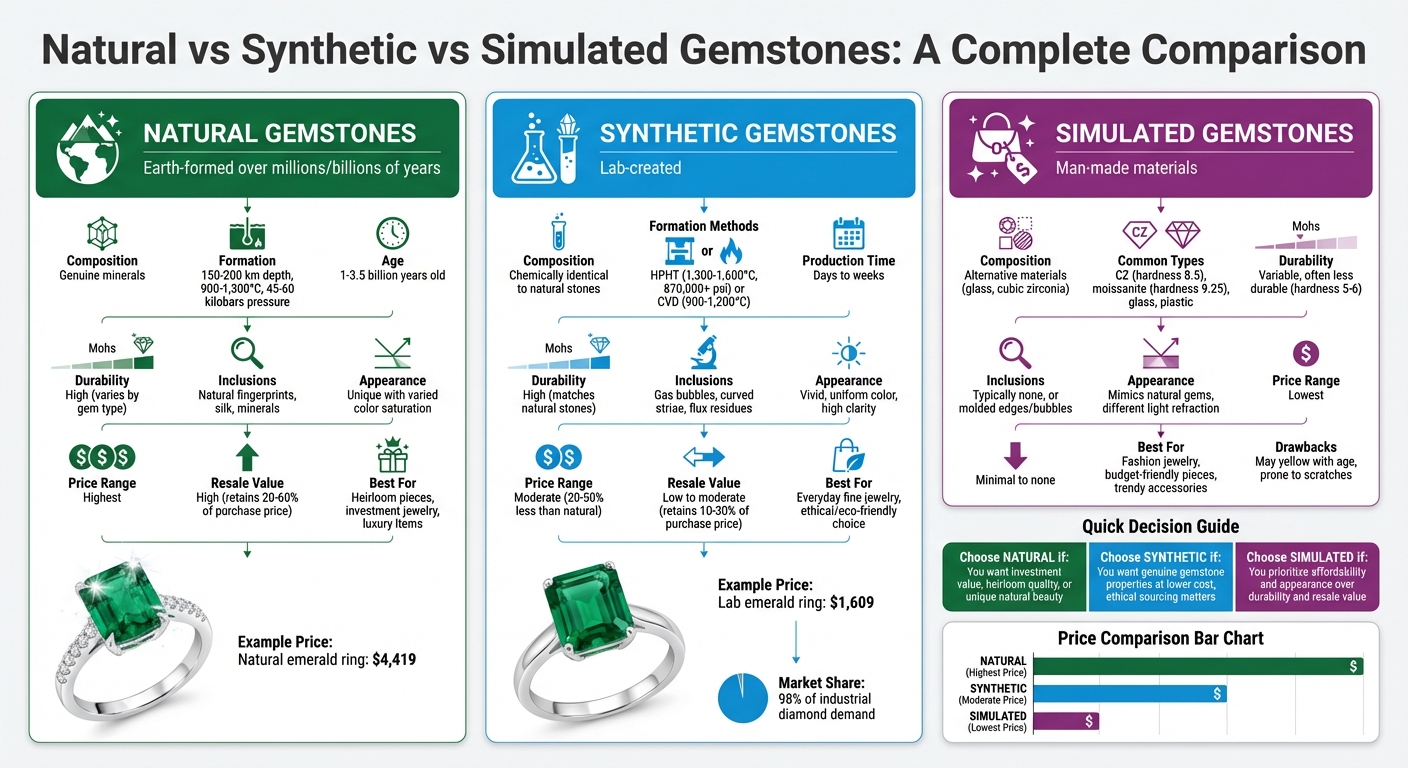
Natural vs Synthetic vs Simulated Gemstones Comparison Chart
Natural Gemstones: Characteristics and Value
How Natural Gemstones Form
Natural gemstones are the result of millions or even billions of years of geological processes deep beneath the Earth's surface. These minerals are shaped under intense heat and pressure, giving them their distinctive chemical structures. For instance, diamonds are formed at depths of 150–200 km (93–124 miles), where temperatures soar to 900–1,300°C (1,652–2,372°F) and pressures reach 45–60 kilobars - conditions about 50,000 times higher than the atmospheric pressure at sea level. Most diamonds we see today are between 1 billion and 3.5 billion years old.
These gemstones don’t just surface on their own. Instead, they are brought closer to the Earth's crust by rapid volcanic eruptions, which create "pipes" of kimberlite or lamproite rock. Interestingly, only about 1 in every 200 kimberlite pipes contains diamonds of gem quality. This rarity is a big part of what makes natural gemstones so valuable. Unlike lab-grown stones, natural gems often have unique inclusions - tiny imperfections that serve as proof of their authenticity. These formation processes are what give natural gemstones their distinct beauty and character.
Common Natural Gemstones
The Earth's natural processes produce a variety of gemstones, each with its own appeal. Some of the most sought-after include diamonds, rubies, sapphires, and emeralds. Diamonds are celebrated for their unparalleled hardness and brilliance, while rubies and sapphires - both types of corundum - are admired for their vivid colors and durability. Emeralds, with their iconic green hue, have a hardness of 7.5–8 on the Mohs scale, but they are more likely to contain inclusions compared to other precious stones.
The colors in natural diamonds are influenced by specific impurities or structural defects. For example, nitrogen creates yellow or brown hues, boron gives diamonds a blue tint, and exposure to natural radiation can result in green diamonds. Additionally, about 25% to 35% of natural diamonds exhibit fluorescence under ultraviolet light. Gemologists can often identify natural diamonds by their octahedral crystal shape, a feature that helps differentiate them from lab-grown alternatives.
Why Natural Gemstones Cost More
Several factors contribute to the high price of natural gemstones. First, they are finite resources - the Earth only produced a limited supply over billions of years. Extracting these stones is a challenging and costly process, requiring specialized equipment, skilled labor, and significant investment. The combination of scarcity and the expense of mining naturally drives up their value.
Natural gemstones also tend to hold their worth in the resale market. They typically retain 20–60% of their purchase price, compared to the much lower 10–30% for lab-created stones. Their unique inclusions and color variations make each stone truly one-of-a-kind, which is a quality collectors and investors cherish. Beyond financial value, there’s an emotional appeal: owning a gemstone shaped by nature over eons carries a sense of wonder and significance that synthetic stones can’t replicate. This is why natural gemstones remain the top choice for luxury and heirloom jewelry, treasured for generations.
Synthetic Gemstones: Lab-Created Alternatives
What Synthetic Gemstones Are
Synthetic gemstones are lab-made materials that replicate the chemical composition, crystal structure, and physical properties of natural gems. The Gemological Institute of America (GIA) defines synthetic gems as:
"A synthetic gem is a man-made material with essentially the same chemical composition, crystal structure and optical and physical properties as the natural gem material."
Unlike simulants, which mimic the appearance of natural gems without sharing their chemistry, synthetic gemstones are genuine counterparts to their natural versions. For instance, a lab-grown sapphire is chemically identical to a natural sapphire, while cubic zirconia, often mistaken for diamond, is only a simulant and lacks the same chemical structure.
Now, let’s explore how these lab-created gems are crafted to replicate natural processes.
How Labs Create Synthetic Gemstones
Scientists replicate Earth's natural conditions to produce synthetic gemstones using techniques such as melt, solution, and vapor deposition processes.
For synthetic diamonds, two main methods dominate:
- High Pressure, High Temperature (HPHT): This process mimics the extreme conditions deep within the Earth, using temperatures between 1,300–1,600°C (2,372–2,912°F) and pressures exceeding 870,000 psi.
- Chemical Vapor Deposition (CVD): In this method, carbon atoms are deposited onto a diamond seed inside a vacuum chamber heated to 900–1,200°C (1,652–2,192°F).
Other gemstones are created using different methods, such as Flame Fusion (Verneuil Process) for rubies and sapphires, hydrothermal growth for emeralds and quartz, and flux growth for alexandrites. By 2025, advancements in synthetic diamond technology have enabled the production of stones weighing up to 125 carats.
These techniques not only replicate nature but also offer practical advantages.
Benefits of Synthetic Gemstones
The controlled environment of labs allows synthetic gemstones to be more affordable and ethically sourced. For example, rough synthetic corundum, used in rubies and sapphires, can cost just a few cents per carat, compared to the steep prices of natural gems that can reach hundreds or thousands of dollars. Additionally, synthetic gemstones are conflict-free, have a smaller environmental footprint compared to mining, and often feature fewer inclusions with more consistent and vibrant colors.
The ability to produce gems "on demand" gives jewelers the flexibility to create pieces with precise color and clarity specifications - qualities that may be rare or unattainable in natural stones. Synthetic diamonds now meet about 98% of the global demand for industrial-grade diamonds, and some lab-grown diamonds even boast thermal conductivity up to 7.5 times higher than copper. While synthetic gems may not hold their resale value like natural ones, their combination of beauty, affordability, and ethical production has made them a favorite choice in modern jewelry design.
Simulated Gemstones: Budget-Friendly Options
Simulated gemstones are a cost-effective way to enjoy the beauty of natural gems without breaking the bank. While synthetic gemstones are lab-created replicas with identical chemical properties to their natural counterparts, simulated gems focus solely on mimicking the look of the real thing.
What Simulated Gemstones Are
Simulated gemstones are designed to replicate the appearance of natural gems but lack their chemical and physical characteristics. According to gemologist Gavin Clarke, simulants are stones that imitate the visual appeal of natural gems but differ in their optical, physical, and chemical properties.
Here’s the key difference: synthetic gems are chemically identical to natural stones, while simulants are entirely different materials that merely look similar. For instance, cubic zirconia sparkles like a diamond but is made from zirconium dioxide. Gemologists can easily distinguish simulants because their refractive index, hardness, and density don’t align with the properties of the gems they imitate.
Types of Simulated Gemstones
Cubic zirconia (CZ) is the most popular diamond simulant. It boasts a Mohs hardness of 8.5 and offers stunning clarity at a fraction of the cost of a diamond. Another option, synthetic moissanite, scores 9.25 on the Mohs scale and has over twice the fire of a natural diamond. However, its brilliance in larger sizes can sometimes reveal its simulant nature.
Other simulants include materials like glass and plastic, which can be crafted in virtually any color to mimic gems such as emeralds, sapphires, or amethysts. Synthetic spinel is another common option, often used to replicate stones like sapphire, aquamarine, and peridot due to its ability to capture accurate colors. Additionally, some simulants are assembled stones, such as doublets or triplets, where a thin layer of precious material is fused to a less expensive backing to mimic the appearance of high-value gems. Each type of simulant has its own strengths and weaknesses, making them suitable for different purposes.
Pros and Cons of Simulated Gemstones
One of the biggest advantages of simulated gemstones is their affordability. They’re an attractive choice for fashion jewelry collections or even temporary engagement rings, offering the look of precious gems without the high price tag or the environmental and ethical concerns of mining or lab production.
However, simulants do have their downsides. Their durability is often lower than natural or synthetic gems. For example, materials like glass or strontium titanate, which typically have a Mohs hardness of 5–6, are prone to scratches and may develop rounded facet edges over time. Cubic zirconia can yellow with age, and moissanite’s double refraction can create a slightly blurry appearance inside the stone compared to a diamond. Additionally, simulants generally hold little to no resale value and don’t increase in worth over time.
For those seeking an affordable way to enjoy the beauty of gemstones, simulants offer a practical solution, but it’s important to weigh their limitations before making a choice.
Comparing the 3 Gemstone Types
Property Differences Between Gemstone Types
When it comes to gemstones, the key distinctions lie in their composition and origin. Natural and synthetic gemstones share the same chemical structure, but their origins differ. Natural stones are formed deep within the Earth, while synthetic ones are grown in controlled lab environments. Simulated gemstones, on the other hand, are crafted from materials like glass or cubic zirconia, designed to mimic the appearance of real gems without replicating their physical or chemical properties.
| Feature | Natural Gemstones | Synthetic Gemstones | Simulated Gemstones |
|---|---|---|---|
| Composition | Formed naturally in the Earth | Chemically identical to natural stones | Made from alternative materials (e.g., glass, CZ) |
| Durability | High (varies by mineral) | High (matches natural stones) | Variable, often less durable |
| Inclusions | Natural "fingerprints", silk, minerals | May show gas bubbles, curved striae, flux residues | Typically none or molded edges, bubbles |
| Appearance | Unique with varied color saturation | Vivid, uniform color, high clarity | Mimics natural gems but refracts light differently |
| Value | Highest due to rarity | Moderate, more affordable alternative | Lowest, ideal for fashion jewelry |
| Resale Value | High; retains value over time | Low to moderate | Minimal to none |
These differences are reflected in the pricing. For instance, a lab-created emerald engagement ring costs around $1,609, whereas the same design featuring a natural emerald is priced at $4,419 - more than double the cost. Similarly, a lab-created ruby solitaire ring is about $689, compared to $1,255 for a natural AA-grade ruby.
These distinctions are not just theoretical; they play a practical role in how experts and buyers differentiate between gemstone types.
How to Tell Gemstone Types Apart
Gemologists rely on tools and expertise to identify a gemstone's origin, often using 10× magnification to examine its unique characteristics. Natural gemstones typically reveal angular inclusions, silk-like patterns, or mineral deposits - evidence of their chaotic formation process. As John Koivula from the GIA famously said:
"Nature plays in a dirty kitchen".
Synthetic gemstones, grown in controlled lab environments, often display curved growth lines, gas bubbles, or flux residues - features rarely found in natural stones. For example, natural jade and amethyst often show unique growth patterns like "Brazil-law twinning", a trait almost never seen in synthetic amethysts produced via hydrothermal methods.
Specialized tools can also help differentiate stones. Thermal testing devices measure heat conductivity to distinguish diamonds from most simulants, though moissanite can be tricky since it also disperses heat efficiently.
For high-value purchases, certification from independent labs like the Gemological Institute of America (GIA) or the American Gem Society (AGS) is crucial. Advanced techniques, such as FTIR spectroscopy, can further verify a gemstone's origin. For instance, this method detects water-related features in natural emeralds and alexandrite, while flux-grown synthetics appear "dry".
These identification methods ensure you know exactly what you're purchasing, especially for significant investments.
Best Uses for Each Gemstone Type
Each type of gemstone serves different purposes, depending on your priorities and budget.
- Natural gemstones are perfect for heirloom and investment pieces. Their rarity and enduring value make them ideal for special occasions and jewelry meant to be passed down through generations.
- Synthetic gemstones are a practical choice for everyday fine jewelry. They offer the same durability as natural stones at a fraction of the cost, making them great for rings, bracelets, and other items that face regular wear. They're also a popular option for those seeking conflict-free and eco-friendly alternatives.
- Simulated gemstones are best for budget-conscious buyers. They're commonly used in costume jewelry, travel accessories, and trendy pieces where style matters more than durability. These stones are a visually appealing option when you want the look of luxury without the financial commitment.
Understanding these distinctions helps you choose the right gemstone for your needs, whether you're investing in a timeless piece or shopping for something stylish and affordable.
Choosing the Right Gemstone
Main Points to Remember
When it comes to gemstones, understanding their categories is key. They fall into three main types based on origin and composition. Natural gemstones are mined from the earth and come with their own unique traits. Synthetic gemstones are lab-created to replicate natural stones in chemical, physical, and optical properties, offering the same durability and sparkle but at a more affordable price. Meanwhile, simulated gemstones are crafted from materials like glass or cubic zirconia to imitate the look of real gems, though they lack the same chemical makeup.
Durability is another critical factor, especially for jewelry you plan to wear daily. For rings or bracelets, aim for stones with a Mohs hardness of 7 or higher to avoid scratches. For example, diamonds score a perfect 10 on the Mohs scale, while rubies and sapphires rank at 9 - both excellent choices for everyday wear. On the other hand, softer stones are better suited for items like earrings or pendants, which experience less wear and tear.
Price often reflects rarity and origin. Natural gemstones are the most expensive, while synthetic ones usually cost 20–50% less, providing a budget-friendly yet high-quality alternative. Simulated gemstones are the most economical choice, ideal for those who want the look without the hefty price tag. This pricing structure is why top designers, including LaCkore Couture, carefully select their materials based on purpose and style.
How LaCkore Couture Uses Natural Gemstones

LaCkore Couture integrates natural gemstones into its handcrafted jewelry to highlight both quality and individuality. The brand uses a mix of precious and semi-precious stones - such as turquoise, quartz, and hematite - to create pieces with unique textures and designs. This approach allows for creativity while keeping many options affordable, with beautiful natural gemstones available for under $100. Each piece is crafted in the USA with meticulous attention to detail and customization, ensuring the jewelry reflects personal style and craftsmanship.
Making Smart Jewelry Choices
Armed with this knowledge, you can make more informed decisions when shopping for jewelry. As noted earlier, your choice between natural, synthetic, and simulated stones will impact both the durability and value of your piece. If you're looking for an heirloom or an investment, natural gemstones are a great option because of their enduring value and distinct natural beauty. For everyday fine jewelry, synthetic stones offer the same durability and brilliance as natural ones, often at a lower cost and with a lighter environmental footprint. If you're after trendy, budget-friendly pieces, simulated stones deliver the desired look without breaking the bank.
Always confirm the details of what you're buying. Ask the seller about the stone's origin and whether it has undergone treatments like heating or irradiation. For high-value purchases, request a certificate from a trusted lab, such as the GIA or AGS, to verify authenticity. Additionally, check the store's return policy - especially for online purchases - to ensure the piece aligns with your lifestyle, preferences, and budget.
FAQs
What ethical factors should I consider when choosing between natural and synthetic gemstones?
When choosing between natural gemstones and synthetic gemstones, there are several ethical considerations to weigh.
Natural gemstones are mined, a process that can lead to issues like habitat destruction, soil erosion, and water pollution. In some regions, mining operations may also involve unsafe labor conditions or even fund conflicts. To make a more responsible choice, consider gemstones that are responsibly sourced or certified as fair trade. These certifications often ensure fair wages, community benefits, and measures to protect the environment.
Synthetic gemstones, created in laboratories, replicate the chemical and physical properties of natural stones. They bypass the large-scale environmental damage caused by mining and usually come with a smaller carbon footprint. That said, their production still requires energy and raw materials. It's worth checking if the lab prioritizes renewable energy or follows sustainable practices.
The most ethical choice comes down to balancing factors like environmental impact, labor rights, and sourcing transparency - values that are at the heart of LaCkore Couture's carefully selected collections of both natural and lab-grown gemstones.
How can I tell if a gemstone is natural, synthetic, or simulated?
To figure out whether a gemstone is natural, synthetic, or simulated, start by taking a closer look at it under magnification. Natural gemstones often have tiny inclusions or irregularities that reflect their natural origins. Their clarity can vary due to how they form in the earth. Synthetic gemstones, while made in a lab, have the same chemical and optical properties as natural ones. However, they often appear more flawless and may show specific growth patterns that are characteristic of lab creation. Simulated stones, designed to mimic real gems, are made from different materials, which can lead to noticeable differences in traits like refractive index, density, or hardness.
If you're still uncertain, it’s a good idea to seek advice from a professional jeweler or gemologist who can provide a precise evaluation. At LaCkore Couture, we pride ourselves on using high-quality materials, including natural stones, to craft jewelry that’s as distinctive as you are.
Why do natural gemstones typically have higher resale value than synthetic or simulated ones?
Natural gemstones often command a higher resale value because of their rarity and the time it takes for them to form - millions of years beneath the Earth’s surface. This natural process makes each gemstone unique, which adds to their desirability. Additionally, trusted certifications and a strong secondary market bolster their appeal, making them a popular choice for those seeking both beauty and long-term value.
On the other hand, synthetic and simulated stones are created in labs and produced in large quantities. While they can be stunning and budget-friendly, they don’t carry the same exclusivity or investment potential as natural gemstones. Their abundance and manufactured origins make them more accessible but less prestigious.