Skip to content




How Streetwear Jewelry Reflects Hip-Hop Culture
Streetwear jewelry has become a powerful expression of identity within hip-hop culture. From its origins in the Bronx during the 1970s to its current collaborations with luxury brands, jewelry in hip-hop tells stories of success, heritage, and individuality. Gold chains, pendants, and rings have evolved from simple symbols of ambition to highly personalized pieces featuring intricate designs, unconventional materials, and cultural references.
Key takeaways:
- Origins: Hip-hop jewelry began as bold, statement-making gold chains in the 1970s, inspired by African heritage and local street trends.
- Evolution: Early styles like Run-DMC’s oversized chains have grown into modern designs featuring diamonds, gemstones, and layered looks.
- Storytelling: Custom pieces now often include personal symbols, family initials, or cultural motifs, highlighting connections to roots and milestones.
- Inclusivity: Affordable options and collaborations with brands like Tiffany & Co. make hip-hop jewelry accessible to a broader audience.
- Modern Trends: Gender norms are shifting, with artists embracing unisex designs, pearls, and creative materials like titanium and enamel.
LaCkore Couture, a U.S.-based brand, exemplifies this evolution with handcrafted jewelry inspired by hip-hop’s boldness and individuality. Their collections combine 18k gold, semi-precious stones, and customizable charm options, offering a balance of style and affordability.
Whether you prefer high-end luxury pieces or modern handcrafted designs, streetwear jewelry transforms personal stories into wearable art.
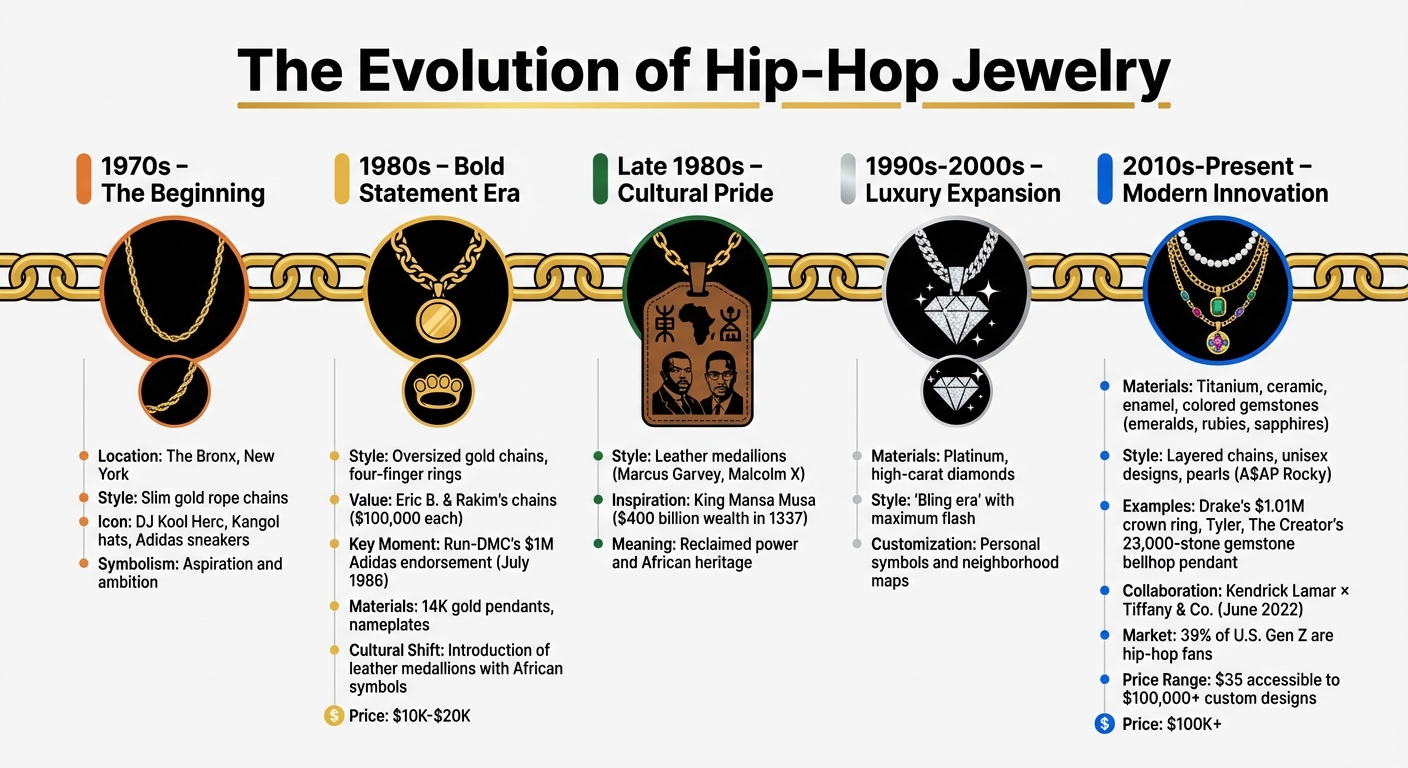
Evolution of Hip-Hop Jewelry from 1970s to Present
The Origins of Streetwear Jewelry in Hip-Hop
Hip-hop took root in the early 1970s in the Bronx, a neighborhood grappling with poverty and hardship. This tough environment gave rise to a bold and statement-driven style, where fashion became a way to project ambition and identity.
DJ Kool Herc was among the first to define this look, sporting slim gold rope chains paired with Kangol hats and Adidas sneakers without laces. For hip-hop pioneers, jewelry quickly became more than just an accessory - it was a symbol of aspiration. While many New Yorkers sold their gold on 47th Street to make ends meet during the recession, hip-hop artists did the opposite. They donned chunky gold pieces to embody the success they aimed to achieve. This daring attitude set the stage for the bold designs that would later define streetwear.
As Elena Romero, author of Fresh Fly Fabulous, put it:
In the 1980s, the way you dressed said more about you than anything else. […] so it had to fit perfectly and it had to define you.
The inspiration for these early styles often came from "street legends" - hustlers and drug dealers who used oversized jewelry to signal their wealth and influence in the urban landscape. These pieces became what Meek Mill would later describe as "trap trophies", representing resilience, success, and street credibility. Customization was a key part of the culture, with gold pendants often featuring personal touches like nameplates or symbols tied to local pride, such as the Mercedes-Benz logo . By the late 1980s, the iconic chains worn by Eric B. & Rakim on the Paid In Full album cover were valued at an estimated $100,000 each.
What started as modest gold ropes in the 1970s evolved into the massive chains made famous by Run-DMC in the mid-1980s . In July 1986, during a performance of "My Adidas" at Madison Square Garden, Run-DMC inspired 40,000 fans to hold up their Adidas sneakers. This moment led to a $1 million endorsement deal and the creation of 14-karat gold pendants shaped like sneakers . Four-finger rings also became iconic, worn by artists like Biz Markie and Big Daddy Kane.
Jewelry wasn’t just about flash - it could also make a statement. By the late 1980s, some artists moved away from flashy gold and embraced leather medallions featuring African silhouettes or images of leaders like Marcus Garvey and Malcolm X. These pieces connected wearers to their African heritage, inspired by historical figures such as King Mansa Musa, whose wealth was estimated at $400 billion at the time of his death in 1337. For many, these accessories symbolized reclaimed power, cultural pride, and triumph over adversity. These early experiments in self-expression laid the foundation for the personalized and bold jewelry designs we see today.
1. Hip-Hop Inspired Streetwear Jewelry
Cultural Significance
Hip-hop jewelry has grown far beyond its origins as a status symbol - it’s now a powerful medium for storytelling. Back in the 1980s, gold chains represented success in the face of adversity. Fast forward to today, and these pieces often carry deeply personal meanings. Artists commission custom designs featuring everything from neighborhood maps to family initials or symbols of childhood memories, creating a tangible connection to their roots. As Vikki Tobak, author of Ice Cold: A Hip-Hop Jewelry History, puts it:
The rise of jewelry mirrored the way hip-hop began to understand and wield its power.
These pieces don’t just tell stories - they celebrate milestones and personal achievements. Many modern designs also pay homage to heritage, incorporating African symbols, Caribbean patterns, and Latin influences, reflecting a deep connection to ancestry. This cultural depth has inspired the creative use of materials in today’s designs.
Design and Materials
Modern hip-hop jewelry takes historical symbolism and reinvents it with contemporary materials. Gold remains a staple - whether 14-karat or 18-karat - but it’s now often paired with unconventional elements like titanium, ceramic, enamel, and vibrant stones such as spinel and tourmaline. There’s also been a move away from exclusively white diamonds, with bold designs now featuring emeralds, rubies, and sapphires.
Layering is a hallmark of hip-hop jewelry. Artists stack chains of different lengths to create a textured, dynamic look. For instance, a typical combination might include a short diamond chain, a mid-length pendant, and a long Cuban link chain. Gender norms are also being redefined. Artists like A$AP Rocky have embraced pearls and unisex designs, blending timeless materials with modern streetwear aesthetics.
Customization Options
Personalization has become a cornerstone of hip-hop jewelry, with custom pieces showcasing both creativity and craftsmanship. High-profile examples include Drake’s $1.01 million 14-karat crown ring and a necklace featuring 42 diamonds, each representing a significant moment in his life.
The demand for unique, custom designs has pushed craftsmanship to new heights. Take Tyler, The Creator’s custom bellhop pendant as an example - it features 23,000 hand-set stones and was displayed at the American Museum of Natural History’s "Ice Cold" exhibit in 2024. As Vikki Tobak explains:
Hip-hop's tradition of individuality was expressed through customisation. To have something nobody else has... is to show the world who you are.
Today’s custom pieces often include intricate 3D figures, moving components, or even light-up features, turning jewelry into wearable art.
Modern Appeal
The mainstream appeal of hip-hop jewelry is undeniable, with 39% of U.S. Gen Z identifying as avid hip-hop fans. Once excluded from luxury spaces, hip-hop culture now collaborates with high-end brands. A standout moment came in June 2022, when Kendrick Lamar performed at Glastonbury wearing a custom diamond-encrusted "Crown of Thorns" headpiece designed by Tiffany & Co., blending streetwear aesthetics with luxury craftsmanship.
Affordable, entry-level options have also widened access to hip-hop-inspired jewelry. Streetwear brands now offer smaller diamond chains and mini pendants that capture the essence of the style without the hefty price tags. This balance of accessibility and innovation ensures hip-hop jewelry continues to evolve and remain relevant. The current trends set the stage for further exploration of the market’s opportunities and challenges.
2. LaCkore Couture's Handcrafted Collections
Cultural Significance
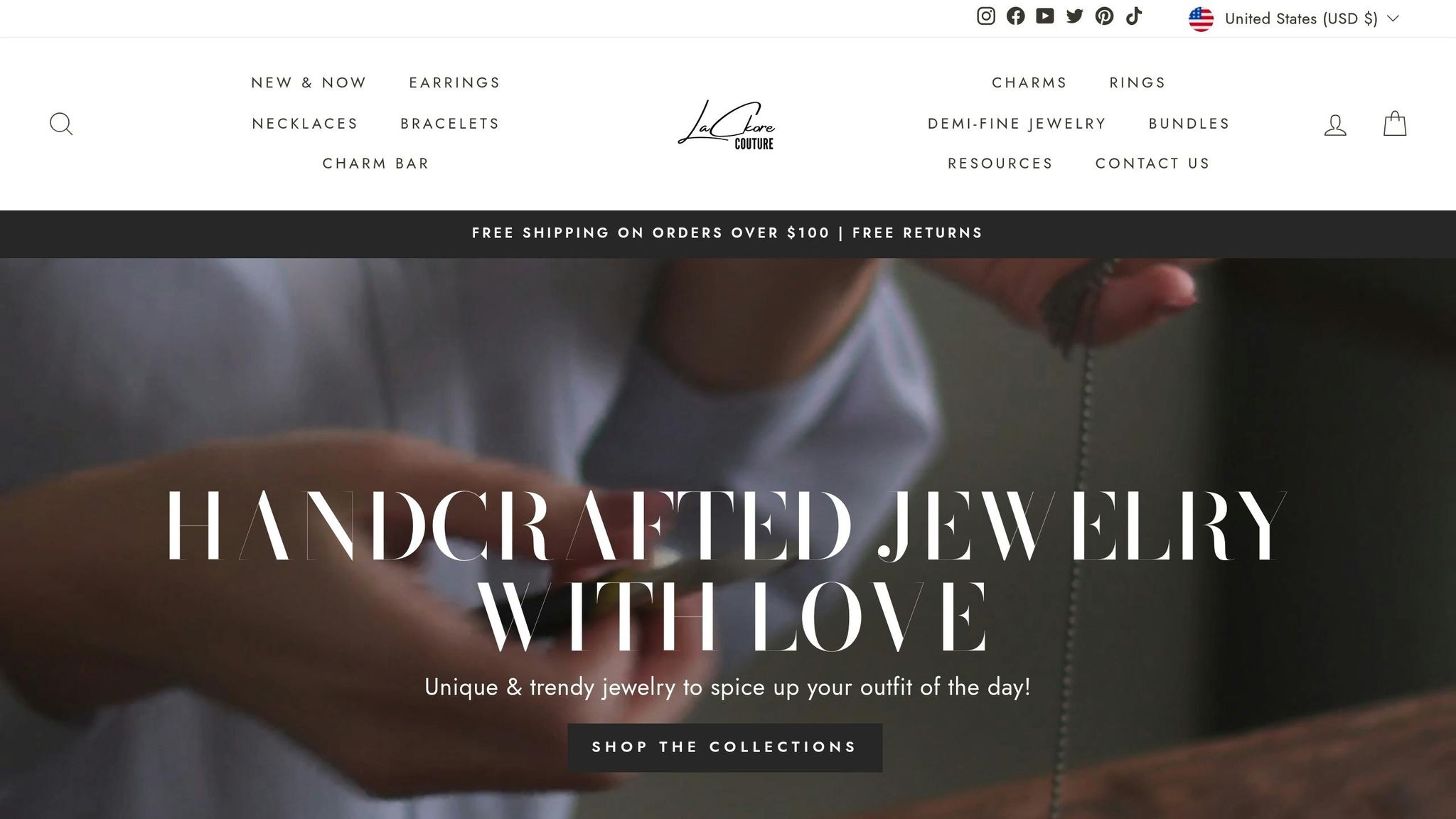
LaCkore Couture captures the bold essence of hip-hop through its striking jewelry designs. Drawing inspiration from the 1980s - a transformative era for hip-hop fashion - the brand reimagines iconic styles like oversized hoops, gold disc earrings, and chunky chainlink necklaces that defined the time. As the brand puts it:
"Jewelry from the 1980s was all about bold expression... jewelry became a way to express yourself."
Every piece is meticulously handcrafted in the United States, reflecting values of individuality and empowerment - principles deeply rooted in hip-hop culture [22, 23]. The collections are designed with the mantra of "showing up and showing out", celebrating the movement's history while pushing modern style boundaries. This commitment to honoring hip-hop’s legacy is evident in every detail, from material choices to the overall design philosophy.
Design and Materials
The "Rockstar" stacks exemplify the brand’s creative approach, blending 18k gold with striking stones like hematite, jasper, obsidian, and howlite. Gold, an enduring symbol of status in hip-hop, serves as the foundation for these collections, reinforcing its cultural significance. Layering is central to LaCkore Couture’s aesthetic, encouraging customers to stack necklaces and bracelets for a layered, textured look that resonates with hip-hop’s dynamic style [22, 23].
Even the product names, like the "Crazy Sexy Cool Necklace", nod to the influence of '90s hip-hop and R&B, seamlessly connecting music history with contemporary streetwear. The pieces cater to a wide range of tastes, from understated to bold statement designs. One customer, Hallie M. from Los Angeles, gave a statement necklace a glowing 5-star review, praising its "super well made and high quality" craftsmanship and "gorgeous stones".
Customization Options
Customization lies at the heart of LaCkore Couture’s design philosophy, echoing hip-hop’s tradition of personalization and remixing. The brand’s Charm Bar allows customers to create one-of-a-kind necklaces and bracelets by choosing specific bases and charms [22, 23]. Charms range from initials and zodiac signs to tarot cards and symbolic pendants, empowering wearers to tell their own stories. This concept mirrors the way hip-hop artists commission custom jewelry to reflect their personal narratives. As Vikki Tobak explains:
"Hip-hop has a culture of remixing and customization... those two things as well relate to the jewelers."
Adding to its appeal, each piece is backed by a Lifetime Guarantee, emphasizing durability and quality over fast fashion [22, 23]. For those looking to embrace the hip-hop aesthetic, the brand offers DIY guides to help style layered looks and pair jewelry with streetwear, making the bold spirit of hip-hop accessible to everyone.
Strengths and Weaknesses
Streetwear jewelry rooted in hip-hop culture offers a fascinating balance between the opulence of traditional designs and the artistic flair of modern handcrafted collections. This dynamic highlights shifts in priorities - authenticity, quality, and personal expression.
Traditional hip-hop jewelry has long been a symbol of status and success, often crafted from solid gold, platinum, and high-carat diamonds. As Donovan Barnett explains:
Jewelry in rap has always symbolized escaping that struggle. As Meek Mill pointedly called it, jewelry is a 'trap trophy'
. Back in the 1980s, a gold chain might have cost $10,000 to $20,000. Today, similar high-end custom pieces often surpass $100,000. These designs, created by master jewelers, cater to those with deep pockets, reinforcing their exclusivity. This traditional approach sets the stage for a fresh take on hip-hop jewelry.
Modern streetwear collections, like those from LaCkore Couture, take a different path, focusing on storytelling and artistic expression over sheer extravagance. Designer Martine Ali describes this shift:
I want to give the artist something that feels a little disassembled, something a little bit more cool, something a little more low‐key
. LaCkore's handcrafted pieces are priced within a mid-range bracket, from around $35 to $97, and come with a Lifetime Guarantee. Their Charm Bar allows for modular customization, blending luxury with accessibility and enabling wearers to adjust their style daily.
Material quality also showcases a clear trade-off. Traditional hip-hop jewelry relies on solid 10k–14k gold and high-carat diamonds to present a bold, luxurious image. In contrast, LaCkore uses 18k gold paired with semi-precious stones like hematite, jasper, and obsidian. While this approach delivers trendy, artisan-crafted pieces, it doesn't match the high-luxury appeal sought by artists such as Slick Rick, who has said:
Big pieces are my thing. On stage, I want the concertgoers and supporters to see and feel my pieces from the farthest seat in the house
.
Here’s a side-by-side look at the differences:
| Aspect | Traditional Hip-Hop Jewelry | LaCkore Couture Collections |
|---|---|---|
| Authenticity | Status symbols representing escape from struggle | Artistic expression and personal storytelling |
| Craftsmanship | Custom "remixing" by elite jewelers | Handcrafted artisan work made in the USA |
| Material Quality | Solid gold, platinum, and high-carat diamonds | 18k gold with semi-precious stones |
| Customization | One-of-a-kind commissioned pieces | Modular Charm Bar with mix-and-match options |
| Accessibility | High-end pieces often exceeding $100,000 | Pieces ranging from approximately $35 to $97 with free shipping over $100 |
| Guarantee | Typically none | Lifetime Guarantee |
Both styles celebrate hip-hop’s essence: individuality. As Vikki Tobak notes:
Hip-hop's translation of individuality was expressed through customisation. To have something that no one else has... is to show the world who you are
. Ultimately, the choice between traditional luxury and modern handcrafted storytelling reflects the evolution of hip-hop itself.
Conclusion
Streetwear jewelry and hip-hop culture share a deep connection, rooted in bold self-expression and creativity. Emerging from the vibrant streets of 1970s New York, where artists thrived under immense pressure, jewelry became a powerful visual language for hip-hop. As Slick Rick famously said:
"Every culture celebrates its creative contributions in its own ways. Black culture goes above and beyond. Going big is just how we roll. This is true of our music, our dance, our sense of fashion . . . and our jewelry."
From the iconic gold rope chains of the past to today’s intricate, handcrafted designs, hip-hop jewelry has evolved while staying true to its essence. It’s a blend of bold tradition and modern artistry, reflecting the culture’s ability to adapt without losing its roots. This evolution is seen in everything from Megan Thee Stallion's $425,000 "Hot Girl" necklace to more accessible, customizable pieces like those offered by LaCkore Couture's Charm Bar.
LaCkore Couture continues to honor the spirit of hip-hop with collections that celebrate individuality and creativity. By focusing on artisan-crafted designs and mix-and-match customization, the brand captures the genre's rebellious energy, offering jewelry that tells personal stories while remaining affordable and expressive.
Whether you lean toward classic luxury or contemporary handcrafted pieces, streetwear jewelry turns self-expression into wearable art, allowing everyone to showcase their unique identity.
FAQs
How has hip-hop jewelry transformed from its early days to today?
Hip-hop jewelry has transformed significantly since its early days, where it served as a bold declaration of street credibility and success. Back then, oversized chains, flashy pendants, and chunky rings were more than just accessories - they were symbols of power, resilience, and unapologetic self-expression within the hip-hop scene.
As the years passed, these iconic pieces grew to represent much more. Today, hip-hop jewelry intertwines personal branding with a celebration of cultural heritage, while also embracing the world of luxury and artistry. Drawing from African royal traditions and merging with high-fashion aesthetics, modern designs highlight intricate craftsmanship and individuality. It’s become a striking emblem of identity and creative expression.
What materials and trends define modern hip-hop jewelry?
Modern hip-hop jewelry stands out with its use of high-end materials like gold, diamonds, silver, and natural stones. Gold, often crafted into bold chains or eye-catching pendants, represents both wealth and cultural identity. Diamonds - commonly called "ice" - bring a signature sparkle to standout pieces like watches and medallions. Meanwhile, mixed-metal designs and natural stones are becoming increasingly popular, giving a new twist to timeless styles.
Today’s styles focus on oversized, personalized pieces that highlight individuality. Layered chains, chunky rings, and custom pendants often feature personal branding or cultural motifs. The growing trend of mix-and-match collections lets wearers experiment with unique combinations, blending streetwear vibes with luxury elements. These evolving designs ensure hip-hop jewelry continues to make a strong impact in both music culture and contemporary fashion.
How does hip-hop jewelry allow for personal expression through customization?
Customization has always been at the heart of hip-hop jewelry, turning each piece into a deeply personal statement rather than just a flashy status symbol. Whether it’s initials, birthdates, or meaningful symbols, artists have used custom designs to showcase their identity and share their stories. Take the iconic “Jesus piece,” made famous by The Notorious B.I.G. - it’s been reinvented time and time again with unique engravings, intricate stone patterns, and custom settings, all tailored to reflect personal tastes and beliefs.
LaCkore Couture carries this tradition forward with their handcrafted jewelry, proudly made in the USA. They offer customization options using materials like gold, silver, and natural stones, allowing for necklaces, bracelets, or rings to be designed to match the wearer’s style and personality. Each piece celebrates hip-hop’s enduring legacy of individuality and self-expression.