Skip to content



Sterling Silver Alloys: What 925 Really Means
925 means 92.5% silver by weight - not tarnish-proof jewelry or a promise of quality. When I shop for sterling, I check which parts are silver, what other metals are used, and whether the piece has plating.
Here’s my short checklist:
- Know the metal: Fine silver is typically 99.9% silver; sterling is at least 92.5%. Silver-plated pieces have a silver coating over another metal.
- Check the build: Added metals, thickness, joints, and clasps affect wear. A 925 stamp alone doesn’t prove silver content or mean nickel-free.
- Match care to the piece: Tarnish is a surface reaction, not proof of fake silver. I store jewelry dry and check how to clean silver jewelry before using polish or cleaners on stones and finishes.
My rule: <u>read beyond the stamp</u>. I look for written details on materials, dimensions, weight, coatings, and care - not just “925.”
What's in Sterling Silver?
925 Silver vs. Fine Silver vs. Silver Plating
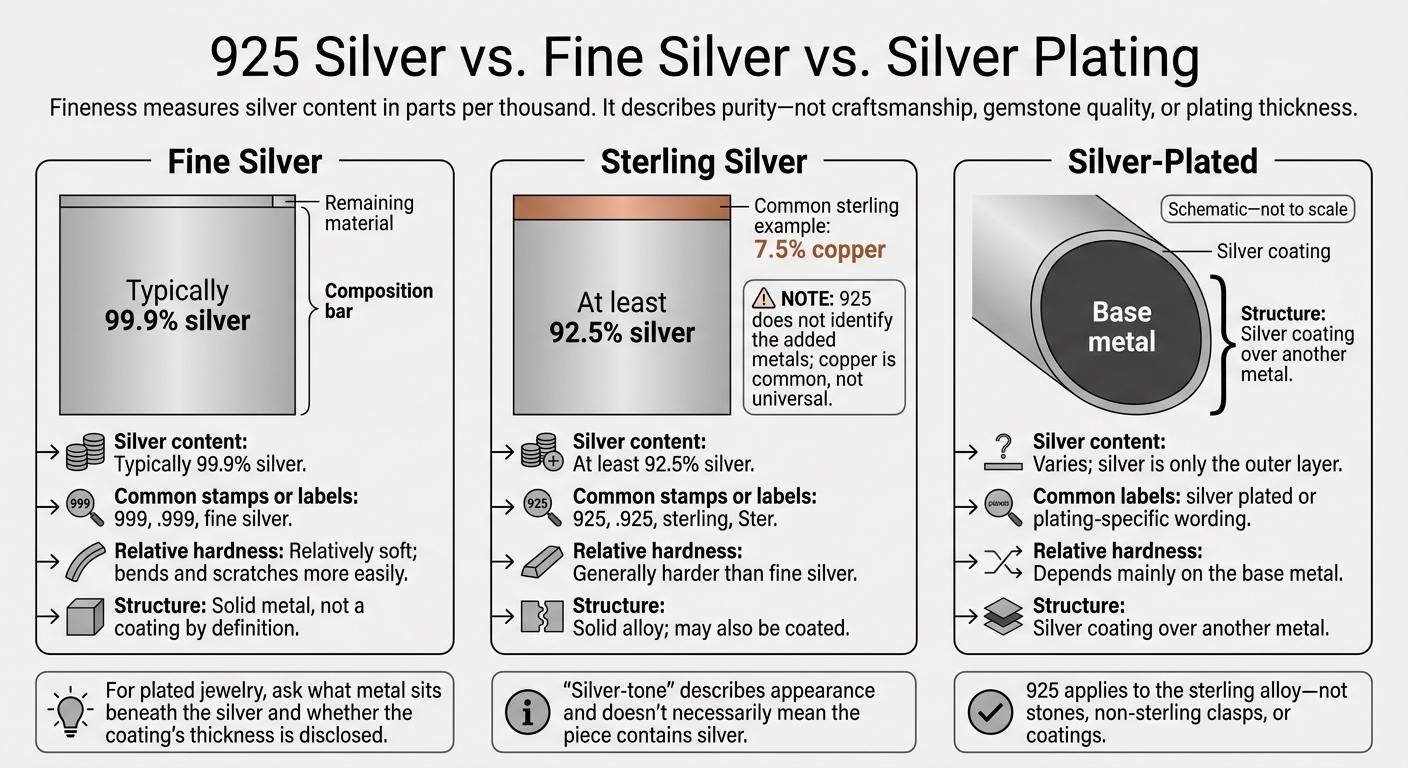
An alloy is a mix of metals. Fineness measures silver content in parts per thousand. It tells you about purity - not craftsmanship, gemstone quality, or plating thickness. Understanding sterling silver starts with the metal mix.
925 Means 92.5% Silver
925, .925, and sterling are common sterling silver marks. They indicate silver content but don't identify the other metals in the alloy. That number applies ONLY to the sterling alloy - not stones, non-sterling clasps, or coatings.
Fine Silver vs. Sterling Silver vs. Silver Plating
| Material | Silver content | Common stamps or labels | Relative hardness | Solid metal or plated |
|---|---|---|---|---|
| Fine silver | Typically 99.9% | 999, .999, fine silver | Relatively soft; bends and scratches more easily | Solid metal, not a coating by definition |
| Sterling silver | At least 92.5% | 925, .925, sterling, Ster. | Generally harder than fine silver | Solid alloy; may also be coated |
| Silver-plated | Varies; silver is only the outer layer | silver plated or plating-specific wording | Depends mainly on the base metal | Silver coating over another metal |
For plated jewelry, ask what metal sits beneath the silver and whether the seller discloses the coating's thickness. Plating tells you nothing about the base metal's purity. “Silver-tone” describes appearance and doesn't necessarily mean the piece contains silver.
Solid sterling and silver plating are different materials. With sterling, the next detail to check is which metals make up the alloy.
Copper and Other Added Metals
Sterling is often described as 92.5% silver and 7.5% copper. Copper adds hardness and strength, but it can also contribute to oxidation and tarnish.
Other metals may help with casting or tarnish resistance. Palladium-containing silver alloys offer better tarnish resistance, but they're specialized alloys - not standard sterling. The best choice depends on the piece's use, construction, finish, and care.
The added metals help explain why sterling is harder than fine silver, why it still tarnishes, and how it should be cared for.
How Alloys Affect Wear and Tarnish
Hardness vs. Tarnish Resistance
Hardness measures resistance to dents and scratches - not overall durability. Rolling, hammering, and drawing harden sterling, while annealing softens it for shaping or repair. Casting and heat treatment also affect performance. Alloy type alone won’t tell you how a piece will wear.
| Material | Hardness tendency | Workability | Tarnish tendency | Typical uses |
|---|---|---|---|---|
| Standard sterling | Harder than fine silver; cold working hardens it further | Suitable for forming, soldering, and casting | Moderate to relatively high | Rings, chains, clasps, settings |
| Sterling with tarnish-reducing metals | Depends on alloy and processing | Repair and finishing needs vary | Generally lower under comparable exposure; not tarnish-proof | Frequently worn pieces |
| Fine silver | Softer; scratches and dents more easily | Easy to form | Usually slower to tarnish than standard sterling | Decorative elements, earrings, low-stress components |
These are general tendencies, not fixed performance ratings.
Construction matters as much as surface hardness. Shank and prong thickness, chain-link joints, and clasp design all affect durability. A hard alloy won’t make up for weak joints or thin parts. Rhodium plating reduces exposure of the silver beneath it, but the plating wears independently. Intentional oxidation is a surface finish - not a measure of strength.
Why Sterling Silver Tarnishes
Tarnish is a surface reaction: sulfur compounds react with silver to form silver sulfide. Humidity, sweat, cosmetic residue, and storage materials that release sulfur speed up that reaction. Tarnish doesn’t mean a piece is fake or that its silver content has disappeared. And tarnish-resistant means slower discoloration, not zero tarnish.
How to Care for Silver, Stones, and Finishes
Store jewelry clean and dry in a sealed bag or box with anti-tarnish material or a desiccant packet. Avoid rubber bands, wool, and sulfur-containing paper. When practical, keep storage humidity below about 50%. Put jewelry on after cosmetics dry, and take it off before bathing, swimming, exercising, or cleaning.
Wipe gently with a soft cloth. Use polishing cloths only when the maker permits them. They can wear through plating, remove intentional oxidation, or change matte finishes. Follow the maker’s instructions for stones, coatings, adhesives, and delicate construction. Don’t assume soaking or silver dips are safe for every part of the piece.
What to Check in a 925 Jewelry Listing
Once you know what 925 means, check the listing to see which parts are actually sterling silver.
Check Which Parts Are Sterling
Look for “sterling silver,” “925 silver,” or “.925 silver,” rather than “silver tone” or “silver color.” Check whether that description applies to the pendant, chain, clasp, posts, and backs. Stones, beads, enamel, and non-silver findings should be listed separately. Silver-plated jewelry may have a non-silver base, while gold vermeil is sterling silver with gold plating.
At LaCkore Couture, read each item’s materials and care notes. Don’t assume every piece is sterling.
Understand What a 925 Stamp Can Tell You
A 925 stamp is a claim, not proof. Marks can be inaccurate, and a missing stamp doesn’t mean a piece isn’t sterling. If the listing has conflicting descriptions, ask the seller to correct them before you buy. For high-value purchases or disputes, get a professional assessment.
The mark doesn’t guarantee nickel-free jewelry. Ask which added metals and separate components any nickel-free claim covers. Save the product description and the seller’s written response, especially if you’re buying a gift for someone with metal sensitivities.
Review Weight, Size, and Construction
Check the length, width, thickness, ring size, chain gauge, and weight - not just enlarged photos. Ask whether the listed weight includes stones or other components, and whether the piece is hollow or solid. Sterling purity alone doesn’t tell you either. Pieces of different sizes can still meet the same 92.5% standard.
Conclusion: Your 925 Jewelry Buying Checklist
925 marks silver content, not overall quality. The alloy mix and construction affect hardness, wear, and finish. Tarnish is a surface reaction - not proof that sterling silver is fake.
Before buying, check the alloy, finish, and construction. Confirm sterling wording, sterling components, finishes, nickel and metal-sensitivity disclosures, dimensions, weight, and care instructions for every part. If details are missing, ask for them in writing instead of making assumptions.
Check whether cleaners, polishing cloths, dips, and ultrasonic cleaning are safe for every material, finish, and stone in the piece. Look for a listing that explains the materials beyond the stamp.
FAQs
How can I verify that 925 silver is genuine?
Check for a hallmark such as 925, .925, 92.5, Ster, or S.S. But a missing stamp doesn’t always mean a piece isn’t genuine. Sterling silver isn’t magnetic, and rubbing it with a soft, clean cloth may leave black oxidation marks.
Buy from reputable sellers, and be wary of unusually low prices. If you’re unsure, a professional jeweler can check whether the piece is genuine.
Which sterling alloys suit sensitive skin?
If you have sensitive skin, check which metals are mixed with the 92.5% silver. Look for alloys explicitly labeled nickel-free, since nickel commonly causes allergic reactions.
Silver-platinum alloys labeled hypoallergenic are one option. Rhodium-plated sterling silver also adds a protective, hypoallergenic barrier over the base metal. If you have known metal sensitivities, always verify the alloy’s composition.
How can I spot weak construction in 925 jewelry?
Check for signs that a piece isn’t sterling silver throughout. If it’s attracted to a magnet, it may be silver-plated or silver-filled rather than solid sterling. A strong metallic smell may point to a high concentration of base metals. Watch for misshapen pieces or ones that bend easily, too. They may lack the durability of a proper 925 sterling silver mix.