Skip to content




6 Status Signs in Roman Jewelry
Roman jewelry was a status code you could read at a glance. In public, people used gold, pearls, carved gems, seals, imperial images, large rings, and matched sets to show wealth, rank, office, loyalty, and family standing.
Here’s the short version:
- Gold, pearls, and gems showed money and elite rank.
- Intaglios and cameos showed fine stone work and access to skilled makers.
- Signet rings showed legal identity and control over seals.
- Imperial portraits and Roman symbols showed loyalty and court ties.
- Large rings made rank easier to see in public.
- Layered jewelry sets linked wealth with office and family identity.
A few facts make the point fast:
- One top-grade pearl could cost about 120,000 sesterces
- Pliny ranked pearls at the top of luxury goods
- Under Tiberius, only men meeting strict birth and property rules could wear gold rings in public
- In some cases, a carved seal said more than a plain gold ring
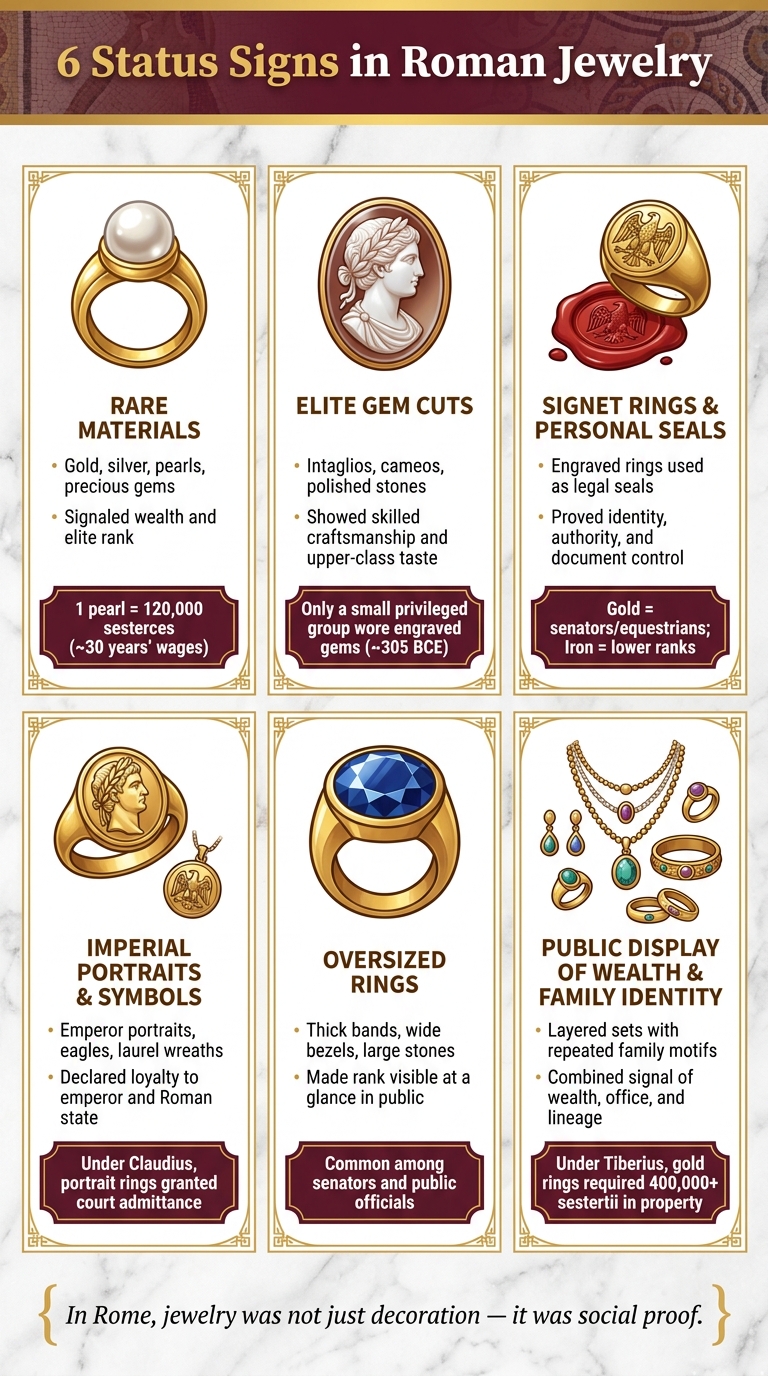
6 Status Signs in Roman Jewelry: What Each Signal Meant
Quick Comparison
| Status sign | What people saw | What it said |
|---|---|---|
| Rare materials | Gold, silver, pearls, gems | Wealth and high rank |
| Elite gem cuts | Intaglios, cameos, polished stones | Skilled work and upper-class taste |
| Signet rings | Engraved rings used as seals | Identity, authority, legal use |
| Imperial imagery | Emperor portraits, eagles, laurel | Loyalty and political ties |
| Oversized rings | Thick bands, large bezels, big stones | Open display of rank |
| Full jewelry display | Rings, earrings, bracelets, necklaces | Wealth, office, and family line |
If I had to sum it up in one line, I’d say this: in Rome, jewelry was not just decoration - it was social proof.
How Jewelry Communicated Status in Roman Society
In Roman society, jewelry did more than decorate the body. It showed rank through material, workmanship, and visibility. The six signs below show how Romans made that social code easy to read.
Material, Symbolism, and Visibility Worked Together
Romans used jewelry as a visual language. Gold, silver, pearls, and gemstones pointed to wealth. Engraved cuts and carved images pointed to skilled work. Symbols could mark family, rank, office, or loyalty.
That meant a smaller ring with a meaningful seal could carry more social weight than a bigger, plainer gold band. In other words, the message mattered just as much as the metal.
Public Settings Made Jewelry Easy to Read
Status jewelry mattered most in public settings - ceremonies, hearings, banquets, and civic events - where rank needed to be clear at a glance. In those moments, jewelry became part of everyday social display.
Not Every Status Sign Was About Raw Wealth
Not every signal came down to money. A signet ring could authenticate documents and show legal authority. Other marks pointed to inherited rank, public office, or allegiance. Those signals appear in six common forms below.
1. Rare Materials: Gold, Silver, Pearls, and Precious Gems
In Roman jewelry, material spoke first. Scarce metals and gems sent an instant public signal, and people could read that signal at a glance.
Gold stood at the top. It was bright, durable, and hard to miss. Rings, earrings, and necklaces made of gold pointed to elite standing, while people of lower rank were more likely to wear cheaper metals or substitutes.
Pearls carried even more social force. Pliny the Elder put them above every other luxury good, calling them:
"the very highest position among valuables."
That makes sense. Pearls were rare, imported, and easy to spot in public. They didn’t just look expensive - they announced rank. Julius Caesar reportedly limited pearl-wearing to women of a certain age and social position, which shows that pearls could work almost like regulated badges of status, not just decoration. The price drove that point home too: a single unio pearl could cost 120,000 sesterces, or about 30 years of wages.
Precious gems such as emeralds, sapphires, and garnets added another layer to the display. These stones had to be imported, sourced through trade, and worked by skilled artisans. So owning them hinted at more than money. It also suggested access, reach, and a taste shaped by the larger Roman world. The clearest case of gem-and-pearl excess is Lollia Paulina, wife of Caligula. Pliny described her as covered in emeralds and pearls worth 40,000,000 sesterces.
Silver also marked wealth, but it didn’t project the same authority as gold. It could still signal respectability and a solid place among the better-off, especially when the work was finely made. Still, next to gold or pearls, silver sent a softer message.
Material gave the first clue. After that, the details of cut and carving made the signal even sharper.
2. Elite Gem Cuts: Intaglios, Cameos, and Polished Stones
In Roman jewelry, cut signaled status just as much as the stone itself. Intaglios and cameos called for skilled cutters and hard-to-get stones such as sardonyx, carnelian, garnet, and amethyst. That mix of rarity and labor made them markers of elite taste in Roman jewelry. In Rome, the cut mattered as much as the gem.
An intaglio is carved into the stone, so the image sits below the surface. Press it into wax, and the design appears as a raised impression. A cameo does the reverse: the background is cut away so the image stands out in relief. Craftsmen often chose layered stones like sardonyx because the contrast between layers made the figure stand out at a glance. To shape these hard materials for seals and display, cutters used abrasive tools. In public life, that level of workmanship signaled rank. Around 305 BCE, rings set with engraved gems were worn by only a small privileged group. Pliny dismissed glass-set rings as common imitations, which makes the class line plain.
A sharp example is Dioskourides' signed gem, which became Emperor Augustus' signet ring. That link between a master carver and the emperor shows how elite gem cutting was tied to Roman political authority.
| Cut Type | How It Works | Primary Use | Status Signal |
|---|---|---|---|
| Intaglio | Design carved below the surface | Signet seals, signet rings | Private authority, official seal |
| Cameo | Design raised above the surface | Decorative display, luxury adornment | Visible refinement and wealth |
| Polished stone | Ground and buffed to a fine finish | Gold, silver, or bronze settings | Material quality, patron's taste |
Cameos, unlike intaglios, did not work well as seals. Their raised relief and layered color contrast made them public display pieces. Wealthy Romans even collected them in gem cabinets called dactyliothecae.
When carved stones carried seals, they worked as both ornament and authority.
3. Engraved Signet Rings and Personal Seals
When carved stones started serving as seals, they took on a second job: they became legal proof. In Rome, a signet ring wasn't just jewelry. It was a working legal tool used to confirm letters, contracts, and official orders. Its force came from three things: it was distinct to the owner, easy to recognize, and kept under that person's control. In elite and political circles, control of a seal often meant control of access, approval, and trust.
The engraved image mattered just as much as the ring. Seals often showed portraits, gods, military symbols, family emblems, or initials. Each image sent a clear message. A deity could point to piety or a line of work. A portrait could stress lineage. A family emblem worked like an instant personal badge. Romans were used to reading these signs at a glance, so the image itself carried weight.
Gold signet rings marked senators and equestrians. Iron or bronze rings were more common among people below them.
The risks were plain. If a signet ring was stolen, someone could use it to forge agreements or pose as the owner, because the seal impression was treated as proof of identity and consent. Under Roman law, falsifying a seal could lead to loss of civic standing.
Archaeological finds from Roman sites show this same object type in both elite gold versions and everyday iron ones. In other words, the form stayed familiar across social ranks, even when the material changed. That same visual code could also carry political meaning.
4. Imperial Portraits and Political Symbols
If signet rings proved identity, imperial images proved allegiance. They served a different job. A signet ring could show who you were. An imperial portrait showed whose side you were on.
In Rome, wearing an imperial portrait was a public sign of loyalty to the emperor. At times, it also opened doors. Under Emperor Claudius, people who wore a gold ring engraved with his portrait were granted free admittance to his audiences. That ring worked like a credential. It marked the wearer as someone the court recognized and trusted.
Court circles also used portrait jewelry as gifts. Imperial portrait rings and cameos were often handed out by the court itself. A gold ring set with a cameo portrait of Augustus, now held at the Metropolitan Museum of Art, was likely made as a gift for friends and supporters of Augustus and his dynasty. A cameo showing Septimius Severus and Julia Domna, mounted in a gold pendant from the Ferrell Collection, is identified by scholars as an imperial presentation piece - a reward that honored the recipient while also tying that person more closely to the emperor.
The message was not limited to faces. State symbols such as eagles, laurel wreaths, and military standards also appeared on rings and pendants to show loyalty to Rome itself rather than to one ruler. That difference mattered. A portrait ring suggested personal closeness to the emperor. An eagle or laurel motif pointed to allegiance to Roman power more broadly.
This kind of imagery also traveled well beyond Rome. Finds from the Middle and Lower Danube include empress-style cameos, including Julia Domna busts, buried with coins and rings. Provincial elites used these pieces to signal alignment with the imperial household, even from far away. The point was recognition. Anyone who saw the image understood the claim being made.
Another status cue was size itself.
5. Oversized Rings and Conspicuous Scale
In Roman jewelry, size wasn't random. It sent a message.
Thick bands, wide bezels, and large gemstones stood out right away. Elite Romans - especially senators and public officials - often wore heavy rings with large settings. Those rings weren't just personal items. They worked as public signals.
Smaller, plainer rings were more common among people of lower status. By contrast, a broad gold ring could turn an ordinary hand movement into a clear sign of rank.
Larger rings also made family crests, portraits, and seals easier to see. So scale played a direct role in how Romans put wealth, office, and family identity on display in public.
6. Public Display of Wealth, Office, and Family Identity
For Romans, status wasn't just about one large piece. People read rank from the full set someone wore. Elite men often wore rings. Elite women usually went further, adding earrings, necklaces, bracelets, and hair ornaments. Put together, those pieces showed stored wealth and social standing in plain view.
The symbols on jewelry mattered too. When the same family mark appeared on a ring, pendant, and bracelet, it stopped looking like decoration alone. It became a public sign of the family line. Repeat that symbol across several pieces, and the message was hard to ignore.
This mattered most in places where people saw and judged one another all the time: forums, baths, banquets, and festivals. Jewelry stayed on display there. A layered set let others size up status almost at once.
Under Tiberius, only freeborn men of three generations and at least 400,000 sestertii in property could wear gold rings in public. That rule turned the gold ring into a legal marker of rank. Add other pieces on top of that, and the signal was plain.
These six details show how Roman jewelry worked as a status code that people could read in public.
Quick Reference: What Each Jewelry Detail Signaled
This table sums up the six main status signs and what they usually meant. Think of it as a quick decoder for Roman jewelry. It also helps separate signals tied to money from those tied to office, authority, and loyalty.
| Jewelry Detail | Typical Form | Status Meaning |
|---|---|---|
| Rare materials | Gold or silver rings, pearl earrings, gem-set necklaces | High wealth and elite rank |
| Elite gem cuts | Intaglio or cameo stones set in rings and pendants, with polished stones as focal points | Refined taste, skilled craftsmanship, and elite access |
| Engraved signet rings and personal seals | Rings with engraved bezels or carved stones, often carnelian, garnet, or agate | Legal identity and authority to seal documents |
| Imperial portraits and political symbols | Coin-set rings, pendants, and brooches with ruler imagery or official emblems | Loyalty to the emperor and state power |
| Oversized rings | Heavy gold rings with large gemstones, often worn in multiples | Deliberate status display and elite privilege |
| Public display of wealth, office, and family identity | Layered sets of rings, bracelets, necklaces, and hair ornaments repeating family motifs, deities, or military emblems | A combined signal of wealth, office, and family identity |
Not every sign pointed to the same kind of status. Rare materials and oversized rings mostly signaled wealth. Signet rings and imperial imagery pointed more to office, authority, or loyalty. In plain terms, a carnelian seal could say more than a plain gold band. That’s why, in Roman jewelry, symbol could matter as much as cost.
Why Symbolic Design Mattered as Much as Cost
Cost mattered, but it wasn't the whole story. Roman jewelry worked because people understood what its designs meant at a glance.
Symbols Made Rank Easier to Recognize
Roman jewelry showed rank through visible design, not price alone. Romans read clothing, rings, and portraits as signs of status. Jewelry wasn't just decoration. It was a deliberate public signal.
Because of that shared way of reading symbols, a private object could say something out loud in public.
Jewelry Linked Private Ownership to Public Identity
The same engraved design that proved a seal belonged to one person could also make that person recognizable in public. The ring was both a seal and a status marker. Rings engraved with ancestral portraits or family emblems tied the wearer to a lineage that other people could recognize on sight.
Coins and portraits pushed this even further, turning jewelry into a visible claim of imperial favor.
Status Depended on Shared Recognition
These symbols only worked because Romans read them in much the same way. The code was shared: gold marked rank, iron marked everyday use, and intaglios marked authority.
Conclusion
Roman jewelry did more than decorate the body. It worked like a social signal system. A ring, a carved image, or the choice of material could tell other people who you were, where you stood, and how much power your family held.
Across the six signs covered here, the same pattern shows up again and again: rare materials and oversized rings signaled wealth, while signet rings, imperial imagery, and family emblems pointed to authority, loyalty, and lineage. In that sense, jewelry functioned as a public language, readable at a glance in a forum, bath, temple, or court. Cost could show wealth, but symbolism is what made status visible in public.
FAQs
Why were gold rings regulated in Rome?
In ancient Rome, gold rings weren’t just jewelry. They worked as a public sign of rank.
People used them to show social standing and public identity at a glance. In a world that cared deeply about class, that small detail mattered.
Over time, Roman law tightened who could wear them. Gold rings were eventually reserved for senators, while common citizens were limited to more accessible materials like bronze or iron.
How did signet rings prove authority?
Signet rings showed authority by working as a personal signature. Their engraved designs were pressed into wax to seal and verify documents.
Because that mark confirmed the owner’s identity and lineage, signet rings also showed status and political power. They weren’t just decorative. Their everyday use, paired with their costly look, made them a clear public sign of rank.
Did Roman jewelry show rank more than wealth?
Yes. In Roman society, jewelry often signaled social rank more clearly than wealth. Gold and gemstones mattered, of course. But laws and social custom often set limits on who could wear what.
A gold ring, for example, could mark senatorial status. Other people were limited to bronze or iron. During the Imperial period, jewelry could also point to lineage and political identity.