Skip to content




Sacred Symbols in Jewelry: History and Meaning
Sacred symbols in jewelry have held deep spiritual, cultural, and protective meanings for centuries. From the Egyptian Ankh to the Eastern Om, these symbols transcend mere decoration, serving as talismans of protection, faith, and personal expression. Here's a quick overview of what you'll learn:
- Ancient Origins: Symbols like the Eye of Horus, Celtic knots, and the Star of David carried spiritual and cultural significance across civilizations.
- Eastern Traditions: The Om and Lotus Flower represent enlightenment, while the Hamsa and Evil Eye offer protection.
- Indigenous Symbols: Feathers and sun motifs symbolize connection to nature, life, and spiritual balance.
- Modern Trends: Today’s jewelry blends these ancient meanings with contemporary designs, offering personalized, wearable spirituality.
These symbols continue to inspire modern designs, connecting wearers to their beliefs and heritage through meaningful, everyday adornments.
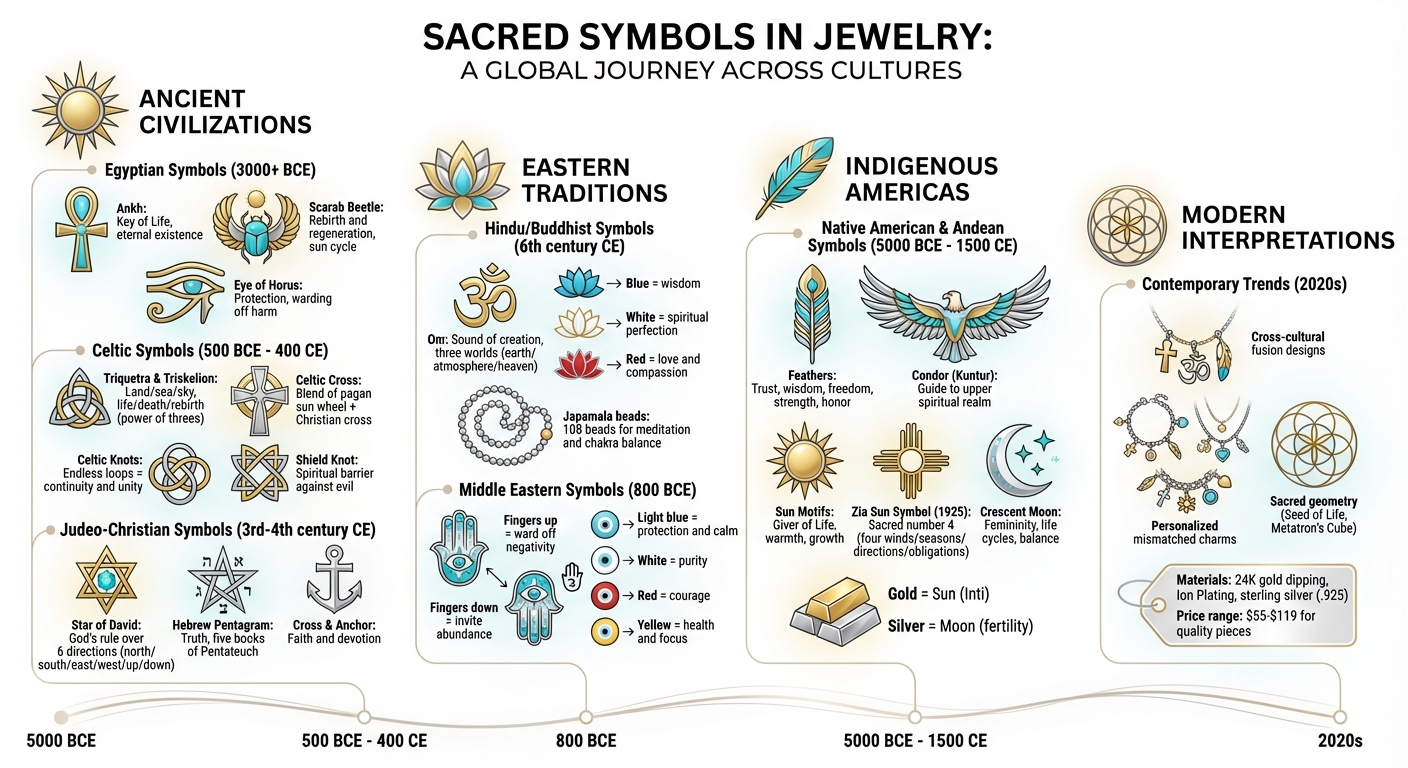
Sacred Jewelry Symbols Across Cultures: Meanings and Origins
Sacred Symbols in Ancient Jewelry
Ancient jewelry was more than just decoration - it intertwined beauty with spiritual significance, often serving as a bridge to the divine or as a source of protection. Rings, amulets, and necklaces were transformed into powerful talismans by embedding sacred symbols, each carrying a deep religious or cultural meaning.
"The symbol is, in effect, the mediator, presence, and real (or intelligible) representation of the holy in certain conventional and standardized forms." - Kurt Moritz Artur Goldammer, Professor of Comparative History of Religions
This rich tradition highlights how different cultures uniquely incorporated symbolic motifs into their adornments.
Egyptian Symbols: Ankh, Scarab, and Eye of Horus
In ancient Egypt, jewelry was infused with profound spiritual purposes. The Ankh, often called the Key of Life, symbolized "life" and eternal existence. It was commonly depicted in the hands of deities, who offered it to pharaohs as the "Breath of Life".
The Scarab Beetle, representing rebirth and regeneration, mirrored the daily cycle of the sun. Scarab amulets were especially significant for the deceased, believed to ensure their reincarnation. Meanwhile, the Eye of Horus acted as a safeguard, offering protection and warding off harm.
Celtic Symbols: Triskelion, Triquetra, and Celtic Cross
Celtic jewelry reflected a worldview deeply rooted in interconnectedness and the power of threes. Symbols like the Triquetra and Triskelion embodied concepts such as land, sea, and sky; life, death, and rebirth; and the celestial, physical, and spiritual realms.
"Celtic knots, stones, leaves, corners, and other designs are intentionally made this way to reflect the Celtic belief that everything of importance comes in a set of three." - Jennifer deMario
The intricate Celtic knots, with their endless loops, symbolized continuity and unity. The Triskelion, an ancient design predating Celtic culture by about 2,500 years, is prominently displayed on monuments like the Newgrange tomb in Ireland, emphasizing its timeless significance.
The Celtic Cross emerged as a blend of pagan and Christian traditions, combining the Christian cross with the sun wheel to signify the transition from Paganism to Christianity. Protective symbols like the Shield Knot were also popular, believed to create a spiritual barrier against evil forces.
Judeo-Christian Symbols: Star of David, Anchor, and Cross
As spiritual traditions evolved, Judeo-Christian cultures introduced their own powerful symbols into jewelry, reshaping devotional practices. The Star of David, for instance, was used as early as the 3rd and 4th centuries in synagogues and on Jewish tombstones. Its six points symbolized God's rule over all directions - north, south, east, west, up, and down.
"Devotional medals date back to early Christianity, replacing pagan amulets with symbols of faith... encouraging their use as tools for evangelization and protection." - Caroline King, Catholic Faith Store
The Cross, Anchor, and Hebrew Pentagram were similarly meaningful. The Hebrew Pentagram, for example, represented "Truth" and the five books of the Pentateuch. Even the choice of stones or colors in these pieces carried weight, with certain hues believed to promote health or signify divine favor. These symbols served as compact, wearable expressions of faith, offering both spiritual connection and protection.
Sacred Symbols in Eastern Cultures
Eastern spiritual traditions have long infused jewelry with symbols that reflect protection, enlightenment, and a deep sense of connection. These timeless motifs continue to influence modern designs, bridging ancient practices with contemporary aesthetics.
Om and Lotus Flower
The Om symbol, revered in Hinduism, Buddhism, and Jainism, represents the sound of creation and first appeared in manuscripts as far back as the 6th century.
"The syllable om is composed of the three sounds a-u-m... which represent several important triads: the three worlds of earth, atmosphere, and heaven; thought, speech, and action; and the three qualities (gunas) of matter (goodness, passion, and darkness); and the three sacred Vedic scriptures." - Britannica Editors, Encyclopedia Britannica
In jewelry, Om often appears as a central pendant in necklaces or as part of traditional japamalas (meditation beads). These beads, typically numbering 108, are used to energize and balance specific energy centers, such as the Root Chakra. Many wearers incorporate these pieces into meditation practices, aiming to channel grounding energy and maintain a connection to divine consciousness.
The Lotus Flower is another beloved symbol in Eastern jewelry, representing spiritual awakening and purity. Its journey from muddy waters to full bloom mirrors the soul's path from material concerns to enlightenment. Each color of the lotus carries unique meanings: blue signifies wisdom and spiritual triumph, white reflects spiritual perfection, and red symbolizes love and compassion.
"As a clean and beautiful flower that rises up from the muddy water, the Lotus is a symbol of mental and spiritual purity and reflects the soul's progress out of the mud of materialism." - David Weitzman, Jewelry Artist, Ka Gold Jewelry
Modern designs often pair the lotus with gemstones to enhance its spiritual essence. For example, Jade is used to resonate with the Heart Chakra, while Lapis Lazuli is linked to illumination. The pink lotus, considered the "supreme lotus" in Buddhism, holds special ties to the historical Buddha. Together, Om and the Lotus encapsulate the spiritual essence of Eastern jewelry, paving the way for other protective symbols.
Hamsa and Evil Eye
The Hamsa, a hand-shaped talisman, adds another layer of meaning to Eastern-inspired jewelry. Its origins trace back to ancient Mesopotamia and the Phoenician goddess Tanit in Carthage, around 800 BC, predating modern Abrahamic religions. Known as "Hamsa" in Arabic, meaning "five", this symbol has been embraced across various faiths, each attributing its own spiritual interpretations.
In Islam, the Hamsa is called the "Hand of Fatima", symbolizing the Five Pillars of Islam. Judaism refers to it as the "Hand of Miriam", representing the five books of the Torah or God's strength. Christianity names it the "Hand of Mary", while in Hinduism and Buddhism, its five fingers correspond to the five elements - fire, air, ether, earth, and water.
"The hamsa is regarded as the most important apotropaic sign in the Islamic world." - Eva-Maria von Kemnitz, Author and Researcher
The orientation of the Hamsa also holds meaning. When worn with fingers pointing upward, it is believed to ward off negativity, while fingers pointing downward are thought to invite abundance, prosperity, and fertility. Many modern designs incorporate a central eye into the Hamsa, amplifying its protective qualities against the Evil Eye - a curse associated with envy or jealousy.
The Evil Eye symbol itself carries various meanings depending on its color. Light blue is associated with protection and calm, white symbolizes purity and clearing obstacles, red represents courage, and yellow promotes health and focus. Traditionally crafted in materials like jet or silver, these symbols have evolved into popular "good luck" charms in contemporary jewelry.
The Hamsa's enduring appeal is reflected in its addition to Unicode in 2021 as U+1FAAC 🪬, cementing its status as a cultural and spiritual icon. Today, it is not only a protective talisman but also a symbol of peace, with Middle Eastern activists often wearing it to highlight shared cultural roots across different faiths. These ancient symbols continue to inspire modern jewelry, blending historical depth with current trends.
Indigenous and Native Symbols in Jewelry
Throughout history, jewelry has carried deep spiritual and cultural significance, and Indigenous traditions are no exception. Across the Americas, sacred symbols in jewelry have served as powerful markers of identity and belief. From the copper ornaments of the Great Lakes region, dating back to the 5th millennium BCE, to the intricate gold adornments of the Inca, these symbols represent much more than decoration - they embody spiritual meanings and cultural narratives that have endured for millennia.
Feathers and Sun Motifs
In Native American traditions, feathers are rich with spiritual meaning, symbolizing trust, wisdom, freedom, strength, and honor. They are believed to carry the energy of the bird they come from, connecting humans to the natural and spiritual world.
"Native Americans believed a falling feather transfers the bird's energy to a person. It's perceived as an unexpected gift - one that arrives unforeseen, but not without purpose." – Alex and Ani
In Andean cultures, the Condor (Kuntur) holds a similar reverence. This majestic bird is seen as a guide and protector, linking individuals to the upper spiritual realm known as Hanan Pacha. While North American tribes often incorporated real feathers into jewelry and ceremonial headdresses, the Inca valued feathers as sacred symbols of divine connection.
Sun motifs are another recurring theme in Indigenous jewelry, representing the "Giver of Life." These designs embody warmth, growth, and abundance. A striking example is the Zia Sun Symbol, the official state symbol of New Mexico since 1925, which reflects the sacred number four - representing the Circle of Life: the four winds, seasons, directions, and sacred obligations.
"The Zia Sun Symbol originated with the Native Americans of Zia Pueblo... Four is a sacred number that symbolizes the Circle of Life: four winds, four seasons, four directions, and four sacred obligations." – Pueblo of Zia
For the Inca, gold was far more than a precious metal. It was seen as a sacred manifestation of the sun, often described as the "excretion" of Inti, the sun god. Inca artisans created dazzling gold headdresses and collars that reflected sunlight, symbolizing divine status and a connection to their celestial protector [44,46].
Crescent Moon
The crescent moon is another powerful symbol found in Indigenous jewelry, often representing femininity and the cyclical nature of life. In Andean traditions, the moon was associated with silver, a material that symbolized fertility and balance. Inca artisans frequently combined gold and silver to reflect cosmic harmony, blending the energies of sun and moon.
In Native American cultures, the moon also acts as a symbol of protection and serenity. Its meaning can shift based on the seasons, the harvest, or its pairing with other symbols. The interplay of sun and moon - gold and silver, masculine and feminine, day and night - illustrates the Indigenous understanding of balance and the interconnectedness of all things [46,47].
Modern Interpretations of Sacred Symbol Jewelry
Ancient symbols have found a new life as wearable talismans, blending deep spiritual meanings with contemporary design. Today’s jewelry designers are reimagining these age-old emblems with techniques like 24K gold dipping, heavy gold electroplating, and Ion Plating. The latter is especially popular for its durability, ensuring long-lasting finishes on both silver and gold pieces.
Modern sacred jewelry leans heavily toward personalization rather than uniformity. Think mismatched statement charms - zodiac signs, protective Hamsas, and lucky Evil Eye motifs - that reflect personal beliefs and spiritual journeys. This trend mirrors a larger movement where jewelry becomes a "tangible language" for self-expression and individual spirituality.
Cross-Cultural Design Elements
Today’s jewelry designs often pull inspiration from various spiritual traditions, creating pieces that transcend cultural boundaries. For instance, you might find a Tibetan Vajra paired with an Egyptian Ankh or the Flower of Life accented with pave crystals. These combinations resonate with a global audience seeking spiritual connection, free from religious limitations.
Sacred geometry plays a prominent role in modern designs, with rigid geometric shapes and sharp angles carrying spiritual significance. Symbols like the Seed of Life and Metatron’s Cube are appreciated not only for their intricate patterns but also for their perceived harmonizing and therapeutic qualities. By integrating these ancient designs with modern materials - such as turquoise and jade alongside pave crystals or even retro beads featuring peace signs and smiley faces - designers strike a balance between tradition and playfulness.
Symbols like the Hamsa hand and Evil Eye have also evolved into bold fashion statements. These protective emblems now come in color-coded variations: orange for creativity, dark blue for karma, and yellow for health. This modern interpretation of classic symbols highlights the growing trend of blending tradition with customization.
Sacred Symbol Jewelry at LaCkore Couture
LaCkore Couture embraces the fusion of sacred traditions with modern aesthetics. Their collections include protective Hamsa hands, Evil Eye necklaces, zodiac-themed charms, and tarot card pendants, all crafted from high-quality materials like sterling silver (.925) and various gold finishes.
"The Hamsa hand is an amulet from the Middle East that represents God's hand. It is a protective symbol in all faiths. It bestows happiness, luck, health, and fortune on its owner." – LaCkore Couture
One standout feature of the brand is its Charm Bar, where customers can create personalized necklaces and bracelets that reflect their spiritual beliefs and aesthetic style. Whether layering charms or pairing a zodiac sign with a protective talisman, this approach celebrates the trend of jewelry as self-expression.
"Nothing says effortlessly cool than a handmade and mismatched assortment of statement charms wrapped around your neck." – LaCkore Couture
LaCkore Couture offers charm necklaces ranging from $55 to $119, providing quality craftsmanship at accessible prices. Each piece is hallmarked for authenticity, with metal content stamps like .925 for sterling silver, ensuring customers receive genuine, handcrafted designs. By combining traditional symbolism with modern design elements, LaCkore Couture allows wearers to carry spiritual meaning and protection into their everyday lives.
Conclusion
Sacred symbols in jewelry have carried profound meanings for centuries. From the Star of David's protective role in Kabbalistic teachings during the 13th and 14th centuries to their enduring presence as wearable connections to ancient wisdom, heritage, and personal spirituality, these symbols have stood the test of time.
"Symbols play a powerful part in the rituals of expression... bind us together and provide a common language that bestows upon us a unifying platform." – Lang Antiques
Whether it's the protective energy of the Hamsa hand, the grounding strength of a Celtic Cross, or the mindfulness evoked by the Om symbol, these pieces transcend mere decoration. They serve as physical reminders for meditation and intention-setting. The Hebrew "Chai" symbol, with its representation of life through the number 18, adds a deeply personal layer of meaning.
"Contemporary Jewish jewelry reminds us that while the world may change, the significance of these symbols remains eternal." – Shaked Karabelnicoff, Writer and Content Creator, Unpacked
Today, modern wearers choose symbols like the Tree of Life for grounding, the Triskele for progress, or the Ankh for vitality, blending traditional significance with contemporary design. As you explore these timeless pieces, ensure authenticity by looking for hallmarks like .925 for sterling silver and examining gemstones - real jade, for instance, feels heavier and lacks air bubbles. Let your jewelry reflect your beliefs and identity, bringing their enduring energy into your daily life.
FAQs
What do sacred symbols in jewelry represent spiritually?
Sacred symbols in jewelry hold profound spiritual meanings, often tied to ancient traditions and beliefs. Take the Om symbol, for instance - it embodies universal harmony and is closely linked to meditation and a sense of inner calm. Similarly, the lotus flower stands for purity and spiritual growth, serving as a reminder of our capacity to rise above life's difficulties. The ankh, a well-known Egyptian emblem, symbolizes eternal life and the balance of energies.
Other cherished symbols include the evil eye, believed to ward off negativity, and the butterfly, which represents transformation and renewal. These designs are more than just accessories - they tell stories, weaving together personal meaning and cultural history. LaCkore Couture’s handcrafted jewelry brings these timeless motifs to life, blending artistry with a deep sense of spiritual connection.
How are ancient sacred symbols used in modern jewelry design?
Modern jewelry design breathes new life into ancient sacred symbols, seamlessly combining their deep-rooted meanings with contemporary aesthetics. Motifs like the Hamsa hand, Eye of Horus, Tree of Life, and Thor’s Hammer are being transformed into sleek pendants, layered necklaces, and delicate charms. These updated interpretations make it easy for wearers to embrace the historical and protective essence of these symbols while staying stylish.
Designers often use premium materials such as gold, silver, and natural stones to elevate the appeal and significance of these pieces. Take, for instance, a Hamsa hand pendant or an Evil Eye charm: these might feature intricate craftsmanship or be adorned with gemstones, adding a modern flair while honoring their origins. This careful balance ensures these ancient symbols continue to resonate with today’s jewelry enthusiasts, blending tradition with personal expression.
Why are specific materials and colors used in sacred symbol jewelry?
The materials and colors in sacred symbol jewelry aren't just about aesthetics - they're deeply tied to spiritual and symbolic meanings. For centuries, gemstones and metals have been valued not only for their visual appeal but also for their believed effects on energy and well-being. Take gold and silver, for example. These metals are celebrated for their purity, resilience, and ability to conduct energy, making them perfect for sacred designs. Likewise, natural stones are chosen for their distinct qualities, such as fostering healing or promoting balance.
Colors bring another layer of significance to sacred jewelry. They're often linked to specific intentions or energy centers, like chakras. For example, red or orange stones might symbolize grounding and stability, while blue or green stones are associated with communication and emotional balance. By thoughtfully combining these meaningful materials and colors, sacred symbol jewelry becomes more than just adornment - it connects wearers to enduring traditions and deeper intentions.