Skip to content




Roman Amulets and Greek Charms in Ritual Life
Greek and Roman amulets were more than jewelry: people wore them for protection, healing, devotion, and identity. I look at the wearer, inscriptions, and find location - not just the design - to judge whether an object served as a charm.
Here’s what I cover:
- Gorgon heads, eye beads, and phallic charms: images believed to ward off harm or the evil eye.
- Bullae and lunulae: pendants linked to childhood, family status, and life changes.
- Amber beads: jewelry whose material was credited with protective or healing powers.
- Engraved gems and deity rings: objects that could express belief, seek relief, or serve as seals.
- Bead strings, cords, and mixed pendants: sets that could combine adornment with protection.
The examples range from a Greek pendant dated around 450 BCE to magical gems well documented in the 2nd and 3rd centuries CE. My guiding point: <u>belief in protection is not proof of protection</u>, and a symbol alone cannot tell us how someone used it. Modern personal charms offer a parallel in self-expression, without establishing ancient ritual meanings.
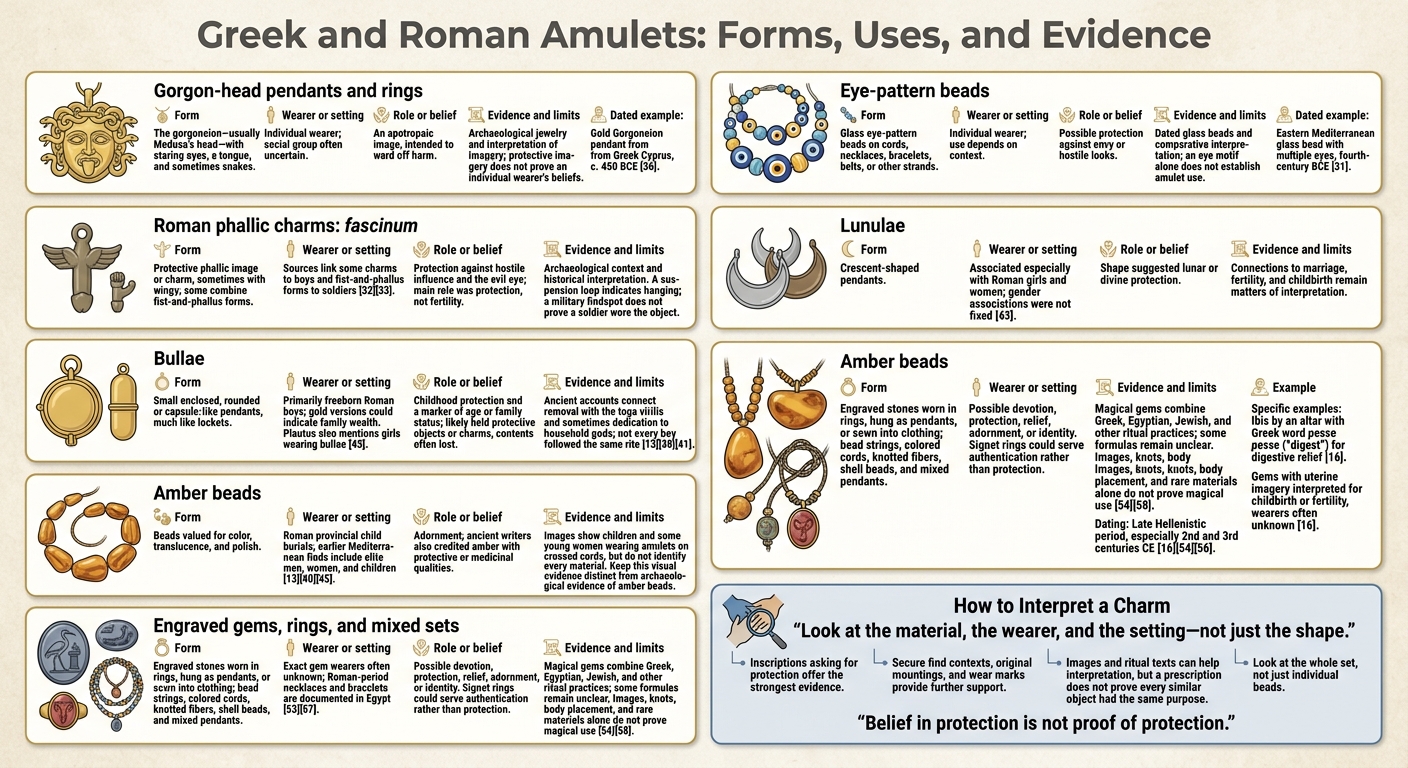
Greek and Roman Amulets: Forms, Uses, and Evidence
Images Used to Ward Off Harm
Greek and Roman wearers used familiar images to give protection a visible form.
Gorgon-Head Pendants and Rings
The gorgoneion - usually Medusa’s head - was an apotropaic image, meaning it was intended to ward off harm. Staring eyes, a tongue, and sometimes snakes made it a deliberately fearsome charm for pendants and rings. That protective meaning, though, does not prove what an individual wearer believed.
A gold Gorgoneion pendant from Greek Cyprus, dated c. 450 BCE, shows the image used as personal adornment.
Repeated eye motifs drew on a similar idea of protection.
Eye Beads and Jewelry Motifs
Glass eye-pattern beads could be strung on cords, necklaces, bracelets, belts, or other strands. They may have guarded against envy or hostile looks. But an eye motif alone does not establish that an object served as an amulet.
A fourth-century BCE eastern Mediterranean glass eye bead carries multiple eyes across its surface, suggesting multiplied watchfulness.
Roman charms gave this protective idea more explicit forms.
Roman Phallic Charms
The fascinum was a Roman protective phallic image or charm, sometimes depicted with wings. Its main role was protection, not fertility. Sources link some charms to boys and fist-and-phallus forms to soldiers.
A suspension loop indicates that a charm was meant to hang. A military findspot, however, does not by itself prove that a soldier wore it. These forms served as worn protection, rather than decoration alone.
| Wearable form | Wearer or setting | Protective meaning | Evidence type |
|---|---|---|---|
| Gorgon-head pendant or ring | Individual wearer; social group often uncertain | Fearsome face meant to ward off harm | Archaeological jewelry and interpretation of imagery |
| Eye-pattern bead on a cord or strand | Individual wearer; use depends on context | Possible protection against envy or hostile looks | Dated glass beads and comparative interpretation |
| Phallic charm or fascinum | Boys; fist-and-phallus forms linked to soldiers | Protection against hostile influence and the evil eye | Archaeological context and historical interpretation |
Amulets for Childhood and Life Changes
Enclosed pendants, crescents, and beads marked childhood and shifts in status during rituals and rites of passage. Their meanings depended on wealth, status, region, and local customs.
Like earlier amulets, these objects guarded against harm. But they also signaled a wearer’s age and family status.
Bullae for Freeborn Roman Boys
The bulla was a small, enclosed pendant worn around a child’s neck, much like a locket. Ancient texts associate it mainly with freeborn Roman boys, and gold versions could show family wealth. Its contents are often lost, though it likely held protective objects or charms.
Ancient accounts connect its removal with the toga virilis, which marked entry into adult male status. Some also describe dedicating it to household gods. The practice is documented, but not every boy followed the same rite.
Crescent pendants associated with female wearers served a similar role, as did other childhood markers.
Lunulae for Girls and Women
A lunula was a crescent-shaped pendant associated especially with Roman girls and women. Its shape suggested lunar or divine protection, though connections to marriage, fertility, and childbirth remain matters of interpretation.
The gender split was not fixed: Plautus mentions girls wearing bullae, while Isidore of Seville links lunulae to female wearers.
| Feature | Bulla | Lunula |
|---|---|---|
| Form | Enclosed, rounded or capsule-like pendant | Crescent-shaped pendant |
| Associated wearer | Primarily freeborn Roman boys | Roman girls and women |
Amber Beads and Beliefs About Materials
Amber’s color, translucence, and polish made it appealing as jewelry. Ancient writers also credited it with protective or medicinal qualities.
Greek, Cypriot, and Etruscan images show children and some young women wearing amulets on crossed cords. The images do not identify every material. Separate evidence from Roman provincial cemeteries shows amber beads in child burials, while earlier Mediterranean finds include elite men, women, and children.
These amulets also appeared alongside engraved gems and mixed charm sets.
Engraved Gems and Charm Combinations
Some charms drew their meaning less from their shape or material than from images and inscriptions carved into the stone. An engraved image alone does not establish ritual use; other evidence is needed.
Engraved Gems and Deity Rings
Engraved magical gems date to the late Hellenistic period, with especially strong evidence from the 2nd and 3rd centuries CE. Their images and inscriptions combine Greek, Egyptian, Jewish, and other ritual practices. Some include formulas whose meaning remains unclear. People could wear these stones in rings, hang them as pendants, or sew them into clothing.
Form: An engraved magical gem from the Roman imperial period. Symbol: An ibis tied beside an altar, accompanied by the Greek word pesse, meaning “digest.” Wearer: An unidentified person, possibly seeking relief from indigestion. Ritual Association: Relief from indigestion. Evidence: National Museums Liverpool links the image and inscription to digestive relief.
Bead Strings, Cords, and Mixed Pendants
Engraved stones could also belong to larger wearable sets that combined adornment, identity, devotion, and protection. Roman-period finds from Egypt include necklaces and bracelets made with colored cords, knotted fibers, and shell beads.
Look at the whole set, not just individual beads. Neither knots nor placement on the body proves magical use. Rare stones may instead point to trade, wealth, or personal taste.
What the Evidence Shows
These objects sit between adornment and ritual, so context matters. Inscriptions asking for protection offer the strongest evidence. Secure find contexts, original mountings, and wear marks provide further support.
Images and ritual texts can help explain an object, but a written prescription does not prove that every similar gem served the same purpose. Most gems cannot be linked to particular groups of wearers.
| Object | Documented wearer or setting | Danger or hope addressed | Evidence type |
|---|---|---|---|
| Gem with uterine imagery | Roman imperial magical-gem tradition; exact wearer often unknown | Childbirth or fertility | Iconography and museum interpretation |
| Bead-and-cord necklace or bracelet | Roman-period domestic or personal setting, including Egypt | Adornment; protection only where supported | Surviving fibers, beads, and construction |
| Engraved signet ring | Owner, official, or household member | Authentication or identity; not necessarily protection | Ring form, inscriptions, and sealing evidence |
Conclusion: Protection, Devotion, and Identity
Greek and Roman charms could serve several roles at once: protection, devotion, and identity. Their meaning depended on the material, the wearer, and the setting - not just their shape. These associations reflect belief, not proof that the charms offered protection.
As a modern parallel, LaCkore Couture offers handcrafted, customizable charms and necklaces for personal expression, without claiming ritual power.
FAQs
Could ordinary jewelry become a protective charm?
Yes, ordinary jewelry can serve as a protective charm. Throughout history, people wore shells, stones, bones, and animal teeth as talismans they believed could ward off negative energy, evil spirits, and misfortune. Sacred symbols like the Hamsa hand, Evil Eye, or Herakles knot gave these pieces meaning beyond decoration.
Today, the LaCkore Couture Charm Bar lets you personalize protective jewelry by pairing meaningful symbols with your own style.
How were ancient amulets activated or blessed?
The provided search results link ancient amulets to spiritual life, offerings at sanctuaries, and protection against evil spirits or curses. But they don’t describe the rituals used to bless or activate them, or explain how they were consecrated for the wearer.
Did Greeks and Romans share amulet traditions?
Yes. Greeks and Romans shared amulet practices through contact and exchange. Romans adopted Greek customs and adjusted them, including offering jewelry at temples and wearing protective charms.
The bulla, a children’s amulet worn to ward off evil, originated in Greece before becoming common in Rome. Both societies also believed in the evil eye and used charms, such as blue beads, to guard against negative energy and misfortune.