Skip to content




Renaissance Revival vs. Original Renaissance Jewelry
The short answer: original Renaissance jewelry was a public signal, while Renaissance Revival jewelry became more about private taste.
If I had to boil the whole topic down, I’d put it this way:
- 1400 to 1600: jewelry showed faith, rank, marriage, and family ties
- 1860s to 1870s: jewelers reused many of the same looks, but for history-minded style
- Same motifs, different job: pearls, enamel, heraldry, myth figures, and gemstones stayed in use, but their message changed
- Big shift: fixed social meaning gave way to personal choice
One fact stands out: the Revival peaked about 300 years after the original Renaissance. That time gap matters. By then, jewelry no longer had to follow the same public rules tied to rank and religion.
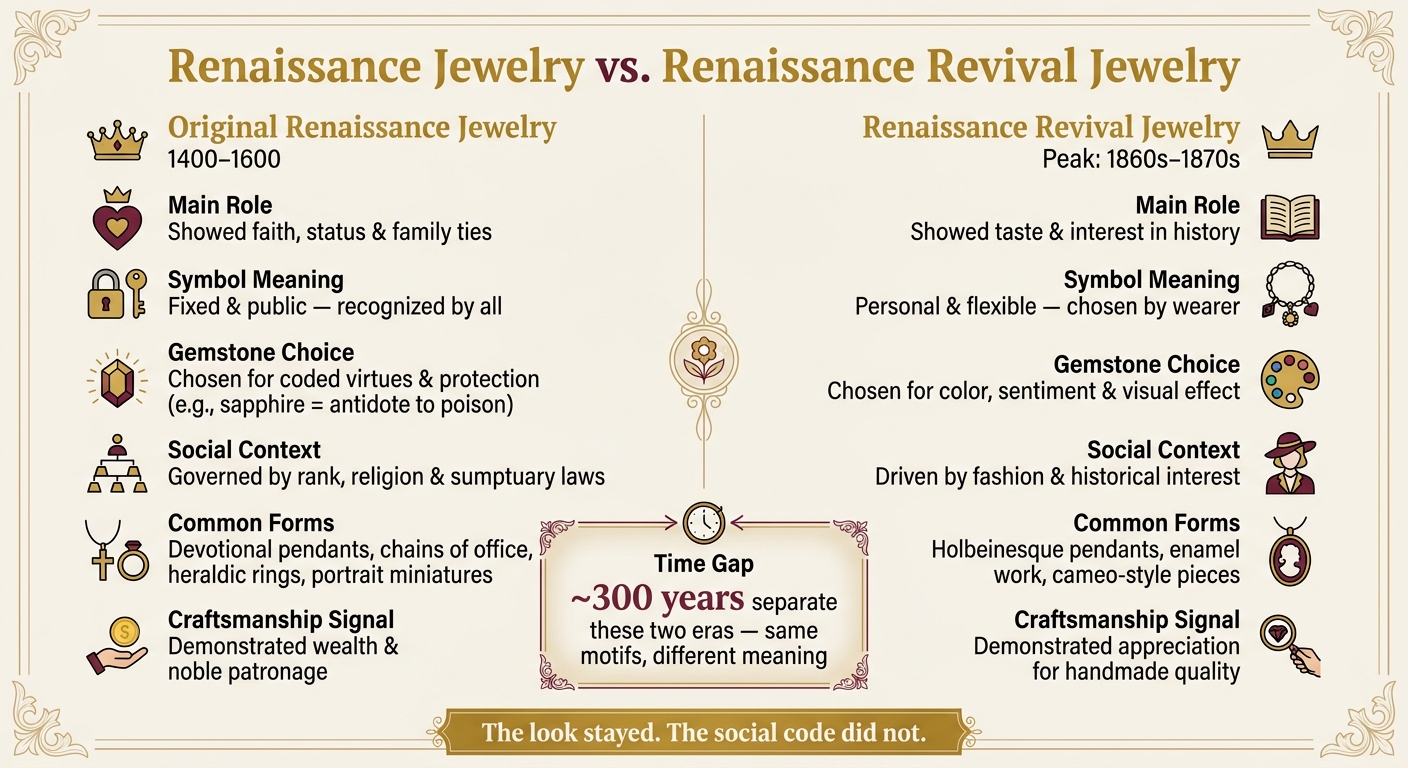
Renaissance Jewelry vs. Renaissance Revival: Key Differences at a Glance
Quick Comparison
| Point | Original Renaissance Jewelry | Renaissance Revival Jewelry |
|---|---|---|
| Main role | Showed faith, status, and family | Showed taste and interest in the past |
| Time period | c. 1400–1600 | Peak in the 1860s–1870s |
| Meaning of symbols | More fixed and public | More personal and loose |
| Common forms | Pendants, chains, rings, portrait pieces | Historic-style pendants, enamel work, cameo-style pieces |
| Gemstones | Chosen for known meanings and use | Chosen more for look and feeling |
| Social context | Linked to rank and social rules | Linked to fashion and historic interest |
In short, the article shows that the look often stayed close, but the meaning did not. That is the key point to keep in mind as you read the rest.
Original Renaissance Jewelry
In European courts, Renaissance jewelry worked like a public code for identity, rank, and faith. As Jelena Kulic puts it:
"Jewelry has long served as a highly visible language of identity and romance... Gold and gemstones allowed nobility and the rising merchant class to display their status, education, and faith."
Pendants became the signature jewelry form of the period. People often wore them on long gold chains or hung them from girdles.
Religious, Status, and Family Symbols
Faith and rank sent the clearest message. Devotional pendants showed saints, scenes from the Bible, or the sacred IHS monogram. Some even held relics or written prayers. Wearing one made devotion visible at a glance.
Jewelry also marked rank and family ties. Noblemen wore heavy gold chains of office to show their position and political loyalties at court. Heraldic devices and family coats of arms appeared on rings and pendants, putting dynastic ties on display. Portrait miniatures and cameos of rulers pushed that idea even further, linking personal identity with political alliance.
In Agnolo Bronzino's state portrait of Eleonora di Toledo, Duchess of Florence, her jewelry does exactly that. Her multi-strand pearl necklaces and diamond pendant with a laurel wreath point to Medici dynastic aims and political legitimacy.
Love, Marriage, and Gemstone Meaning
Marriage in Renaissance Europe was not just personal. It was legal, political, and tied to family power. Jewelry made that bond public. In Rome, a bride received three rings from the groom, and one carried his family's arms to mark her entry into his lineage. As Andrea Bayer, Curator at the Metropolitan Museum of Art, notes:
"The groom's gifts to the bride were considered an outward symbol of her integration into his family."
Betrothal jewelry used symbols people would have read right away: "fede" motifs with clasped hands, hearts, and myrtle garlands. "Poesy" rings carried short romantic verses engraved inside the band. The first recorded diamond engagement ring was given by Costanzo Sforza to Camilla d'Aragona in 1475. That came before the better-known 1477 ring from Archduke Maximilian of Austria to Mary of Burgundy, which used flat-cut diamonds arranged in the shape of an "M".
Gemstones carried meanings that viewers in the period would have recognized on sight.
| Gemstone | Renaissance Symbolic Meaning |
|---|---|
| Diamond | Lasting commitment and romance |
| Pearl | Purity |
| Ruby | Passion or courage |
| Sapphire | Wisdom, faith, or antidote to poison |
| Emerald | Hope |
| Garnet | Vigor; driving out sadness and suspicion |
| Amethyst | Prevention of drunkenness and disease |
| Coral | Driving bad dreams from the mind |
These meanings were not only symbolic. People often treated them as practical, too. Sapphires were believed to work as an antidote to poison. Coral was worn to ward off bad dreams. So gemstone choice was never random. It carried a set public meaning, and those fixed meanings later gave the Revival a model to copy, even if it did not keep that meaning intact.
Renaissance Revival Jewelry
Renaissance Revival jewelry - also called Neo-Renaissance - hit its high point in the 1860s and 1870s as a romanticized reworking of 15th- and 16th-century design. It took Renaissance forms and reshaped them for 19th-century wear. As jewelry appraiser Peter Shemonsky puts it:
"With a lot of the revivals, jewelers were looking back at not just jewelry but styles and motifs, and they were updating them into wearable jewelry."
That’s what makes this style so interesting. It looked backward, but it wasn’t trying to serve the same role as original Renaissance jewelry. Instead of following strict social and religious codes, Revival pieces leaned into historic craft and personal taste.
Historical References and Romanticized Motifs
If original Renaissance jewelry used symbols to show identity, Revival designers used those same ideas more like visual callbacks. They pulled from Renaissance imagery with a free hand: floral scrollwork, acanthus leaves, classical cameo profiles, heraldic imagery, and mythological figures like Venus, Cupid, and mermen. French revivalist Jules Wièse became known for mythical creatures worked in chased gold and colored enamel. The "Holbeinesque" style, drawn from Hans Holbein the Younger's Tudor portraits, featured rich pendants with a large central cabochon, colorful enamel, and a suspended pearl drop.
The key difference is purpose. In the original Renaissance, symbols often marked status or belief. In the Revival, those same motifs kept the look but not the old social job. And because 19th-century methods gave these pieces a sharper, more polished finish, the jewelry could feel historical without repeating Renaissance meaning.
Personal Style and Gemstone Associations Today
Gemstones kept many of their older associations, but the Revival treated them less like fixed public signals and more like personal choices. Meaning became more private and flexible, with stones selected for emotional pull and visual effect instead of a strict symbolic code.
Why the Revival Still Appeals to U.S. Shoppers
That move from public meaning to personal expression helps explain why the Revival still connects with shoppers in the U.S. today. The mix of historic detail, hand-worked quality, and individual meaning fits what many buyers want: jewelry that feels rooted in the past but still personal. LaCkore Couture's handcrafted, customizable pieces fit that preference.
Symbolism Compared: Original Renaissance vs. Renaissance Revival
Once symbolism moved from public code to personal taste, the contrast becomes much easier to see side by side.
What Stayed the Same
Both styles kept many of the same motifs, but they spoke to different people and did different jobs. In both eras, jewelry drew on prestige, skilled handwork, and recurring images like flowers, vines, birds, animals, and classical figures. The catch is that the meaning behind those motifs changed.
| Element | Original Renaissance | Renaissance Revival |
|---|---|---|
| Prestige | Marked wealth, rank, and family power | Signaled cultural taste and education |
| Nature motifs | Symbolized divine order and abundance | Used as historic decoration |
| Classical figures | Carried allegorical moral weight | Served as romantic historical references |
| Gemstones | Chosen for coded virtues and protection | Selected for color, sentiment, and visual effect |
| Craftsmanship | Demonstrated wealth and patronage | Demonstrated appreciation for handmade quality |
The motifs still looked familiar. Their meaning had shifted.
What Changed in the Revival
The Revival reused Renaissance symbols as style choices rather than social signals. During the Renaissance, jewelry worked as part of a public language tied to rank, religious devotion, and family power. In many places, sumptuary laws even helped control who could wear certain items based on social standing.
By the 19th-century Revival, that system had faded. The same symbols were no longer bound to strict social rules. Instead, Renaissance-inspired jewelry let wearers show taste, education, and an interest in history.
So a griffin or classical figure no longer pointed to rank. It pointed to taste and historical interest.
The forms stayed. The social code behind them did not.
Conclusion: Inherited Meaning vs. Modern Reinterpretation
Put simply, Renaissance jewelry used symbols in plain public ways. Renaissance Revival jewelry borrowed those same symbols and gave them a more personal, modern sense.
Original Renaissance jewelry treated motifs as public signs of faith, rank, and family. Renaissance Revival jewelry reused those motifs as part of a historical look, not as a fixed social code.
"With a lot of the revivals, jewelers were looking back at not just jewelry but styles and motifs, and they were updating them into wearable demi-fine jewelry."
That’s the core shift: original Renaissance jewelry carried inherited meaning, while Renaissance Revival jewelry turned that meaning into modern reinterpretation.
FAQs
How can I tell Renaissance jewelry from Renaissance Revival pieces?
It often takes expert analysis to tell the difference.
Original Renaissance jewelry from the 14th–17th centuries usually features native-cut stones, natural imperfections, and handwork that can look a bit rougher by modern standards. That’s not a flaw. It reflects the tools and methods available at the time.
By contrast, Renaissance Revival pieces from the 19th century tend to show more precision. You’ll often see stone faceting that looks more advanced, enamel that appears even and uniform, and goldwork with a finer finish.
Chemical analysis of enamel can also help confirm the true period.
Why did the meaning of Renaissance jewelry symbols change over time?
In original Renaissance jewelry, symbols were deeply personal. They were tied to humanism, faith, and classical philosophy. In many cases, a piece of jewelry did more than decorate the body. It signaled status, devotion, or even a person’s intellectual identity.
By the 19th-century Renaissance Revival, that meaning had shifted. The focus leaned more toward historical reference and visual appeal. Instead of carrying the same private, coded symbolism seen in the original Renaissance, these pieces more often reflected education, an interest in antiquity, or admiration for earlier craftsmanship.
Which Renaissance motifs stayed popular in Revival jewelry?
Renaissance Revival jewelry held on to many of the best-known motifs from the original era. You still see symmetrical layouts, scrollwork, cartouches, and masks showing up again and again. Classical mythological figures also stayed in style, along with cameos and intaglios.
Designers kept the focus on fine artistic detail. They used enamel work, sculptural relief, and pierced openwork to give later pieces that same polished, historical feel.