Skip to content




Religious Symbols in Jewelry Design
Religious symbols in jewelry have been used for centuries as expressions of faith, identity, and protection. From the Christian cross to the Jewish Star of David, the Islamic crescent, and the Hamsa hand, these designs bridge spiritual beliefs with personal style. Today, they continue to evolve, blending historical significance with contemporary aesthetics.
Key Highlights:
- Christian Jewelry: Crosses (Latin, Greek, Celtic), Ichthys, and anchors symbolize faith, hope, and redemption. Modern designs cater to diverse tastes, from minimalistic to elaborate.
- Jewish Jewelry: The Star of David, Chai, and Menorah reflect Jewish heritage and spirituality, with options ranging from simple silver to diamond-encrusted gold.
- Islamic Jewelry: The star and crescent and the Hamsa hand represent faith and protection, often paired with Arabic calligraphy for deeper meaning.
- Eastern Symbols: The lotus flower and Yin-Yang signify purity, balance, and spiritual growth, often crafted with gemstones and elegant designs.
- Modern Trends: Personalization, subtle designs, and ethical materials are reshaping religious jewelry, making it meaningful and stylish.
Religious jewelry remains a powerful way to carry faith and tradition into daily life, combining timeless symbolism with personal expression.
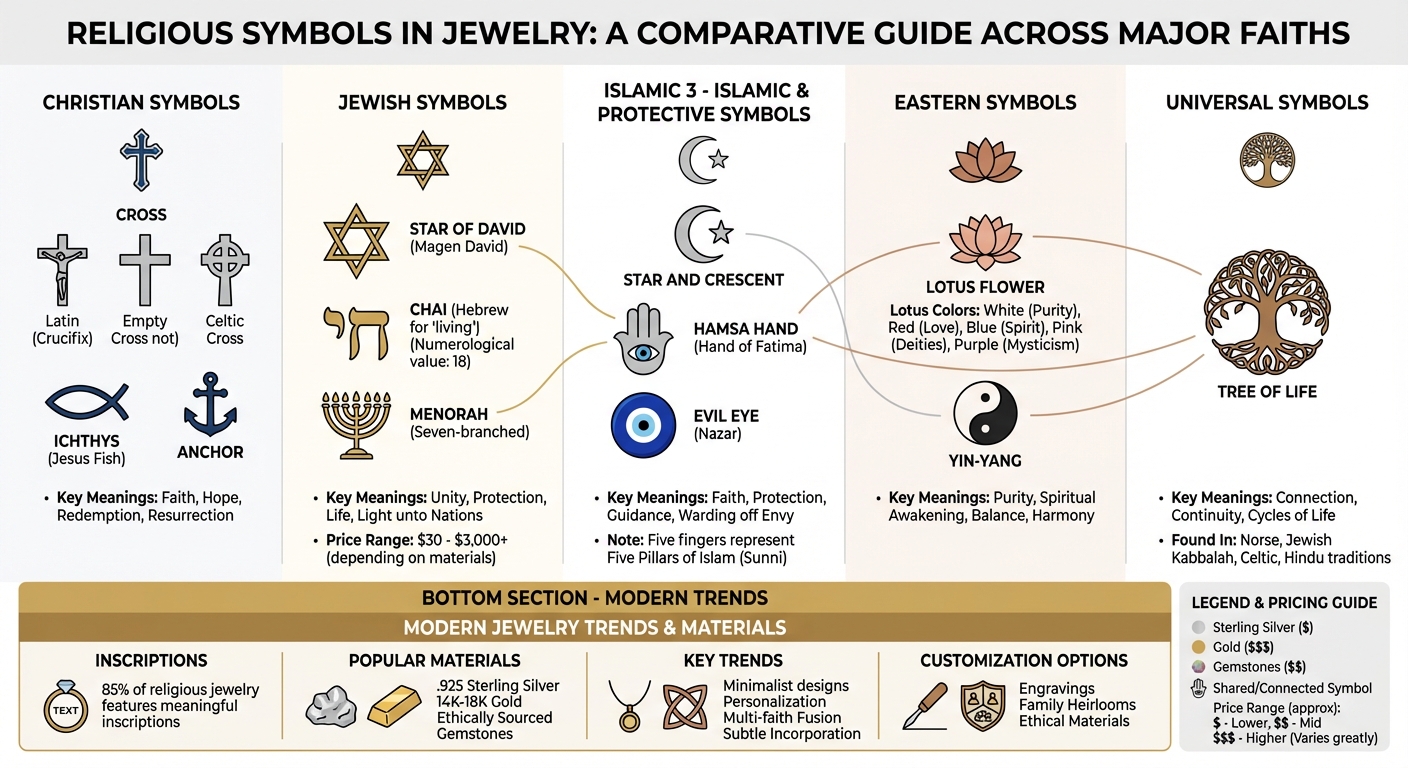
Religious Jewelry Symbols Across Major Faiths: Meanings and Design Elements
Christian Symbols in Jewelry Design
Christian symbols in jewelry serve as deeply personal expressions of faith, carrying centuries of historical and spiritual significance.
The Cross: A Central Symbol of Faith
The cross stands as Christianity's most recognizable emblem, but it wasn't always displayed openly. Before Emperor Constantine's conversion in the early 4th century CE, early Christians often used discreet symbols like the swastika and anchor to avoid persecution. Constantine's embrace of Christianity marked a turning point - he abolished crucifixion as a punishment and elevated the cross as a symbol of redemption and divine love.
Over time, various cross designs emerged, each carrying unique theological meanings. The Latin, Greek, and Celtic crosses highlight themes ranging from Christ's sacrifice to the hope of resurrection. Byzantine and medieval artisans often adorned crosses with precious metals and gemstones, reflecting the reverence of the era. A notable distinction lies between the crucifix, which depicts Jesus on the cross to emphasize his suffering, and the empty cross, favored by Protestant denominations as a symbol of resurrection and triumph over death. By the 9th century, the crucifix had become a prominent design, and in the 20th century, Roman Catholicism introduced depictions of Christ as a crowned king and priest, symbolizing authority and hope rather than suffering.
In modern times, cross jewelry has evolved into a versatile accessory, appearing in necklaces, bracelets, rings, and earrings. Crafted from high-quality metals and often featuring intricate designs, these pieces cater to a wide range of tastes. The 1980s saw a surge in gender-neutral and layered cross designs, blending bold symbolism with contemporary fashion.
Ichthys and Anchor: Discreet Christian Motifs
While the cross is a bold declaration of faith, early Christians also turned to subtler symbols like the Ichthys and anchor during periods of persecution. The Ichthys, or "Jesus fish", is a Greek acronym for "Jesus Christ, Son of God, Savior." It became a secret identifier among believers, reflecting the biblical call for disciples to be "fishers of men". Similarly, the anchor, inspired by Hebrews 6:19 ("an anchor for the soul, firm and secure"), symbolized hope and steadfast faith during life's challenges.
These understated designs continue to resonate with those seeking subtle ways to express their faith. As jewelry designer Beverly Schweigert explains:
"The Ichthys, or Jesus fish, was used by early Christians facing persecution as an 'underground' method for identifying their faith".
Fashion expert Vlad Joseph adds:
"The anchor reflects the message that Christ is the anchor of our souls, keeping us grounded and secure through life's storms".
Today, these symbols are often incorporated into minimalist jewelry, such as delicate charms on necklaces, rings, and bracelets. Modern designs range from 14k white gold pendants to diamond-encrusted fish motifs, combining spiritual meaning with contemporary style. Missionaries also frequently wear "anchor crosses" as reminders of their faith-driven work, emphasizing hope and love. These timeless motifs, reinterpreted for modern tastes, continue to blend historical depth with subtle elegance in today's jewelry designs.
Jewish Symbols in Jewelry Design
Jewish jewelry beautifully merges ancient traditions with modern artistry, conveying profound spirituality and a strong sense of cultural identity.
Star of David: A Symbol of Unity and Protection
The Star of David, or Magen David, is made up of two interlocking triangles. The upward triangle represents humanity's aspiration toward the divine, while the downward triangle signifies divine blessings flowing to earth. Together, they create a harmonious connection between heaven and earth. Its six points are said to symbolize the six days of creation, with the center representing the Sabbath. As Jewish jewelry expert Evelina Grezak explains:
"The star's two interlocking triangles carry deep mystical meaning in Kabbalah - one triangle pointing upward represents humanity's aspirations toward the divine, while the other pointing downward symbolizes God's blessings flowing to earth, creating perfect harmony between heaven and earth".
Adopted as the official symbol of the Zionist movement in 1897, the Star of David evolved into a universal emblem of Jewish identity and later became a symbol of the State of Israel. Today, artisans incorporate this iconic design into pendants, earrings, rings, and bracelets using materials such as 14K gold, sterling silver, and distinctly Israeli elements like Eilat Stone and ancient Roman Glass. Modern styles range from minimalist gold designs ideal for layering to bold, oxidized silver pieces often favored by men. Sterling silver Star of David jewelry typically costs between $30 and $200, while 14K or 18K gold versions start around $300, with more elaborate designs featuring diamonds or intricate craftsmanship exceeding $3,000. Alongside the Star of David, other symbols like the Chai and Menorah continue to hold a special place in Jewish jewelry design.
Chai and Menorah: Symbols of Life and Tradition
In addition to the Star of David, the Chai and Menorah are powerful symbols that celebrate Jewish heritage and values.
The Chai symbol, which represents the Hebrew word for "living", highlights the Jewish focus on the sanctity and vitality of life. In Hebrew numerology, or Gematria, the letters of Chai (Chet = 8, Yud = 10) add up to 18, making this number especially meaningful in Jewish traditions. This connection makes Chai jewelry a popular gift for Bar/Bat Mitzvahs, weddings, and milestone birthdays, often given in multiples of 18 to symbolize blessings and the gift of life. As writer Shaked Karabelnicoff explains:
"The Chai symbol in jewelry... serves as a poignant reminder of the value of life. It underscores the importance of living with purpose and gratitude".
Contemporary designs often combine the Chai symbol with other motifs, such as placing it within a Hamsa for added layers of meaning, including protection and blessings. Prices for Chai jewelry start at around $30 for simple sterling silver designs and can reach up to $2,000 for gold and diamond-encrusted pieces. In Israeli culture, wearing a bold Chai pendant is often associated with being a "mensch" - a person of integrity and honor - making it both a spiritual and cultural statement.
The Menorah, one of Judaism's oldest symbols, represents the mission of the Jewish people to be a "light unto the nations". Before the Star of David became widely recognized, the seven-branched Menorah served as a primary Jewish emblem. Today, it remains a cherished symbol, often featured in jewelry designs. Menorah pendants and earrings are typically crafted with intricate metalwork that reflects its sacred and historical significance, continuing to honor its role as a beacon of light and tradition.
Islamic and Protective Symbols in Jewelry
Islamic jewelry carries a deep connection to spiritual and cultural traditions, crafting pieces that not only captivate the eye but also serve as symbols of protection and divine guidance. Below, we delve into two of the most prominent symbols found in Islamic-inspired jewelry.
Star and Crescent: A Symbol of Faith
The Star and Crescent is one of the most well-known symbols in Islamic-inspired jewelry. While its roots are more cultural than theological, its association with Islam began when the Ottoman Empire adopted it as a state emblem in the late 18th century. As the Ottoman Empire served as the Caliphate, this emblem became intertwined with the Islamic faith.
In jewelry design, the star and crescent often symbolize the new moon of Ramadan, representing enlightenment and the guiding light for believers. As eJannah describes:
"Beyond its visual allure, the crescent and star serve as constant reminders of the ever-present light guiding the path of believers".
Modern interpretations of the star and crescent often feature the "floating star" design, where the star appears inside a crescent moon. These designs are commonly found on gold pendants, diamond-studded charms, bracelets, and anklets. Many contemporary pieces incorporate Arabic calligraphy, such as the words "Allah" or "Bismillah", to add spiritual significance.
Regional variations in design highlight the blend of tradition and creativity. For example, Turkish-inspired jewelry places the star outside the crescent's arc, while designs from Algeria, Tunisia, and Pakistan position the star within the crescent. Such details reflect the regional heritage and artistic interpretation of this symbol. However, jewelry featuring the name of Allah should always be handled respectfully and removed before entering a bathroom.
Next, we examine protective symbols that transcend cultural boundaries.
Hamsa and Evil Eye: Protective Amulets
The Hamsa Hand and Evil Eye are ancient symbols of protection that have become staples in modern jewelry, cherished across various traditions. The Hamsa, often referred to as the "Hand of God", is believed to bring happiness, health, and good fortune. The name "Hamsa" originates from the Arabic word for "five", symbolizing the five fingers of the hand. This symbol predates modern religions, tracing back to the Phoenicians, who associated it with an ancient Middle Eastern goddess.
The Hamsa carries different meanings depending on the tradition. In Islam, it is known as the Hand of Fatima, named after the Prophet Mohammed's daughter. In Judaism, it is called the Hand of Miriam, and in Christianity, the Hand of Mary. As Goddess Garden explains:
"In the Islamic faith, the hamsa hand symbolizes The Hand of Fatima, daughter of the Prophet Mohammed".
For Sunni Muslims, the five fingers represent the Five Pillars of Islam, while for Shi'ite Muslims, they symbolize the Five People of the Cloak.
The Evil Eye, or Nazar, is another ancient symbol aimed at protecting against harm caused by envy or jealousy. This belief dates back nearly 3,000 years to ancient Greece and Rome. In jewelry, the Evil Eye often appears as a standalone charm or is incorporated into the palm of a Hamsa hand. Andrew Wilson from All Diamond explains:
"The symbol is used to ward off the evil eye and is associated with the saying 'khamsa fi ainek', meaning 'five fingers in your eye'".
Hamsa jewelry can be worn with the hand facing either up or down, as both orientations are thought to offer protection and success. Today’s designers reimagine these ancient amulets as fine jewelry, using materials like 14K–18K gold, diamonds, sapphires, and rubies. For example, 18K gold Hamsa pendants adorned with 0.33–0.60ct diamonds are priced between $1,060 and $2,160, while simpler silver versions can be found for around $55.
Interestingly, the Hamsa has also taken on a modern role as a symbol of peace and unity, particularly among activists who use it to highlight the shared heritage between Judaism and Islam.
Eastern and Universal Symbols in Jewelry Design
Jewelry often carries meaning far beyond its aesthetic appeal, and symbols from Eastern traditions and universal archetypes play a big role in modern designs. These motifs speak to timeless spiritual themes like balance, enlightenment, and interconnectedness, offering a bridge between ancient traditions and contemporary creativity. Let’s dive into a few examples to see how these symbols resonate in jewelry today.
Lotus Flower: A Sign of Purity and Spiritual Awakening
The lotus flower holds deep meaning across many Eastern traditions. Known for its ability to emerge pristine from muddy waters, it symbolizes spiritual growth and awakening. Confucius once said:
"I have a love for the Lotus, while growing in mud it still remains unstained."
In Buddhism, the lotus represents the journey toward enlightenment. A closed bud reflects an undeveloped mind, while a fully bloomed lotus signifies complete spiritual awakening. The flower is also tied to the Tibetan mantra "Om Mani Padme Hum", which translates to "Hail to the Jewel in the Lotus". In Hinduism, deities like Lakshmi and Brahma are often depicted with lotus flowers, symbolizing purity and divine energy [41,43].
Anisha Ghosh, Co-founder and Head Designer at Saffron Marigold, captures the essence of the lotus beautifully:
"The lotus is my absolute favorite flower... I often visualize the blooming lotus flower and use its eastern spiritual meaning as a metaphor for life."
Modern jewelry designers bring the lotus to life in various forms, from simple silver pendants to ornate gold pieces adorned with gemstones. These designs often signify new beginnings or personal growth. Prices for lotus-inspired pieces range widely, from $89 for a minimalist charm necklace to $5,292 for an intricate gold Ankh and Lotus necklace [42,43]. The lotus is also frequently paired with other spiritual symbols, such as the Om, Hamsa, or Buddha imagery.
Interestingly, the color of the lotus adds another layer of meaning. White represents mental purity and perfection, red embodies love and compassion, blue symbolizes the triumph of spirit over the senses, pink is associated with the highest deities, and purple conveys mysticism.
Yin-Yang and Tree of Life: Harmony and Connection
The Yin-Yang symbol is a cornerstone of Taoist philosophy, representing the balance of opposing forces in the universe. The black and white halves, with their interlocking dots, serve as a reminder that light and dark, masculine and feminine, and other dualities are interconnected. The outer circle symbolizes the universe as a whole, showing that nothing exists in isolation. In jewelry, designers often use contrasting materials - like black onyx and white pearl - to bring this concept to life.
Equally meaningful is the Tree of Life, a universal symbol found in many cultural traditions, including Norse mythology's Yggdrasil, Jewish Kabbalah, and Celtic and Hindu lore. With its deep roots and flourishing branches, the Tree of Life represents the connection between all living things and the cycles of life and death. It also bridges the physical and spiritual realms - linking heaven, earth, and the underworld.
While the Yin-Yang focuses on balance, the Tree of Life emphasizes continuity and connection. In modern jewelry, it often appears in "family tree" designs, where the branches symbolize family members staying connected through life's ups and downs. A popular style involves wire-wrapped trees within circular frames, with gemstones or crystals forming the leaves.
Celtic interpretations of the Tree of Life tend to highlight symmetry and geometric patterns, while Indian versions feature more organic, flowing forms, often with birds perched on the branches. These designs allow wearers to express personal values, seek spiritual grounding, or carry daily reminders of intentions like peace and resilience.
Modern Design Trends and Fusion in Religious Jewelry
Today’s jewelry designers are breathing new life into sacred symbols, creating pieces that reflect contemporary tastes while still honoring their deep-rooted traditions. The result? A striking combination of timeless meaning and modern aesthetics that resonates with today’s wearers. This merging of tradition and fresh design sensibilities has opened the door to exciting reinterpretations of religious icons.
Combining Old and New Design Aesthetics
Designers are finding innovative ways to reimagine religious symbols. Take the cross, for example - it might be redesigned with sleek, minimalist lines for a modern vibe or adorned with intricate filigree for a blend of vintage and contemporary styles. These fresh takes allow traditional symbols to feel both familiar and new.
Another growing trend is the fusion of motifs from different faiths. Designers might pair the Tree of Life with Islamic geometric patterns or combine elements like the Star of David, the Buddha, and the Cross in a single piece. Even ancient symbols like the Yin-Yang are being updated with recycled metals, ethically sourced gemstones, and contrasting diamonds. Some designs lean into edgier aesthetics, incorporating spikes or dagger-like shapes to appeal to alternative fashion lovers. In fact, one jewelry retailer noted that 85% of their inventory now features pieces with spiritual meanings or inscriptions, reflecting a major shift toward “jewelry with meaning”.
Subtlety is another hallmark of modern religious jewelry. Many individuals now prefer understated details - think a small lotus flower on stud earrings, a cross etched discreetly into a wedding band, or an Ichthys symbol hidden within a tennis bracelet. Bhindi Jewelers highlights this trend:
"Modern designers reinterpret these traditional symbols with fresh viewpoints. A cross might be rendered in minimalist lines... This creative evolution keeps religious jewelry relevant across generations."
As designs evolve, the rise of personalization has also transformed religious jewelry into something deeply personal and unique.
Personalization and Customization of Religious Jewelry
Personalization has become a cornerstone of modern religious jewelry. Beyond reimagining traditional designs, customization allows individuals to create pieces that tell their own spiritual stories. Bhindi Jewelers describes this shift perfectly:
"The most significant religious jewelry trend is personalization. The pieces can be hand-designed specifically to represent one's individual religious journey."
This personalization takes many forms. Some choose to incorporate family heirlooms into new designs, blending the old with the new. Others commemorate key life events or infuse their jewelry with personal interpretations of their faith. For many, combining symbols from multiple traditions creates pieces that reflect a more personal spiritual path rather than adherence to a single faith.
Ethical considerations also play a big role in customization. Many consumers now prefer jewelry made from recycled metals or ethically sourced gemstones, aligning their purchases with both their spiritual beliefs and ethical values. This shift transforms religious jewelry into more than just an accessory - it becomes a meaningful expression of faith and values.
There’s also a stark difference between mass-produced pieces and handcrafted, custom designs. High-quality metals like solid gold and silver, paired with natural stones, give custom pieces a sense of permanence and value, making them perfect for passing down through generations. Whether it’s through engravings, unique stone choices, or symbolic touches, customization ensures that each piece carries a deeply personal significance.
LaCkore Couture's Handcrafted Religious-Inspired Pieces
LaCkore Couture takes sacred symbols and reimagines them for the modern world, creating handcrafted jewelry that blends timeless spirituality with contemporary design. Made in the U.S., their pieces honor tradition while embracing modern aesthetics, using tarnish-free, high-quality materials. With every item backed by a lifetime guarantee, the brand emphasizes both craftsmanship and durability.
"Every woman should feel beautiful in their jewelry... whether you're looking for a special gift or just a unique way to express yourself, LaCkore Couture is the perfect place".
Their religious-inspired jewelry uses materials such as .925 sterling silver (a mix of 92.5% pure silver and copper for added strength), 16k and 24k gold, and natural stones. To ensure transparency about quality, each piece is stamped with its metal content.
Religious-Inspired Collections
LaCkore Couture's talisman pieces, like the Evil Eye and Hamsa Hand, combine deep spiritual meaning with a sleek, modern look. The Evil Eye collection features charms in various colors, each symbolizing something unique: dark blue for karma and fate, yellow for health and optimism, white for purity, orange for creativity, and red for courage. Gold Evil Eye charms are priced between $19 and $24.
The Hamsa Hand, a symbol of protection, blessings, and strength, is available in both 16k gold and silver. For necklaces, designs like the "Black Out" and "Crystal Dreams" are priced at about $97, while more elaborate pieces, such as the Long Lock Charm Necklace, cost around $119. One satisfied customer, Hallie M., gave the jewelry a 5-star rating, praising the "well-made, high-quality" pieces and their "gorgeous" stones.
Customization and Personal Expression
In addition to their ready-made collections, LaCkore Couture offers ways for customers to personalize their jewelry. Through the Charm Bar, shoppers can choose chain lengths (16, 18, or 20 inches), select thin or thick chain styles, and add gold initial charms for $19. This allows wearers to combine religious symbols with their own personal touch.
For those who follow traditional practices, the brand recommends having an Evil Eye talisman gifted to you by someone wishing you good fortune to maximize its protective energy. They also suggest wearing Evil Eye rings or bracelets on the left side, as the left arm is traditionally associated with guarding against vulnerability. Another happy customer, Leigh H., described LaCkore Couture as her "go-to gift shop" for beautiful and well-loved pieces.
Conclusion
Religious symbols have stood the test of time because they connect deeply to faith, heritage, and personal identity. As Bhindi Blog aptly puts it:
"Fashions change! Yet religious jewelry has lasted for centuries... because they represent something more than appearance. They resonate with the human desire for connection".
These pieces act as portable tokens of belief, helping wearers maintain their spiritual ties as they navigate daily life.
Modern designs are building on this rich tradition, blending sacred motifs with contemporary aesthetics. Today’s brands are reinterpreting iconic symbols with clean lines, 24k gold accents, and understated elegance. Personalization has also become a key trend, with 85% of religious jewelry now featuring meaningful inscriptions that reflect individual spirituality.
LaCkore Couture is a shining example of this balance between tradition and modernity. Known for its handcrafted designs, the brand honors sacred symbols while embracing a fresh, stylish approach. Their Charm Bar, for instance, allows customers to pair timeless icons like the Hamsa or Evil Eye with personal elements, creating one-of-a-kind pieces that tell unique spiritual stories. Crafted from .925 sterling silver and genuine gold, these pieces are both accessible and deeply meaningful.
Symbols like the protective Hamsa, the lotus flower’s message of enlightenment, and the Tree of Life’s representation of universal balance show how religious jewelry carries beliefs while reflecting personal style. The blending of symbols across faiths mirrors our interconnected world, where many seek spiritual meanings that go beyond a single tradition. Each piece contributes to an ongoing dialogue between heritage and modern design, ensuring their relevance for generations to come.
FAQs
What are some common religious symbols used in jewelry design today?
Religious symbols have found a prominent place in modern jewelry design, often carrying profound spiritual or personal significance. Familiar examples include the Christian cross, symbolizing faith and redemption, the Hamsa hand, believed to offer protection and bring good fortune, the Islamic star and crescent, and Buddhist motifs like the lotus flower and the Dharma Wheel, which represent purity and the path to enlightenment. These symbols beautifully intertwine faith, tradition, and individuality.
Jewelry featuring these sacred designs goes beyond mere decoration. It often acts as a tangible connection to one's beliefs or heritage. Whether crafted from gold, silver, or enhanced with natural stones, these pieces balance style with meaning, making them cherished keepsakes that stand the test of time.
How do jewelry designers use ethical materials in religious-inspired pieces?
Jewelry designers today are placing a stronger emphasis on using ethically sourced materials, blending spiritual meaning with responsible practices. Many opt for gemstones certified by initiatives like the Kimberley Process for diamonds or Fairmined for gold. These certifications guarantee fair wages, safe working environments, and responsible mining methods. Additionally, lab-grown stones have become a favorite choice for being both conflict-free and environmentally conscious.
At LaCkore Couture, these values are at the heart of creating religious-inspired jewelry. The brand uses recycled precious metals and conflict-free gemstones to craft necklaces, earrings, and bracelets that reflect both quality and ethical responsibility. From crosses to lotus flowers and dharmachakra symbols, every piece is thoughtfully designed with respect for the planet and its people.
What does the lotus flower represent in Eastern-inspired jewelry?
The lotus flower holds a special place in Eastern-inspired jewelry, symbolizing purity, spiritual growth, and enlightenment. Rooted in Buddhist traditions, it reflects the path toward awakening and rebirth, just as the lotus rises gracefully from murky waters to bloom.
Lotus-themed jewelry often carries a deeper meaning, acting as a personal reminder of one’s journey through growth, resilience, and the quest for inner peace.