Skip to content




5 Religious Jewelry Types and Their Meanings
Religious jewelry is more than decoration - it's a way to express faith, spirituality, and personal identity. Here's a quick look at five popular types of religious jewelry and their meanings:
- Cross Necklaces and Pendants: Represent faith, sacrifice, and transformation in Christianity, with variations across denominations.
- Prayer Beads and Rosaries: Used in multiple religions (Christianity, Islam, Hinduism, Buddhism) to aid prayer, meditation, and mindfulness.
- Amulets and Talismans: Offer protection or attract blessings, seen in traditions like Judaism, Islam, and Hinduism.
- Medallions and Saint Pendants: Symbols of devotion, intercession, and faith, often tied to Christian saints or holy figures.
- Religious and Spiritual Rings: Represent vows, authority, or spiritual commitments across Christianity, Islam, and Hindu traditions.
Each piece combines history, symbolism, and craftsmanship to connect wearers with their beliefs and heritage. Whether it's a cross pendant or a prayer ring, these items serve as personal and spiritual reminders.
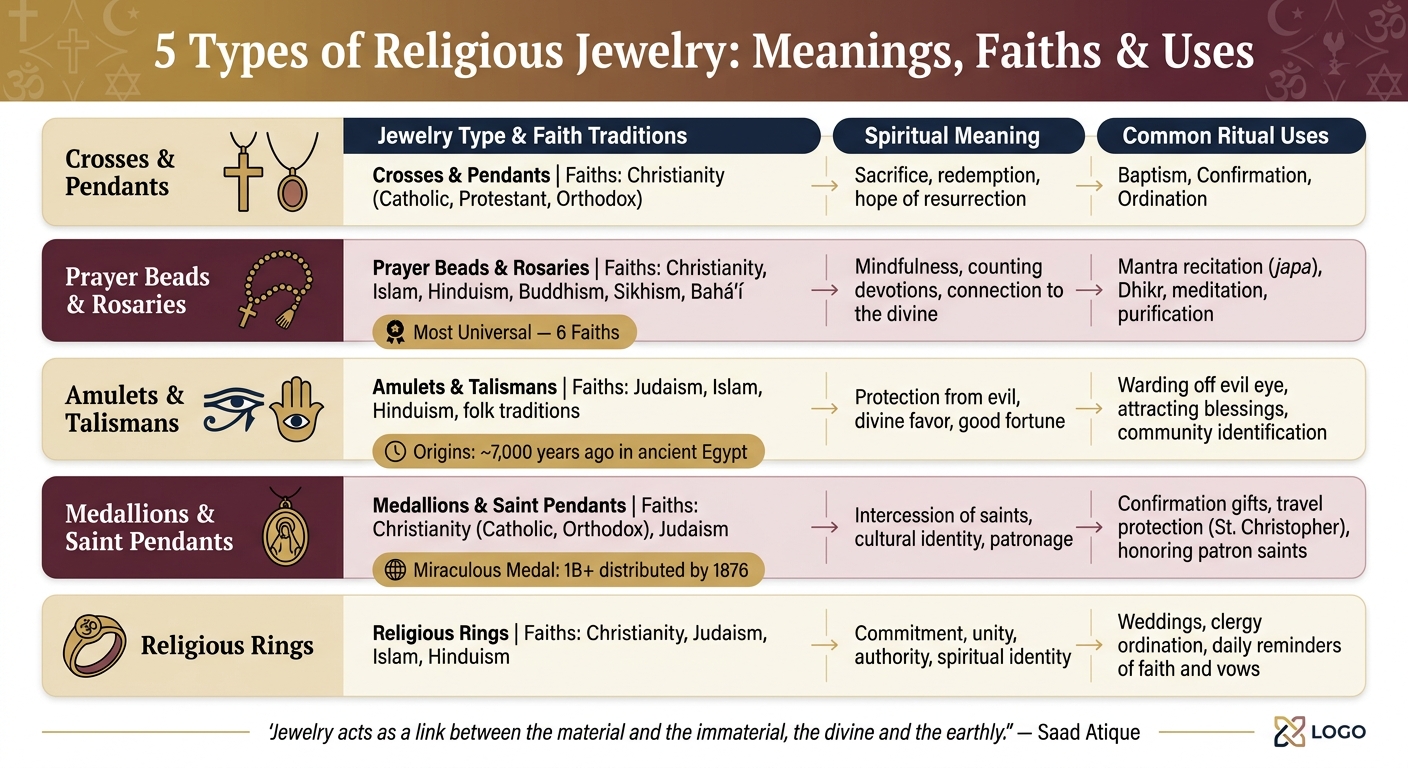
5 Types of Religious Jewelry: Meanings, Faiths & Uses
1. Cross Necklaces and Pendants
The cross stands as one of the most enduring and recognizable symbols of faith. While it is now closely associated with Christianity, its roots stretch back to ancient civilizations. For example, the Egyptian ankh symbolized life, and the Mesopotamian crux ansata was linked to fertility.
The cross took on a new role after Emperor Constantine's conversion in 313 AD and the Edict of Milan. What once was a discreet emblem of faith became a public and celebrated symbol. By the 6th century, the crucifix - a cross featuring the figure of Jesus - was a common motif in Christian art.
Different Christian denominations have their own traditions around the cross. In the Eastern Orthodox Church, individuals are often expected to wear their baptismal cross at all times. Catholics frequently wear crucifixes, emphasizing Jesus' sacrifice, while many Protestants favor a plain cross, highlighting themes of resurrection and hope. Cross necklaces also serve as meaningful gifts for milestones like baptisms and confirmations.
"The cross became the central symbol of Christianity because it represents both sacrifice and transformation." – Noir KĀLA
In modern times, cross necklaces appeal to both religious and secular audiences. Customization options abound, from engraved designs to birthstone accents. Prices vary widely, starting at around $65 for simpler pieces and reaching $1,490 for high-end, handcrafted designs like Black Pearl of Queens' Lumine Four Lab-Grown Diamond Cross Necklace. Durable materials like solid gold and sterling silver not only add longevity but also ensure skin-friendly wear. The cross’s timeless significance continues to inspire, making it a cornerstone in the world of religious jewelry and beyond.
2. Prayer Beads and Rosaries
Prayer beads have been a part of human spirituality for centuries, tracing their origins back to ancient Hindu practices. Over time, they became integral to Buddhism, Islam, and Christianity, and today, they even play a role in modern mindfulness routines.
Each faith has its own take on prayer beads. Hindu and Buddhist malas typically feature 108 beads, symbolizing 108 human afflictions or deities. In Islam, the misbaha consists of 99 beads, each representing one of Allah's names. Catholic rosaries, on the other hand, include 59 beads used to reflect on the Mysteries of Christ’s life. Meanwhile, Eastern Orthodox monks use a komboskini, a knotted wool rope where each knot is tied with a complex pattern of seven overlapping crosses. These variations reflect the rich diversity of spiritual practices and the unique rituals tied to religious jewelry.
Despite their differences, all traditions share a common goal: helping the mind stay focused during prayer or mantra recitation. Moving bead by bead provides a tactile rhythm that enhances concentration. Neuroscientist Andrew Newberg explains this connection, noting:
"Activities involving meditation and intensive prayer permanently strengthen neural functioning in specific parts of the brain that are involved with lowering anxiety and depression."
Beyond their religious significance, prayer beads have found a place in secular stress relief. Meditation practices in the U.S. have surged, with adult participation growing from 7.5% in 2002 to 17.3% in 2022. This trend has fueled interest in beads as mindfulness tools. Smaller wrist malas with 21–27 beads are especially practical for managing stress on the go. The repetitive motion of handling the beads can disrupt anxious thoughts and bring a sense of calm.
Today, prayer beads are evolving to meet modern tastes. Customization options, like choosing specific gemstones or metals, blend traditional elements with contemporary aesthetics. These updates reflect how prayer jewelry continues to bridge ancient traditions with modern wellness practices.
3. Amulets and Talismans
Though often used interchangeably, amulets and talismans serve distinct purposes. An amulet is considered a passive charm, offering protection against harm, while a talisman is more active, designed to attract positive outcomes like luck, love, or courage.
Scholar Theodor H. Gaster explains:
"Amulets and talismans are two sides of the same coin. The former are designed to repel what is baneful; the latter, to impel what is beneficial."
The use of amulets dates back thousands of years. Some of the earliest examples, from ancient Egypt around 7,000 years ago, include the Eye of Horus, believed to provide healing and protection, and scarabs, which symbolized rebirth. In ancient Rome, a fascinus (a phallic symbol) was hung under a general's chariot during victory parades to shield against envy. Across cultures, amulets have long been tied to spiritual protection, with examples found in Judaism and Islam as well.
Each tradition has its own unique designs. In Tibetan Buddhism, Gau boxes are used to enclose sacred objects and rolled mantras, invoking deities like Green Tara or Medicine Buddha for protection. In Judaism, kemiot - inscribed with divine or angelic names - were historically used to safeguard childbirth. Catholic tradition often turns to the Saint Benedict Medal, believed to ward off evil and temptation.
In modern times, symbols like the nazar (evil eye bead) and the Hamsa have become popular in fashion, appearing in everything from casual streetwear to high-end red carpet looks. Many people choose these items based on their heritage or for specific purposes, such as promoting health or ensuring safe travel. It's also common to layer multiple symbols - like a cross, saint medal, or Italian cornicello - on a single chain for combined protection.
One practical belief about amulets is that if they break or crack, it’s often seen as a sign they’ve absorbed negative energy. Tradition suggests replacing them rather than attempting repairs. Up next, we’ll delve into the meaning behind religious rings.
4. Medallions, Icons, and Saint Pendants
Religious medals have been part of Christian tradition for centuries. Archaeologists have uncovered medals depicting Saints Peter and Paul dating back to the 2nd century, when early Christians used them as discreet symbols of their faith during times of persecution. By the 4th century, these medals took on new meaning as commemorative items. For example, St. Zeno of Verona is noted for giving them to newly baptized Christians, while St. Genevieve wore one as a personal reminder of her vow of virginity.
During the medieval period, these medals evolved into practical keepsakes. Pilgrims visiting holy sites like Canterbury or Santiago de Compostela would buy small lead or pewter "pilgrim signs" (signacula) to mark their spiritual journey. At the height of their popularity, shrines sold more than 100,000 badges each year. In January 1200, Pope Innocent III granted the canons of St. Peter's Basilica in Rome exclusive rights to cast and sell these tokens to pilgrims. This laid the groundwork for the iconic religious medals we recognize today.
One of the most famous examples is the Miraculous Medal. Its origins trace back to reported apparitions of the Virgin Mary to Sister Catherine Labouré in Paris. The first 1,500 medals were struck on June 30, 1832. By 1835, over 1 million had been distributed globally, and by the time of Sister Catherine’s death in 1876, that number had surpassed 1 billion. The medal bears the inscription:
"O Mary, conceived without sin, pray for us who have recourse to thee."
In Catholic teaching, medals like this are considered sacramentals - sacred signs connected to the wearer’s faith and the Church's prayers. As Fr. William Saunders explains:
"Never should we look upon the wearing of a religious medal as a 'charm,' but always as a sacred symbol of the supernatural protection offered directly by our Lord, Blessed Mother or saint."
Today, saint pendants are cherished gifts for milestones like Baptisms, First Communions, Confirmations, and weddings. Popular choices include St. Christopher, St. Jude, and St. Michael. For those with multiple devotions, the Four-Way Medal - which combines St. Christopher, St. Joseph, St. Michael, and the Miraculous Medal on a single cross-shaped design - offers a meaningful option. Modern touches like engraving, birthstones, and different metals have added a personal element. Among these, 14K gold stands out as a favorite for its durability and timeless significance, making it ideal for daily wear.
5. Religious and Spiritual Rings
Religious rings carry a rich history of symbolism, expanding on the tradition of sacred medals and pendants. These rings have long represented authority, vows, and spiritual commitments. For instance, in ancient Egypt, signet rings symbolized power, a practice reflected in Biblical narratives and later adopted in church ceremonies. St. Isidore of Seville described the ring as "an emblem of the pontifical dignity or of the sealing of secrets". A notable example is the Pope's Fisherman's Ring (Anulus Piscatoris), engraved with an image of St. Peter casting a net. This ring served as the official papal seal and was traditionally destroyed upon the Pope’s death.
The use of rings to symbolize faith and commitment dates back centuries. In the 9th century, Pope Nicholas I established engagement rings as a sign of faith. The custom of wearing a wedding ring on the fourth finger of the left hand stems from the ancient Roman and Egyptian belief in the vena amoris - a "vein of love" thought to connect directly to the heart. Across many faiths, the unbroken circle of a ring symbolizes an eternal covenant.
Religious rings often signify vows beyond marriage. For example, rosary rings, featuring ten raised knobs and a small cross, allow discreet counting of prayer cycles like a decade of Hail Marys. In Islam, Aqiq rings made of carnelian are worn in emulation of the Prophet Muhammad. In Kerala, India, the Payyannur Pavithra Ring, traditionally crafted from sacred dharba grass, is used during pithru bali (ancestral worship rituals) to maintain the purity of offerings. The artisans who create these rings must abstain from meat and alcohol throughout their lives to preserve the ring's ritual sanctity.
Modern innovations have added personalization to these symbolic rings while preserving their spiritual essence. Stackable bands allow wearers to combine symbols from multiple faiths or devotions. Some rings now incorporate nanotechnology, embedding a tiny chip engraved with the full text of the KJV Bible. Material choice also carries meaning; in Vedic tradition, gold is linked to Jupiter, symbolizing wisdom, while silver is associated with the Moon, representing emotional balance. These advancements highlight how religious rings continue to serve as meaningful expressions of faith in contemporary life.
| Ring Type | Faith/Culture | Core Meaning |
|---|---|---|
| Signet Ring | Ancient Egypt/Biblical | Authority and legal sealing |
| Fisherman's Ring | Catholic | Papal office and seal of faith |
| Aqiq Ring | Islam | Emulation of the Prophet Muhammad |
| Rosary Ring | Christianity | Portable tool for prayer cycles |
| Pavithra Ring | Hindu (Kerala) | Ritual purity in ancestral worship |
| Purity Ring | Christianity | Public vow of chastity until marriage |
Comparison Table
Each type of jewelry carries its own spiritual purpose, deeply rooted in various faith traditions and rituals. Here's a quick comparison of their meanings and uses:
| Jewelry Type | Primary Faith Traditions | Spiritual Meaning | Common Ritual Uses |
|---|---|---|---|
| Crosses & Pendants | Christianity (Catholic, Protestant, Orthodox) | Sacrifice, redemption, and hope of resurrection | Baptism, Confirmation, Ordination |
| Prayer Beads & Rosaries | Christianity, Islam, Hinduism, Buddhism, Sikhism, Baháʼí | Mindfulness, counting devotions, connection to the divine | Mantra recitation (japa), Dhikr (Islam), meditation, purification |
| Amulets & Talismans | Judaism, Islam, Hinduism, folk traditions | Protection from evil, divine favor, good fortune | Warding off the evil eye, attracting blessings, community identification |
| Medallions & Saint Pendants | Christianity (Catholic, Orthodox), Judaism | Intercession of saints, cultural identity, patronage | Confirmation gifts, travel protection (St. Christopher), honoring patron saints |
| Religious Rings | Christianity, Judaism, Islam, Hinduism | Commitment, unity, authority, spiritual identity | Weddings, clergy ordination, daily reminders of faith and vows |
This table highlights how each jewelry type reflects its cultural and spiritual origins.
A few interesting patterns stand out. Prayer beads are the most universally used, appearing in at least six major religions, while saint medallions are closely tied to Catholic and Orthodox practices. Amulets, on the other hand, often blur the boundaries between formal religion and folk traditions, making their use especially adaptable.
The choice of material also plays a key role in reinforcing the meaning of these items. As one jeweler explains, "Gold doesn't tarnish, rust, or decay, making it the perfect representation of an eternal bond between the wearer and their faith." This sentiment applies across various forms, from cross pendants to misbahas and bishop's rings.
"Jewelry acts as a link between the material and the immaterial, the divine and the earthly, in rituals and religion." - Saad Atique
Conclusion
From cross pendants to prayer beads, amulets, medallions, and rings, every piece carries its own spiritual significance.
Religious jewelry goes beyond mere decoration - it represents faith, tradition, and identity. Whether it’s a cross pendant received at baptism, a rosary used in daily prayer, or a saint medallion gifted at Confirmation, these items serve as powerful, tangible links to one's beliefs and heritage. They are not just accessories; they are symbols of personal and communal connection.
"Religious jewelry symbols are more than mere adornments; they are profound representations of faith, spirituality, and cultural identity." - JewelryNearMe
Their timeless appeal adds to their meaning. These pieces demonstrate the deep relationship between physical craftsmanship and spiritual devotion, with some becoming cherished heirlooms passed down through generations.
When selecting religious jewelry, craftsmanship matters. Handcrafted items - like those available through LaCkore Couture - highlight the importance of quality and attention to detail. Choosing materials like solid gold or sterling silver ensures your jewelry is not only beautiful but also durable enough for everyday wear.
The perfect piece is one that resonates with your faith and personal story. Take the time to appreciate its symbolism, allowing it to become a treasured expression of your beliefs - one that bridges your personal journey with the enduring traditions explored in this article.
FAQs
How do I choose religious jewelry that matches my faith?
To select religious jewelry that truly represents your faith, begin by focusing on symbols that hold personal significance and align with your beliefs. Think about the purpose of the piece - whether it’s meant for protection, an expression of devotion, or to mark important events like baptisms or confirmations. At LaCkore Couture, we offer handcrafted designs that blend craftsmanship with individuality, helping you share your spiritual story with style and purpose.
Can I wear prayer beads or rosaries as jewelry without using them for prayer?
Yes, you can wear prayer beads or rosaries as jewelry, but it's important to approach them with respect. Many people wear them as a sign of their faith or as a personal reminder of prayer. However, if you're unsure whether it's appropriate, you might want to opt for jewelry that's specifically designed for wearing, rather than items intended strictly for prayer or meditation.
What’s the difference between an amulet and a talisman?
Although people often confuse the two, amulets and talismans have different roles. An amulet is meant to protect, acting as a barrier against harmful energies, misfortune, or danger. On the other hand, a talisman is created to bring positive things into your life, like love, success, or bravery. You can think of an amulet as a shield that keeps negativity away, while a talisman works like a magnet, pulling in the energy you want to enhance your abilities.