Skip to content




Top 7 Rare Gemstones with Historical Legends
Gemstones are more than just beautiful stones - they carry stories of power, protection, and history. From rubies believed to make warriors invincible to pearls once thought to be gods' tears, each gem has a rich past. Here's a quick look at seven rare gemstones and their fascinating legends:
- Ruby: Known as the "king of precious stones", rubies have been tied to invincibility, divine power, and prosperity. Ancient warriors even embedded them under their skin for protection in battle.
- Emerald: Treasured by Cleopatra and mined as early as 1500 BCE, emeralds symbolize eternal life and fertility. Legends say they were formed from the tears of immortal beings.
- Pearl: The only gemstone created by living organisms, pearls have been symbols of purity and wealth for thousands of years. Cleopatra famously dissolved one in vinegar to win a bet.
- Diamond: Associated with invincibility and divine power, diamonds have been central to myths like the cursed Hope Diamond and legends of treasure-filled valleys.
- Sapphire: Worn by ancient Greeks for prophecy and medieval clergy for purity, sapphires were believed to bring peace and protect against envy.
- Alexandrite: Discovered in Russia, its color-changing properties symbolize duality and hidden power. It was named after Czar Alexander II.
- Oriental Cat's Eye: Known for its striking "cat's eye" effect, this gem is linked to protection and mystical powers in ancient Vedic texts.
Each gemstone is rare due to unique geological conditions, with some, like untreated rubies and natural pearls, commanding millions of dollars per carat. Their stories and scarcity make them timeless treasures.
Quick Comparison
| Gemstone | Legends | Symbolism | Rarity |
|---|---|---|---|
| Ruby | Grants invincibility; Syamantaka jewel produces gold daily | Power, protection, prosperity | Large flawless rubies are extremely scarce |
| Emerald | Formed from tears of immortals; Cleopatra’s favorite stone | Eternal life, fertility | Eye-clean specimens are very rare |
| Pearl | Tears of gods; Cleopatra dissolved one in vinegar | Purity, wealth | Natural pearls are almost nonexistent |
| Diamond | Fragments of stars; Hope Diamond’s curse | Invincibility, divine power | Type IIa diamonds and blue diamonds are rare |
| Sapphire | Linked to prophecy and celestial favor | Peace, protection, purity | Untreated stones make up ~1% of supply |
| Alexandrite | Color-changing gem tied to Russian pride | Duality, hidden power | High-quality stones over 1 carat are rare |
| Oriental Cat's Eye | Protects against evil; origins tied to Vala’s war cry | Intuition, protection | The rarest gemstone with a cat's eye effect |
These gems are not just treasures - they're pieces of history. Let’s dive into their stories and uncover their enduring allure.
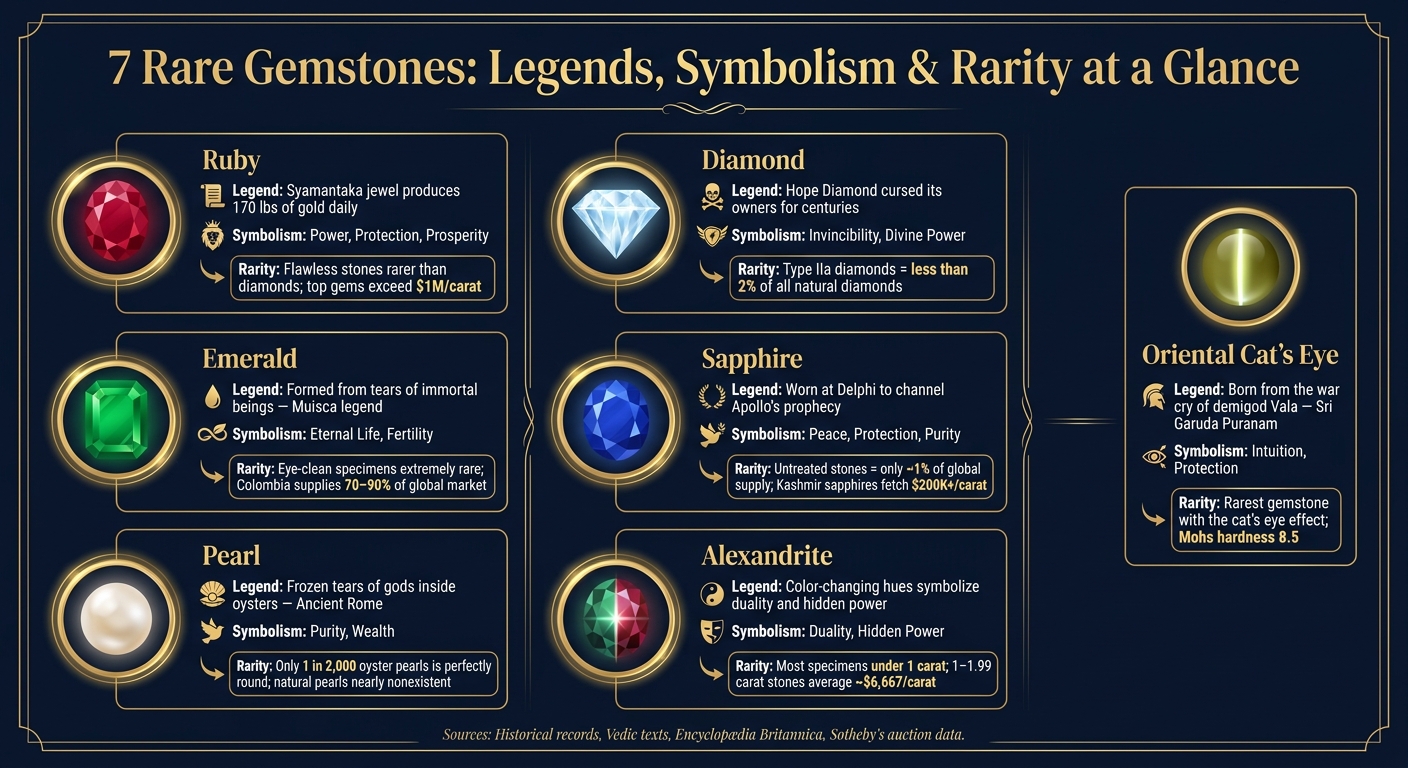
7 Rare Gemstones: Legends, Symbolism & Rarity at a Glance
1. Ruby
Historical Origin
Rubies have a rich history that traces back to the Mogok Valley of Myanmar (formerly Burma), a legendary gem-mining region with over a millennium of heritage. Another ancient source is Sri Lanka, where the city of Ratnapura, meaning "City of Rubies", became a historic center for the gem trade.
The earliest recorded mention of rubies as treasured gifts dates to the 3rd century B.C.. The Sri Lankan chronicle Mahavamsa details how King Devanampiyatissa sent rubies to Emperor Ashoka of India. Even Marco Polo, during his travels to Sri Lanka in 1292, was captivated by their beauty. He wrote:
"The island produces more beautiful and valuable rubies than are found in any other part of the world... The king is supposed to possess one of the grandest rubies that ever was seen, being a span in length and the thickness of a man's arm." - Marco Polo, Venetian Traveller
Such accounts laid the foundation for the countless myths and legends surrounding rubies.
Associated Legends and Myths
Rubies have been revered across cultures, often seen as more than just ornamental gems. Ancient Burmese warriors believed rubies granted invincibility in battle, even going so far as to implant them under their skin. This belief highlights the mystical power attributed to the stone.
In Hindu mythology, rubies are referred to as ratnaraj, or "king of precious stones." The Harita Smriti states:
"He who worships Krishna with rubies will be reborn as a powerful emperor. If with a small ruby, he will be born a king."
One famous tale from the Vishnu Purana describes the Syamantaka jewel, a massive ruby said to generate 170 pounds of gold daily and protect its land from natural disasters. In medieval Europe, rubies were thought to contain an inner flame so powerful it could boil water or glow through thick cloth.
Cultural Significance
Rubies often played a role in royal and political spheres. For instance, during the Battle of Agincourt in October 1415, King Henry V of England wore a helmet adorned with the "Black Prince's Ruby." When the French Duke of Alençon struck his helmet, the gem was credited with saving the king's life. Interestingly, that gem, now part of the British Imperial State Crown, was later identified as a red spinel, not a true ruby. This mix-up reflects how loosely the term "ruby" was applied before chemical analysis became available in 1783.
Beyond warfare, rubies were cherished as protective talismans. They were traditionally placed on the left side of the body, near the heart, to safeguard estates, resolve disputes, and protect homes from storms.
Rarity
Rubies owe their scarcity to a unique chemical process: chromium replaces aluminum in corundum, creating internal stress that often results in cracks and fissures. Because of this, large, flawless rubies are incredibly rare, making them much harder to find than diamonds of similar size.
The most sought-after rubies, known as "pigeon's blood red," are primarily found in Myanmar. These top-quality stones can fetch over $1,000,000 per carat. In June 2023, the Estrela de Fura, a spectacular 55.22-carat ruby, sold at Sotheby's in New York for a record-breaking $34.8 million, becoming the most expensive ruby ever auctioned. Adding to their rarity, over 95% of rubies on the market are heat-treated to enhance their color and clarity. Untreated, high-quality rubies are exceptionally rare and command an even higher premium.
2. Emerald
Historical Origin
Emeralds are among the oldest gemstones ever mined. Their earliest known source, Mount Smaragdus (modern-day Wadi Sikait) in Egypt's Eastern Desert, dates back to at least 1500 BC. Queen Cleopatra was famously enamored with emeralds, using them as symbols of wealth and even gifting them to visiting dignitaries.
When Spanish conquistadors arrived in Colombia during the mid-1500s, they discovered emeralds of unmatched richness and depth, a stark contrast to the paler stones of Egypt. The indigenous Muzo and Muisca people had been mining these vibrant green gems since approximately 500 AD. The Spanish seized control of these mines, funneling the gems into European, Indian, and Persian markets. This long and storied history has cemented the emerald’s role as a symbol of wealth and mystique.
Associated Legends and Myths
Emeralds have been steeped in myth and legend across cultures. In ancient Egypt, they were seen as symbols of fertility and eternal life. The Romans and Greeks associated their green hue with Venus, the goddess of love and beauty. In Hindu tradition, offering an emerald to Krishna was believed to bring "Knowledge of the Soul and the Eternal."
A particularly striking tale comes from the Muisca people of Colombia. According to their legend, emeralds were formed from the tears of immortal beings who wept after losing their immortality, a transformation said to be the work of the god Are. These gems were also thought to possess mystical qualities, such as enhancing memory, predicting the future, and even revealing unfaithful lovers. Archbishop Rabanus Maurus of Mainz famously noted:
"In the emerald is expressed the strength of faith in adversity."
Cultural Significance
Throughout history, emeralds have been more than just decorative stones - they have held deep cultural and spiritual significance. Ancient gem cutters believed the green color of emeralds could soothe tired eyes, keeping them on their workbenches to provide relief during long hours of intricate work. In the Americas, the people of Manta (modern-day Peru) revered a massive emerald called "Umina", said to be the size of an ostrich egg. Priests encouraged worshippers to offer smaller emeralds, described as its "daughters", as acts of devotion.
Emeralds are also mentioned in the Bible, where they are listed as one of the foundation stones of the Heavenly City in the Book of Revelation. Early Christian tradition even associated the gem with John the Evangelist. Across civilizations, emeralds have shaped cultural narratives, often representing divine favor, power, and mystery.
Rarity
Emeralds belong to the beryl family of minerals, but their vibrant green color comes from trace amounts of chromium and vanadium. These elements must combine with beryl under rare hydrothermal conditions, making emerald formation an infrequent natural phenomenon.
Most emeralds are characterized by internal inclusions and fractures, commonly referred to as jardin (French for "garden"). These inclusions are so prevalent that they are a hallmark of natural emeralds, helping to distinguish them from synthetic stones. Eye-clean emeralds, free of visible inclusions, are extraordinarily rare.
Colombia remains the world’s leading producer, supplying an estimated 70–90% of the global emerald market. One of the most extraordinary finds, the Tena Emerald, discovered in 1999, weighs an astonishing 2,000 carats and is considered the most valuable emerald ever unearthed. High-quality Colombian emeralds over 50 carats can command prices that far exceed those of diamonds of similar size.
3. Pearl
Historical Origin
Pearls stand out as the only gemstones created by living organisms. Unlike other gems that require cutting and polishing, pearls form naturally, making them a timeless treasure. They have been used in jewelry for an estimated 6,000–8,000 years.
The oldest known natural pearl, called the "Abu Dhabi Pearl", was discovered on Marawah Island and radiocarbon dated to between 5,800 and 5,600 BCE. Mohamed Khalifa Al Mubarak, Chairman of DCT Abu Dhabi, reflected on this 2019 discovery by saying:
"The discovery of the oldest pearl in the world in Abu Dhabi makes it clear that so much of our recent economic and cultural history has deep roots that stretch back to the dawn of prehistory."
For thousands of years, coastal civilizations in the Persian Gulf, especially in Bahrain (historically known as Dilmun), were deeply connected to pearl diving. This practice, dating back at least 4,000 years, cemented the region's reputation as a center for pearl culture and inspired countless myths.
Associated Legends and Myths
Pearls have long been shrouded in mystery, often explained through myths and divine stories across different cultures. Here are a few examples:
| Culture | Legend |
|---|---|
| Ancient Greeks | Believed pearls formed when lightning struck the sea. |
| Ancient Romans | Thought pearls were frozen tears of gods inside oysters. |
| Ancient Hindus | Included in 5,000-year-old tales featuring the deity Krishna. |
| Early Arabs | Imagined pearls as raindrops captured by clams. |
| Polynesia | Told of the god Lono presenting black pearls to a princess via a rainbow. |
| Ancient China | Saw pearls as falling from the sky during battles between dragons, symbolizing wisdom. |
One of history's most extravagant stories comes from Cleopatra. Around the 40s BCE, she reportedly dissolved a pearl earring in vinegar and drank it during a banquet to win a wager with Marc Antony, showcasing her ability to host the most luxurious dinner ever.
Cultural Significance
Throughout history, pearls have symbolized purity, wealth, and feminine power. In ancient Rome, their exclusivity was so pronounced that laws restricted pearl-wearing to the aristocracy. Beyond their status as luxury items, pearls were also believed to have medicinal benefits.
The value of pearls has been extraordinary. A famous example from 1917 involves jeweler Pierre Cartier, who traded a double strand of natural pearls - worth $1,000,000 at the time - for a Fifth Avenue mansion. That building remains the flagship Cartier store in New York today.
Even now, pearls retain their timeless appeal. Modern designers, like LaCkore Couture, continue to draw inspiration from their rich history, creating handcrafted jewelry that celebrates the pearl's enduring elegance.
Rarity
Natural pearls are a marvel of chance. They form when a parasite or organic material becomes trapped inside a mollusk, which then coats the irritant with layers of nacre. This process is slow and unpredictable, making natural pearls incredibly rare. Only 1 in 40 oysters produces a pearl, and just 1 in 2,000 of those pearls is perfectly round.
4. Diamond
Historical Origin
Diamonds boast one of the richest histories of any gemstone. They were first discovered in India, where they were mined from the alluvial deposits of the Penner, Krishna, and Godavari rivers. This practice dates back at least 3,000 years, though some estimates suggest it began as far back as 6,000 years. Early civilizations valued diamonds not for their sparkle but for their use as religious symbols and durable tools for engraving.
The word diamond has its roots in the Ancient Greek term adamas, which translates to "invincible" or "unalterable". For centuries, India’s Golconda region dominated the global diamond trade, producing millions of carats. It wasn’t until around 600 AD that diamonds were discovered in Borneo, with Brazil becoming a key source in the 1730s. South Africa’s diamond rush in the 19th century forever changed the industry, marking a new era for these coveted stones.
Associated Legends and Myths
Given their ancient origins, diamonds naturally became the subject of fascinating myths and stories. The Ancient Greeks believed diamonds were fragments of stars or tears shed by the gods. In ancient Indian lore, diamonds were associated with the vajra, the thunderbolt weapon of gods like Indra, symbolizing divine, unstoppable power.
One of the most captivating tales is the "Valley of Diamonds," a legend recounted by both Marco Polo and in the stories of Sindbad the Sailor. This tale describes a perilous valley filled with diamonds, guarded by venomous snakes. Merchants supposedly threw pieces of raw meat into the valley, allowing diamonds to stick to the meat. Eagles would then carry the meat - and the attached gems - back to their nests, where traders could retrieve them.
Real-life diamonds also carry their own mystique. The Hope Diamond, for instance, began as a massive 115-carat stone purchased in India by French explorer Jean-Baptiste Tavernier. Sold to King Louis XIV in 1669 for 220,000 livres, it was later recut into the 69-carat "French Blue" before being reduced to its current 45.52-carat size. Over the centuries, tales of a "curse" surrounding the diamond have added to its allure, with stories of misfortune befalling its various owners.
Cultural Significance
Over time, diamonds transitioned from symbols of power and invincibility to emblems of love and devotion. In the Mughal courts, they signified royal status. The Koh-i-Noor, one of history’s most famous diamonds, was originally set in Shah Jahan’s opulent Peacock Throne, which reportedly cost four times as much as the Taj Mahal to construct. The diamond later became part of the British Crown Jewels after being ceded by 10-year-old Duleep Singh in 1849.
"The transition is startling when the diamond becomes a symbol of potency rather than beauty... it becomes this gemstone like the ring in Lord of the Rings, one ring to rule them all." - Anita Anand, Historian
By the mid-20th century, diamonds had been transformed into the ultimate symbol of romantic love, a shift largely driven by savvy marketing campaigns rather than ancient customs. This cultural shift was underscored in April 2013 when Christie's auctioned the Princie Diamond, a 34.65-carat pink Golconda stone, for an astounding $39,323,750. This set a record of about $1.1 million per carat for Golconda diamonds.
Rarity
The diamond’s history is matched only by its geological rarity. These gems form deep within the Earth, between 93 and 155 miles below the surface, under extreme heat and pressure. Most natural diamonds are between 1 billion and 3.5 billion years old, making them some of the oldest materials on Earth. They reach the surface through rare volcanic eruptions in kimberlite or lamproite rocks.
Even with all this, finding diamonds is incredibly challenging. It takes approximately 15 to 30 million parts of waste rock to extract just one part diamond. Among diamonds, the rarest are Type IIa diamonds - chemically pure stones without nitrogen impurities - which make up less than 2% of all natural diamonds. These exceptional stones, often originating from the Golconda mines, remain some of the most sought-after gems in the world.
5. Sapphire
Historical Origin
Sapphires have captivated humanity for over 2,700 years, with their earliest recorded use dating back to the Etruscans in the 7th century BC. In ancient times, Sri Lanka was the primary source of sapphires, where they were mined from river deposits and traded along routes that passed through regions now known as Turkey, Iran, Afghanistan, and Pakistan. The extensive Roman road network further spread these gems across Europe.
The name sapphire has roots in multiple languages. It stems from the Greek sáppheiros and Latin sapphirus, and may also trace back to the Sanskrit sanipriya, meaning "a dark-colored stone sacred to Saturn", or the Hebrew sappir, meaning "the perfect". Interestingly, many ancient mentions of sapphire, such as those in the biblical breastplate of Aaron, likely referred to lapis lazuli, as the two stones were often confused.
Associated Legends and Myths
Sapphires have inspired fascinating myths and stories across cultures. The ancient Greeks linked them to Apollo, the god of prophecy. Those visiting the Oracle at Delphi were said to wear sapphires to enhance their insight and better interpret divine guidance. The gem was also believed to open the "third eye", fostering greater understanding and awareness.
During medieval times, sapphires were thought to bring peace, resolve disputes, and encourage harmony. They were also considered antidotes to poison and remedies for eye ailments, a belief possibly rooted in older Egyptian practices involving blue copper oxide.
In Christian tradition, star sapphires were known as the "Stone of Destiny." The three intersecting lines on these gems symbolized Faith, Hope, and Destiny. They were often used as talismans to protect against the Evil Eye and to safeguard travelers on long journeys.
Cultural Significance
Sapphires have long represented divinity and power. In the Middle Ages, clergy wore them as symbols of the heavens and divine purity, while monarchs believed the stones could protect them from envy and deceit. The gem's sky-blue color made it an emblem of celestial favor. Medieval scholar Friburgi once described it as:
"...like the pure sky, and mighty Nature has endowed it with so great a power that it might be called sacred and the gem of gems"
By the Renaissance, sapphires had become a status symbol for the wealthy, often featured in bespoke jewelry collections, who believed the stone could ward off poverty and enhance intellect. In the 18th century, color-changing sapphires were even used to test a woman’s fidelity, with a color shift interpreted as a sign of unfaithfulness. A modern testament to sapphire's enduring allure is Princess Diana's iconic 12-carat royal blue Ceylon sapphire engagement ring, originally valued at $60,000 in 1981 and now worth over $600,000.
Rarity
What sets an ordinary sapphire apart from an extraordinary one lies in its origin, color, and whether it has undergone treatment. Around 99% of sapphires on the market are heat-treated to enhance their color, making untreated stones - only about 1% of the global supply - highly sought after by collectors.
Certain sapphires are exceptionally rare and valuable. Kashmir sapphires, known for their "velvety" glow, and padparadscha sapphires, with their rare pinkish-orange hue, are among the most prized. These gems can fetch over $200,000 per carat. Kashmir sapphires, mined from the Zanskar Range in the Himalayas, owe their unique appearance to fine silk inclusions that scatter light in a distinctive way. Since the original deposits are nearly depleted, verified examples are incredibly rare. Additionally, sapphire's ranking of 9 on the Mohs hardness scale makes it one of the most durable gemstones, second only to diamond.
6. Alexandrite
Historical Origin
Alexandrite was discovered in the 1830s in Russia's Ural Mountains. In 1834, Finnish mineralogist Nils Gustaf Nordenskiöld initially identified it, mistaking it for an emerald. Later that year, Count Lev Alekseevich Perovskii officially named the gem after the future Czar Alexander II. Its striking red and green hues mirrored the military colors of Imperial Russia, adding to its regal connection.
Associated Legends and Myths
The gem's unique ability to change color - shifting from green or blue-green in daylight to red or purplish-red under incandescent light - has fueled a variety of myths. This remarkable trait has often been linked to themes of duality and hidden power, further cementing its royal ties in 19th-century Russia.
Cultural Significance
In Russia during the 19th century, alexandrite was a symbol of national pride and good fortune, with its name and colors closely tied to Alexander II. By the mid-20th century, it gained recognition as the modern birthstone for June. Today, it remains a prized gem for collectors and demi-fine jewelry enthusiasts alike.
Rarity
The formation of alexandrite requires a rare geological combination of beryllium and chromium, making it exceptionally uncommon. The original deposits in the Ural Mountains were quickly exhausted. While later discoveries in Brazil provided new sources, high-quality alexandrite remains hard to find. Most natural specimens are under 1 carat, and stones with a full color shift are particularly rare. Prices reflect this scarcity: smaller stones under 1 carat average around $1,818 per carat, while stones between 1.00 and 1.99 carats can fetch about $6,667 per carat. The largest known faceted alexandrite, a 65.7-carat gem from Sri Lanka, is part of the Smithsonian Institution's collection.
7. Oriental Cat's Eye
Historical Origin
The Oriental Cat's Eye gemstone is steeped in history and myth. According to the ancient Vedic text Sri Garuda Puranam (Chapter 73), its origin is tied to a fascinating legend. The demigod Vala, upon his capture, let out a powerful war cry that transformed into the seeds of this gemstone. These mythical seeds were said to have fallen into the sea and eventually washed ashore near Vaidurya Hill in Sri Lanka (formerly known as Ceylon) - a region historically celebrated for producing these rare stones.
In ancient times, the stone was referred to as Vaidurya, named after the Sri Lankan hill. The term "Oriental Cat's Eye" was later introduced to distinguish the chrysoberyl variety from the more common quartz cat's eye, which is sometimes called the "Occidental" variety. This rich origin story has contributed to the gemstone's enduring mystique.
Associated Legends and Myths
The Oriental Cat's Eye is renowned for its striking optical effect called chatoyancy, derived from the French term œil de chat, meaning "cat's eye." This effect occurs due to the alignment of microscopic titanium dioxide fibers within the crystal structure.
In Vedic astrology, the stone is linked to Ketu, a shadow planet believed to bring hidden challenges and unforeseen dangers. Wearing the gemstone is said to counteract Ketu's negative influence, providing protection and balance. This connection has cemented its place in various cultural and spiritual traditions.
Cultural Significance
The Oriental Cat's Eye holds a revered position across South and Southeast Asia, particularly in Navaratna jewelry, where it is valued for its protective and astrological properties. Comparable to the rubies worn by Burmese warriors or the sapphires carried by medieval travelers, this gemstone was thought to shield against the "evil eye", enhance intuition, and even attract unexpected financial prosperity.
Historically, a top-quality Oriental Cat's Eye was highly prized, often valued at about one-third the price of a comparable blue sapphire. A notable example of its historical significance is a specimen from the Hope collection, once displayed at the Victoria and Albert Museum in London.
Rarity
Among gemstones displaying the cat's eye effect, the Oriental Cat's Eye is the rarest. It features a dense crystal structure with a specific gravity of 3.7, far greater than the 2.65 typical of quartz cat's eyes. Additionally, its Mohs hardness rating of 8.5 makes it exceptionally durable, outlasting many imitations.
The most coveted specimens exhibit a sharply defined, moving band of light in hues like golden-green (reminiscent of a peacock's feathers) or light honey-green (similar to bamboo leaves). Stones with brown or burgundy tones are less desirable. To highlight its mesmerizing chatoyancy, the gemstone is usually cut into a cabochon - a smooth, dome-shaped style that aligns the internal fibers parallel to the base. Faceted cuts, by contrast, fail to showcase this unique optical effect.
"Precious cat's-eye, oriental cat's-eye or chrysoberyl cat's-eye... the rarest of all, is a chatoyant variety of chrysoberyl, showing in the finest stones a very sharply defined line of light." - Frederick William Rudler, 1911 Encyclopædia Britannica
Comparison Table
Each of these seven gemstones carries a rich history - shaped by geography, mythology, and centuries of meaning. The table below provides a side-by-side look at their origins, legends, cultural significance, and rarity, as supported by historical records.
| Gemstone | Historical Origin | Key Legends | Cultural Role | Rarity |
|---|---|---|---|---|
| Ruby | Mogok Valley, Myanmar, and Sri Lanka | The Syamantaka ruby is said to produce 170 lbs of gold daily and protect its virtuous owner. | Symbolizes divine authority, prosperity, and is revered as worn by the deity Vishnu. | Known as the "most magnificent ratnam". |
| Emerald | Ancient Egypt and Colombia | Muisca legend claims emeralds formed from the tears of immortal beings. | Central to Mughal history, representing divine favor and power. | Flawless, eye-clean specimens are extremely rare. |
| Pearl | Persian Gulf coastal civilizations | Ancient Greeks believed pearls formed when lightning struck the sea. | Seen as a symbol of purity and feminine power; natural pearls were once exclusive to aristocracy. | Natural pearls are now exceptionally scarce. |
| Diamond | Historic Golconda mines, India | The Hope Diamond is famously linked to misfortune for its owners. | Represents authority and imperial power. | Type IIa diamonds make up less than 2% of natural diamonds; blue diamonds are among the rarest. |
| Sapphire | Kashmir region and Sri Lanka | Ancient Greeks wore sapphires at Delphi for prophetic insight. | Worn by clergy and monarchs as a symbol of celestial favor and purity. | Among the rarest colored gemstones; untreated stones make up only ~1% of the supply. |
| Alexandrite | Ural Mountains, Russia | Its color-changing hues symbolized duality and hidden power in Imperial Russia. | A 19th-century Russian symbol of pride and good fortune, tied to Czar Alexander II. | Exceptionally rare; most specimens are under 1 carat. |
| Oriental Cat's Eye | Vaidurya Hill, Sri Lanka | According to the Sri Garuda Puranam, it originated from the war cry of the demigod Vala. | Valued for protective and astrological properties in Navaratna jewelry. | The rarest gemstone with the cat's eye effect. |
This table highlights the unique stories and qualities of each gemstone, complementing the detailed exploration above. Rubies and diamonds stand out in mythology - rubies linked to divine protection and prosperity, while diamonds are tied to imperial power and legendary curses. Emeralds, pearls, and sapphires, meanwhile, reflect faith, status, and celestial connections. Alexandrite and the Oriental Cat's Eye, though less known, carry fascinating histories tied to national pride and ancient traditions.
The rarity of diamonds, especially blue ones, is unmatched. The Golconda mines, the primary source until Brazil's discovery in 1725, produced an estimated 10,000,000 carats in total. Yet gem-quality blue diamonds remain so scarce that one expert remarked:
"The total world production of gem-quality blue diamonds in all of recorded human history could fit comfortably inside a small box. This is not marketing language. It is geology." - Regal Studio
These comparisons illustrate the timeless allure and mystique behind each of these rare gemstones.
Conclusion
Throughout history, gemstones like ruby, emerald, pearl, diamond, sapphire, alexandrite, and Oriental Cat's Eye have captivated humanity with their rarity and the stories woven around them. Each stone carries a legacy shaped by centuries of myths, beliefs, and cultural shifts, making them more than just beautiful objects - they are symbols of the human experience.
Take the Hope Diamond, for example. Originally acquired by King Louis XIV in 1669, this 45.52-carat gem has been reshaped and reimagined over time. Its infamous "curse" wasn't part of its story until a Washington Post article in 1908 sparked public fascination, proving how modern narratives can amplify a gem's allure and mystique.
Mineralogist John Mawe eloquently captured the essence of such treasures when he wrote:
"The unrivaled gem is of a deep sapphire blue, and from its rarity and color, might have been estimated at a higher sum. It has found its most worthy destination in passing into the possession of a monarch..."
These gemstones aren't just relics of the past; they remain living connections to the cultures and ambitions that once cherished them. Whether admired in a museum or worn as jewelry, they keep their stories alive, bridging the gap between history and the present.
For those who feel inspired by the timeless beauty and stories of natural stones, LaCkore Couture offers handcrafted pieces featuring genuine gemstones. It’s a meaningful way to bring a touch of history and elegance into your everyday life.
FAQs
How can I tell if a gemstone is natural or treated?
To figure out if a gemstone is natural or treated, start by examining it under magnification. Look for inclusions or distinctive features that can hint at its origin. Treatments like heating, irradiation, or dyeing are common and can significantly change a stone’s look. Reputable sellers usually disclose these treatments. For added certainty, reviewing gemological reports can offer detailed insights into whether a gemstone has undergone any treatments.
Why are some gems worth more per carat than diamonds?
Some gemstones are worth more per carat than diamonds, thanks to their rare availability, striking colors, historical importance, and the demand they command among collectors. The finest examples can sell for millions, turning them into prized possessions.
What’s the difference between a real ruby and red spinel?
The primary distinction between rubies and red spinels is found in their mineral makeup and structure. Rubies are a variety of corundum (aluminum oxide) and have a hexagonal crystal structure. In contrast, red spinels are composed of magnesium aluminum oxide and feature a cubic structure. Although they can look alike, their coloring comes from different sources: rubies get their red hue from chromium, while spinels typically occur naturally in their vibrant shades without requiring treatments. Interestingly, history reveals that many famous 'rubies,' such as the Black Prince’s Ruby, were later discovered to actually be spinels.