Skip to content




Queen Elizabeth II's Jewelry: Stories Behind the Gems
Queen Elizabeth II's jewelry collection is a blend of history, symbolism, and craftsmanship. It includes Crown Jewels, used for state ceremonies, and personal heirlooms, passed through generations. These pieces are more than ornaments - they represent the monarchy's legacy, diplomacy, and personal milestones.
Key highlights:
- Crown Jewels: 142 ceremonial items with 23,000+ gemstones, including the Imperial State Crown and St. Edward’s Crown.
- Cullinan Diamonds: The largest diamond ever found, transformed into nine major stones, including Cullinan I and II, featured in royal regalia.
- Personal Heirlooms: Items like the "Granny’s Chips" brooch, Brazilian Aquamarine Tiara, and Prince Albert Brooch carry deep family and historical significance.
- Diplomatic Symbols: Jewelry often reflected the Queen’s respect for nations during state visits, like the Brazilian Aquamarine Tiara gifted by Brazil.
- Repurposed Designs: Many pieces were redesigned to suit modern styles, reflecting the Queen’s appreciation for craftsmanship.
This collection showcases the monarchy's connection to history, family, and global relations, making it a silent storyteller of her reign.
The Cullinan Diamonds: A Royal Legacy
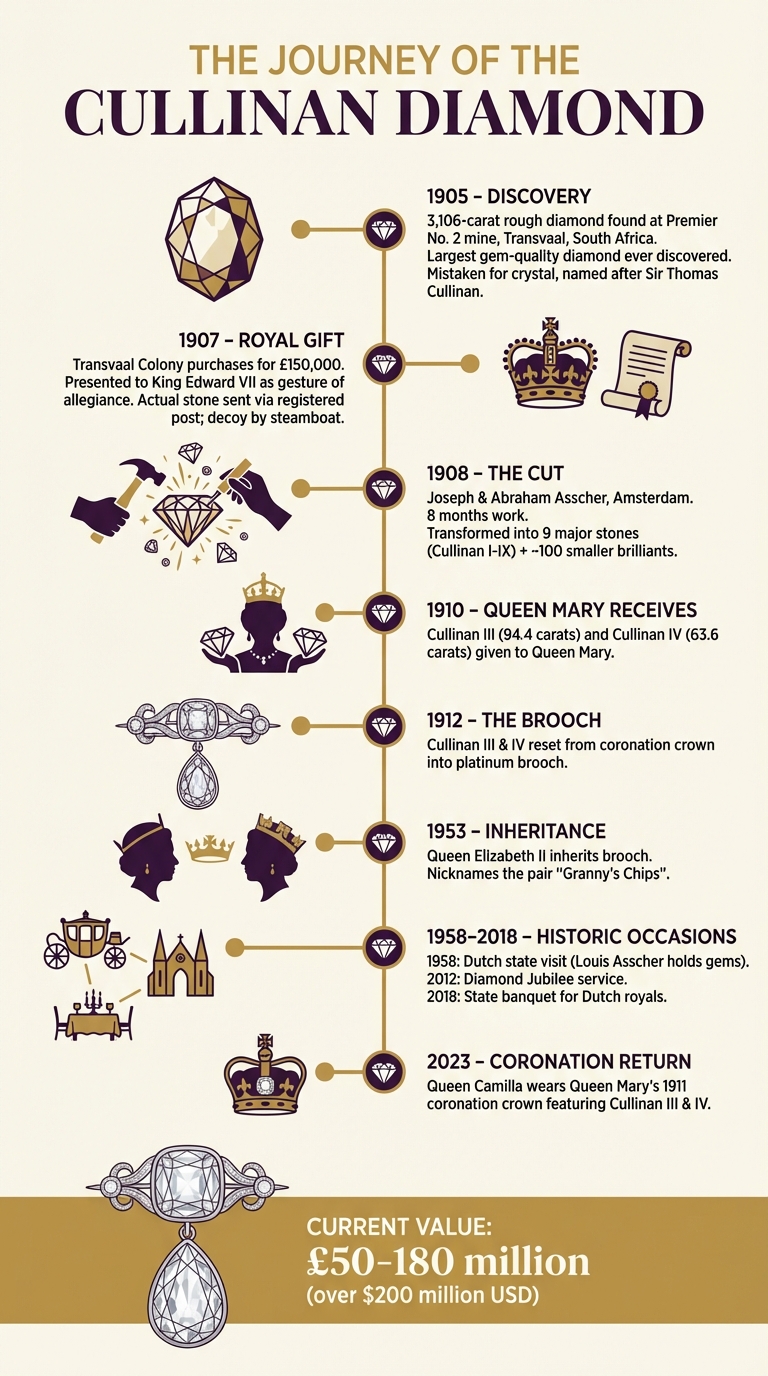
Journey of the Cullinan Diamond from Discovery to Royal Crown Jewels
It all started in 1905 at the Premier No. 2 mine in Transvaal, South Africa, when miners unearthed a 3,106-carat rough diamond - the largest gem-quality diamond ever discovered. Initially mistaken for a crystal by the mine manager, the stone was nearly discarded before its true worth was recognized. Named after Sir Thomas Cullinan, the mine's owner and chairman, this extraordinary gem became a centerpiece of royal history.
The Cullinan Diamond's journey from an unexpected find to a symbol of monarchy and loyalty is a striking example of how precious stones can shape royal traditions.
In 1907, the Transvaal Colony government purchased the diamond for £150,000 and presented it to King Edward VII as a gesture of allegiance following the Second Boer War. Transporting the diamond to the United Kingdom required ingenuity: while the actual stone traveled discreetly by registered post, a heavily guarded decoy was sent by steamboat. Once in Amsterdam, master cutters Joseph and Abraham Asscher worked for eight months in 1908 to transform the rough diamond into nine major stones (Cullinan I–IX) and roughly 100 smaller brilliants.
Among these, the 94.4-carat Cullinan III and the 63.6-carat Cullinan IV hold special significance. Queen Mary received these diamonds in 1910 and had them reset in 1912 from her 1911 coronation crown into a stunning platinum brooch. When Queen Elizabeth II inherited the brooch in 1953, she affectionately nicknamed the pair "Granny's Chips".
The brooch has graced several historic occasions. In 1958, during a Dutch state visit, Queen Elizabeth allowed Louis Asscher, the brother of the original cutter, to hold the gems. She wore the brooch again at her 2012 Diamond Jubilee service at St. Paul’s Cathedral and during a 2018 state banquet for King Willem-Alexander and Queen Máxima.
In May 2023, the diamonds returned to the spotlight when Queen Camilla wore Queen Mary’s 1911 coronation crown - featuring Cullinan III and IV - for her own coronation. Today, the brooch is estimated to be worth between £50 million and £180 million, which translates to over $200 million in current U.S. dollars. These jewels, with their rich history and symbolism, continue to be a shining testament to the legacy of the British monarchy.
The Brazilian Aquamarine Tiara: A Gift of Friendship
The story of the Brazilian Aquamarine Tiara began in 1953 when Queen Elizabeth II received a breathtaking necklace and matching pendant earrings as part of her coronation gifts. These pieces, featuring nine perfectly matched square-cut aquamarines, were a heartfelt gesture from the President and people of Brazil, symbolizing a lasting bond between the two nations.
In 1957, Queen Elizabeth II decided to expand this stunning set. She commissioned the royal jeweler Garrard to create a tiara that would complement the original necklace and earrings. The initial design was a diamond and aquamarine bandeau, crowned with three sizable detachable aquamarine ornaments, which could also double as brooches. Brazil continued to enrich the collection over the years, presenting the Queen with a bracelet featuring seven large aquamarines and a square brooch in 1958, followed by aquamarine and diamond hair ornaments in 1968.
By 1971, the Queen opted for a bold redesign of the tiara. She tasked Garrard with replacing the central ornament with a larger emerald-cut aquamarine - originally the pendant from the 1953 necklace. To elevate the tiara's grandeur, four fan-shaped motifs, inspired by the 1968 hair ornaments, were added, more than doubling the tiara's original height.
"The Brazilian Aquamarine Tiara is the epitome of a statement jewel. A masterpiece of regal elegance, it showcases an unparalleled collection of Brazilian aquamarines, impressive in both size and beauty."
- Claire Scott, Design and Development Director, Garrard
This tiara became more than just a piece of jewelry; it was a symbol of diplomacy and friendship. Queen Elizabeth II wore it at key events celebrating the enduring connection between the United Kingdom and Brazil. Notably, she donned the tiara during her 1968 visit to Brazil and at all three Brazilian state visits to the U.K. Her final public appearance in the fully assembled tiara was at the Spanish State Banquet at Buckingham Palace in 2017. Through her thoughtful choices, the Queen demonstrated how jewelry can transcend adornment, serving as a powerful emblem of international respect and shared history. The evolution of this tiara reflects a blend of personal elegance and national heritage, cementing its place in the royal collection.
Tiaras and Brooches with Historical Importance
Queen Elizabeth II's jewelry collection seamlessly bridged the past with the present, blending her royal ancestry with modern traditions. Each tiara and brooch in her collection not only highlighted her connection to royal heritage but also served as enduring symbols of the monarchy's continuity. Let’s take a closer look at some of these extraordinary pieces.
The Cartier Halo Tiara
The Cartier Halo Tiara is a shining example of this legacy. Purchased on November 18, 1936, by the Duke of York (later King George VI) from Cartier, it was a gift for his wife, the Queen Mother. On April 21, 1944, the Queen Mother passed this exquisite piece to Princess Elizabeth, the future Queen Elizabeth II. While Queen Elizabeth II never wore it publicly, the tiara found its place with younger royals. Princess Margaret donned it for her brother’s coronation in 1953, and Princess Anne made her debut with it at the State Opening of Parliament in October 1967.
The tiara gained global fame when Kate Middleton wore it during her wedding to Prince William on April 29, 2011. Its intricate design, featuring 739 brilliant-cut diamonds and 149 baguette diamonds arranged in elegant scroll motifs on a geometric band, made it a standout piece.
The Richmond Brooch
The Richmond Brooch, another treasure steeped in history, was originally inherited by Queen Mary in 1893. When Queen Elizabeth II received it from her grandmother in 1953, it became part of the "heirlooms of the Crown". This tradition of passing down significant jewelry within the royal family underscores the importance of preserving these treasures as symbols of continuity across generations.
The Prince Albert Brooch
On February 9, 1840, just one day before his wedding to Queen Victoria, Prince Albert of Saxe-Coburg-Gotha presented her with a breathtaking sapphire and diamond brooch. Deeply touched, Queen Victoria wore the piece on her wedding day. The brooch features a striking 20–30-carat blue sapphire surrounded by 12 large diamonds, creating a timeless and elegant design.
"Albert came to her sitting room and presented her with a beautiful sapphire and diamond brooch." – Queen Victoria, Queen of the United Kingdom
Queen Elizabeth II inherited this iconic brooch in 1952 and wore it on numerous significant occasions, including the 1986 Maundy Thursday ceremony. This piece not only reflects the royal family's enduring appreciation for sapphires but also serves as a tangible connection to Queen Victoria’s legacy.
Crown Jewels and National Treasures
While Queen Elizabeth II’s personal jewelry holds deep sentimental value, the Crown Jewels represent the enduring authority and history of the British monarchy. These iconic treasures belong to the Crown itself and are reserved for state ceremonies, setting Britain apart as the only European monarchy that still uses its regalia during the consecration of a sovereign. Each ceremonial piece carries centuries of tradition, making them powerful symbols of royal heritage.
The Imperial State Crown, perhaps the most recognized piece associated with Queen Elizabeth II, was crafted by Garrard & Co in 1937 for King George VI’s coronation. Weighing 2.3 pounds and adorned with thousands of gemstones - including diamonds, sapphires, emeralds, pearls, rubies, and spinels - this crown has a storied history. The Queen wore it as she exited Westminster Abbey after her 1953 coronation and for every State Opening of Parliament during her reign. Reflecting on its weight and design, she once quipped:
"You can't look down to read the speech, you have to take the speech up, because if you did your neck would break." – Queen Elizabeth II
The crown’s front band features the 317.4-carat Cullinan II diamond, while the front cross is adorned with the 170-carat Black Prince’s Ruby, a red spinel linked to Henry V’s victory at Agincourt. Atop the crown, the St Edward’s Sapphire - believed to have come from Edward the Confessor’s 11th-century ring - stands as the collection’s oldest gemstone. As historian Anna Keay vividly described:
"It can be quite hard to look at sometimes because of the sheer light that comes off them. It's literally dazzling… visually overpowering." – Anna Keay, Historian and Author of The Crown Jewels
Another standout piece is the Sovereign’s Sceptre with Cross, featuring the Cullinan I, a 530.2-carat diamond and the largest colorless cut gem. Alongside this, the Sovereign’s Orb, symbolizing Christian sovereignty, and St Edward’s Crown, used exclusively during the coronation ceremony, form part of a remarkable collection. This "working collection" includes over 100 objects and more than 23,000 gemstones, each steeped in history. The current regalia was recreated in 1661 for Charles II, replacing the originals destroyed on Oliver Cromwell’s orders in 1649.
These treasures are more than just dazzling artifacts - they are living links to Britain’s royal past, embodying the continuity and tradition of the monarchy.
The Legacy of Queen Elizabeth II's Jewelry Collection
Queen Elizabeth II's jewelry collection is more than a display of wealth or status - it tells the story of a 70-year reign defined by diplomacy, tradition, and personal milestones. Every piece carried meaning, from the miniature crown she wore at age 11 during her father's coronation to the Flame-Lily Brooch that marked her return from Kenya following King George VI's passing. As historian Suzy Menkes aptly put it:
"Few things captured the dualities of Queen Elizabeth II's personality - her love for heritage and thrift alongside her appreciation for finery, grand gestures, and innovation - quite like her extensive jewelry collection".
Through this lens, her jewelry became a silent yet powerful storyteller on the global stage.
The Queen understood the unspoken power of her adornments. Brooches, in particular, became her silent diplomats, chosen with care to honor the nations she visited during royal tours. Each piece symbolized respect and acknowledgment, speaking volumes without a single word. Caroline de Guitaut, Deputy Surveyor of the Queen's Works of Art, highlighted this unique aspect:
"I think the perennial jewel we see on the Queen are magnificent brooches. They have a way of communicating with the audience without having to say anything".
This thoughtful use of symbolism elevated her jewelry collection to a form of diplomatic language.
Her approach to jewelry also reflected a deep commitment to sustainability and craftsmanship, long before these ideas became mainstream. She often reimagined heirlooms, dismantling and repurposing them to give new life to old stones. Jewelry historian Joanna Hardy noted:
"The Queen was not into 'brands' or fashion in that sense. She was very much about championing craftsmanship and individual makers, particularly in Britain".
The Platinum Jubilee brooch, her final commissioned piece by British designer David Marshall, exemplified her dedication to supporting artisans.
This philosophy of blending tradition with innovation continues to inspire modern jewelry design. Today, her legacy is reflected in handcrafted pieces that prioritize versatility, sentimentality, and individual artistry. Contemporary brands like LaCkore Couture embrace these values, offering handcrafted, customizable designs made in the USA. The growing trend of repurposing inherited stones, creating convertible pieces, and choosing jewelry with personal meaning mirrors the Queen's inventive approach. Her influence reaches far beyond royal circles, encouraging everyday jewelry enthusiasts to see their collections as connections to history, heritage, and their own unique stories.
FAQs
What is the importance of the Cullinan Diamonds in Queen Elizabeth II's jewelry collection?
The Cullinan Diamonds, crafted from the largest rough diamond ever found, hold a special place in the history of the British monarchy. Cullinan I, famously called the Great Star of Africa, is mounted in the Sovereign’s Scepter, while Cullinan II, known as the Second Star of Africa, takes pride of place in the Imperial State Crown. These extraordinary jewels symbolize royal authority, heritage, and the enduring legacy of the monarchy, making them among the most prized treasures in the Crown Jewels.
How did Queen Elizabeth II use her jewelry to strengthen diplomatic relationships?
Queen Elizabeth II had a knack for turning her jewelry into a quiet yet impactful form of diplomacy. She carefully picked pieces that carried historical or cultural meaning, using them to honor her hosts and show respect. A memorable example was when she wore the Grand Collar of the Order of the Aztec Eagle at a state banquet in Mexico, a thoughtful nod to the bond between the two countries.
Her choices often went beyond mere decoration. By selecting gifts or wearing symbolic pieces connected to her hosts' heritage, the Queen used her jewelry to express goodwill and build bridges. These accessories weren’t just beautiful - they became meaningful tools in fostering international relationships.
How does craftsmanship shape Queen Elizabeth II's jewelry collection?
Craftsmanship lies at the heart of Queen Elizabeth II's jewelry collection, turning each piece into a lasting masterpiece. For generations, the royal family has relied on the expertise of master jewelers to design iconic items like brooches, tiaras, and necklaces. These artisans, with skills honed over centuries, ensure that every gem is cut, set, and polished with extraordinary precision, preserving both the quality and the story behind each piece.
Take the sapphire-cluster brooch, originally crafted for Queen Victoria, or the glittering Diamond Diadem - each creation showcases the unmatched talent of these jewelers. Their unwavering attention to detail not only elevates the beauty of the collection but also protects the deep history and symbolism woven into the royal family's treasures.