Skip to content




Why Purple Symbolizes Royalty in Jewelry
Purple has been linked to royalty for over 3,000 years, primarily due to its rarity and cost. In ancient times, producing Tyrian purple dye required thousands of sea snails, making it so expensive that only emperors and kings could afford it. This exclusivity led to its association with power, wealth, and divine authority. Roman and Byzantine laws restricted purple clothing to rulers, and violators faced severe penalties.
Even today, purple gemstones like amethyst, tanzanite, and purple sapphire carry this legacy. These stones are prized for their bold hues and historical significance, often featured in royal artifacts and modern jewelry. While synthetic dyes made purple more accessible after 1856, its regal aura remains intact. Purple continues to symbolize sophistication and elegance in both historical and contemporary contexts.
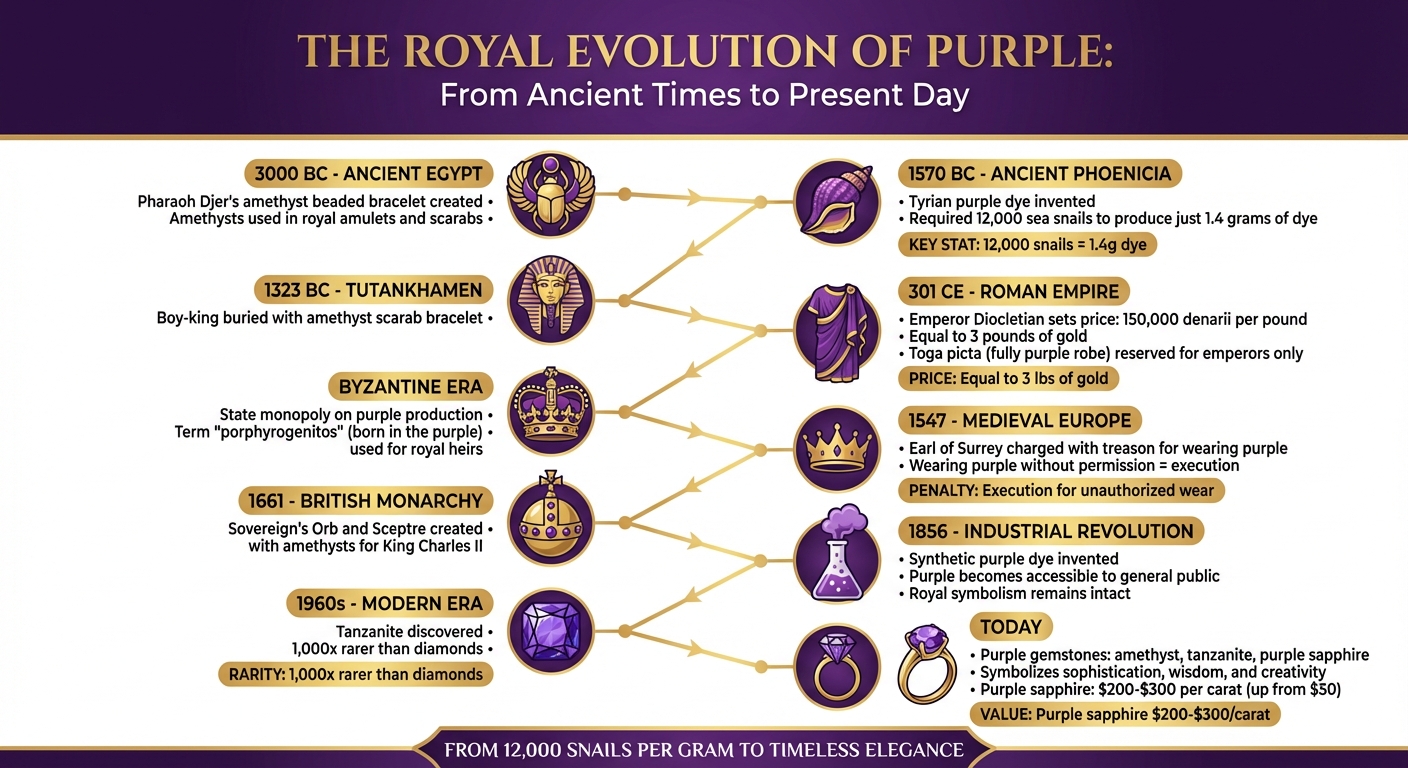
3000 Years of Purple as a Royal Symbol: From Ancient Phoenicia to Modern Jewelry
How Purple Became the Color of Royalty
Tyrian Purple Dye from Ancient Phoenicia
The origins of purple as a symbol of royalty trace back to the Phoenicians of Tyre and Sidon, who developed the first purple dye around 1570 BC. This dye, known as Tyrian purple, was extracted from the hypobranchial glands of sea snails like Bolinus brandaris, Hexaplex trunculus, and Stramonita haemastoma. The process was painstakingly labor-intensive: thousands of snails were collected, their tiny glands removed, and the secretion boiled for days to produce the dye.
To give you an idea of how rare this dye was, creating just 1.4 grams required around 12,000 snails. In Sidon, the scale of production was so immense that discarded shells from the process formed a mound towering about 131 feet high. The process was also notoriously unpleasant, producing such a foul odor that the Talmud even allowed dyers' spouses to seek divorce because of it. A vivid description from the ancient Papyrus of Anastasi reads: "The hands of the dyer reek like rotting fish".
By 301 CE, the dye’s value had skyrocketed. Emperor Diocletian set its price at 150,000 denarii per pound - equivalent to three pounds of gold. Similarly, a pound of purple-dyed wool cost as much as a pound of gold. In Rome, sumptuary laws strictly regulated its use: the toga picta, a fully purple robe adorned with gold thread, was reserved for emperors, while magistrates wore the toga praetexta, a white robe with a purple border.
This grueling production process and the dye’s rarity made purple synonymous with exclusivity, paving the way for its association with power and royalty.
Purple in Byzantine and Medieval Europe
The Byzantine Empire inherited Tyrian purple’s prestige and took it a step further by establishing a state monopoly on its production. Only the emperor and those granted special permission could wear silk garments dyed with this coveted color. The term porphyrogenitos, meaning "born in the purple", was used to describe children born to reigning emperors in the Purple Chamber, a room lined with porphyry marble. This designation reinforced their legitimacy as heirs to the throne.
The exclusivity of purple was so entrenched that laws strictly reserved it for rulers. In 1547, Henry Howard, the Earl of Surrey, was charged with high treason against King Henry VIII. One of the damning pieces of evidence? He was seen wearing purple clothing, a privilege legally reserved for the King of England. Throughout Medieval Europe, wearing purple without royal permission could even result in execution.
The Catholic Church also adopted purple as a symbol of spiritual authority. In 1464, Pope Paul II replaced traditional purple robes with scarlet ones, but purple retained its importance for bishops and cardinals, signifying their high rank within the Church. In this context, purple came to represent both the divine authority of Christian rulers and a connection to the sacred.
Amethyst: The Purple Gemstone of Kings and Queens
Once upon a time, Tyrian purple dye reigned supreme in royal fashion. But when it came to gemstones, amethyst was the crown jewel of choice - a natural treasure that symbolized power and prestige. For centuries, amethyst stood shoulder to shoulder with diamonds, rubies, sapphires, and emeralds, commanding both value and admiration. Even today, this purple gem continues to evoke a sense of royal elegance in modern jewelry.
Amethyst in Ancient Egypt and Greece
In ancient Egypt, amethyst was more than just a beautiful stone - it was believed to hold divine powers. Pharaohs used it to craft amulets and scarabs, seeking protection and guidance. One of the oldest examples is a beaded amethyst bracelet found in the tomb of Pharaoh Djer, dating back to around 3000 BC. Even Tutankhamen, the iconic boy-king, was buried with an amethyst scarab bracelet in 1323 BC, highlighting its importance in royal burial practices. Cleopatra herself wore an amethyst ring, sparking a trend that quickly caught on among Roman noblewomen [14, 17, 18, 19].
The Greeks, on the other hand, gave amethyst its name - amethystos, meaning "not intoxicated." They believed the stone could ward off drunkenness and encourage mental clarity. Some nobles even drank from amethyst goblets, which turned water a wine-like shade, symbolizing sobriety and self-control [14, 15, 18, 20].
Amethyst's Value in Medieval and Renaissance Times
Amethyst's allure didn't fade with time. During the Medieval and Renaissance periods, it retained its status as a "cardinal gem", ranking alongside diamonds, rubies, sapphires, and emeralds. For centuries, its price and exclusivity made it a prized possession for royalty and high-ranking clergy alike. In fact, 12th-century Bishop Marbodus of Rennes lamented its growing availability, writing:
"The Tyrian purple the rich Amethyst dyes... The gem, if rarer, were a precious prize, But now too common it neglected lies".
The Catholic Church embraced amethyst as the "Bishop's Stone", with clergy often wearing simple gold rings adorned with the gem to signify their spiritual connection to heaven. Amethyst also found its way into some of the most iconic royal artifacts. The medieval Iron Crown of Lombardy, one of the oldest surviving royal treasures, boasts 22 gemstones, including four stunning amethysts. Similarly, the British Royal Orb is made entirely from a single, large amethyst, symbolizing the Christian world [14, 15, 17].
Amethyst's exclusivity endured until the early 19th century, when massive deposits were discovered in Brazil. This sudden abundance caused prices to drop, making the gem more accessible to the public. Still, its regal history and timeless beauty continue to make it a favorite for jewelry lovers worldwide [16, 24].
Purple Gemstones in Historic Royal Jewelry
Amethysts in the British Crown Jewels
The British Crown Jewels include some of the most iconic purple gemstones in royal history. Among these, the Kent Amethyst Suite shines as a standout piece. This demi-parure - comprising a necklace, earrings, and a brooch - originally belonged to Princess Viktoria of Saxe-Coburg-Saalfeld, the Duchess of Kent. In 1861, her daughter, Queen Victoria, inherited the set and held it in such high regard that she designated it as an official heirloom of the crown. This ensured its place in the royal collection for future generations.
Amethysts also feature prominently in the Sovereign's Orb and Sceptre, crafted in 1661 for the coronation of King Charles II. These pieces, adorned with purple gemstones, symbolized the monarch's divine authority and their connection to Christian ideals.
Beyond Britain, royal families across Europe and Russia also treasured purple gemstones, each region favoring unique varieties.
Purple Gemstones in Russian and European Royal Collections
Purple gemstones have long been associated with royal power, and Russian and European monarchs were no exception in showcasing their splendor. Russian royalty, for instance, highly valued "Siberian" amethysts sourced from the Ural Mountains. These stones, with their intense purple color and flashes of red or blue, became the gold standard for imperial jewelry in Russia.
In Europe, amethysts were equally sought after, especially before the 19th century when only royalty could access the finest specimens. These gemstones were often paired with Tyrian purple fabrics, which were similarly exclusive to royal wardrobes. Together, they created a striking visual display of opulence and authority.
Purple Gemstones in Today's Jewelry
Popular Purple Gemstones in Modern Designs
Purple gemstones have evolved from symbols of royalty to expressions of personal style, blending their historical significance with modern jewelry trends. Among these, amethyst stands out as the most sought-after option. With a Mohs hardness of 7, it offers both durability and beauty, ranging in color from soft lilac to rich violet. This versatility makes amethyst a favorite for everyday rings and bracelet stacks.
Tanzanite, discovered in the 1960s, has quickly gained popularity for its striking ability to shift between blue and purple hues depending on the light. It’s considered nearly 1,000 times rarer than diamonds, with Tanzanian mines expected to run out within the next 15–20 years.
For those seeking something rare and durable, purple sapphire is a stunning choice. As a variety of corundum with a Mohs hardness of 9, its value has been steadily increasing. Quality stones now range from $200 to $300 per carat, compared to just $50 per carat in the past. Meanwhile, purple spinel offers a more budget-friendly alternative. With vibrant, natural coloring that requires no artificial treatment, fine specimens are priced at under $100 per carat.
Jewelry designers often pair these purple gemstones with metals like platinum, white gold, or yellow gold, creating designs that can feel either modern or vintage. These stones are perfect for everything from understated pendants to bold cocktail rings, making them a versatile choice for any occasion. Brands like LaCkore Couture are embracing this trend, reimagining purple gemstones' royal legacy in designs that feel fresh and contemporary.
Purple Gemstone Jewelry at LaCkore Couture
LaCkore Couture brings the timeless allure of purple gemstones into the modern era with handcrafted designs that emphasize quality, individuality, and elegance. Their collections highlight natural stones, allowing wearers to celebrate the rich heritage of purple gemstones while showcasing their personal style.
One of the brand's standout features is its focus on customization. From charm bracelets to stackable designs, LaCkore Couture makes it easy to mix and match purple gemstones with materials like gold and silver. This approach transforms the historical exclusivity of purple into a modern symbol of self-expression.
Whether you’re drawn to the color’s associations with creativity and wisdom or simply love its bold, luxurious hue, LaCkore Couture’s jewelry offers a way to carry centuries of tradition in designs tailored for today’s lifestyle. Their pieces blend the past with the present, making purple gemstones a striking choice for anyone looking to stand out.
Conclusion
Purple's association with royalty has endured for over 3,000 years, all rooted in one undeniable fact: its rarity made it priceless. In ancient times, producing even a small amount of purple dye required thousands of mollusks, making it as precious as gold. This exclusivity meant only emperors and kings could afford to wear it, solidifying its status as the ultimate symbol of power and divine authority.
Even with the invention of synthetic dyes in 1856, purple's regal aura never faded. It continues to grace royal ceremonies, religious vestments, and official portraits. Beyond its historical ties, modern psychology associates purple with qualities like wisdom, creativity, and mystery. This blend of historical prestige and contemporary meaning ensures its enduring appeal.
"Purple isn't just a color. It's a declaration. Of individuality. Of mystery. Of taste. It says you know your history - and you're not afraid to wear it." - HolyClothing
Today, gemstones like amethyst, tanzanite, and purple sapphire bring this rich legacy into the realm of modern jewelry. These stones allow wearers to embrace centuries of tradition while expressing their personal style. Whether you're captivated by its historical significance or simply drawn to its elegance, purple gemstone jewelry adds a layer of sophistication and depth to any collection.
LaCkore Couture honors this legacy by crafting wearable art that combines royal history with contemporary design. Their handcrafted pieces feature natural stones and customizable options set in gold and silver. Choosing purple for your jewelry isn't just a fashion statement - it's a connection to a timeless legacy that has inspired generations.
FAQs
Why was Tyrian purple so expensive?
Tyrian purple was one of the most costly dyes in history because of how it was made. It required extracting mucus from thousands of sea snails - over 9,000 mollusks just to produce a single gram of dye. This painstaking and time-consuming process drove its price higher than gold. As a result, it became a luxury reserved for the wealthy and royalty, symbolizing power and exclusivity.
Which purple gemstones feel most “royal” today?
Purple gemstones, such as amethyst and tanzanite, are often regarded as some of the most "royal" stones available today. Amethyst, with its striking violet hue, has been linked to royalty for centuries due to its opulent color and symbolic ties to power. However, its rarity - and thus its value - declined after significant deposits were uncovered in the 19th century. Tanzanite, on the other hand, boasts a captivating purplish-blue tone that brings a sense of modern elegance and luxury to contemporary jewelry designs.
How do I choose a durable purple stone for daily wear?
To choose a long-lasting purple gemstone for daily wear, prioritize those with a high Mohs hardness rating. For instance, purple sapphires score a 9 on the scale, making them highly scratch-resistant. Purple garnets, with a hardness of 7 to 7.5, are also sturdy enough for regular use. Steer clear of softer stones, as they are more prone to chipping or scratching, ensuring your gemstone stays beautiful and practical for everyday wear.