Skip to content




History of Punk Gothic Jewelry Design
Punk and gothic jewelry started as a way to show identity fast. Punk grew in the mid-1970s with DIY pieces made from safety pins, chains, padlocks, and razor-blade imagery. Goth followed in the late 1970s and 1980s, taking that raw look into darker territory with crosses, skulls, bats, black stones, and detailed silver work.
If you want the short version, here it is:
- Punk jewelry came from music scenes in the U.S. and UK and pushed shock, anger, and anti-mainstream style.
- Goth jewelry came after punk and leaned into dark romance, death themes, Victorian mourning, and medieval church shapes.
- Both styles used jewelry as a visual code for nonconformity.
- In the 1990s and 2000s, mall stores like Hot Topic sold the look to more people, often in the $10–$40 range.
- Today, many makers use .925 sterling silver, oxidized finishes, and stones like black onyx, garnet, amethyst, and black tourmaline.
- The look now works with daily outfits, often through one bold ring, pendant, or chain instead of a full head-to-toe scene look.
What matters most is simple: these pieces were never just decoration. They came from music, attitude, and self-expression, and that still shows in the way people wear them now.
| Style | Time period | Main look | Common materials | Main message |
|---|---|---|---|---|
| Punk | Mid-1970s | Raw, harsh, confrontational | Safety pins, chains, padlocks, spikes | Rebellion |
| Goth | Late 1970s–1980s | Dark, ornate, moody | Silver, pewter, onyx, garnet, crosses | Mystery, death, romance |
If you’re reading this to understand the style fast, that’s the core story: punk jewelry hit first with shock and DIY grit, then goth turned that energy into a darker, more ornate design language that still shapes jewelry now.
Cultural roots in punk rock and gothic music
Punk and goth jewelry didn't start in stores. It came out of music scenes and subcultures that pushed back against mainstream style and mass consumption. That background shaped the symbols, materials, and meaning behind each look.
Punk in the mid-1970s: DIY rebellion in the U.S. and UK
Punk took shape in New York and London in the mid-1970s, driven by economic strain and a sharp rejection of polished, commercial culture. In the UK, recession sent young people to jumble sales, army surplus stores, and charity shops to find raw materials they could remake into something aggressive and confrontational. Safety pins, padlocks, razor blades, and heavy chains were reused on purpose to shock the public and push against social norms.
These materials weren't random. They signaled attitude. Chains suggested strength, while broken-heart imagery pointed to defiance and disorder.
As punk's blunt force spread, goth took some of that same energy and turned it into something darker and more theatrical.
Goth in the late 1970s and 1980s: dark romance and theatrical style
Goth grew out of punk's aftermath, but the mood shifted. Instead of direct confrontation, the style leaned into melancholy, drama, and death imagery. In August 1979, Bauhaus released "Bela Lugosi's Dead," using plectra scraped across strings to produce ghostly sound effects. That single helped mark the move from punk toward the emerging goth look.
By the early 1980s, London's Batcave had helped shape that style: chain jewelry, theatrical makeup, and references to Victorian mourning, medieval forms, and horror cinema. Crosses and ankhs also became countercultural symbols.
Shared themes: identity, nonconformity, and visual code
Both styles used jewelry as a visual code, but they weren't saying the same thing. Punk wanted to confront. Goth wanted to enchant.
| Feature | Punk Jewelry (Mid-1970s) | Gothic Jewelry (Late 1970s–1980s) |
|---|---|---|
| Primary intent | Confrontation and anti-establishment shock | Theatricality, dark romance, and mystery |
| Materials | Safety pins, razor blades, padlocks, chains | Ornate silver/pewter, dark gemstones, heavy chains |
| Key motifs | Spikes, studs, subverted symbols | Crosses, bats, skulls, architectural filigree |
| Inspiration | Street rebellion and DIY necessity | Medieval architecture, Victorian mourning, Romantic literature |
Signature materials, motifs, and symbolism
In punk and goth style, materials aren't just materials. They signal identity. A safety pin, a chain, or a black stone can say a lot before anyone speaks.
Punk motifs: spikes, studs, chains, and repurposed hardware
Punk jewelry leaned on cheap, reused hardware. Safety pins, padlocks, dog collars, paperclips, and razor-blade imagery were confrontational on purpose. Raw, industrial finishes pushed that message even further. Mixed-metal chains and leather gave pieces a rough, half-finished look that pushed back against standard ideas of what jewelry was supposed to be.
Spikes and studs sent a blunt message: danger and power.
Gothic motifs: crosses, skulls, bats, roses, and ornate metalwork
Goth kept punk's defiant streak, but turned it into something darker and more ornamental. Oxidized silver and blackened pewter made carved details stand out through heavy contrast. Dark gemstones - black onyx, garnet, and amethyst - were common picks.
The symbols carried their own meanings. Bats stood for "night knowledge" - finding your way through darkness by instinct. Roses with thorns pointed to the pull between beauty and pain. Ravens tied into mystery, the uncanny, and the Norse ideas of thought and memory. Crosses took many forms, from Celtic and Maltese styles to inverted versions, and could point to religious roots, cathedral design, or subcultural rebellion, depending on the setting.
What these symbols communicate
| Motif | Subculture | Core meaning |
|---|---|---|
| Safety pins / razor blades | Punk | DIY rebellion, anti-establishment shock |
| Spikes | Punk / Goth | Danger, power, visual warning |
| Chains | Punk / Goth | Strength, tension between restraint and freedom |
| Skulls | Goth | Memento mori - live deliberately, accept mortality |
| Crosses | Goth | Faith, architectural history, or religious subversion |
| Bats / ravens | Goth | Mystery, the uncanny, inner navigation |
| Black onyx / garnet | Goth | Protection (onyx), passion and strength (garnet) |
That is why punk and gothic jewelry works as communication, not just decoration. As Grim Studio Collection describes it, "Gothic jewellery isn't simply 'dark-coloured jewellery.' It's a deliberately cultivated aesthetic rooted in specific design principles."
As these symbols moved beyond the original scenes, the meanings stayed in place, even as the styling changed.
How punk and gothic jewelry changed over time
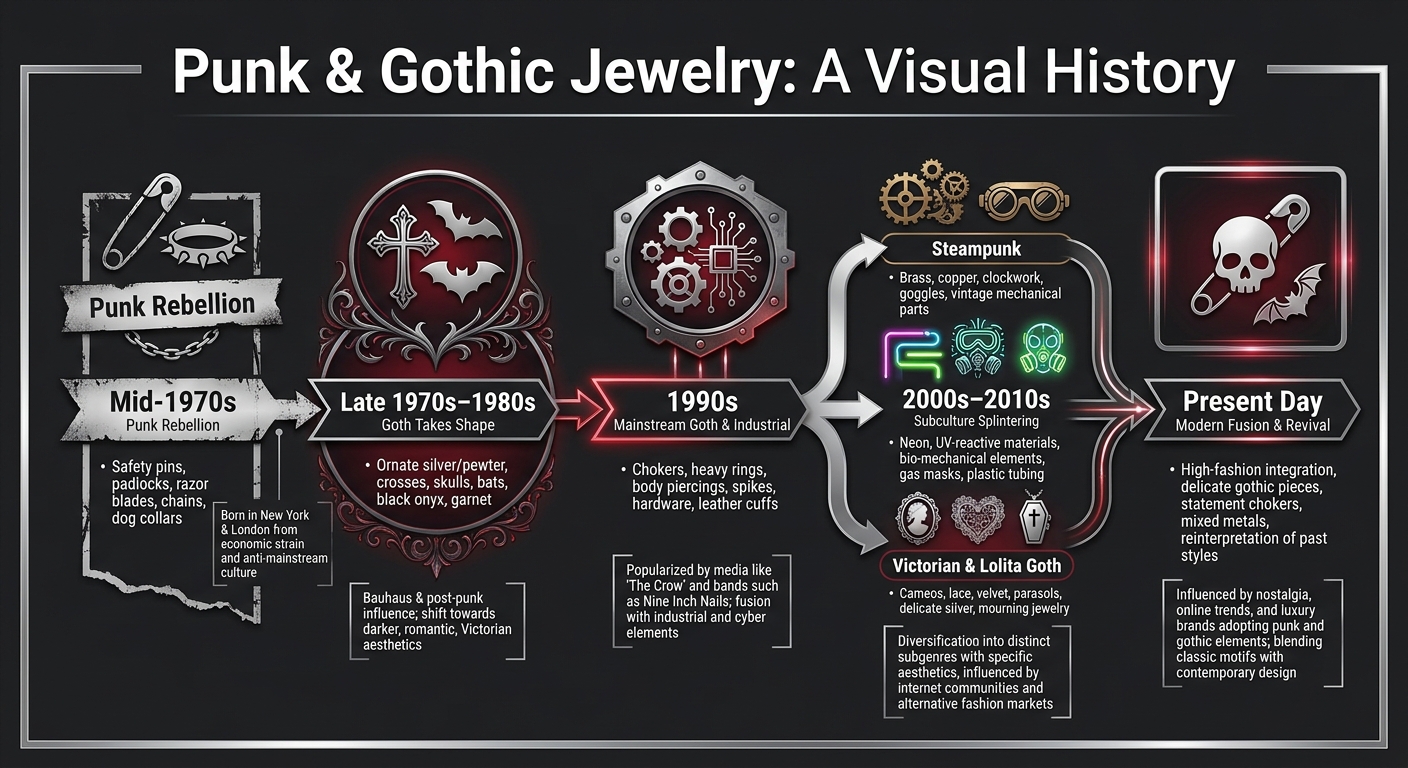
Punk & Gothic Jewelry: A Visual History from 1970s to Today
1970s–1980s: DIY origins and thrifted customization
As punk shifted from street revolt into goth’s darker look, the handmade approach stayed in place. But the mood changed. Punk’s rough, improvised materials carried over into goth, which layered in Victorian mourning details and medieval references.
1990s–2000s: spread into alternative fashion
By the 1990s, the look had moved past its underground roots. Hot Topic, founded in 1989, brought alternative style into American malls and put it in front of a much larger teen audience, with prices usually landing between $10 and $40.
Goth imagery also started showing up more often in fashion. In the late 1990s, cybergoth entered the picture, mixing in neon accents, tech accessories, and chainmail. Mass-produced pieces became more standardized. That said, they also helped push the style far beyond its early scene.
That broader reach opened the door for the heavier, better-made handmade pieces seen now.
Current handcrafted interpretations in silver, gold, and natural stones
Recent pieces swing back toward handcrafted production, this time with better materials and more refined build quality. In Los Angeles, silversmiths like Gabor Nagy and brands like Chrome Hearts, founded in 1988, helped shape the "Gothic Silver" movement through hand-carved wax models and oxidized sterling silver.
Modern pieces often use oxidized contrast finishing. Makers treat .925 sterling silver with liver of sulfur to darken recessed areas while keeping polished surfaces bright. That bright-against-blackened look echoes worn cathedral stonework.
Natural stones like black onyx, garnet, and black tourmaline now show up often, and weight has become a sign of quality. Modern makers keep the style personal through custom metalwork and natural stones. LaCkore Couture carries that line forward with handcrafted gold, silver, and natural-stone pieces that can be customized.
Today, the style lives on through pieces made for everyday wear without losing its edge.
How the style is worn now and why its history still matters
Modern styling: mixing bold symbols with everyday pieces
That handmade legacy shows up today in a much simpler way. Punk and gothic jewelry isn’t limited to full subculture looks anymore. It fits into everyday outfits.
A common U.S. approach is an everyday alternative look built around one bold focal piece. That could be a skull ring or a large pendant, worn with easy basics like a T-shirt or flannel shirt. Layering a few chains and rings adds depth without turning the outfit into a full scene look.
Natural stones like garnet, onyx, and amethyst can also take the edge off darker motifs and make them easier to wear day to day.
For office-friendly goth styling, slimmer oxidized bands or small cross signet rings keep things understated.
That’s a big reason the look still works: it can be expressive without being hard to wear.
Why handcrafted designs carry the tradition forward
That same pull explains the interest in handcrafted pieces now. People still respond to jewelry that shows visible handiwork and artisanal detail.
Customization matters here too. Mixing pieces, stacking jewelry in different combinations, and building a look over time keeps that spirit in motion. LaCkore Couture carries that idea forward with handcrafted gold, silver, and natural-stone pieces made in the USA, designed for customization and mix-and-match wear.
Conclusion: The lasting design legacy of punk and goth
That day-to-day wearability helped keep the style in play. Both styles started as music-driven subcultures, then grew into lasting design languages. Their symbols still signal identity, mood, and attitude right away.
FAQs
How did punk jewelry influence goth jewelry?
Punk jewelry helped shape goth jewelry by bringing in a DIY mindset. The focus wasn’t on polish or perfection. It was on attitude, imperfection, and unexpected materials like safety pins and chains.
That anti-establishment spirit pushed goth jewelry into something more personal. Instead of leaning only on historical references, it opened the door to more experimental, visually bold, and handmade pieces as a form of self-expression.
What symbols are most common in gothic jewelry?
Common gothic jewelry symbols often draw from mortality, religion, nature, and rebellion. You’ll usually see motifs like:
- skulls, skeletons, coffins, and hourglasses
- crosses, ankhs, and rosaries
- bats, spiders, crows, feathers, and roses
- fleur-de-lis, lions, swords, spikes, and chainmail
Taken together, these elements point to themes like impermanence, medieval style, occult imagery, danger, power, and defiance.
How can I wear punk or goth jewelry every day?
Wear punk or goth jewelry every day by leaning into personal style and self-expression. If you want something more low-key, try a corp goth look: clean, office-friendly clothes with understated accessories, like skulls, bats, or sharp architectural shapes.
These styles work so well because they’re built on mixing and matching. So you can add a bold piece to your usual outfit and get a look that feels edgy and personal.