Skip to content




Orange Gemstones: 7 Shades and Stone Meanings
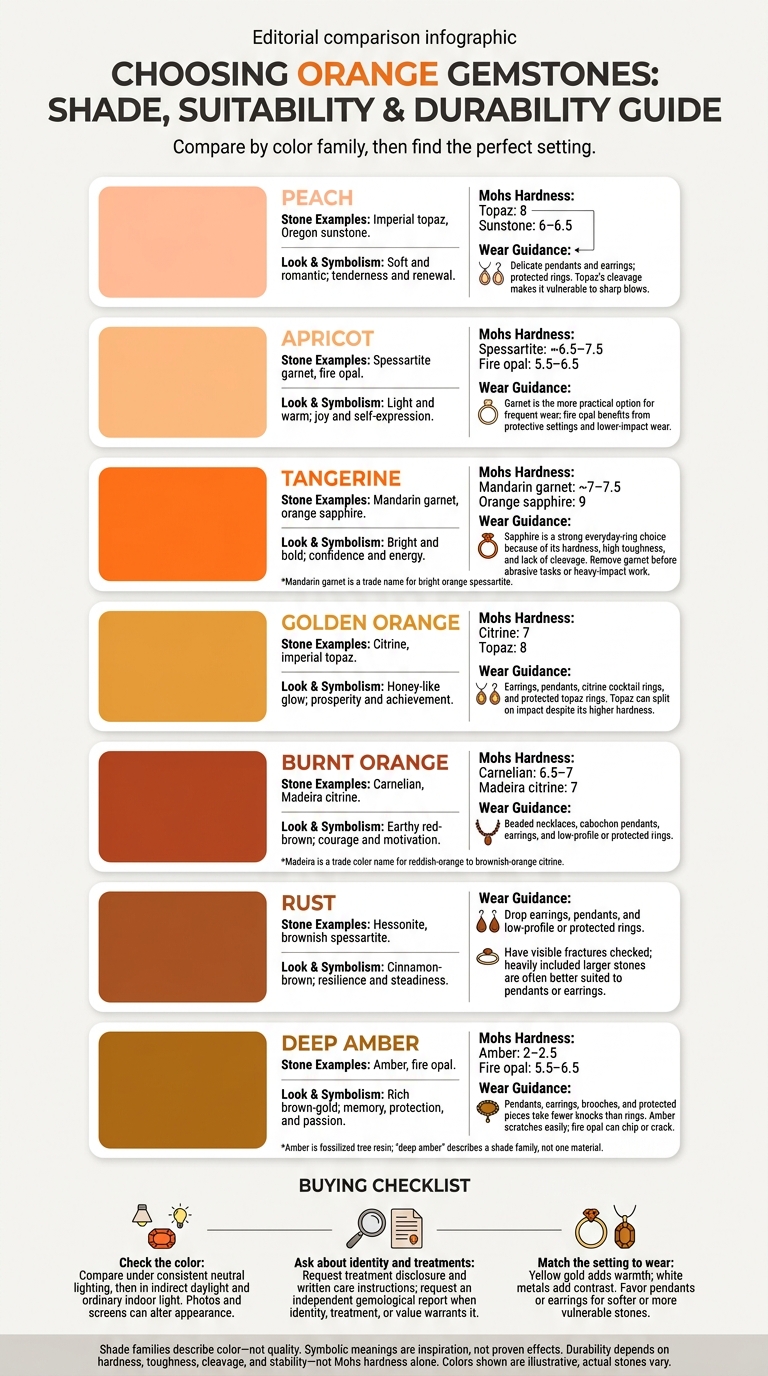
I’d choose an orange gemstone by shade first, then durability. These 7 shade families describe color - not quality - and their meanings are symbolic, not proven effects. For a daily ring, orange sapphire offers a stronger option than amber: sapphire rates 9 on the Mohs scale, while amber rates 2–2.5, though hardness alone doesn’t predict damage.
Quick Comparison
| Shade | Stone examples | Look and common symbolism |
|---|---|---|
| Peach | Imperial topaz, Oregon sunstone | Soft and romantic; tenderness and renewal |
| Apricot | Spessartite garnet, fire opal | Light and warm; joy and self-expression |
| Tangerine | Mandarin garnet, orange sapphire | Bright and bold; confidence and energy |
| Golden orange | Citrine, imperial topaz | Honey-like glow; prosperity and achievement |
| Burnt orange | Carnelian, Madeira citrine | Earthy red-brown; courage and motivation |
| Rust | Hessonite, brownish spessartite | Cinnamon-brown; resilience and steadiness |
| Deep amber | Amber, fire opal | Rich brown-gold; memory, protection, and passion |
My buying checklist is simple: <u>compare the stone in daylight and indoor light</u>, ask about treatments, and get care instructions. Yellow gold adds warmth; white metals add contrast. For softer stones, I’d favor pendants or earrings over rings - and treat symbolism as inspiration, not a promise.
7 Orange Gemstone Shades: Meanings and Durability
Understanding Orange Gemstone Colors and Meanings
Transparency describes how light passes through a gemstone: clearly (transparent), diffusely (translucent), or not at all (opaque). Together with color, it helps you compare the seven shade families below: peach, apricot, tangerine, golden orange, burnt orange citrine, rust, and deep amber.
Ask for a full color description, such as “light-tone, translucent peach-orange”, instead of “peach” alone. Commercial shade names are descriptive only; ask for treatment and identity details separately, and request a lab report when value matters.
Compare colors under consistent, neutral lighting. Then check the stone in indirect daylight, ordinary indoor light, and the setting where you plan to wear it. Warm bulbs can bring out golden, red, or brown tones, while cool lighting can make the color look less warm. Photos and screen settings can change its appearance, too.
Symbolic meanings differ across communities and may include artistic expression, confidence, prosperity, and protection. These associations are symbolism - not proven healing benefits or measurable emotional effects.
Durability depends on hardness, toughness, and stability. A Mohs rating alone doesn’t tell you how well a stone will hold up.
1. Peach Orange: Imperial Topaz and Oregon Sunstone
Shade and Stone Examples
Peach sits at the softest end of orange, giving stones a warm, airy, understated look. Peach orange is a light, blush-toned orange with pink, cream, or soft gold undertones. Shades range from blush pink to soft champagne-orange.
Imperial topaz can appear in pale peach, pinkish orange, and warm champagne-orange tones, while Oregon sunstone may show peach-to-orange color from copper within its feldspar structure.
Treat imperial as a market label, and judge the stone by its actual hue.
Transparency and Gem Properties
Imperial topaz ranges from transparent to translucent, giving it a glassy appearance. Oregon sunstone can also be transparent. Its copper inclusions produce aventurescence, a metallic-like flash that changes with the viewing angle. This clarity works well with open settings and warm metals.
Style and Wear Guidance
Rose gold brings out peach’s romantic warmth, while white gold or sterling silver adds cooler contrast. Delicate pendants and drop earrings show off topaz’s clarity or sunstone’s gentle flash.
Topaz rates 8 on the Mohs scale, while sunstone rates 6 to 6.5. Choose topaz for greater hardness or sunstone for a stronger color flash. But hardness isn’t the whole story: topaz’s cleavage leaves it vulnerable to sharp blows.
Symbolic Meanings
Peach orange’s soft warmth often suggests tenderness, warmth, optimism, and renewal. These are symbolic associations, not proven effects.
Apricot orange comes next, with a warmer, brighter look.
2. Apricot Orange: Spessartite Garnet and Fire Opal
Shade and Stone Examples
Apricot orange is a light, warm orange with peach, yellow, or soft coral undertones. It ranges from the softer shades of fire opal to the deeper tones of spessartite garnet.
Yellow-orange spessartite garnet sits at the deeper end of apricot, while lighter orange fire opal offers a paler example.
Go by the stone’s actual color, not just its name. Brown undertones shift spessartite toward rust, while stronger reds take it beyond apricot.
Transparency and Gem Properties
Spessartite gets its orange color from manganese. Its transparency and glasslike luster give it strong brilliance when well faceted.
Fire opal ranges from transparent to translucent, often with a softer glow. Its body color runs from yellow to red, and it may or may not display flashes of color.
Style and Wear Guidance
Choose settings that let apricot’s soft glow show through.
Pair faceted spessartite earrings and necklaces with denim and cream for a playful look; choose a domed fire opal in a protective bezel for a softer, artistic style.
Spessartite measures approximately 6.5–7.5 on the Mohs scale, compared with 5.5–6.5 for fire opal. That makes garnet the more practical option for frequent wear. Save opal rings for occasions that don’t involve rough activity.
Symbolic Meanings
Apricot orange is often linked with joy and warmth, as well as artistry and self-expression through art.
Next comes tangerine orange, where the color gets brighter and more electric.
3. Tangerine Orange: Mandarin Garnet and Orange Sapphire
Shade and Stone Examples
Tangerine orange is the brightest shade so far, sitting between citrus orange and golden orange.
Mandarin garnet is a trade name for bright orange spessartite, often linked to Namibian stones. Orange sapphire is a color variety of corundum, ranging from yellow-orange to strong orange and red-orange.
Transparency and Gem Properties
Mandarin garnet has a glassy luster and is usually transparent to translucent. Its strong brilliance depends on the stone’s cut and clarity. Gem-quality orange sapphire is typically transparent.
Before judging a sapphire’s value, ask whether its color is natural, heat-treated, or diffusion-treated.
Style and Wear Guidance
Yellow gold brings out tangerine’s warmth. White gold or platinum creates a stronger contrast.
Sapphire’s Mohs hardness of 9, high toughness, and lack of cleavage make it a strong choice for everyday rings. Mandarin garnet is softer, at approximately 7–7.5, so take it off before abrasive tasks or heavy-impact work.
Symbolic Meanings
Tangerine orange suggests enthusiasm, confidence, artistic expression, and sociability. Mandarin garnet feels expressive, while orange sapphire conveys optimism.
Next comes golden orange, where the color softens into warmer, richer tones.
4. Golden Orange: Citrine and Imperial Topaz
Shade and Stone Examples
After tangerine’s brightness, this range shifts toward a softer, warmer yellow-orange.
Citrine offers lighter honey-orange and orangy-yellow shades, while imperial topaz can show richer golden, amber, or pinkish-orange tones.
Compare the actual color first. Citrine and imperial topaz can overlap in shade.
Transparency and Gem Properties
Transparent stones show a clearer golden glow, while more translucent stones look softer. Ask whether citrine has been heat-treated. For imperial topaz, request treatment details and a lab report.
Style and Wear Guidance
Honey-orange citrine suits a classic bezel pendant or vintage-inspired cocktail ring. Richer imperial topaz works well in drop earrings and heirloom-style pendants.
Citrine has a Mohs hardness of 7 and good toughness. Topaz ranks 8 on the Mohs scale, but its cleavage plane means it can split on impact.
For a topaz ring, ask a jeweler about a protective bezel and have the setting inspected before regular wear. Remove either gem before gardening or playing sports.
Clean both stones with warm, soapy water. Avoid steam cleaning for citrine, and avoid both steam and ultrasonic cleaning for topaz.
Symbolic Meanings
Citrine is commonly linked with abundance, prosperity, and joy, making it a meaningful way to mark a new venture. Imperial topaz is associated with confidence, generosity, and achievement. These are symbolic associations, not proven effects.
Next comes burnt orange, where the shades deepen into earthier tones.
5. Burnt Orange: Carnelian and Madeira Citrine
Shade and Stone Examples
Burnt orange is a muted, earthy orange with red-brown undertones. It’s deeper and more subdued than tangerine or golden orange.
Carnelian ranges from yellow-orange to orangey-brown; Madeira citrine is a trade color name for saturated reddish-orange to brownish-orange citrine.
Transparency and Gem Properties
Carnelian is a variety of chalcedony that gets its color from iron. It’s usually translucent to opaque. Madeira citrine is transparent quartz, usually faceted to bring out its sparkle.
Style and Wear Guidance
Choose a carnelian cabochon or carved pendant for earthy, relaxed styling with cream, olive, denim, and warm neutrals. Faceted Madeira citrine in yellow gold gives black or deep navy clothing a richer focal point.
Ask for citrine treatment disclosure rather than relying on the “Madeira” label.
Carnelian rates 6.5–7 on the Mohs scale, while Madeira citrine rates 7. If you wear either stone often in a ring, choose a low-profile setting that protects its edges. Store pieces separately from harder gems. Keep citrine away from extreme heat and prolonged direct light.
Symbolic Meanings
Carnelian is often linked with courage, motivation, and energy; Madeira citrine with confidence, optimism, and warmth.
Next comes rust orange, where the brown undertones deepen further.
6. Rust Orange: Hessonite and Brownish Spessartite
Shade and Stone Examples
Rust orange takes burnt orange a step further toward brown.
Hessonite, a grossular garnet, has cinnamon-to-orange-brown tones. Brownish spessartite is a distinct, manganese-bearing garnet that often appears orange, reddish orange, or brownish orange.
Rust orange describes the color, not the garnet variety.
Transparency and Gem Properties
Both stones range from transparent to translucent. Internal growth irregularities give hessonite its heat-wave effect, while spessartite is often clearer. Garnets are durable, but an impact can still chip them.
Style and Wear Guidance
Yellow gold, rose gold, and antique finishes bring out these stones’ coppery undertones. Engraved bezels suit hessonite’s vintage character. Geometric settings can draw attention to spessartite’s brighter orange.
For rings, have visible fractures checked and choose settings that protect the stone’s edges. Larger stones with heavy inclusions are often better suited to pendants or earrings.
View rust-orange garnets in both daylight and indoor light. Ask for the exact garnet variety and, when value matters, a gemological report.
Symbolic Meanings
In modern color symbolism, rust orange suggests resilience, steadiness, warmth, and grounded confidence. Hessonite’s cinnamon tones suggest composure and persistence, while spessartite’s orange flashes suggest vigor and artistic energy. These are symbolic associations, not proven effects.
Deep amber carries the color shift into richer brown-gold tones.
7. Deep Amber: Amber and Fire Opal
Deep amber closes the spectrum with rich brown-gold and resin tones.
Shade and Stone Examples
Deep amber includes cognac, burnt honey, and reddish-brown tones in fossilized tree resin. Compared with burnt orange, deep amber looks warmer, darker, and more resinous. Deep orange fire opal offers a brighter, more glassy appearance.
Ask about amber treatments before buying. Heat, oil, and dye can change its appearance.
Transparency and Gem Properties
Amber ranges from transparent to opaque and measures just 2–2.5 on the Mohs scale. Fire opal is generally transparent to translucent, with a hardness of 5.5–6.5 on the Mohs scale. Even so, it can chip or crack. Its warm body color - not rainbow flashes - puts it in this shade family.
Style and Wear Guidance
Amber’s light weight makes it a good fit for chunky beads, carved charms, and sculptural earrings. Smooth settings help reduce abrasion. Fire opal works well in glowing cabochon pendants or earrings with protective bezels. Both pendants and earrings take fewer knocks than rings.
Keep amber away from heat, strong light, perfume, and chemicals. Clean it with a soft cloth or mild soap and lukewarm water. For fire opal, avoid sudden temperature changes, prolonged heat, and dry conditions that can cause crazing, or fine cracks. Clean it with mild soap and lukewarm water. Skip steam and ultrasonic cleaners for both materials.
Symbolic Meanings
Amber’s ancient organic origin and aged, resin-rich look link it with warmth, memory, preservation, and protection. Fire opal’s orange-red glow suggests passion, artistic expression, energy, and transformation. These are symbolic associations, not proven effects.
Next, compare the seven shades by mood, setting, and durability.
Compare Orange Gemstone Shades and Styles
These seven shade bands give you a simple way to compare orange gemstones. Transparency, cut, and inclusions can change how a stone looks, even within the same shade. Use the table to compare color, mood, symbolism, and jewelry options side by side.
| Shade range | Gemstone examples | Visual effect | Style mood | Symbolic meanings | Best jewelry formats |
|---|---|---|---|---|---|
| Peach orange | Imperial topaz; Oregon sunstone | Topaz gives bright, faceted reflections; sunstone can show a metallic flash. | Soft, romantic, airy | Tenderness, affection, openness | Delicate pendants, earrings, and protected rings |
| Apricot orange | Spessartite garnet; fire opal | Faceted spessartite sparkles; cabochon fire opal gives a warm glow. | Playful, warm, artistic | Artistic expression, warmth, enthusiasm | Garnet cocktail rings, earrings, pendants, and protected fire opal rings |
| Tangerine orange | Mandarin garnet; orange sapphire | Mandarin garnet gives saturated orange sparkle; orange sapphire adds transparent brilliance. | Bold, modern, energetic | Energy, confidence, motivation | Securely set sapphire rings; garnet cocktail rings, pendants, and earrings |
| Golden orange | Citrine; imperial topaz | Citrine has a warm, glassy look; imperial topaz gives strong, faceted brilliance. | Sunny, polished, classic | Optimism, abundance, success | Earrings, pendants, citrine cocktail rings, and protected topaz rings |
| Burnt orange | Carnelian; Madeira citrine | Carnelian looks smooth and softly opaque; Madeira citrine adds orange-brown sparkle. | Earthy, autumnal, vintage | Grounding, courage, endurance | Beaded necklaces, cabochon pendants, earrings, and protected rings |
| Rust orange | Hessonite garnet; brownish spessartite | Transparent to translucent, with cinnamon or brown-orange depth. | Antique, organic, understated | Heritage, resilience, stability | Drop earrings, pendants, and low-profile or protected rings |
| Deep amber | Amber; fire opal | Amber may show visible inclusions; deep-orange fire opal can glow more than it sparkles. | Glowing, organic, dramatic | Memory, protection, renewal | Brooches, earrings, pendants, and protected pieces |
For style, choose the mood first, then the finish: transparent facets look dressier, while translucent cabochons look softer. Once you’ve picked a shade, match it to the jewelry style that suits it best. If the piece is for daily wear, make durability your final check.
Pairing Orange Gemstones With Jewelry Designs
Yellow gold brings warmth to citrine and amber, while silver gives mandarin garnet and orange sapphire a sharper look. Let that guide your pairings. Mixing metals? Use one for the main setting and the other for a small accent.
Start with a peach pendant. Pair imperial topaz or Oregon sunstone with a slim chain and a simple bezel or four-prong setting. Wear it with ivory for softness or navy for contrast. If you layer necklaces, keep the other chains shorter and understated so they don’t crowd the pendant.
With tangerine earrings, choose small studs or short drops for daytime, then longer drops for evening. Keep the rest of the jewelry minimal so the earrings remain the focal point.
For a more layered look, move from single pieces to bracelets. Build a burnt-orange bracelet stack around carnelian or Madeira citrine, with slimmer metal bracelets as supporting layers. Brown tones keep it earthy. LaCkore Couture’s handcrafted necklaces, earrings, bracelets, rings, and charms fit this layered, mix-and-match look.
For the boldest finish, let a deep amber statement piece stand alone. Wear a substantial amber pendant on a simple chain against black, white, or beige, or choose a cocktail ring with understated earrings. Gold reinforces its antique character; silver makes it feel more graphic. Keep other orange pieces minimal.
For rings and pieces you’ll wear daily, use durability to narrow your final choice.
Orange Gemstone Durability and Care
Once you’ve chosen a shade and style, check how well the stone will hold up. Durability depends on hardness, toughness, cleavage, and stability - not just color. Choose a stone that suits how you’ll wear it, especially for rings you plan to wear often.
Garnet and citrine can handle regular wear, but neither is damage-proof. Amber, fire opal, and sunstone need more protection. Pendants and earrings take fewer knocks than rings, making them safer choices for these stones. After narrowing your options, check what care each stone needs.
Keep cleaning gentle, as long as the stone’s treatments allow it:
- Wash garnet, citrine, topaz, carnelian, and sunstone with lukewarm water, mild soap, and a soft brush.
- Clean untreated fire opal with lukewarm soapy water and a soft cloth.
- Wipe amber with a slightly damp cloth, then dry it immediately.
Avoid ultrasonic and steam cleaning unless a jeweler confirms that the stone, its treatment, and its setting are machine-safe. Keep topaz, sunstone, fire opal, and amber out of these machines. Store each piece separately, and apply perfume or hairspray before putting on your jewelry.
Before buying or arranging repairs, ask whether the stone is natural or lab-grown, when relevant, and whether it’s heated, dyed, coated, fracture-filled, or composite. These details can change how you should care for it. Get written care instructions, and have any loose, chipped, or cracked stone checked before wearing it again.
Conclusion: Choose by Shade, Style, and Durability
The seven shades run from soft to deep: peach orange for softness, apricot orange for warmth, tangerine orange for brightness, golden orange for glow, burnt orange for autumn character, rust orange for subdued intensity, and deep amber for a heritage-inspired finish. Stones that represent these shades include imperial topaz, Oregon sunstone, spessartite garnet, fire opal, mandarin garnet, orange sapphire, citrine, carnelian, hessonite garnet, brownish spessartite, and amber.
Once you pick a shade, check it in neutral daylight and indoors. Buy based on the color you see: cut, transparency, and setting metal can shift orange toward peach, brown, red, or gold. Look for a shade that fits your wardrobe and preferred style.
How you plan to wear the stone matters, too. Harder stones resist scratches, while tougher stones and protective settings stand up better to daily wear. Ask about treatments and whether the stone is natural, lab-grown, or imitation. Get written care instructions, especially for treated or high-value stones. If the stone’s identity or treatment is uncertain, request an independent report.
Treat symbolism as inspiration, not proof. Keep buying decisions grounded in how the stone’s color, style, durability, price, and care needs fit your life.
FAQs
How can I tell if an orange gemstone is genuine?
Examine the stone under magnification for inclusions or other features that may point to its origin. Heating, irradiation, and dyeing are common treatments that change a stone’s appearance. Reputable sellers typically disclose these treatments. For more certainty about the stone’s history, request a gemological report.
LaCkore Couture specializes in handcrafted jewelry featuring natural stones. Its one-of-a-kind, artisan-made collections focus on quality and genuine materials.
What affects an orange gemstone’s price?
An orange gemstone’s price depends mainly on its color, clarity, cut, carat weight, and geographic origin. Color intensity and saturation, rarity, and historical importance also affect its value.
Inclusions can reduce clarity, while the quality of the cut shapes how well the stone shows its color and brilliance. Larger stones generally cost more, and those from highly regarded locations often attract more interest.
Which orange gemstones suit an engagement ring?
Morganite is a popular choice for a modern engagement ring that stands apart. Its soft pink-to-peach hues can also carry hints of orange or yellow. For an orange-toned ring, rare padparadscha sapphire offers a prized pinkish-orange color and the durability suited to an engagement ring.
LaCkore Couture offers handcrafted, high-quality jewelry that celebrates the beauty and symbolism of natural stones.