Skip to content




5 Ways Nature Shapes Art Nouveau Jewelry
Art Nouveau jewelry turns nature into the shape of the piece itself. From about 1890 to 1910, makers used flowers, leaves, insects, water, and the female figure to build jewelry with flowing lines, uneven balance, and soft color.
If you want the short answer, here it is:
- Flowers shape pendants, rings, and earrings with petal-like curves
- Leaves form long S-curves and vine-like bands
- Insects bring light wings, motion, and fine detail
- Water adds wave patterns, soft drape, and smooth movement
- The female form blends hair, body, and nature into one flowing outline
A few style clues show up again and again:
- Whiplash curves that bend like stems or waves
- Uneven layouts instead of mirror-image balance
- Enamel used for soft color and light effects
- Cabochon stones, pearls, opals, and moonstones for a softer look
- Designs that feel grown from nature, not just decorated with it
Art Nouveau jewelry had a short peak - about 20 years - but its look still stands out today because nature is the framework, not just the trim. Below, I break down the 5 main motifs and show where each one fits best.
Quick Comparison
| Motif | What it borrows from nature | Best use | Main effect |
|---|---|---|---|
| Floral forms | Orchids, irises, lilies | Pendants, rings, earrings | Soft, lush, romantic |
| Leaf curves | Ivy, willow, tendrils | Necklaces, rings, drop earrings | Light movement, airy flow |
| Insect motifs | Dragonflies, butterflies, beetles, bees | Pendants, rings, brooches, earrings | Motion, shimmer, fantasy |
| Water lines | Waves, rivers, sea plants | Necklaces, rings, long earrings | Calm flow, smooth rhythm |
| Female form | Hair, body lines, merged organic shapes | Pendants, rings, dangle earrings | Dreamlike, sensual, symbolic |
If you’re trying to spot the style fast, start with the line: curved, flowing, and plant-like. That one trait explains most of what makes Art Nouveau jewelry look the way it does.
Why Nature Is Central to Art Nouveau Jewelry
Art Nouveau uses natural forms as the logic behind the design. Nature isn’t something added at the end. It shapes the piece from the start. You can see that most clearly in flowers, leaves, insects, water, and the female form.
Nature as Structure, Not Just Decoration
Start with the silhouette. In many earlier styles, motifs worked like surface ornament. Art Nouveau flipped that idea and built the whole piece around a natural form.
A pendant necklace might take on the shape of a stylized orchid, with petals making up the main body and the stem curving into the bail. A ring shank might twist like a vine or branch, with leaves holding gemstones instead of standard prongs. Earring drops could follow the line of a dragonfly wing or a trailing tendril, so the natural form becomes the drop itself, not a charm hanging off the necklace. Flowers make this idea especially easy to see.
Key Visual Traits of the Style
These forms tend to share a few clear signals. The first is uneven balance: pieces often don’t mirror themselves, because living things rarely do. A vine bends off course. A wing sits at an angle. Hair falls to one side. Art Nouveau jewelry follows that same rhythm.
Then come the whiplash curves - long S-shapes drawn from stems, hair, and wings - that make the piece feel like it’s moving even when it’s still. Enamel, especially translucent methods like plique-à-jour, brought in color that echoed thin petals and the shifting look of insect wings. Sculpted metal gave flowers, faces, and animals a sense of depth.
Next, floral forms show how that logic turns into wearable shape.
1. Floral Forms
Natural Motif Source
Orchids, irises, and lilies sat at the heart of Art Nouveau jewelry. Designers chose them not just for what they meant, but for how they looked.
An orchid petal twists and folds in uneven ways. An iris stem shoots up in a long, clean line. A lily opens outward in one bold, sweeping flare. Those shapes fit jewelry almost perfectly, especially in curved metalwork and enamel.
That’s why floral motifs in Art Nouveau don’t feel pasted on. The flower itself becomes the structure. Its bends, folds, and shifting outlines gave jewelers a built-in model for the style’s flowing silhouettes. René Lalique and Georges Fouquet often built entire pieces around one bloom instead of sprinkling in small floral details.
Signature Art Nouveau Lines
Floral forms lean on uneven balance, narrowing petals, and layered relief to suggest motion. One side may hold a larger petal, while the other stretches out into buds or leaves. That slight imbalance keeps the design from feeling stiff.
Layered relief also helps the piece catch light from more than one angle, which gives it depth and a sculpted feel.
Best Jewelry Applications
This motif works especially well in a few formats:
- Pendants: Place an enamel-painted bloom at the center, then frame it with openwork gold stems and leaves. A pearl or cabochon opal can add a dew-drop touch.
- Rings: Let the band curve like a stem, with leaves guiding the eye toward the center stone.
- Earrings: Use cascading blossoms with articulated petals to create a sense of flow.
Visual Effect
Soft enamel gradients give these pieces a painted surface, while cabochon stones keep the mood organic and fluid. The final look feels like a flower caught halfway through opening.
That same bloom-to-form idea carries into the next motif, where leaves become curves and stems become lines.
2. Leaf Curves
Natural Motif Source
If flowers show Art Nouveau in full bloom, leaf curves show how the style moves. Jewelers looked closely at ivy, willow, and curling tendrils, then turned those growth patterns into metalwork. Ivy, laurel, ginkgo, and chestnut showed up again and again, often stylized with longer tips and more pronounced midribs.
Signature Art Nouveau Lines
The line that defines this look is the whiplash curve: a long S-shape that begins thick, like a stem, and narrows into a leaflike point. These curves branch, overlap, and flow much like living foliage. An off-balance layout keeps the design loose instead of rigid. That branching rhythm gives leaf forms much of their power in necklaces, rings, and earrings.
Best Jewelry Applications
Leaf curves fit especially well in a few types of jewelry:
- Necklaces that drape like garlands
- Rings with vine-like shoulders
- Drop earrings with small articulated leaf clusters
Visual Effect
Leaf curves pull the eye along one continuous path, while the open space between leaves adds an airy, layered look. The effect feels romantic, light, and organic. It's a big reason this motif works so well across many Art Nouveau jewelry designs.
3. Insect Motifs
Natural Motif Source
After flowers and leaves, insects bring a stronger sense of movement to the style. For Art Nouveau designers, they offered built-in form and rhythm. Dragonflies, butterflies, beetles, and bees showed up again and again, and it’s easy to see why. Their segmented bodies, fine wings, and curved antennae gave jewelers forms they could stylize without losing their link to nature.
Signature Art Nouveau Lines
Insect anatomy fit Art Nouveau almost perfectly. Long wings, uneven outlines, and curling antennae slipped easily into the style’s flowing lines. Designers often used plique-à-jour enamel for wings because it let light pass through, much like the thin transparency of actual insect wings. Instead of boxing these forms into stiff frames, they worked wings, bodies, and antennae into fluid settings.
René Lalique's Dragonflies brooch used plique-à-jour enamel to mirror the iridescence of real wings. Together, they show how Art Nouveau turned insects into symbols of motion and transformation.
Best Jewelry Applications
Insect motifs tend to work best in pieces where the form has room to stand out, such as:
- holiday statement earrings
- pendant necklaces
- statement rings
- brooches
Earrings can echo winglike balance around the face. Pendants create a strong vertical point. Rings and brooches, on the other hand, let a beetle or bee sit at the center as a small but striking focal point.
Visual Effect
The visual effect is luminous and full of motion. Translucent wings, articulated bodies, and gem-set details can make a piece seem almost alive. That mix of natural form and human fantasy leads into the female form.
4. Water Lines
Natural Motif Source
After flowers, leaves, and insects, water pushed Art Nouveau's organic movement into softer, more continuous curves. It shaped the structure of Art Nouveau jewelry through flowing forms that feel almost in motion.
Designers looked to ocean waves, river bends, and underwater plants for that sense of flow. They translated those forms into metal and enamel, borrowing from currents, algae, and trailing aquatic vegetation. Ernst Haeckel's Art Forms in Nature also strengthened interest in these sinuous aquatic shapes.
Signature Art Nouveau Lines
Water motifs often rely on the whiplash line - Art Nouveau's signature S-curve - to suggest currents and swells. Compared with floral or leaf motifs, these forms are often a bit more abstract.
You see that in repeated wave-like arcs, smooth S-curves, overlapping crescent shapes, trailing fronds, and ribbon-like bands. Together, these lines hint at ocean swells, river bends, and underwater vegetation.
Best Jewelry Applications
Water lines work best in pieces where drape and movement do a lot of the visual work:
- Necklaces: linked, wave-like segments that trace the collarbone
- Rings: tapering shanks with arcing shoulders
- Earrings: long drops and articulated chains that move as the wearer moves
Visual Effect
The result is calm, rhythmic motion. Repeated arcs pull the eye along in a steady pattern, while whiplash curves add a sharper sense of drama.
Materials help sell the effect. Opals, moonstones, pearls, and translucent enamel in blue, green, or seafoam tones bring to mind shimmer, reflection, and the shifting surface of water. Put it all together, and the piece can feel like moving water shaped into metal.
That same fluidity leads into the final motif: the female form.
5. The Female Form
Natural Motif Source
After water’s flowing curves, the female form turns that same sense of motion into figure and hair. In Art Nouveau, the female figure isn’t just a portrait. It becomes part of the design itself.
One of the best-known Art Nouveau images is "a naked or partially clothed woman surrounded by her loose flowing hair," often shown swimming or in flight. In many pieces, the hair does most of the visual work. It becomes the main sweeping line, echoing vines, water, or wings.
Signature Art Nouveau Lines
This is where the curve shifts from ornament to silhouette. The lines of the body and hair carry the same flowing S-curve seen across Art Nouveau, often creating halos or frames in place of standard metal borders. Facial features tend to stay soft and idealized, while the body is shaped with gentle, serpentine curves instead of sharp anatomical detail.
What makes this motif so striking is the way it blends the figure with other forms from nature. A strand of hair can turn into a vine. The outline of a woman can slip into flowers or other organic detail without a hard break.
Best Jewelry Applications
This motif shows up especially well in jewelry that gives the figure room to flow:
- Pendant necklaces: A bust or head anchors the pendant, while hair and openwork create the outer shape.
- Portrait-style rings: A face fills the top, while curved shoulders carry the hairline around the finger.
- Dangle earrings: A small head or bust sits near the ear, with hair falling into flowers or gemstone accents.
Visual Effect
The overall effect is romantic and dreamlike. Closed or veiled eyes can suggest introspection, while hair and garments that dissolve into water or plant forms put motion ahead of stillness.
That blend of figure, curve, and organic detail rounds out the five main motifs.
Quick Comparison of the Five Motifs
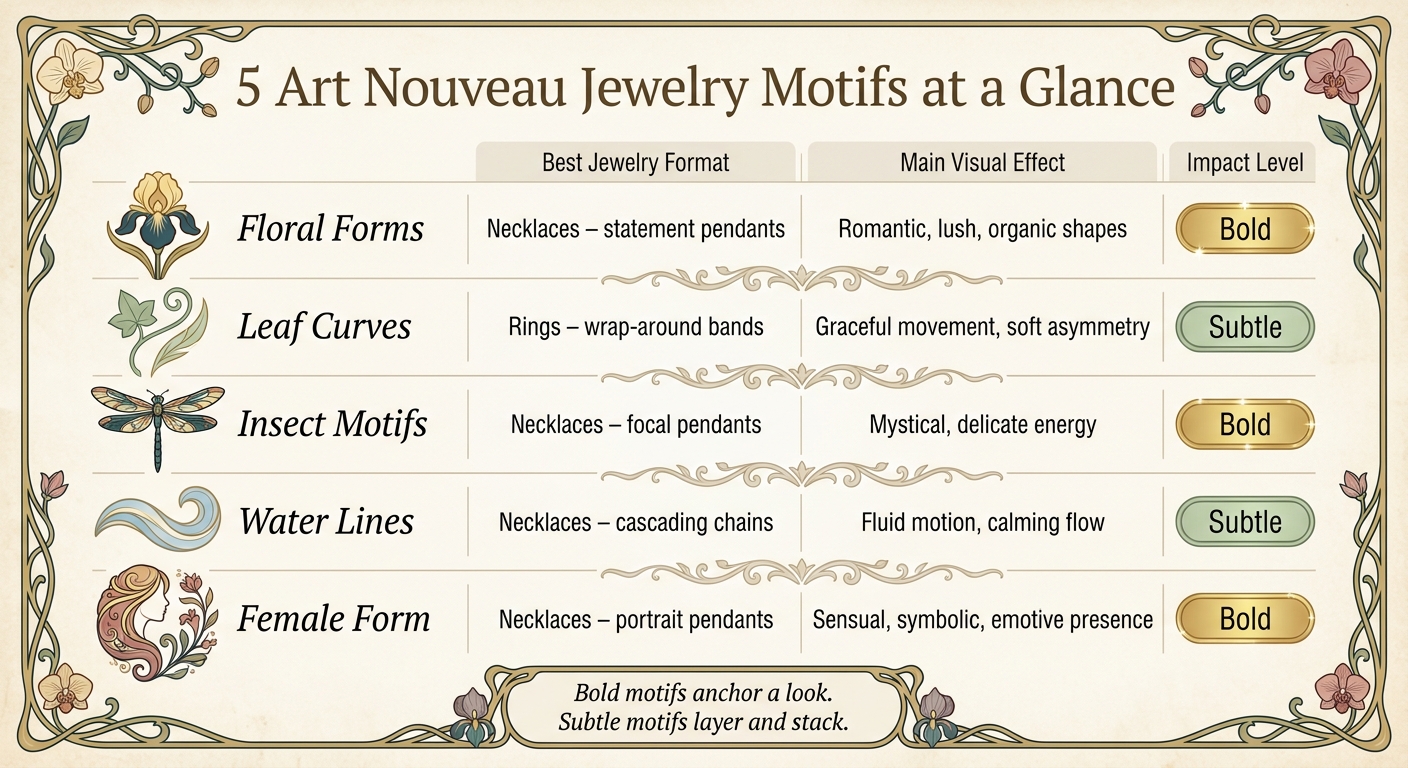
5 Art Nouveau Jewelry Motifs: Nature, Form & Effect
After the five motif profiles, it helps to line them up side by side. Each one brings its own shape, mood, and ease of wear. The table below gives you a fast read.
| Motif | Best Format | Main Visual Effect | Impact |
|---|---|---|---|
| Floral Forms | Necklaces – statement pendants | Romantic, lush, organic shapes | Bold |
| Leaf Curves | Rings – wrap-around bands | Graceful movement, soft asymmetry | Subtle |
| Insect Motifs | Necklaces – focal pendants | Mystical, delicate energy | Bold |
| Water Lines | Necklaces – cascading chains | Fluid motion, calming flow | Subtle |
| Female Form | Necklaces – portrait pendants | Sensual, symbolic, emotive presence | Bold |
One thing jumps out right away: necklaces show up the most. A few of these motifs need room to open up, which makes pendants and chains a natural fit. Floral forms, insect motifs, water lines, and the female form all tend to read better when they have more space. Leaf curves are the main exception, and they often shine best in rings.
The split between bold and subtle matters too. Florals, insects, and the female form work well as focal pieces. They draw the eye and tend to set the tone for the whole look. Leaf curves and water lines feel lighter, so they’re easier to stack, layer, or wear every day without much effort.
That contrast gives you a simple way to sort your options: go bold when you want the jewelry to lead, or keep it softer when you want it to blend into a larger look.
Styling and Shopping Notes
When you shop, use the same visual signals from the five motifs: curved lines, asymmetry, and natural forms worked into the design.
Details That Point to an Art Nouveau Influence
The clearest Art Nouveau sign is the line itself. Look for whiplash curves, tapering stems, and shapes that seem to grow out of the setting. Curves should loop and narrow, not stop in hard angles. If a piece looks grown rather than assembled, you're probably looking in the right place.
Asymmetry is another strong marker. One side of a pendant may stretch farther than the other, or a ring setting may twist instead of matching side to side. Soft enamel, especially translucent areas, can echo stained glass. For stone settings, look for natural stones or cabochons set into curved metalwork with leaves, tendrils, or other organic shapes. The best pieces make the motif part of the structure, not something pasted on afterward.
For handcrafted gold, silver, and natural-stone pieces in this style, LaCkore Couture offers artisan-made options with a strong focus on craftsmanship and individuality.
Once you can spot the style, the next step is wearing it in a way that doesn't take over the whole outfit.
How to Wear the Look Today
Let one sculptural piece do the heavy lifting. A pendant or botanical ring can anchor the outfit on its own. Piling on more ornate pieces at the same time can make the look feel crowded.
Pair it with solid neutrals so the curves and detail stay front and center. Choose pieces shaped like flowers, leaves, wings, water, or flowing hair instead of pure abstract ornament. That link to nature helps the look feel intentional, not costume-like.
That balance keeps the look current while holding on to its Art Nouveau character.
Conclusion
In Art Nouveau jewelry, flowers, leaves, insects, water, and the female form do more than decorate the surface. They shape the whole piece. That shared design logic is what gives the style its staying power.
It also explains why the style still feels so alive. In a dragonfly pendant, the wings, the metalwork, and the sense of motion all work together. The result doesn’t feel static or stiff. It feels like it could move.
You can see that same organic approach in handcrafted work from LaCkore Couture, which carries these traits forward in gold, silver, and natural-stone pieces with curving silhouettes and nature-inspired detail.
Whether you're drawn to a floral pendant, a leaf-curve ring, or earrings with a flowing feminine silhouette, the appeal comes from the same place. These pieces feel grown, not assembled, which is why Art Nouveau-inspired jewelry still feels fluid and expressive today.
FAQs
How can I identify Art Nouveau jewelry at a glance?
Look for nature-inspired design with flowing, organic lines. You’ll often see floral forms, leaf-like curves, insect motifs, water-like lines, and nods to the female figure.
Art Nouveau jewelry usually feels fluid and asymmetrical, not stiff or boxy. It also tends to show fine craftsmanship, with small details worked in throughout the piece. Techniques like plique-à-jour enamel can give it a soft, stained-glass look.
Which Art Nouveau motifs work best for everyday wear?
For everyday wear, Art Nouveau motifs with a nature-inspired feel tend to work best when the design stays minimal and organic. Floral details like cherry blossoms are a strong fit, especially in understated pendants or delicate studs.
They strike a nice balance between elegance and simplicity, which makes them easy to pair with casual outfits. More detailed styles, such as cameos, usually make more sense for special occasions.
Why is asymmetry important in Art Nouveau jewelry?
Asymmetry matters in Art Nouveau jewelry because it mirrors the organic, flowing shapes seen in nature. Instead of sticking to rigid balance, designers used uneven forms to suggest things like falling petals or the irregular growth of plants.
That shift gives each piece a more lively, dynamic feel. It also helps natural motifs look more individual and lifelike, rather than stiff or overly perfect.