Skip to content




Mid-Century Modern Jewelry: Style Guide
Mid-century modern jewelry is usually easy to spot once you know the signs: bold shape, sculptural form, textured metal, and a date range of about 1945 to 1969. If I want to tell it apart from Edwardian, Art Deco, 1970s, or 1980s jewelry, I look at volume, metal finish, motifs, stones, and hardware first.
Here’s the short version:
- Time period: about mid-1940s to late 1960s
- Main look: sculptural, geometric, organic, and three-dimensional
- Common metals: 14K/18K yellow gold, platinum, white gold, and sterling silver
- Common finishes: hammered, satin, etched, braided, pierced, and mesh
- Common stones/materials: diamonds, turquoise, coral, lapis, amethyst, pearls, enamel, Lucite, rhinestones, and wood
- Main motifs: atomic bursts, starbursts, orbit forms, leaves, branches, birds, and abstract nature forms
- How it differs: less delicate than Edwardian, less flat than Art Deco, and less bulky than 1970s and 1980s jewelry
- Dating clues: rollover safety catches, box clasps, screw-backs, early clip-ons, and marks like 14K, 18K, or STERLING
If I had to sum it up in one line, I’d say this: mid-century jewelry puts shape and surface first, then uses stones and color to support the design.
Quick Comparison
| Era | Main look | Shape | Metal feel | Usual motifs |
|---|---|---|---|---|
| Edwardian | light, delicate | lace-like, airy | platinum openwork | bows, garlands, florals |
| Art Nouveau | flowing | curved, nature-led | enamel and soft lines | vines, flowers, insects, female forms |
| Art Deco | precise | straight, symmetrical | white metals, polished finish | chevrons, steps, sunbursts |
| Mid-Century | sculptural | geometric + organic | textured gold and silver | atomic forms, abstract nature |
| 1970s | chunky | broad, stacked | heavy gold, mixed materials | earthy symbols, casual forms |
| 1980s | bold, power-driven | oversized, angular | bright gold, mixed metals | strong geometric and status-led forms |
About 25 years separates the start of the mid-century period from the late 1960s, and that span helps explain why the style includes both polished fine jewelry and lighter costume pieces. Still, the shared thread is clear: form, texture, and clean design matter more than extra ornament.
So if you’re trying to identify, date, or wear this style now, these are the points I’d keep front and center.
Core Traits of Mid-Century Modern Jewelry
Mid-century modern jewelry sits in a sweet spot between structure and motion. It can look architectural, but it never feels stiff. Clean geometry meets softer, natural lines, and that push-pull is what makes the style so easy to spot. You see it first in the forms.
Shapes, Silhouettes, and Scale
Common shapes include circles, rectangles, triangles, starbursts, sprays, boomerangs, and freeform organic forms. Designers use these shapes as the main focal point or repeat them across linked parts.
The scale feels confident and easy to read. It isn’t tiny and fussy, but it doesn’t go over the top either. You’ll see that balance in dimensional brooches, bold clip earrings, cocktail rings, and articulated necklaces.
Surface Texture and Construction Details
Shape is only part of the story. Texture does a lot of the heavy lifting in mid-century jewelry. Instead of leaning only on stones, designers built visual interest right into the metal.
Common finishes include:
- Hammered
- Satin
- Etched
- Twisted-wire
- Braided
- Pierced
- Mesh
These finishes add depth and catch light without piling on ornament.
Open space matters just as much. In this style, empty areas aren’t empty at all - they’re part of the design. Wire construction pushes that idea further with airy outlines and layered contours that let light move through the piece. That’s how many of these designs feel bold without feeling heavy.
Comparison Table: Geometric vs. Organic Forms
| Feature | Geometric Forms | Organic Forms |
|---|---|---|
| Typical shapes | Rectangles, triangles, circles, starbursts | Leaves, petals, droplets, shells, abstract curves |
| Visual effect | Architectural, precise, engineered | Fluid, nature-inspired, movement-driven |
| Common finishes | Clean metal surfaces, polished edges, repeatable forms | Textured metal, matte surfaces, flowing contours |
| Where they appear most | Clip earrings, geometric rings | Brooches, sculptural pendants, asymmetric cuffs |
| Design feel | Ordered, structured, repeatable | Sculpted, expressive, asymmetric |
Both directions follow the same core idea: strip back ornament, use shape with purpose, and let the construction do the talking.
Those choices in shape naturally connect to the metals, stones, and motifs that define the style.
Metals, Stones, and Design Motifs
Common Metals and Finishes
If shape sets the silhouette, metal sets the mood. In mid-century jewelry, the metal wasn't just the base - it helped make the whole piece.
Yellow gold led the way in fine jewelry, most often in 14K or 18K. Jewelers used woven, bark, nugget, and hammered textures to give it depth and a strong tactile feel. Pieces from the late 1940s into the early 1950s often leaned more rose-toned gold, which softened the look and gave it a gentler, more romantic edge.
Diamond-set pieces went in another direction. Platinum and white gold were the go-to choices for pavé and cluster settings. These metals were usually finished with a high polish or a light brush, so they framed the stones without stealing the show.
Sterling silver shaped another big part of mid-century jewelry: Scandinavian and American studio work. These pieces were often finished by hand with satin, brushed, or oxidized surfaces. The point wasn't sparkle. It was form.
Gemstones, Color, and Alternative Materials
Fine mid-century jewelry leaned into bold, saturated color. Designers used turquoise, coral, lapis lazuli, amethyst, citrine, garnet, and cultured pearls - stones that made an impact right away. Turquoise and coral often appeared as smooth cabochons in yellow gold, a pairing that gave strong contrast. Cultured pearls also changed roles. Instead of staying in delicate Edwardian strands, they showed up in cluster earrings and sculptural multi-strand necklaces.
Diamond jewelry shifted too. Rather than centering one main stone, many pieces used cluster and pavé settings. The result was a domed surface covered in small stones, which gave off a textured kind of light.
Costume and studio jewelry pushed things even further. Lucite opened up a whole new look - clear, frosted, confetti-filled, or glowing with the pearly inner effect of "moonglow" thermoset plastic. It let designers make oversized pieces that stayed light on the body. Enamel brought strong, lasting color to metal surfaces, especially in abstract brooches and modernist pins. Aurora Borealis–coated Swarovski rhinestones added an iridescent, prismatic shimmer that became a calling card of mid-century party jewelry. Wood also had its place, especially in organic studio pieces where the grain echoed biomorphic shapes.
Put simply, these materials gave costume jewelry a sense of drama that precious materials alone often couldn't match.
Those material choices lead straight into the era's recurring motifs.
Motifs: From Atomic Forms to Nature
Two big forces shaped mid-century motifs: space-age fascination and organic nature.
On the space-age side, designers played with atomic bursts, orbit shapes, starburst rays, and Sputnik-style layouts, where parts spread outward from a central point. You see these motifs most often in brooches, cocktail rings, and earrings, usually worked in textured yellow gold or pavé-set diamonds.
Nature ran right beside that futuristic look. Stylized florals, branches, leaves, birds, and fish appeared in both fine and studio jewelry. But mid-century designers didn't treat them literally. They pared them down. A branch could become a textured gold form with pearls standing in as buds. A fish in Scandinavian silver might turn into a flowing outline - smooth, spare, and abstract.
The result feels close to nature without copying it exactly.
That visual language still shapes handcrafted jewelry.
How Mid-Century Jewelry Differs From Other Periods
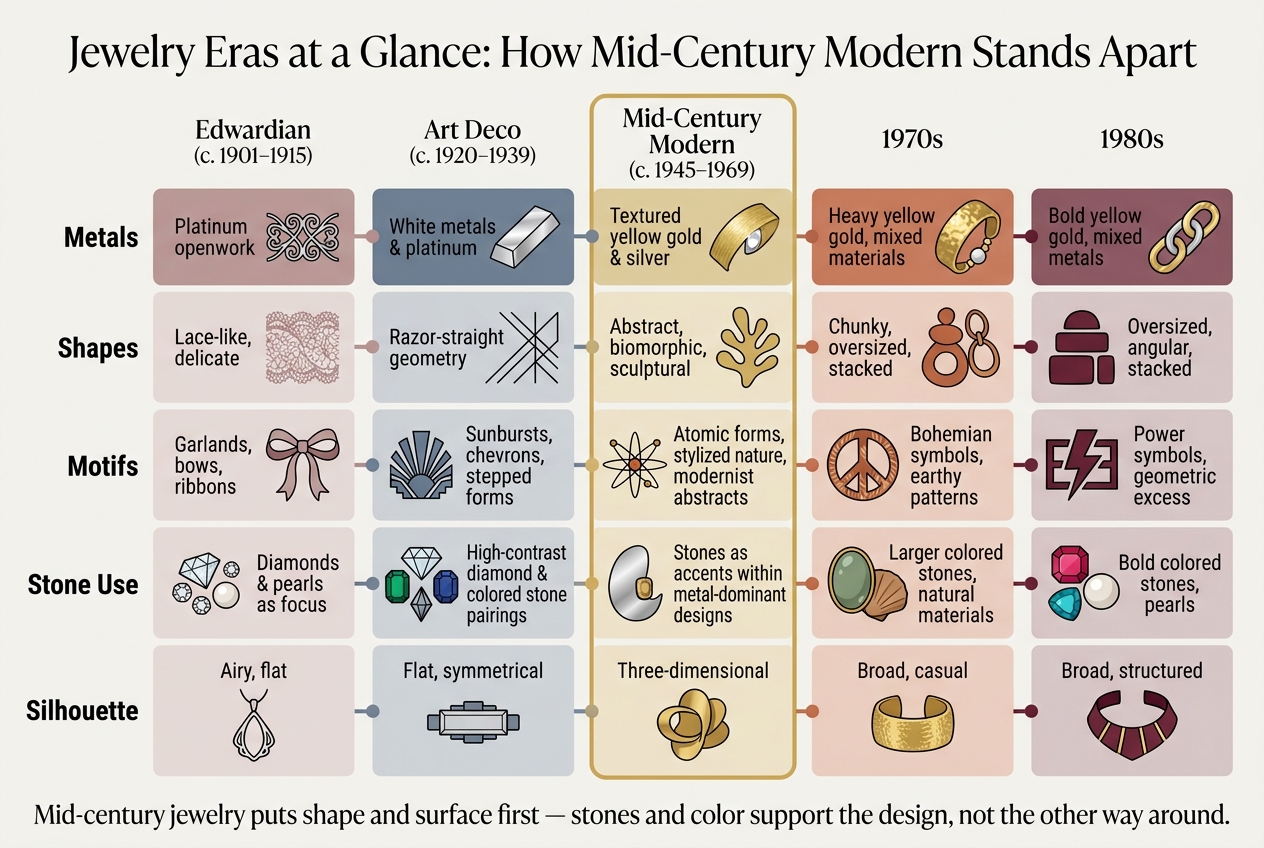
Mid-Century Modern Jewelry vs. Other Eras: Visual Style Guide
Earlier Styles: Edwardian, Art Nouveau, and Art Deco
Edwardian jewelry (c. 1901–1915) is all about platinum openwork. Jewelers used platinum’s strength to make ultra-fine details, millegrain edges, and pierced panels that felt almost weightless. The motifs were soft and romantic - bows, ribbons, garlands, and floral swags. The whole look was delicate and formal. Diamonds and natural pearls took center stage, while the metal worked more like a quiet frame.
Art Nouveau (c. 1890–1910) moved in a very different direction. It favored flowing curves and imagery pulled from nature: vines, flowers, insects, and female figures, often shown with rich enamels and colorful stones. The designs felt almost painterly, with lines that suggested motion instead of rigid structure.
Art Deco (c. 1920–1939) shifted hard toward geometry. Symmetry, contrast, and machine-like precision replaced the organic softness of Art Nouveau. Platinum and other white metals were paired with diamonds and colored stones in architectural layouts. Mid-century modern stands apart because it trades that flat precision for sculptural volume.
That’s the big break: Edwardian is delicate, Art Nouveau flows, and Art Deco stays flat and geometric. Mid-century brings in volume, texture, and a more sculptural sense of depth.
Later Styles: 1970s and 1980s Jewelry
The decades that followed kept the larger scale, but the restraint changed.
1970s jewelry got bigger and earthier - chunky chains, oversized hoops, heavy link bracelets, and a strong turn toward wood, bone, shells, and turquoise. The silhouette felt more casual and stacked, with less attention on fine metalwork detail. 1980s jewelry pushed that even further into power dressing: massive chain-link necklaces, oversized earrings, stacked cuffs, and pearl chokers worn as professional glamour.
Mid-century pieces, by contrast, feel cleaner and more architectural. They’re bold without feeling too much, and sculptural without giving up wearability. Think modernist form, not statement dressing for its own sake.
Comparison Table: Era-by-Era Visual Differences
Side by side, the differences are easier to spot.
| Feature | Edwardian | Art Deco | Mid-Century | 1970s | 1980s |
|---|---|---|---|---|---|
| Metals | Platinum | White metals, platinum | Textured yellow gold, silver | Heavy yellow gold, mixed materials | Bold yellow gold, mixed metals |
| Shapes | Lace-like, delicate | Razor-straight geometry | Abstract, biomorphic, sculptural | Chunky, oversized, stacked | Oversized, angular, stacked |
| Motifs | Garlands, bows, ribbons | Sunbursts, chevrons, stepped forms | Atomic forms, stylized nature, modernist abstracts | Bohemian symbols, earthy patterns | Power symbols, geometric excess |
| Stone Use | Diamonds and pearls as focus | High-contrast diamond and colored stone pairings | Stones as accents within metal-dominant designs | Larger colored stones, natural materials | Bold colored stones, pearls |
| Silhouette | Airy, flat | Flat, symmetrical | Three-dimensional | Broad, casual | Broad, structured |
How to Spot the Style and Wear It Today
What to Look for When Identifying Period Pieces
Once you know the era’s shapes and materials, the next step is pretty hands-on: check the hardware and the wear. Those details often give the fastest dating clues.
Start by turning the piece over. Clasps, earring backs, and metal stamps can tell you a lot at a glance. Rollover safety catches on brooches usually point to post-1940 manufacture. Box clasps are common on mid-century necklaces and bracelets. Lobster claw clasps, on the other hand, often suggest later production or a replacement. So if the design looks right for the period but the clasp looks modern, that’s a warning sign. The piece could be a reproduction or a reworked vintage item.
Earring backs help too. Screw-backs and early clip-ons were widely used through the 1950s. Friction posts with butterfly backs line up more often with later production. Metal stamps matter as well. Look for marks like 14K, 18K, or STERLING on gold and silver pieces. Be careful with 925. That stamp became much more common from the 1970s onward, so a piece that looks like it came from the 1950s but is marked 925 may be newer than it seems.
Then there’s wear. Period pieces usually show age in ways that make sense: patina along the edges, hand-finished prongs, neat solder seams, and surface wear that matches the rest of the build. If the metal looks worn but the clasp looks spotless and modern, that’s a red flag. Construction can also give things away. Older pieces often feel more solid in the hand, with careful fabrication and a balanced silhouette that puts form ahead of extra ornament.
Once you know how to read those signs, styling the look gets much easier.
How to Style Mid-Century Modern Jewelry Now
The easiest move is to let one piece do the talking. A sculptural brooch on a minimalist blazer, a bold geometric ring with a monochrome outfit, or striking earrings with a simple neckline can carry the whole look without much effort.
Handcrafted pieces in gold, silver, or natural stones work best, especially if they have clean geometry or soft organic curves. Stick with one or two strong pieces and skip heavy layering.
Conclusion: Key Traits to Keep in Mind
Use clasp type, stamps, wear, and silhouette to spot the style. When you wear it, keep the focus on one strong focal piece.
FAQs
How can I tell if a piece is truly mid-century?
Look for the bold designs and colorful stones common in jewelry from the 1940s, 1950s, and 1960s. Pieces from the 1950s also often feature high-quality glass crystals with strong brilliance and clarity.
For materials like Bakelite, a few signs can help. It tends to feel heavier, and the hardware is usually riveted or screwed in place rather than glued. A Simichrome polish test may shift from pink to golden yellow, and a hot water test may bring out a formaldehyde odor.
What stones are most common in mid-century modern jewelry?
Mid-century modern jewelry leaned hard into color, size, and showy style.
Instead of relying only on costly gems, many designers used bright, lower-cost stones and stone-like materials to get that bold, glamorous look. That opened the door to jewelry that felt striking and fun without needing fine precious materials in every piece.
Common picks included rhinestones, glass crystals, imitation turquoise, imitation coral, and plastics like Lucite and Bakelite. These materials were often used in chunky, statement pieces that didn’t whisper - they announced themselves.
Can mid-century jewelry be worn with modern outfits?
Yes. Mid-century jewelry works well with modern outfits because its geometric patterns, bold shapes, and textured gold finishes still look timeless.
Details like enamel and Lucite were made to move easily from day to evening. Today, designers still revisit those looks with modern materials, which makes them easy to wear in ways that feel expressive and flexible.