Skip to content



Mid-Century Modern Jewelry FAQ
I look for sculptural shapes and textured metal - not just a date stamp - when assessing mid-century modern jewelry. Often dated 1945–1965, the style favors open space, abstract forms, and off-center designs. But <u>style alone doesn’t prove age</u>.
Here’s my quick guide:
- Spot the differences: Art Deco tends toward symmetry and gemstone contrasts; mid-century modern jewelry often puts metal and sculptural form first.
- Check the materials: Gold, silver, base metals, gemstones, glass, and plastics all appear. I check marks and construction rather than treating any material as proof of age.
- Keep styling simple: I let one statement piece lead and keep nearby jewelry from rubbing against it.
- Protect the finish: I start with a soft cloth, avoid harsh cleaning, and ask a vintage-jewelry specialist about uncertain marks, loose stones, or fragile surfaces.
Common Metals, Stones, and Materials
Materials, finishes, and stones support these design traits. But metal type tells you about construction, not age: the same metals and finishes appear across several periods.
Metals and Finishes
Yellow gold is common in statement pieces. Sterling silver appears often, too, especially in Scandinavian and independent designs. Artisan pieces may use copper, brass, or aluminum, while diamond settings may feature white gold or platinum.
Hammered, brushed, engraved, bark, and braided finishes give pieces texture and a sculptural look. High-polish accents provide contrast. Avoid aggressive polishing, which can flatten textured surfaces.
Stones and Decorative Materials
Mid-century modern jewelry often pairs fine gemstones with decorative materials for contrast and texture. Common gemstones include diamonds, emeralds, rubies, sapphires, aquamarine, citrine, garnet, and amethyst.
Costume pieces often feature glass, crystals, Lucite, and Bakelite. These plastics are closely linked to the era, but they also appear in other periods.
Porous stones, pearls, enamel, and older plastics each need care suited to the material. Avoid harsh chemicals, heat, and abrasive cleaners. Use only a soft cloth on older plastics. For mixed-material pieces, check every material before choosing a cleaning method.
Material choices also help determine how a piece is classified and cared for.
Fine and Costume Jewelry
Artisan and modernist pieces often combine precious and base materials, putting form ahead of material value. Know the difference between solid gold, gold plate (GP) vs gold-filled (GF), and rolled gold plate (RGP).
| Category | Common materials | Care considerations |
|---|---|---|
| Fine jewelry | Precious metals such as 14k/18k gold, platinum, and sterling silver; genuine gemstones | Care depends on stones, settings, and any treatments |
| Costume jewelry | Base metals, plating (GP, GF, RGP), glass, crystals, or plastics | Plating, coatings, adhesives, and plastics may be fragile |
| Artisan jewelry | Sterling silver, copper, brass, or aluminum | Preserve textures; avoid aggressive polishing |
Wearing Mid-Century Modern Jewelry Today
Balancing Statement Pieces
Let one sculptural piece lead the look, and keep the rest of your outfit simple. You don't need vintage clothing to wear mid-century modern jewelry.
For casual outings, an ornate mid-century necklace looks modern with a simple top and jeans. For evening, a black dress lets gold and onyx pieces stand out.
Pair large earrings with a simple neckline so they have room to stand out. Keep other bracelets to a minimum when wearing a bold cuff, and give an architectural ring a mostly bare hand.
Mixing Vintage and Contemporary Jewelry
Tie old and new together with one shared detail: mixing metal jewelry, shape, or texture. If a vintage necklace is the focus, choose small contemporary earrings. Or start with a statement cuff and add smaller accents with a similar finish.
Leave space between delicate vintage jewelry and anything that might rub against or scratch it.
Wearing a contemporary bracelet on the opposite wrist lets you mix eras without contact.
Apply the same rules for scale and finish when selecting newer pieces.
Choosing Contemporary Pieces
When choosing modern supporting pieces, look at proportion, finish, and shape first. Check materials and dimensions before pairing them with vintage jewelry, and treat them as modern accents - not vintage pieces.
Identifying and Caring for Jewelry
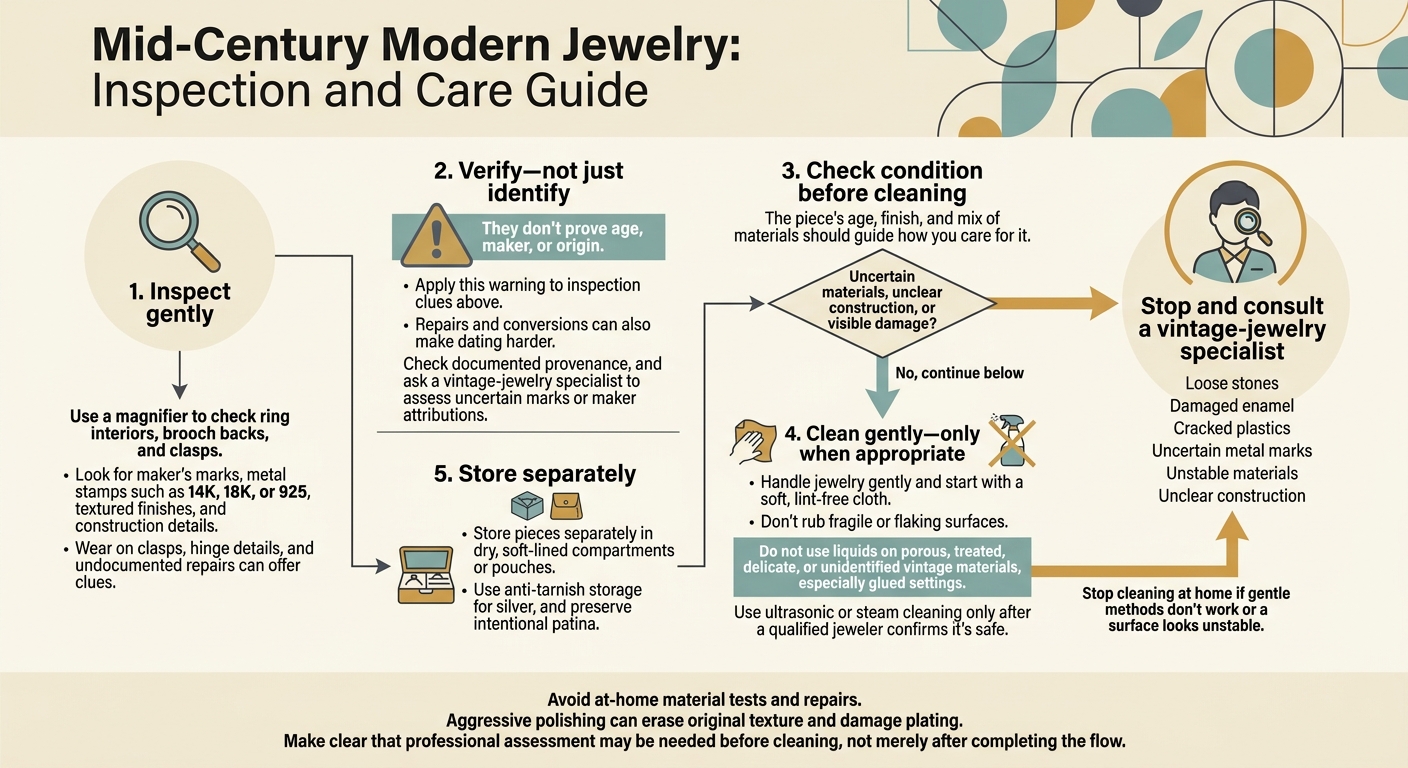
Mid-Century Modern Jewelry: Inspection and Care Guide
Clues to Age and Maker
Once you’re familiar with the style’s shapes and materials, look closely at the details for clues to age and maker.
Use a magnifier to check ring interiors, brooch backs, and clasps. Look for maker’s marks, metal stamps such as 14K, 18K, or 925, textured finishes, and construction details. Wear on clasps, hinge details, and undocumented repairs can offer clues - but they don’t prove age, maker, or origin. Repairs and conversions can also make dating harder. Check documented provenance, and ask a vintage-jewelry specialist to assess uncertain marks or maker attributions.
Cleaning and Storage
Keep cleaning gentle and selective. The piece’s age, finish, and mix of materials should guide how you care for it.
Handle jewelry gently and start with a soft, lint-free cloth. Don’t rub fragile or flaking surfaces. Do not use liquids on porous, treated, delicate, or unidentified vintage materials, especially glued settings. Use ultrasonic or steam cleaning only after a qualified jeweler confirms it’s safe.
Store pieces separately in dry, soft-lined compartments or pouches. Use anti-tarnish storage for silver, and preserve intentional patina.
If materials are unstable or the construction is unclear, leave repairs to a specialist.
When to Seek Professional Help
Consult a vintage-jewelry specialist for loose stones, damaged enamel, cracked plastics, or uncertain metal marks. Stop cleaning at home if gentle methods don’t work or a surface looks unstable. Avoid at-home material tests and repairs. Aggressive polishing can erase original texture and damage plating.
Key Takeaways
Mid-century modern jewelry features sculptural forms, abstraction, negative space, and expressive metalwork.
Choose one focal piece. A period-inspired silhouette alone doesn’t prove a piece’s age.
Match care to the piece’s materials and condition. Protect elevated settings from knocks, and preserve the original finish during restoration.