Skip to content




History of Lotus Motifs in Indian Jewelry
The short answer: the lotus stayed in Indian jewelry for over 2,300 years because its meaning stayed clear even as styles changed.
If you want the full picture fast, here it is: I see the lotus start as a sacred sign in Hindu, Buddhist, and Jain art, move into early ornaments seen in sites like Bharhut and Sanchi, take shape in temple and court jewelry, and then keep going into modern bridal and daily-wear pieces. These styles are often featured in bespoke jewelry collections that blend tradition with modern trends. The look changes - from Shunga gold pieces to Mughal kundan and meenakari, then to lighter modern designs - but the core idea stays the same: purity, prosperity, protection, and spiritual growth.
What this article covers:
- The lotus as a religious and symbolic form
- Early evidence from 3rd-century BCE monuments and c. 150 BCE gold jewelry
- How sculpture helps trace lost jewelry types
- The lotus in Mughal court jewelry, including the hath kamal
- Regional forms in South India, Rajasthan, and Odisha
- Why the motif still appears in bridal, dance, and everyday jewelry
A few terms matter here:
- Kundan: gemstone setting with refined gold foil
- Nakshi: detailed gold carving
- Temple jewelry: jewelry first made for temple idols, later worn by dancers and brides
Here’s the main point in one line: the lotus did not last because of style alone; it lasted because people kept wearing its meaning.
Cultural Origins and Symbolism of the Lotus
The lotus lasted as a jewelry motif because its meaning traveled across Indian traditions. It stayed meaningful because it ties together beauty, purity, and spiritual growth.
The Lotus in Hindu, Buddhist, and Jain Traditions
The main idea behind the lotus is simple: it grows in muddy water, yet comes out clean and beautiful. Across Indian traditions, that made it a symbol of purity, resilience, prosperity, and spiritual awakening.
In Hinduism, the lotus is closely tied to deities such as Lakshmi, Brahma, and Saraswati. It often appears as a divine seat or throne. In Buddhism, the flower stands for the mind’s journey toward enlightenment. In Jainism, it is linked with purity and sacred spiritual ideas, including Padmavati, the protective deity connected with Parsvanatha.
Because these meanings were shared, the lotus moved easily into ornaments used for worship and ceremony.
It also gave jewelers a clear visual language for pieces worn in rituals, weddings, and daily life.
How Sacred Meaning Translated Into Wearable Jewelry
Sacred lotus forms first showed up in ritual objects, then moved into personal ornaments, carrying protective and auspicious meaning into everyday life. In that way, lotus jewelry became wearable devotion.
Over time, these forms grew lighter and easier to wear. They shifted from heavy temple and royal pieces to simpler designs for daily use.
| Tradition | Primary Meaning | Jewelry Application |
|---|---|---|
| Hinduism | Purity, prosperity, creation | Temple pendants, bridal necklaces, Lakshmi-engraved amulets |
| Buddhism | Enlightenment, spiritual journey | Medallions and pendants representing the path to inner clarity |
| Jainism | Spiritual grace and purity | Ritualistic ornaments worn during prayer and sacred ceremonies |
Gold or silver lotus jewelry was believed to offer protection, while red stones, enamel, and pearls echoed the flower’s color and purity.
From there, the lotus moved into temple art, sculpture, and court jewelry.
Historical Evidence: Lotus Motifs From Early India to Court Jewelry
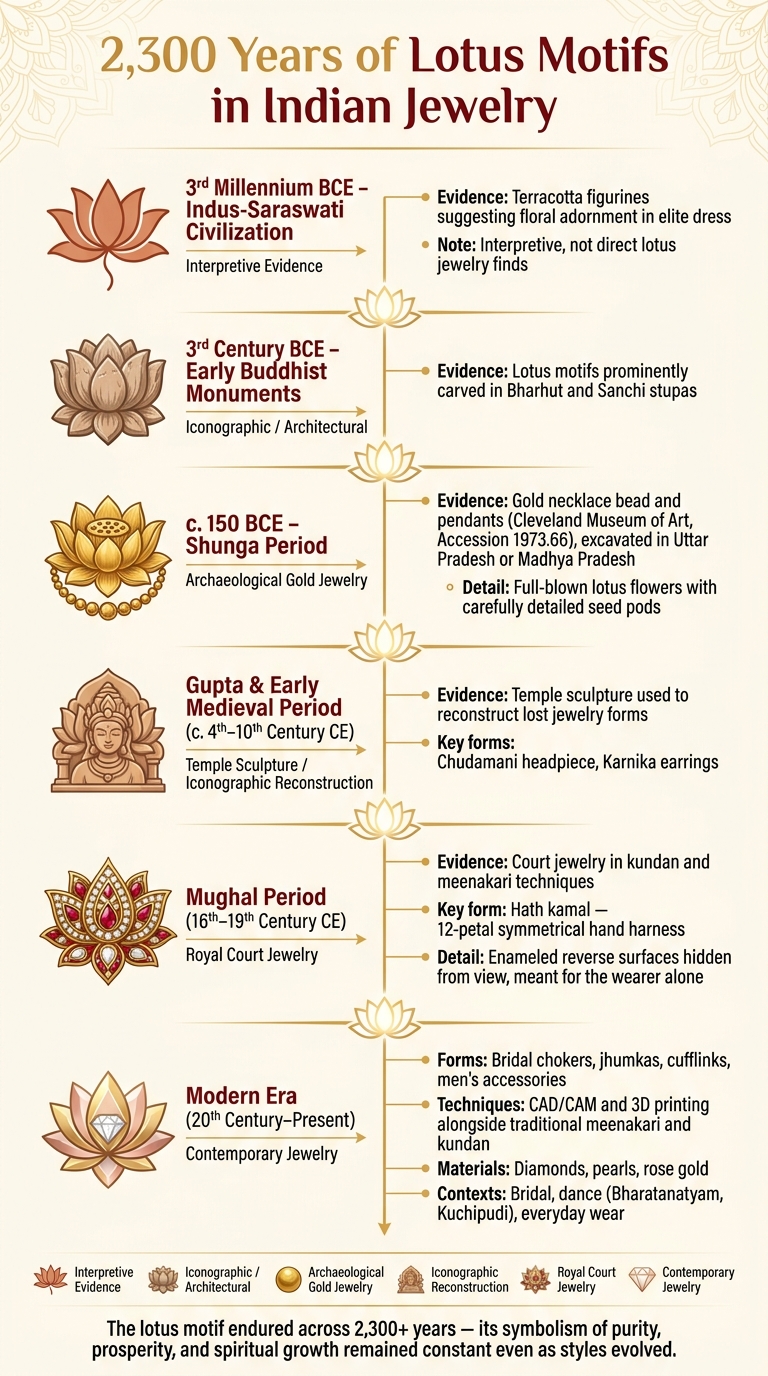
2,300 Years of Lotus Motifs in Indian Jewelry: A Historical Timeline
The lotus appears first as sacred symbolism. Later, it shows up in ornament, sculpture, and handcrafted jewelry that survives from later periods.
Early Archaeological References and Prehistoric Examples
Terracotta figurines from Indus-Saraswati sites in the 3rd millennium BCE suggest that floral adornment was already part of elite dress. That said, these are interpretive examples, not direct finds of lotus jewelry.
By the 3rd century BCE, lotus motifs were already prominent in early Buddhist monuments such as Bharhut and Sanchi. One of the clearest early physical examples comes from the Shunga period, around 150 BCE: a gold necklace bead and a pair of pendants in the Cleveland Museum of Art (Accession 1973.66), excavated in Uttar Pradesh or Madhya Pradesh. The museum describes them this way:
"The auspicious symbols on either side of the egg-shaped bead are in the form of full blown lotus flowers with the seed pods carefully detailed."
Early jewelry survives unevenly, which makes the record patchy. So when the objects themselves are missing, sculpture helps fill in the picture.
Temple Art, Sculpture, and Classical Jewelry Forms
Temple sculpture is one of the main ways scholars trace older jewelry forms when metal pieces no longer survive. Gupta and early medieval sculptures help reconstruct ornaments such as the lotus-shaped Chudamani headpiece and Karnika earrings. Put simply, surviving metalwork and visual evidence work together here. They show how lotus forms were worn, repeated, and reshaped across different periods.
Royal and Court Use in Medieval and Mughal Periods
By the Mughal period, the motif had moved from sacred and sculptural settings into court jewelry. Worked in gold, kundan, and meenakari, Mughal lotus jewelry turned the form into polished, symmetrical pieces meant to be worn. One key Mughal type was the hath kamal, or "lotus of the hand", a 12-petal hand harness. As jewelry historian Cynthia Meera Frederick writes:
"The hath kamal, or lotus, presented by 12 perfectly symmetrical petals - a hallmark of Mughal design - was one of the most popular designs."
Mughal craftsmen also enameled the reverse of kundan pieces, creating a hidden floral surface meant for the wearer alone.
| Period | Evidence Type | Key Lotus Form |
|---|---|---|
| Shunga (c. 150 BCE) | Archaeological (Gold) | Gold necklace bead and pendants with full-blown lotus flowers and seed pods |
| Early Buddhist (3rd c. BCE) | Iconographic (Stupas) | Lotus motifs in Bharhut and Sanchi reliefs |
| Gupta/Medieval | Temple Sculpture | Chudamani headpiece, Karnika earrings |
| Mughal (16th–19th c.) | Court Jewelry | Hath kamal hand harness in kundan and meenakari work |
Regional Styles of Lotus Motifs in Indian Jewelry
As the lotus moved through Indian craft centers, each region gave it its own look. The methods changed. The meaning did not. Across these styles, the flower still carried the same sacred weight.
South Indian Temple and Bridal Jewelry
In South India, lotus jewelry leans toward heavy gold, raised detail, and Lakshmi imagery. The link between the lotus and Goddess Lakshmi made the motif a natural match for Lakshmi Harams and Nethichutti worn by brides seeking her blessings. It often appears within the 16-piece Solah Shringar set, including lotus-themed necklaces and jhumkas.
A big part of the look comes from repoussé, which lifts the lotus in relief from sheet gold. Craftspeople often pair it with nakshi embossing and red and green Kemp stones, so the flower stands out at a glance. That bold shape also shows up well in Bharatanatyam and Kuchipudi, where jewelry has to read clearly from a distance.
North Indian and eastern workshops kept the same sacred meaning, but the work took a different turn.
Rajasthani and Eastern Indian Lotus Jewelry
In Rajasthan, the lotus often appears in kundan and meenakari jewelry. Here, the effect comes less from sculpted weight and more from symmetry, enamel, and careful stone-setting.
In Odisha, the lotus is linked to Kamala, the Lotus Goddess, and to temple ritual. At Puri's Jagannath Temple, the Padma Besha ritual decorates deities with lotuses before they sleep. That practice keeps the flower closely tied to worship in the region.
| Region | Common Jewelry Forms | Key Style / Technique | Ritual / Context |
|---|---|---|---|
| Tamil Nadu | Lakshmi Haram, lotus jhumkas | Repoussé, nakshi, Kemp stones | Bridal jewelry, Bharatanatyam and Kuchipudi |
| Rajasthan | Kundan sets, meenakari pieces | Kundan stone-setting, enamel, symmetrical floral design | Courtly regalia, bridal wear |
| Odisha (Eastern India) | Lotus-inspired devotional ornaments | Devotional floral form | Temple ritual, personal adornment |
These regional styles still shape lotus jewelry made today.
Modern Interpretations and Conclusion
Lotus Motifs in Contemporary Jewelry Design
The lotus has moved far beyond ceremonial jewelry and now shows up easily in everyday pieces. Forms once tied to regional styles now appear in cleaner, more modern versions. Drawing from South Indian, Rajasthani, and Mughal traditions, designers strip the motif down to petal cutouts, stylized buds, and marquise stones. They often pair these shapes with diamonds, pearls, or rose gold, which makes the look easy to wear day to day. Lighter pieces now fit both office wear and formal occasions.
Modern jewelry keeps the lotus easy to recognize, even as its size and production methods change. Meenakari and Kundan still appear often in bridal chokers and jhumkas, but many pieces are now made with CAD/CAM and 3D printing for precision. The motif has also moved into men's accessories, including cufflinks and buttons.
Conclusion: What the Lotus Tells Us About Indian Jewelry History
Across all these changes, the lotus has held onto its core meaning. It began as a sacred symbol in Hindu, Buddhist, and Jain traditions. From there, it moved into temple jewelry and Mughal craftsmanship, then continued through regional bridal styles and into modern daily wear. Each period changed the way it looked, but not what it stood for.
That staying power is what sets the lotus apart. Its symbolism - purity, resilience, and growth from adversity - still makes sense to modern wearers, even when the piece is not worn in a religious setting. Few motifs have traveled so far across time, style, and use while remaining so clear. The lotus still stands as one of the most enduring images in Indian jewelry history.
FAQs
Why has the lotus motif lasted so long in Indian jewelry?
The lotus motif has lasted in Indian jewelry for two big reasons: meaning and beauty.
On the symbolic side, the lotus stands for purity, enlightenment, and renewal. It also has close ties to deities such as Lakshmi, Brahma, and Vishnu, which gives it a deep spiritual place in Indian design.
On the visual side, the lotus is simply striking. Its shape works just as well in ornate, classic pieces as it does in clean, modern designs. That range has helped the motif stay relevant and meaningful across generations.
How do historians trace lotus jewelry when original pieces are missing?
Historians piece together the story of lotus jewelry from records, texts, and art when the original pieces no longer survive.
They turn to ancient literary treatises for details on metallurgy, gemology, and different ornament types. They also study paintings from the period to see how royals and court officials actually wore jewelry.
Archaeological evidence helps fill in the rest. That includes stone reliefs, frescoes, and temple sculptures, along with ethnographic accounts that show these floral motifs continued across time.
How does lotus jewelry differ across Indian regions?
Lotus motifs change from one region to another, and those shifts come from local heritage and long-held artistic styles.
In South India, the lotus sits at the heart of temple jewelry. You’ll often see it embossed with deities and sacred symbols, which links the design to purity and divine beauty.
In North India, especially in styles shaped by Mughal influence, the lotus takes on a more symmetrical and highly detailed floral form. It shows up in gem-set, enameled, or kundan pieces, with design cues drawn from architecture and nature.