Skip to content




Why Ladybugs Symbolize Luck in Jewelry
Ladybugs are widely recognized as symbols of luck and prosperity, making them a popular motif in jewelry. Their vibrant red color and black spots carry meanings tied to fortune, protection, and renewal across different cultures. Historically, they were cherished by farmers for protecting crops, which evolved into their association with abundance and blessings. In Europe, they were seen as divine messengers linked to the Virgin Mary, while in Asia, they represent wealth, love, and harmony. Ladybug jewelry blends this rich symbolism with striking design, often crafted using materials like red enamel, rubies, and gold, creating pieces that are both meaningful and visually appealing.
Key Highlights:
- Origins of Luck: Ladybugs helped farmers by controlling pests, symbolizing abundance and protection.
- Cultural Significance: In Europe, tied to the Virgin Mary; in Asia, linked to love and prosperity.
- Design Appeal: Popular in jewelry for their bold red and black colors, crafted in materials like gold and gemstones.
- Versatility: Seen in various styles, from affordable sterling silver to luxurious 18kt gold pieces.
Ladybug-inspired jewelry offers more than beauty - it carries a legacy of hope, positivity, and good fortune.
Historical Origins of Ladybug Symbolism
Ladybugs in European Folklore
In medieval Europe, farmers constantly battled aphid infestations that threatened their crops. Enter the ladybug - a tiny, winged ally capable of consuming up to 50 aphids a day and an astonishing 5,000 over its lifetime. With such an appetite for pests, it’s no wonder ladybugs earned a reputation as nature’s pest controllers.
Over time, these helpful insects became intertwined with notions of good luck and divine intervention, largely due to folklore. During the Middle Ages, when aphid swarms endangered harvests, farmers often turned to the Virgin Mary in prayer. The arrival of ladybugs, which swiftly tackled the pests, was seen as nothing short of miraculous - a divine response to their pleas.
One fascinating tale from 11th-century France highlights this symbolism. King Robert II, known as "the Pious", was about to execute a prisoner when a ladybug repeatedly landed on the condemned man’s neck. Taking this as a sign from God, the King spared the man’s life. Later, the man’s innocence was proven. As Elaine Jordan recounts:
the King "saw the action of this little insect as a divine intervention, a sign of un bête à bon Dieu [a beast of the good God]"
This story cemented the idea that ladybugs were more than just helpful insects - they were sacred creatures tied to divine will. Their practical role in pest control, combined with these spiritual associations, gave them a special place in European culture.
Religious Connections to Protection
The very name "ladybug" reflects its religious origins. It’s a shortened form of "Our Lady’s Bug" or "Beetle of Our Lady", with "Lady" referring to the Virgin Mary. Across Europe, this connection is evident in the names given to ladybugs:
| Language | Local Name | Literal Translation |
|---|---|---|
| German | Marienkäfer | Mary beetle |
| Croatian | Bubamara | Mary’s beetle |
| Bohemian | Frauenkäferlein | Our Lady’s little beetle |
| Italian | Commaruccia | Little midwives |
| French | Bête à bon Dieu | Beast of the good God |
Even the ladybug’s appearance carries religious symbolism. Its red shell is said to represent the Virgin Mary’s mantle, while its black spots symbolize her joys and sorrows. The seven-spot ladybird, the most common species in Europe, was thought to hold additional meaning: its seven spots were linked to the Seven Joys and Seven Sorrows of Mary. As Caroline Perkins explains:
"The bug's red-orange wings represent the mantle of the Blessed Virgin Mary, while the black spots symbolize her joys and sorrows"
These religious connections elevated the ladybug to the status of a protective charm. In Italy, for instance, if a ladybug landed on a baby’s cradle, it was considered a blessing for the child. Similarly, the belief that killing a ladybug brings bad luck stems from the idea that harming one offends the Virgin Mary. Such medieval beliefs ensured that ladybugs became enduring symbols of divine protection and good fortune, a status they still hold today.
Global Perspectives on Ladybug Symbolism
Ladybug Symbolism in Asian Cultures
Beyond Europe, ladybugs carry rich and varied symbolism across the globe. In Asian cultures, they are often associated with love, prosperity, and romance. For example, in China, these tiny red beetles are seen as symbols of luck and wealth. They frequently appear in wedding decorations and are gifted to newlyweds as tokens of good fortune. According to local folklore, the number of spots on a ladybug's back can predict the number of months until a loved one returns. Some even believe the spots can foretell how many children a couple might have. The seven-spotted ladybug, in particular, is thought to have the power to grant wishes.
In Feng Shui, ladybug figurines often find a home in the "love corner" of a room. This practice is believed to invite and strengthen romantic energy. Their bright red color represents happiness and passion, while the black spots are thought to resemble coins, symbolizing financial luck. In Japan, ladybugs are lovingly referred to as "Red Girl", a nod to their striking appearance. They are connected to celestial influences and the afterlife, adding a spiritual dimension to their charm. Similarly, in Buddhist traditions, ladybugs symbolize inner peace, healing, and mindfulness, making them a meaningful emblem in spiritual practices. Indigenous traditions in the Americas also assign ladybugs protective and transformative qualities, further enriching their global significance.
Ladybugs in Native American Beliefs
In Native American traditions, ladybugs are often seen as guardian spirits, offering protection from both physical and spiritual harm. Their transformation from larvae to adults is a powerful metaphor for renewal, new beginnings, and positive change. Many tribes believe these small creatures carry blessings and serve as guides during life's transitions:
"According to many Native American tribes, ladybugs are symbols of protection and blessings from the spiritual world. They're seen as a sign that you're watched over, especially during times of change."
Ladybugs are celebrated not only as protectors but also as symbols of resilience and hope. They are often viewed as messengers from ancestors, offering reassurance that prayers have been heard. Just as ladybugs protect crops from pests, they are believed to shield people from negative energies, embodying both practical and spiritual roles. Their presence is thought to bring balance and harmony, reminding us that even the smallest beings can carry profound meaning.
Ladybugs in Jewelry Design
Handcrafted Jewelry Featuring Ladybugs
Ladybug motifs bring a touch of charm and vibrant symbolism to jewelry, blending tradition with artistry. For centuries, ladybugs have been seen as symbols of luck and protection, and their iconic red shells with black spots create a visually striking pattern that designers love to incorporate into their creations. As Werneri Grundström aptly puts it:
"Ladybugs, with their vibrant colors and delightful presence, have long captured our imagination... transitioning from natural gardens to refined jewelry".
These pieces often serve as stylish talismans, offering wearers a subtle yet meaningful nod to enduring good fortune. Designs range from playful, three-dimensional pieces with movable wings to elegant fine jewelry adorned with gemstones. Modern trends include stackable ladybug rings and asymmetrical earrings, adding a contemporary and playful twist to classic motifs. Some designers even create interactive elements, like wings that open and close, adding a dynamic feature to their designs. For those who enjoy themed accessories, pairing ladybug pendants with other nature-inspired jewelry - like leaf-shaped necklaces - can create a cohesive, garden-inspired look.
LaCkore Couture is one brand that embraces this motif, offering handcrafted ladybug jewelry in the form of customizable necklaces, earrings, and charms. Their designs allow wearers to incorporate the ladybug’s lucky symbolism into their personal style while choosing from high-quality materials. Made in the USA, these pieces balance creative design with timeless meaning, setting the stage for a deeper appreciation of the materials and craftsmanship behind them.
Materials and Craftsmanship
Ladybug-inspired jewelry often features red enamel or gemstones like rubies paired with black onyx to echo the insect’s iconic appearance. Red, a color widely associated with luck and prosperity, combined with durable materials such as 10k, 14k, or 18k gold and sterling silver (.925), makes these pieces both meaningful and enduring.
Crafting techniques like 3D modeling, intricate etching, and gemstone setting ensure each piece is both visually stunning and of high quality. The use of markings such as '.925' and '14k/18k' guarantees the authenticity of the materials. To maintain the beauty of enameled pieces, it’s best to store them in soft pouches and clean them gently with mild soap to avoid damage.
Comparing Ladybug Symbolism to Other Charms
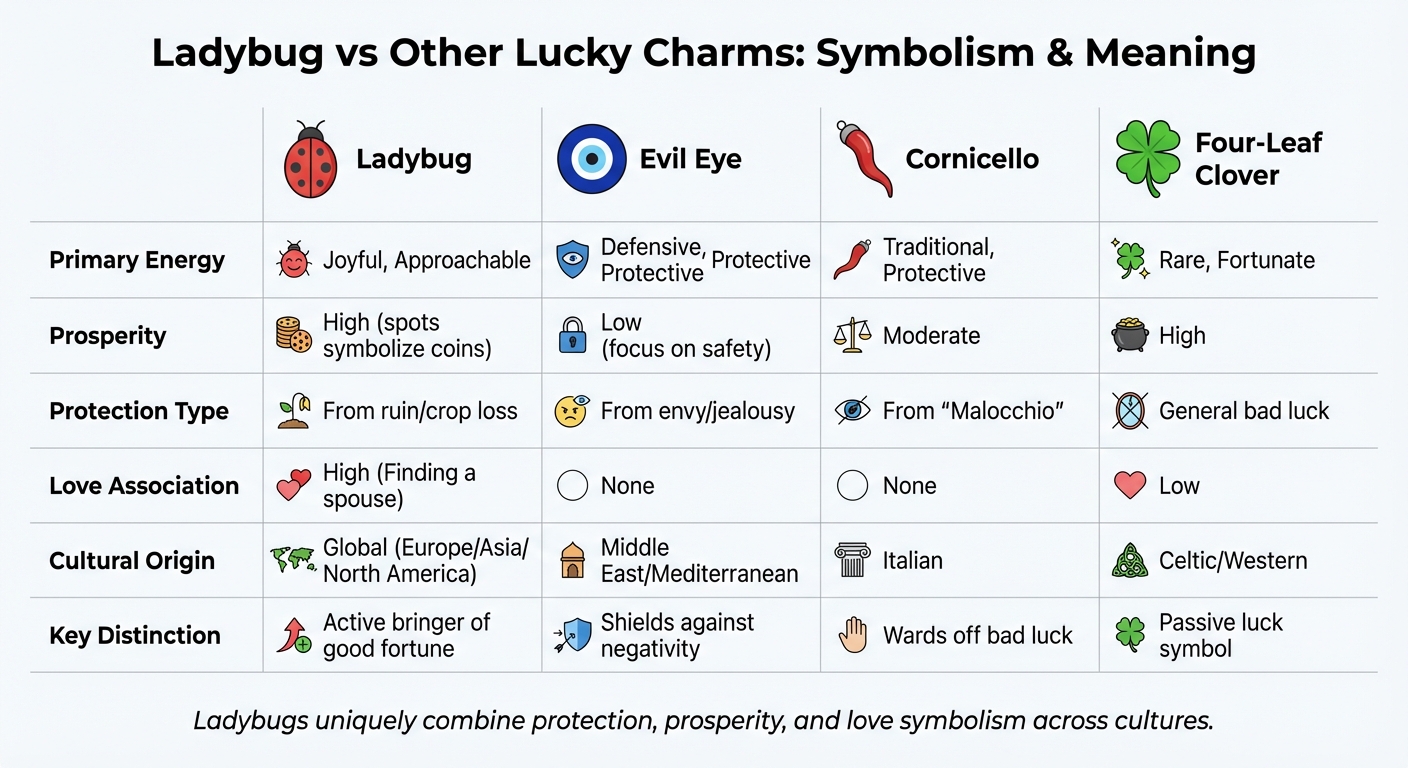
Ladybug vs Other Lucky Charms: Symbolism Comparison
Ladybug vs. Cornicello, Evil Eye, and Four-Leaf Clover
Ladybugs hold a special place in the world of charms, and comparing them to other well-known symbols highlights their unique appeal in modern jewelry. While many charms are designed to shield against negativity, ladybugs take a different approach - they are seen as active bringers of good fortune, drawing positivity into one’s life instead of merely keeping bad energy at bay.
Take the evil eye, for example. Its primary purpose is defensive, protecting against envy and harmful intentions. Similarly, the cornicello, or Italian horn, is a talisman traditionally used to ward off bad luck and the "Malocchio", or evil eye. Ladybugs, on the other hand, are celebrated for their role in nature as protectors of crops and symbols of prosperity and renewal. As Alex and Ani explain:
"The ladybug symbol also stands for protection, healing, and good fortune across the world."
This blend of protection and positivity makes ladybugs stand out among charms.
What truly sets ladybugs apart is their cheerful and approachable energy. Unlike most insects, which people often avoid, ladybugs are universally loved. When one lands on you, it’s a moment of joy and even a chance to make a wish. This friendly and uplifting quality makes ladybugs perfect for jewelry designs that range from whimsical pieces for children to elegant accessories for adults. While the four-leaf clover is widely associated with luck, ladybugs add a romantic twist. For instance, in Sweden, it’s believed that if a ladybug lands on a young woman’s hand, it’s "measuring her for wedding gloves".
Here’s a quick comparison of these charms and their symbolic energies:
| Feature | Ladybug | Evil Eye | Cornicello | Four-Leaf Clover |
|---|---|---|---|---|
| Primary Energy | Joyful, Approachable | Defensive, Protective | Traditional, Protective | Rare, Fortunate |
| Prosperity | High (spots symbolize coins) | Low (focus on safety) | Moderate | High |
| Protection Type | From ruin/crop loss | From envy/jealousy | From "Malocchio" | General bad luck |
| Love Association | High (Finding a spouse) | None | None | Low |
| Cultural Origin | Global (Europe/Asia/NA) | Middle East/Mediterranean | Italian | Celtic/Western |
Another point of distinction is the versatility of ladybug designs. While the evil eye is often limited to blue glass and the cornicello to its signature red form, ladybugs come in a variety of colors, each with its own meaning. Red is tied to traditional luck and wealth, pink symbolizes love and kindness, yellow represents new beginnings, and black signifies transformation. This variety allows wearers to choose pieces that resonate with their personal intentions, making ladybug charms both meaningful and visually dynamic.
Conclusion
Ladybugs have long captured hearts, becoming cherished symbols in jewelry design. While they started as natural helpers in pest control, these tiny creatures grew into global icons of hope and protection. Across cultures, their symbolism shines: medieval European farmers believed they were divine messengers from the Virgin Mary, while in Asian traditions, their red hues and spots are linked to prosperity and good fortune. Ladybugs carry a universal message that resonates worldwide.
Jewelry featuring ladybugs goes beyond aesthetics; it embodies meanings tied to good luck, love, healing, and fresh starts. As Emily Hannemann, Digital Editor at Birds & Blooms, beautifully states:
"Ladybugs serve as colorful symbols of positive change and renewal."
The striking red and black patterns of ladybugs translate effortlessly into jewelry design. Whether crafted with enamel, gemstones, or fine metals, these designs remain eye-catching and versatile. Jewelers use this appeal to create everything from playful charms for kids to elegant, sophisticated pieces for adults.
For those drawn to the beauty and symbolism of ladybug jewelry, LaCkore Couture offers handcrafted designs that prioritize quality and detail. Made in the USA with authenticated metal purities, each piece is a lasting treasure. Ladybug jewelry serves as both a personal talisman and a thoughtful gift, blending the timeless allure of nature with artistic craftsmanship. It’s a perfect way to carry a little luck and inspiration wherever you go.
FAQs
Why are ladybugs seen as symbols of good luck in jewelry?
Ladybugs have been seen as symbols of good luck for centuries, thanks to their role in nature and the stories woven around them. Farmers appreciated them for their knack for eating pests that damaged crops, which made them a sign of protection and abundance. In medieval Europe, people connected ladybugs to the Virgin Mary, calling them "Our Lady's bird", and viewed them as symbols of blessings and safety.
Different cultures have their own beliefs about the luck ladybugs bring. Some say the number of spots on a ladybug predicts how many months of good fortune lie ahead. Others believe their vibrant red color enhances their charm. In certain traditions, when a ladybug lands on you, it’s seen as a sign that your wishes might come true or that good health is on the horizon.
Because of their timeless symbolism, ladybugs are a popular motif in jewelry, often representing luck, protection, and positivity. At LaCkore Couture, our handcrafted ladybug-inspired designs let you carry a little piece of good fortune with you wherever you go.
What materials are used to create ladybug jewelry?
Ladybug jewelry is typically made from gold, silver, or stainless steel, providing a sturdy yet sophisticated foundation. To bring a splash of color and texture, designers often use natural stones, adding an extra layer of beauty to these symbolic pieces. The blend of premium materials with detailed craftsmanship ensures ladybug jewelry is both fashionable and full of meaning.
What makes ladybugs a symbol of luck, and how do they compare to other charms like the evil eye or four-leaf clover?
Ladybugs have long been cherished as symbols of luck and protection, largely due to their role in nature. Farmers, for instance, have historically regarded them as a blessing because these tiny beetles help safeguard crops by devouring pests like aphids. There's also a charming belief that when a ladybug lands on you, it brings good fortune - or even grants wishes - sometimes tied to the number of spots on its back. In Christian folklore, the ladybug holds special significance, often linked to the Virgin Mary and her blessings on the harvest, further reinforcing its positive image.
Though ladybugs are seen as lucky, other charms like the evil eye and four-leaf clover carry distinct meanings. The evil eye is thought to protect against negative energy or curses, while the four-leaf clover, a rare find, symbolizes faith, hope, love, and luck. Each of these symbols has its own unique history and cultural roots, making them meaningful in their own right.