Skip to content




Jewelry as Social Currency: Past to Present
Jewelry has always done more than decorate the body. In this article, I show one clear pattern: jewelry moved from a public sign of rank, law, and religion to a personal tool for style, values, and status. The core idea stayed the same, but the message changed.
Here’s the short version:
- In ancient Egypt and Mesopotamia, jewelry showed rank, religious power, and control over scarce materials like gold and lapis lazuli.
- In Greece and Rome, jewelry could mark class, family place, and even legal rights. In Rome, some pieces were tied to law.
- In the industrial U.S., mass production lowered prices, so more people could buy jewelry. A brooch could cost just $0.35 in the 1890s.
- In the U.S. today, jewelry often works as personal image. It can show money, taste, ethics, or life milestones.
- One stat says a lot: by 1990, 80% of American brides got a diamond engagement ring, up from 10% in 1940.
- Another big shift: lab-grown diamonds now make up nearly 50% of the U.S. engagement ring market, and about 15% of engagement rings now use a colored gemstone.
So if you want the main takeaway in one line, here it is: jewelry went from being assigned by hierarchy to being chosen by the wearer.
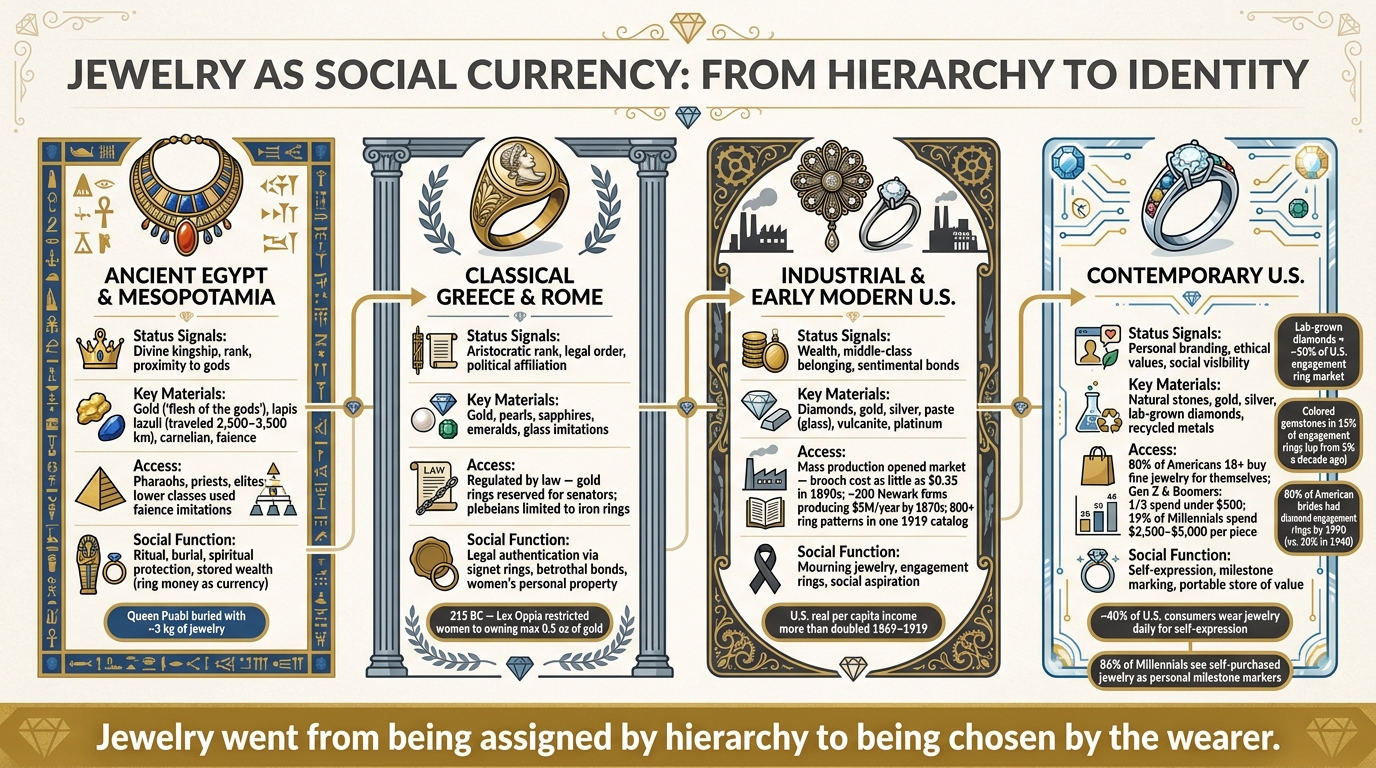
Jewelry as Social Currency: How Its Meaning Evolved Through History
Quick Comparison
| Era | What Jewelry Mainly Showed | Who Had Access | Main Use |
|---|---|---|---|
| Ancient Egypt & Mesopotamia | Rank, divine link, stored wealth | Mostly rulers, priests, elites; some lower-class use in Egypt | Ritual, burial, protection, money |
| Greece & Rome | Class, family place, legal order | Class-based, often controlled by custom or law | Seals, marriage, rank display |
| Industrial & Early Modern U.S. | Wealth, social climbing, belonging | More buyers due to factory production | Fashion, mourning, engagement |
| Contemporary U.S. | Personal image, values, taste, wealth | Much more open across price points | Self-expression, milestone marking, status |
I keep the focus on four simple points throughout: status, materials, access, and social use. That makes it easy to see what changed - and what did not.
1. Ancient Egypt and Mesopotamia
Status Signals
In ancient Egypt and Mesopotamia, jewelry showed rank right away. Egyptian pharaohs wore pieces like the uraeus to mark authority. In Mesopotamia, cylinder seals - carved stones worn on the body - worked as both jewelry and official seals for authenticating clay tablets. In both places, jewelry made social rank visible at a glance.
Materials
That message depended on what a piece was made from. In Egypt, gold was called the "flesh of the gods" and silver their bones, so wearing those metals signaled a direct link to the divine. Mesopotamian elites leaned toward gold, lapis lazuli, and carnelian, each tied to symbolic meaning. Blue lapis stood for the heavens. Red carnelian stood for life and vital energy.
These materials also carried weight because they came from far away. Lapis lazuli traveled about 2,500 to 3,500 kilometers from the Sar-i-Sang mines in Afghanistan to Egyptian and Mesopotamian cities. If you owned it, you weren't just showing taste. You were showing the money and ties needed to control long-distance trade.
Access
Who could get those materials shaped who could wear them. Egypt stood out here because jewelry crossed class lines. Farmers with little wealth and pharaohs both wore it, even if the gap in material was sharp. Lower classes used faience, a blue-green glazed ceramic made to look like lapis. Mesopotamia drew a harder line. There, elaborate jewelry mostly belonged to royalty, priests, scribes, merchants, and military officers.
You could see that class divide almost instantly. Queen Puabi's burial at Ur, excavated in the 1920s by archaeologist Leonard Woolley, held about 3 kilograms of jewelry, including a large gold headdress with lapis lazuli pendants and ten gold rings.
Social Function
Jewelry did more than decorate the body. In Egypt, amulets such as the Eye of Horus were treated almost like protective tools, meant to guard the wearer from disease and evil. In Mesopotamia, cylinder seals had a day-to-day job in administration, and jewelry also appeared in votive offerings given to the gods by high priests and royalty. In other words, Mesopotamian jewelry didn't just show power - it could help confirm it.
It also held wealth in a direct, practical way. In Mesopotamia, ring money - gold and silver rings made to set weights - worked as currency. In Egypt, jewelry was buried with the dead as equipment for the afterlife, and during unstable periods it could be looted or melted down. So jewelry carried several jobs at once: status marker, protection, stored wealth, and identity. Those uses shaped what came later, when jewelry kept its social value but moved more toward civic and personal display.
2. Classical Greece and Rome
Status Signals
Greece and Rome both used jewelry to show rank, but they handled it in different ways.
In Greece, a woman’s jewelry pointed to her husband’s place in society. The more ornate her pieces were, the higher his standing in the community. This wasn’t usually set by formal law. It came from social habit and shared expectations.
Rome took a more rigid path. Status rules were written into law. Gold rings were set aside for senators and bureaucrats, while plebeians were usually limited to iron rings unless they were granted a gold one. Roman elite boys also wore a gold bulla - a small amulet - from birth until adulthood as a plain sign of rank. In both societies, jewelry made status easy to see. In Rome, it also made status easy to police.
Materials
Greek jewelers prized gold for its prestige and because it didn’t tarnish easily. Greek craftsmen also used extremely fine granulation to display technical skill.
Roman taste leaned more toward colored gemstones and pearls. At the same time, glass imitations gave lower-status people a way to copy elite style without paying elite prices. So the gap wasn’t just about who wore jewelry. It was also about what it was made from, and how well it was made.
Access
In Greece, fine jewelry was mostly a female luxury. Men usually wore only a signet ring.
Rome opened access a bit more. Molds helped make bronze, bone, and glass pieces available to lower-income wearers, while the wealthy still wore gold and silver. Roman men also wore more jewelry than Greek men and often stacked several rings.
Social Function
Jewelry did more than signal wealth or taste. It had legal and practical uses too.
In Greece, signet rings worked as personal seals. Pressing one into wax could confirm identity and authorize transactions. In Rome, betrothal rings could serve as legal bonds between families. Jewelry also counted as a woman’s own property, separate from her husband’s finances, which meant she could buy, sell, or leave it to someone else as she chose.
The stakes could turn political. In 215 BC, Rome passed the Lex Oppia, which restricted women from owning more than half an ounce of gold to help fund the Punic Wars. Women protested the gold limit, showing that jewelry had public political force as well as private meaning.
Rome, in particular, turned status into something visible, regulated, and portable. And when women pushed back against the Lex Oppia, they showed how much that portable form of status mattered. These uses also pushed jewelry beyond civic and family authority and closer to the modern idea of personal status.
3. Industrial and Early Modern United States
Industrialization changed jewelry in the United States. It moved from something tied to family inheritance to something people could buy to show status.
Status Signals
In the United States, status in jewelry came less from birth and more from money, taste, and social movement. The 1867 South African diamond discovery, along with U.S. gold and silver rushes, pushed jewelry toward more open display.
Materials
Diamonds, natural pearls, and platinum signaled elite standing. Platinum became especially prized because its white-on-white setting made diamonds seem to float.
Tiffany & Co. also shaped a distinctly American idea of luxury. The company used native stones like Montana sapphires, Maine tourmalines, and Mississippi freshwater pearls to attract elite buyers.
Access
By the 1870s, Newark, New Jersey, had become the center of U.S. jewelry manufacturing. Around 200 firms there produced about $5 million a year. Steam-powered machinery and die-stamping helped bring status-driven styles to middle- and working-class buyers at lower prices.
The numbers make that shift easy to see:
- By the 1890s, a mass-produced brooch could cost as little as 35 cents.
- At that time, a female domestic servant might earn about $2 a week, while a bookkeeper could make up to $20.
- In 1919, Providence-based Ostby & Barton offered a catalog with nearly 800 patterns for "gold shell" rings.
Lower-cost substitutes also entered the market. Vulcanite, a chemically treated rubber, copied the look of expensive tortoiseshell and jet.
Social Function
Lower prices opened the door to more buyers, but jewelry still depended on context. It wasn't just what you wore. It was when and how you wore it.
A good example is the "carriage cover", patented by American jewelers in the 1870s. These hinged gold cases hid diamond earrings during the day and revealed them at night. That little mechanism says a lot. Jewelry could still shift with time, place, and social setting.
Between 1869 and 1919, U.S. real per capita income more than doubled, and more Americans could afford status symbols.
4. Contemporary U.S. Jewelry Culture
Status Signals
As jewelry became easier to buy, its role changed too. In the U.S. today, jewelry says less about inherited rank and more about personal branding. It can signal success, taste, and identity. And it doesn’t just show up at dinners, weddings, or work events. It also shows up online, where personal style can matter just as much as price.
Materials
The material someone chooses can say a lot. It might point to prestige, rarity, ethics, or just personal style.
Colored gemstones like rubies, sapphires, and emeralds are getting more attention as collectors look for pieces that feel rare and personal. About 15% of engagement rings now feature a colored gemstone, up from 5% a decade ago.
Lab-grown diamonds send a different message. They often suggest ethical awareness and comfort with new tech. They now make up nearly 50% of the U.S. engagement ring market. At the same time, they sell at a 60–70% discount compared with natural diamonds, which can hurt long-term resale value.
Access
The gap between jewelry for the elite and jewelry for everyone else has shrunk a lot. Online retail and resale platforms opened the market across many price points. That means more people can buy jewelry on their own terms, whether they’re spending a little or a lot.
Over one-third of Gen Z and Baby Boomers spend less than $500 on self-purchased jewelry, while 19% of Millennials are willing to spend between $2,500 and $5,000 on a single piece. And 80% of Americans age 18 and older now buy fine jewelry for themselves. That’s a sharp shift from earlier eras, when jewelry was more often inherited or given by people in power.
Broader access changed more than the buyer pool. It changed the meaning of jewelry itself.
Social Function
Today, jewelry works as a form of self-expression just as much as a status marker. Nearly 40% of U.S. consumers wear jewelry every day as a form of self-expression. And 86% of Millennials see self-purchased pieces as markers of personal milestones and success.
For wealthy buyers, jewelry can also serve another role: a portable store of value. Some branded pieces hold their value because demand stays high and prices climb over time.
How Jewelry Signals Status: A Direct Comparison Across Eras
Across eras, jewelry moves from inherited authority to chosen identity.
The table below shows that change through four lenses: status signals, materials, access, and social function.
| Era | Status Signals | Key Materials | Access | Social Function |
|---|---|---|---|---|
| Ancient Egypt & Mesopotamia | Divine kingship; proximity to gods; military prowess | Gold, lapis lazuli, carnelian, turquoise, faience | Pharaohs, priests, and high elites | Ritual, burial, and spiritual protection |
| Classical Greece & Rome | Aristocratic rank; legal order; political affiliation | Gold, pearls, sapphires, emeralds, amber | Regulated by sumptuary laws and social class | Legal authentication (signet rings); warding off evil |
| Industrial & Early Modern U.S. | Wealth; middle-class belonging; sentimental bonds | Diamonds, gold, silver, "paste" (glass), jet | Expanding middle class via mass production | Mourning, romantic commitment, social fitting |
| Contemporary U.S. | Personal branding and social visibility; ethical values | Natural stones, gold, silver, lab-grown gems, recycled metals | Broad access across fine, demi-fine, and handcrafted | Self-presentation, fashion, and identity |
What stands out is simple: precious materials have long carried social meaning, but control over that meaning has spread outward. In early periods, jewelry often spoke for institutions like the court, the temple, or the state. A gold collar or signet ring didn’t just look expensive. It marked rank, duty, and place.
By the Industrial & Early Modern U.S., that message had started to loosen. Mass production opened the door to more buyers, and jewelry began to signal not just wealth, but belonging. It could mark grief, romance, or the wish to fit into a certain social world. The message became less fixed and more personal.
In the Contemporary U.S., that shift is even clearer. Jewelry still signals status, but status now shows up in more than one form. It might mean money. It might mean taste, ethics, trend awareness, or a carefully shaped public image. In that sense, jewelry has gone from being a badge assigned by birth to something closer to a statement piece people build for themselves.
That change comes with a tradeoff. When status becomes more visible and easier to access, jewelry gains range and personal meaning. At the same time, it can lose some of its old exclusivity. The symbol still matters - it just speaks in a different voice now.
Jewelry as Status: Benefits and Drawbacks Then and Now
From one era to the next, jewelry changed jobs. It once helped enforce rank. Now it more often helps people express who they are. The tradeoff changed too. In the past, the cost could be legal limits. Today, it’s more about social pressure.
The shift is easy to spot side by side:
| Era | Key Benefits | Key Drawbacks |
|---|---|---|
| Ancient Egypt & Mesopotamia | Portable wealth; spiritual protection; identity within hierarchy | Strict material restrictions; gold and lapis lazuli reserved for elites |
| Classical Greece & Rome | Legal identity through signet rings | Slaves forbidden from wearing rings; gold rings tightly regulated in Rome |
| Industrial & Early Modern U.S. | Wider access; mourning and engagement symbolism | Social pressure to keep up; class distinctions between paste and fine jewelry |
| Contemporary U.S. | Personal identity; ethical signaling; customization | Status anxiety; financial strain; risk of being judged by appearance |
In Ancient Egypt & Mesopotamia, jewelry could store wealth, signal place in society, and carry spiritual meaning. But that came with tight limits. Gold and lapis lazuli were often kept for elites, so the wrong material on the wrong person wasn’t just frowned on. It could bring punishment.
In Classical Greece & Rome, jewelry also worked as a marker of legal identity, especially through signet rings. At the same time, access stayed tightly controlled. Slaves were forbidden from wearing rings, and gold rings in Rome were regulated with care.
By the Industrial & Early Modern U.S. period, more people could buy and wear jewelry. That opened the door for new meanings, including mourning pieces and engagement jewelry. Still, broader access didn’t erase status games. People felt pressure to keep up, and class lines showed up in the gap between paste jewelry and fine jewelry.
In the Contemporary U.S., jewelry often speaks to personal identity. It can also signal ethical choices and give people room to customize what they wear. But the pressure didn’t vanish; it just changed shape. Now jewelry can bring status anxiety, money stress, and snap judgments based on appearance.
So the drawback has moved from law to social life. In ancient times, the risk was direct: wear the wrong material and face punishment. Today, the pressure is less official but still strong. Jewelry can draw attention, invite judgment, and push people to spend more than they want.
Conclusion
Across the eras traced above, jewelry kept the same core role even as its meaning shifted. For thousands of years, jewelry has worked as social currency. The materials changed, but the human impulse stayed much the same: people use adornment to show who they are.
In ancient societies, jewelry helped reinforce fixed hierarchies. In the modern U.S., it works in a different way. Now it’s shaped more by taste, values, and self-presentation than by inherited rank.
In the U.S. today, that social currency is shaped more and more by personal choice, not family status. Craftsmanship, customization, and ethical sourcing now carry more social weight than brand display alone. That’s the space LaCkore Couture occupies: handcrafted, customizable pieces that turn jewelry into personal expression.
FAQs
Why was jewelry considered social currency?
Jewelry worked like social currency because people could see what it said about you. It signaled status, identity, power, and group membership at a glance. In places without written records or standard forms of ID, jewelry helped people show rank, wealth, and political ties without saying a word.
It also did more than signal social standing. Jewelry could act as portable wealth and, at times, even function as actual currency. That gave families a durable way to store value and pass it down across generations.
How did mass production change who could wear jewelry?
Mass production changed jewelry in a big way. What used to signal wealth and social rank started to become something far more common: an accessory middle-class buyers could afford.
During the Industrial Revolution, mechanized tools and electroplating let jewelers make pieces faster and at a lower cost. Production moved from small workshops into factories, and that shift put jewelry within reach for people across many social classes.
What does jewelry signal in the U.S. today?
In the United States, jewelry often signals status, identity, and personal meaning. It used to serve mainly as a marker of wealth and social rank. Now, it more often reflects individuality, life milestones, and personal values.
It can still point to achievement and authority. But for many Americans, jewelry is just as much about self-expression and emotional meaning, whether that shows up in understated pieces or bold statement styles.