Skip to content


How Jewelry Engraving Adds Personal Meaning
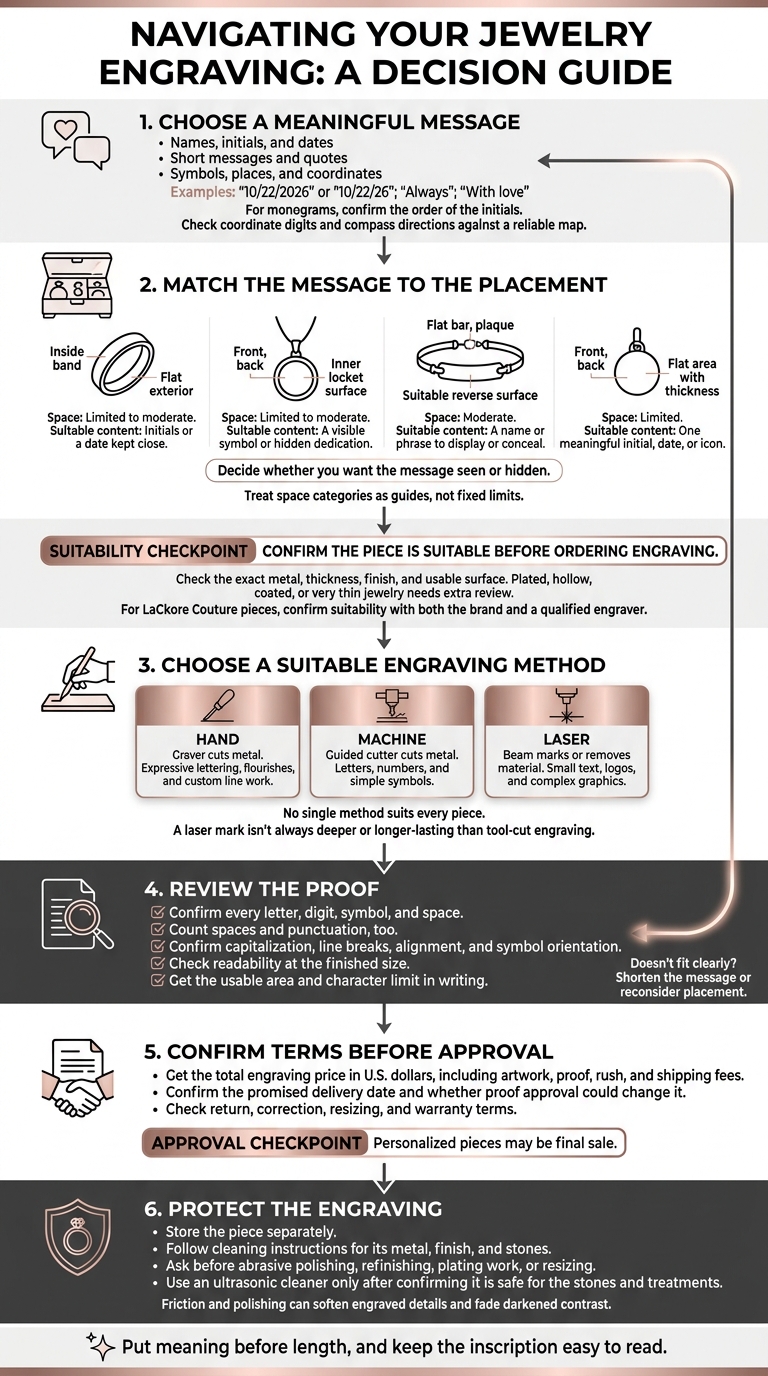
I’d start with a message that matters, then check whether it fits. A name, date like 10/22/26, or shared symbol can connect jewelry to someone you love - without a long inscription.
My checklist is simple:
- Choose the spot: Inside a ring, behind a pendant, or on a bracelet or charm. Decide whether you want the message seen or hidden.
- Check the method: Ask which works best for the piece: hand, machine, or laser engraving.
- Review the proof: Confirm every letter, digit, symbol, and space. Readable beats longer.
- Check the terms: Get the total price in U.S. dollars, delivery date, and return and resizing rules before approving.
- Plan for care: Follow cleaning advice for the metal and stones, and ask before polishing or repairs.
My rule: <u>confirm the piece is suitable before ordering engraving</u>, including any LaCkore Couture piece.
Jewelry Engraving: From Meaningful Message to Final Proof
Choose What to Engrave
Names, Initials, and Dates
Start with a name, date, or initials. A name can honor someone, while a date can mark a milestone. Initials make a discreet tribute; paired initials can represent two people.
Birthdays, anniversaries, adoption dates, graduations, and the date a couple met all work well. For monograms, confirm the order of the initials rather than assuming a standard format. Check capitalization, separators, and punctuation before approving the proof.
Use month/day/year, with a shorter year if space is tight:
10/22/2026 or 10/22/26
Check every digit against the original record.
Short Messages and Quotes
Choose words the wearer will recognize without an explanation. If names or dates feel too specific, try a shared phrase that carries the same meaning. For a longer quote, choose a short excerpt that makes sense on its own.
Count spaces and punctuation, too. Both take up room.
Always
With love
If words won't fit, a symbol or location may express the same feeling in less space.
Symbols, Places, and Coordinates
Choose symbols that reflect the wearer’s story, not just the design. A place name or coordinates can also mark a shared location.
Before approving the proof, confirm that the engraver can reproduce the exact symbol and its orientation. Check coordinate digits and compass directions against a reliable map. Then compare the coordinates with the place name to see which fits the available space better.
With the wording set, match it to the jewelry type and engraving surface so it stays clear and readable.
Where to Engrave Each Jewelry Type
Match the placement to your message, then check the available space. Decide whether you want the engraving seen, hidden, or protected from wear. Surface size, shape, and daily contact all matter. Broad, flat areas generally allow clearer lettering than narrow or curved ones. Exposed surfaces are more likely to rub against skin, clothing, or other objects; backs and interiors offer more privacy. Treat these as guides, not fixed limits.
| Jewelry type | Engraving location | Typical space | Suitable content |
|---|---|---|---|
| Ring | Inside band or on a flat exterior | Limited to moderate | Initials or a date kept close |
| Necklace pendant | Front, back, or inner locket surface | Limited to moderate | A visible symbol or hidden dedication |
| Bracelet | Flat bar, plaque, or suitable reverse surface | Moderate | A name or phrase to display or conceal |
| Charm | Front, back, or another flat area with enough thickness | Limited | One meaningful initial, date, or icon |
Rings: Inside or Outside the Band
An inscription inside the band is better protected from wear, but narrow bands leave less room for readable lettering. Outside engraving needs a smooth surface, such as a broad band or signet face, and faces more scratches and rubbing. Ask whether future resizing could alter or remove the inscription.
Necklaces: Pendant Fronts and Backs
Choose the front to show your inscription or the back to keep it hidden. Check the usable engraving area first: stone settings, elevated borders, openwork, the bail, and curved construction can limit space. Textured finishes can compete with lettering, while shallow engraving on polished metal can be harder to read.
Bracelets: Bars and Plaques
Flat bars and plaques provide a more even writing surface than rounded links. Put a name or message on the front for visibility, or use the reverse for privacy. Have the jeweler check thickness, curvature, edge margins, and clearance around clasps, hinges, and neighboring links. The inscription shouldn't interfere with moving parts or fit.
Charms: Fronts and Backs
Use the front for a visible mark or the back for a personal detail, as long as the charm has enough flat space and material thickness. Tiny, domed, or heavily textured charms may not allow clear lettering. Rather than squeezing a connected message onto one charm, spread it across several. Check where the charms touch, too - repeated rubbing can wear exposed inscriptions.
With placement set, choose an engraving method that suits the metal and finish.
Choose a Method and Check the Details
Make sure the engraving method suits the exact metal, thickness, and finish. The right choice helps keep your message clear and personal. Plated, hollow, coated, or very thin jewelry needs extra review. Cutting through plating, for example, can expose a different base metal. Your choice also affects readability, durability, and turnaround time.
Hand, Machine, and Laser Engraving
No single method suits every piece. Depth, contrast, and durability depend on the material and settings - not just the engraving method. A laser mark isn’t always deeper or longer-lasting than tool-cut engraving. The speeds below cover engraving only. Design approval, setup, finishing, and shipping add to the total turnaround time.
| Method | Visual character | Consistency | Detail capability | Typical speed | Suitable uses |
|---|---|---|---|---|---|
| Hand: graver cuts metal | Bright, dimensional, artisan-made lines with individual variation | Lower than machine or laser work | Well suited to expressive lettering, flourishes, and custom line work | Often slower per piece | Heirloom rings, signatures, artistic motifs |
| Machine: guided cutter cuts metal | Clean, classic tool-cut lettering | High | Good for letters, numbers, and simple symbols | Often efficient once set up | Names, dates, monograms, bands |
| Laser: beam marks or removes material | Fine, precise marks; contrast varies by material and settings | Very high | Well suited to small text, logos, and complex graphics | Often fast once set up | Coordinates, icons, detailed artwork |
Text Length, Fonts, and Layout
Once you’ve chosen a method, finalize the wording and layout. Get the usable area and character limit, including spaces and punctuation, in writing. Check that the font will be readable at its finished size, and confirm capitalization and placement.
Ask how texture, plating, nearby stones, or the band’s curve could affect the result. Review line breaks, alignment, and symbol orientation, then request a preview if one is available.
Cost, Timing, and Return Terms
Confirm costs, deadlines, and correction policies before work begins. Ask for the total engraving price in U.S. dollars, including artwork, proof, rush, and shipping fees. Check the promised delivery date and whether proof approval could change it.
Before giving permission to start, read the return, correction, and resizing terms, along with any warranty limits. Personalized pieces may be final sale. Don’t assume the warranty covers fading, scratches, plating wear, accidental damage, or ordinary wear.
How to Care for Engraved Jewelry
Protect the engraving to keep your message readable. Store the piece separately and follow cleaning instructions for its metal, finish, and stones. Friction and polishing can soften engraved details and fade darkened contrast.
Use an ultrasonic cleaner only after confirming it’s safe for the stones and treatments. Consult a jeweler before abrasive polishing, refinishing, plating work, or resizing.
Conclusion: Keep It Meaningful and Readable
A well-chosen engraving balances meaning, placement, and readability. Put meaning before length, and keep the inscription easy to read. Choose a hidden spot for privacy or an exposed spot for visibility. Check whether daily wear could soften the engraving.
Before approving the proof, compare it with your intended text and review the layout.
For LaCkore Couture pieces, confirm that the piece is suitable for engraving with both the brand and a qualified engraver before ordering. Consider how the inscription will feel personal and remain part of the design over time.
FAQs
How can I choose an engraving that stays meaningful?
Start with the story you want to tell: an important date, a personal quote, or the coordinates of a meaningful place. Pick words or symbols that will still mean something years from now - an inside joke, a romantic phrase, or a shared value.
Placement matters, too. An engraving inside a ring or on the back of a pendant can help protect it from wear. Choose a font that suits your jewelry’s design.
Can an engraving be changed or removed?
Engraving is usually permanent because it physically changes the metal. Removing or changing it can alter or damage your jewelry.
Before production starts, carefully check the dates, messages, and other design details in a digital mockup or proof. Make sure everything looks exactly as you want it.
Can I engrave jewelry I already own?
A professional jeweler can often engrave jewelry you already own and help you choose the right method and placement. Laser and rotary machine engraving are common options, but a specialist should first check whether your piece’s material is suitable.
If you’re looking for a new piece you can customize, LaCkore Couture offers handcrafted rings, necklaces, bracelets, and charms made in the USA to celebrate your personal story and milestones.