Skip to content




Iridescent vs. Opalescent Jewelry: Key Differences
When choosing between iridescent and opalescent jewelry, the main distinction lies in their visual effects:
- Iridescent jewelry shifts colors dynamically, creating a rainbow-like play of hues that change with movement or viewing angle. Think of labradorite, precious opals, or abalone shell.
- Opalescent jewelry emits a steady, milky glow with a soft, dreamy appearance. Common examples include moonstone, common opals, and fire opals.
Quick Overview:
- Iridescence: Bold, shifting colors caused by diffraction or thin-film interference.
- Opalescence: Gentle, consistent glow from light scattering (Tyndall effect).
- Style: Iridescent pieces are vibrant and eye-catching, while opalescent stones offer a softer, elegant look.
- Durability: Both types can be delicate, with opals ranking 5.5–6.5 on the Mohs scale.
Quick Comparison
| Feature | Iridescence | Opalescence |
|---|---|---|
| Effect | Shifting rainbow colors | Soft, milky glow |
| Light Interaction | Diffraction, thin-film interference | Tyndall scattering |
| Common Stones | Precious opals, labradorite, abalone | Moonstone, common opals, fire opals |
| Visual Impact | Bold and dynamic | Calm and ethereal |
Choose iridescence for bold statements and opalescence for understated, timeless elegance. Both styles bring unique beauty to your jewelry collection.
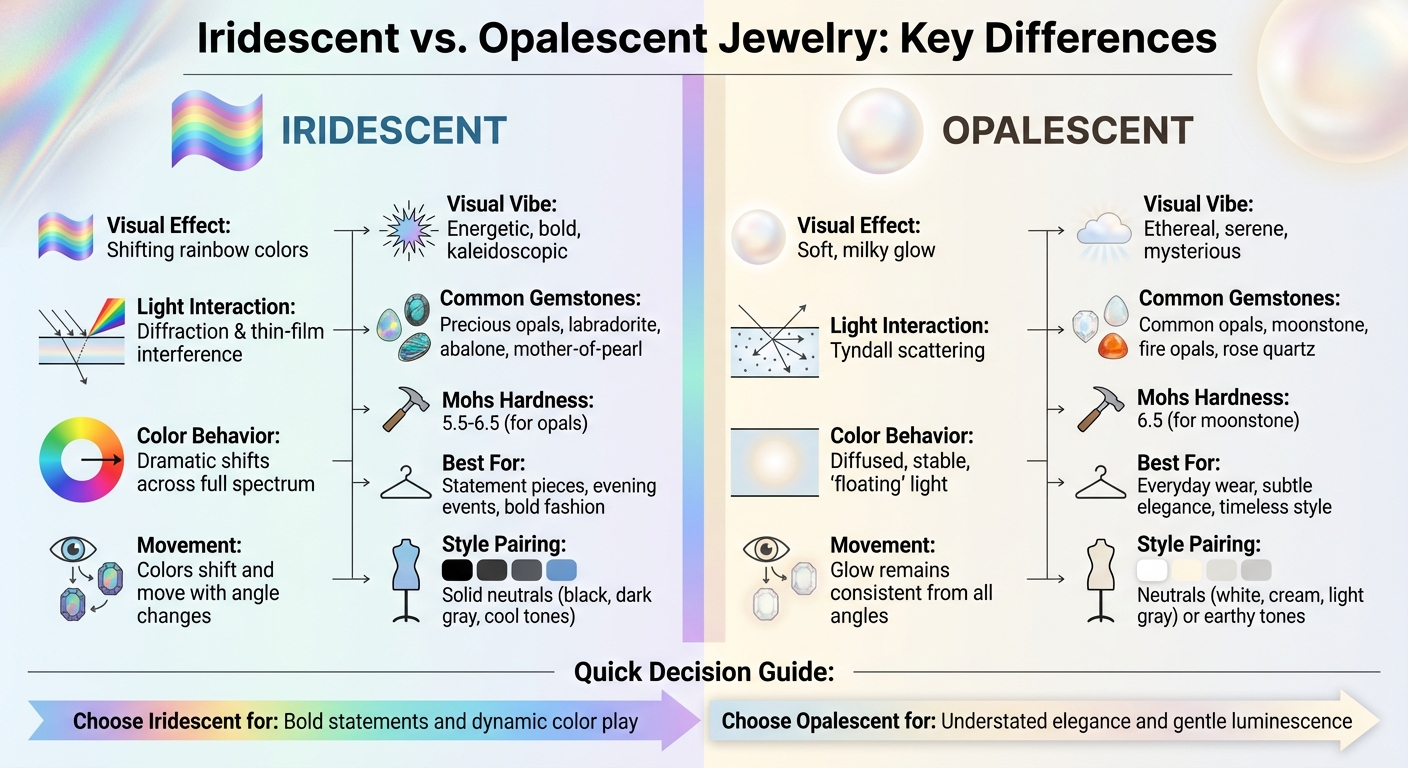
Iridescent vs Opalescent Jewelry Comparison Chart
What is Iridescence?
Iridescence is a fascinating optical effect where a material's color shifts depending on the angle you view it from. This happens because light interacts with microscopic structures within or on the material's surface, creating interference patterns that amplify or cancel out certain colors.
In gemstones, iridescence occurs through two main processes: diffraction and thin-film interference. For example, in precious opals, light passes through tiny, evenly spaced structures - like silica spheres - causing the light waves to bend and split into a spectrum of colors. The size of these structures dictates the colors you see. Smaller structures (less than 1,500 angstroms) create blues and violets, while larger ones (up to 3,500 angstroms) produce oranges and reds. This interplay of light and structure is what gives iridescent jewelry its striking, ever-changing hues.
Characteristics of Iridescent Jewelry
The hallmark of iridescent jewelry is its constantly shifting colors. Move the piece or change your viewing angle, and you'll see colors seem to "roll" or "flash" across its surface. This creates a dramatic, attention-grabbing effect that's hard to miss.
"Opal's shifting play of kaleidoscopic colors is unlike any other gem." – GIA
Unlike gemstones with fixed colors, iridescent pieces are dynamic. The colors visible in one moment might vanish in the next, replaced by entirely different hues. This movement-driven brilliance is especially captivating in settings with varied lighting or when the wearer is in motion, making iridescent jewelry a true standout.
Materials and Gemstones with Iridescence
Several natural materials achieve this mesmerizing effect thanks to their unique internal structures:
- Precious opals (such as black opal, white opal, crystal opal, and boulder opal) exhibit a phenomenon known as "play-of-color." This happens because they are made of sub-microscopic silica spheres arranged in a grid-like pattern. To put it into perspective, about 20,000 of these tiny spheres would fit within the size of a single printed period. The size of the spheres determines the color: spheres around 0.1 microns produce violet flashes, while those closer to 0.2 microns create red flashes.
- Labradorite showcases bold, metallic color shifts called "labradorescence." This effect is caused by light reflecting off its internal layers, or lamellae, which are about 1,000 angstroms thick. The interference between these layers results in its dramatic, shimmering colors.
- Mother-of-pearl and pearls owe their soft, rainbow-like glow, known as "orient", to their layered aragonite structure. Light reflecting and interfering within these overlapping layers creates their signature iridescence.
Other materials with iridescent qualities include abalone shell, iris agate, and even natural cracks in crystals like calcite or topaz, where thin films of air contribute to the interference effects. These diverse materials highlight how nature's intricate structures can produce such stunning optical displays.
What is Opalescence?
Opalescence is a soft, steady glow that seems to radiate from within a gemstone. Unlike the vivid, shifting colors of iridescence, opalescence offers a calm, milky luminescence that remains consistent no matter the viewing angle. It’s like a gentle, pearly light that feels almost otherworldly.
This effect comes from the way light interacts with the stone's internal structure. When light encounters larger or irregularly arranged silica spheres, it scatters and reflects, creating that signature hazy glow. This phenomenon is tied to the Tyndall effect, where tiny particles scatter light to produce a misty appearance. In gemology, opalescence is a type of adularescence - a soft radiance that defines the understated beauty of opalescent stones, setting them apart from the vibrant color shifts of iridescent gems.
Characteristics of Opalescent Jewelry
Jewelry featuring opalescent stones has a subtle, luminous quality that feels timeless and elegant. The glow seems to come from deep within, creating an almost dreamlike effect. Whether you're in bright sunlight or softer indoor lighting, the sheen remains constant, offering a delicate touch of sophistication.
The appearance of opalescent stones can vary depending on the material. Some have a waxy luster or a pronounced milky haze, while others showcase a semi-transparent, glass-like finish. Certain stones may even appear nearly opaque, with a porcelain-like texture that adds to their unique charm.
Materials and Gemstones with Opalescence
The serene glow of opalescence can be found in a variety of gemstones, each with its own distinct look:
- Common Opals: Often called "potch", these are the quintessential opalescent stones. Unlike their "precious" counterparts, common opals lack the rainbow-like play-of-color but instead display a soothing milky sheen. They come in soft pastel shades like pink (Peruvian opal), green (prase opal), and white (milk opal).
- Moonstone: Known for its adularescence, moonstone exudes a floating, ethereal light that evokes moonlight. This glow can range from blue to white, giving it a magical quality.
- Fire Opals: Typically sourced from Mexico, fire opals are celebrated for their vibrant yellow, orange, or red hues. While they’re translucent and don’t usually exhibit color shifts, their internal glow makes them stand out.
Other materials also showcase opalescence, such as girasol opals (or sunstone), which have a semi-transparent radiance, and hyalite (often called jelly opal), a variant that ranges from transparent to translucent with a glassy finish. Each of these stones brings its own interpretation of opalescence, offering a range of options for lovers of this gentle, luminous effect.
Iridescent vs. Opalescent Jewelry: Side-by-Side Comparison
When comparing iridescent and opalescent jewelry, the key difference lies in their visual effects: iridescence dazzles with shifting rainbow hues, while opalescence emits a soft, steady, milky glow.
The science behind these effects is fascinating. Iridescence is caused by diffraction and thin-film interference, where light interacts with microscopic structures to create vibrant, ever-changing colors. On the other hand, opalescence comes from the Tyndall effect, scattering light to produce a consistent, glowing appearance.
"Iridescence is a display of colours which is seen when white light reflects from structures on or in gemstones."
- Barbara Kolator, Collection Curator, Gem-A
These contrasting effects give each jewelry style its own personality. Iridescent pieces are bold and dynamic, perfect for making a statement, while opalescent jewelry exudes a calm and ethereal beauty.
Comparison Table
Here’s a quick overview of the key differences:
| Feature | Iridescence | Opalescence |
|---|---|---|
| Optical Effect | Shifting rainbow "play-of-color" | Soft, milky, or pearly glow |
| Color Behavior | Dramatic shifts across the full spectrum | Diffused, stable, or "floating" light |
| Light Interaction | Diffraction or thin-film interference | Rayleigh or Tyndall scattering |
| Common Gemstones | Precious opal, labradorite, abalone | Common opal, moonstone, rose quartz |
| Visual Vibe | Energetic, bold, and kaleidoscopic | Ethereal, serene, and mysterious |
| Movement | Colors shift and move with angle changes | Glow remains consistent from all angles |
How to Style Iridescent and Opalescent Jewelry
Your choice of styling sets the tone: iridescent jewelry demands attention with its vibrant play of colors, while opalescent pieces offer a softer, more understated glow. By understanding their unique qualities, you can elevate their natural beauty with the right wardrobe choices.
Styling Iridescent Jewelry
Iridescent jewelry is all about making a statement. A labradorite pendant or a black opal cocktail ring can transform a simple outfit into something extraordinary. Pair these eye-catching pieces with solid, neutral-colored clothing - think black, dark gray, or cool-toned shades. This minimalist backdrop allows the vivid flashes of color to stand out and captivate.
"Labradorite's cool, ethereal flash is perfect for statement pieces... It looks incredible set in sterling silver or white gold, which complements its cool tones." - Maya Thompson, Robinson's Jewelers
For evening events or high-energy gatherings, iridescent pieces truly shine under dramatic lighting. Drop earrings, for example, can reveal shifting colors with every movement, adding a dynamic touch. However, remember that some stones, like precious opals, are relatively delicate (ranking 5.5–6.5 on the Mohs scale). To protect them, opt for pendants or earrings rather than rings, or choose bezel settings to shield the stones from potential damage.
Styling Opalescent Jewelry
Opalescent jewelry, on the other hand, brings a sense of calm and sophistication to your look. These gems are perfect for everyday settings, from casual brunches to professional meetings. Pair moonstone studs or common opal rings with neutral tones like crisp white, soft cream, or light gray to let their subtle shimmer take center stage. For warmer-toned opalescent stones, earthy hues like olive, rust, or burgundy create a harmonious balance.
"Neutral backgrounds like crisp white, soft cream, or light gray provide an elegant canvas that allows the opal's color shifts to take center stage." - Australian Opal Direct
Opalescent pieces are incredibly versatile. A pair of simple moonstone studs can add a touch of magic to an everyday outfit, while a bold opal tennis necklace can transition effortlessly into a formal, red-carpet-ready look. With a Mohs scale rating of 6.5, moonstones are durable enough for daily wear, provided they’re cared for properly.
For more ideas on incorporating these stunning styles into your wardrobe, explore LaCkore Couture’s collection of handcrafted jewelry. Their designs are crafted to let your unique personality shine in any setting.
Choosing Between Iridescent and Opalescent Jewelry
Deciding between iridescent and opalescent jewelry often comes down to personal style. Iridescent gemstones, like labradorite or precious opal, dazzle with bold, metallic flashes that span the color spectrum. On the other hand, opalescent stones, such as common opal or moonstone, radiate a softer, milky glow, offering a more subtle and dreamy aesthetic.
Your lifestyle and how you care for your jewelry also play a big role in this choice. Natural opals, with a Mohs hardness of 5.5–6.5, are more delicate and susceptible to scratches, heat, and moisture. For everyday wear, you might lean toward sturdier iridescent options like labradorite or mother of pearl. Alternatively, if you prefer opals, consider protective settings like bezels to help shield the stone. Iridescent pieces, in particular, stand out beautifully under dramatic lighting, making them perfect for special occasions.
"If gemstones had personalities, opal would be the life of the party... It's like someone bottled a rainbow and then gave it a shot of espresso." - Maya Thompson, Robinson's Jewelers
For those seeking something truly distinctive, LaCkore Couture offers handcrafted designs that highlight both iridescent and opalescent effects. Their collections celebrate these mesmerizing optical qualities, blending artistry and craftsmanship to create pieces that reflect your unique style. Whether you’re captivated by the vibrant energy of iridescence or the quiet allure of opalescence, their jewelry ensures you’ll find something that feels just right.
FAQs
What’s the difference between iridescent and opalescent jewelry?
Iridescent jewelry is known for its bold, rainbow-like shimmer that shifts and changes as light hits it from different angles. This captivating effect is the result of light diffraction or interference, creating a lively and attention-grabbing appearance.
In contrast, opalescent jewelry exudes a gentler charm with its soft, milky glow. It features delicate flashes of rainbow hues and a translucent, pearly finish, offering a more subtle and dreamy aesthetic.
Both styles bring their own charm to the table, making them versatile options to complement a wide range of outfits and occasions.
Is opalescent jewelry more durable than iridescent jewelry?
Opalescent jewelry tends to hold up better over time compared to iridescent pieces. Iridescent gemstones, like some opals that display a shimmering play of color, can be quite fragile and may crack if not handled with care. On the other hand, opalescent stones - such as moonstone or certain varieties of opal - often have a more durable structure, making them a better choice for everyday wear.
When deciding between these two styles, think about how often you'll wear the piece and how much effort you're willing to put into its upkeep. With the right care and attention, both types of jewelry can retain their charm and elegance for many years.
What gemstones are commonly used in iridescent and opalescent jewelry?
Iridescent jewelry is known for its captivating gemstones like labradorite, opal, and dichroic glass, which dazzle with shifting colors when seen from different angles. In contrast, opalescent jewelry highlights stones such as opal, moonstone, and girasol, celebrated for their soft glow and gentle color transitions.
These gemstones stand out for their mesmerizing optical qualities, making them an excellent choice for adding a striking or dreamy element to your jewelry collection.