Skip to content




How Jewelers Source Ethical Raw Materials
Ethical sourcing in jewelry ensures responsible practices across the supply chain - from mining to retail. This involves tracing materials, verifying certifications, and working with suppliers who uphold labor rights, environmental safeguards, and legal standards. Here's how jewelers achieve this:
- Supply Chain Mapping: Trace materials from extraction to retail using frameworks like the OECD's Five-Step process.
- Audits: Conduct supplier audits to verify compliance, using tools like the Responsible Jewellery Council (RJC) standards.
- Traceability: Maintain records and use systems like blockchain or unique material IDs to track origins.
- Certified Materials: Source recycled metals, Fairmined Gold, or conflict-free diamonds verified by certifications like the Kimberley Process or GIA Diamond Origin Program.
- Supplier Relationships: Work closely with ethical suppliers and monitor compliance through regular audits and reviews.
Consumers can check for certifications like RJC, GIA, or Fairmined labels to ensure they're supporting ethical practices. Brands like Tiffany & Co. and LaCkore Couture lead the way by prioritizing transparency and ethical sourcing.
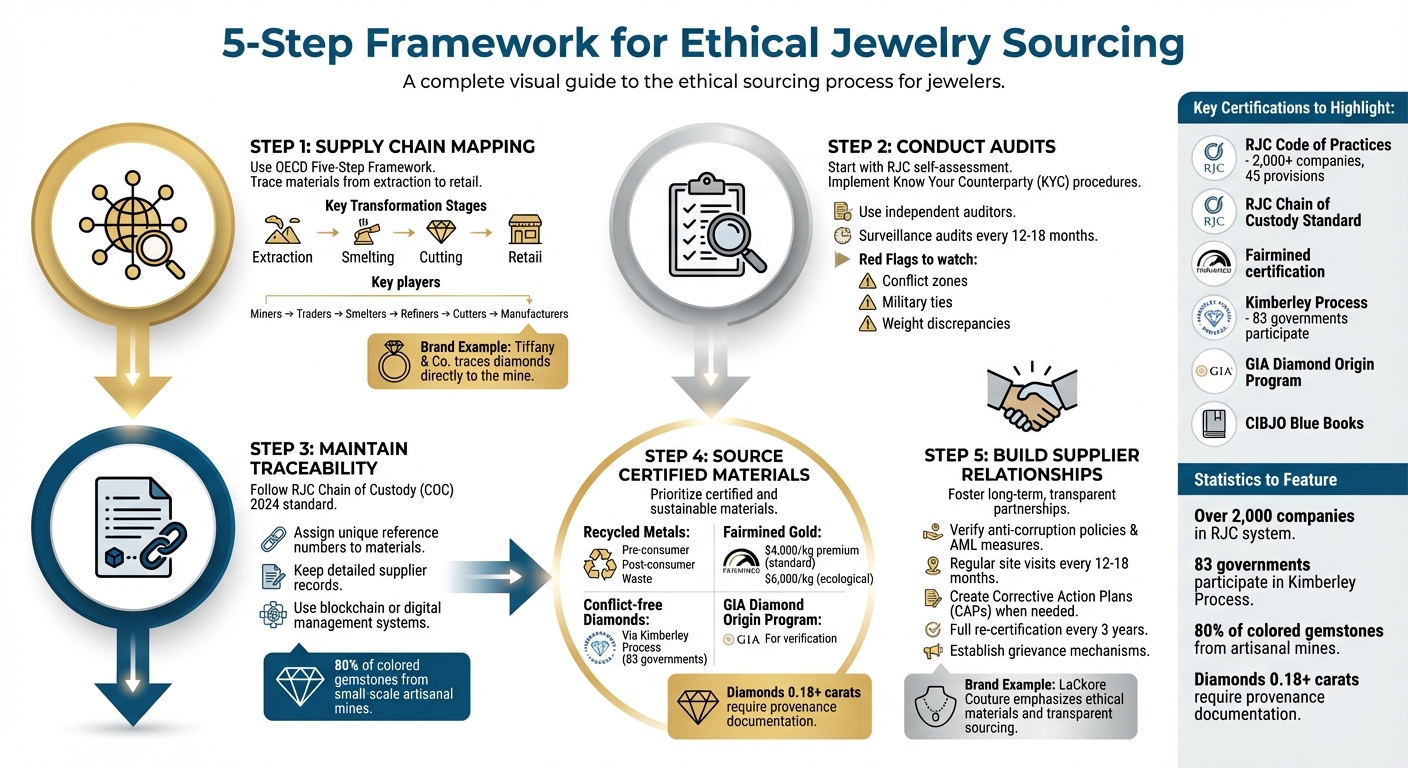
5-Step Framework for Ethical Jewelry Sourcing
Mapping and Auditing the Supply Chain
How to Map the Supply Chain
To effectively map your supply chain, trace its journey from resource extraction to retail using the OECD Five-Step Framework. This involves: setting up management systems, identifying risks, managing those risks, auditing critical control points, and publicly reporting your efforts. Along the way, pinpoint key transformation stages like smelting and cutting.
Each player in the supply chain - miners, traders, smelters, refiners, cutters, and manufacturers - has specific due diligence requirements. It's essential to verify the conditions under which resources are extracted, ensure intermediaries are legitimate, and track how materials are processed. Keep meticulous records of all inputs and outputs at every step.
A notable example is Tiffany & Co.’s Diamond Source Initiative, launched in 2019. The initiative provided provenance information for newly sourced diamonds of 0.18 carats and larger. By 2020, they expanded this into the "Diamond Craft Journey", becoming the first global luxury jeweler to disclose the countries where diamonds are cut, polished, and set. Tiffany & Co. ensures traceability by using controlled, international processing facilities.
Once you’ve mapped the supply chain, the next step is conducting thorough supplier audits to confirm ethical practices are being upheld.
How to Conduct Supplier Audits
Start the audit process with a Responsible Jewellery Council (RJC) self-assessment to identify any gaps before formal audits. Implement Know Your Counterparty (KYC) procedures to verify the identity and legitimacy of suppliers, particularly those sourcing materials from Conflict-Affected and High-Risk Areas (CAHRAs). For objectivity, rely on independent auditors to carry out evaluations.
Auditors will examine both physical and digital transfer documents to ensure materials are responsibly sourced and traded. If any noncompliance is found, suppliers must create a Corrective Action Plan (CAP) to address the issues before they can receive certification. To maintain high standards, conduct surveillance audits every 12–18 months. Watch for red flags like minerals originating from conflict zones, suppliers tied to military groups, or discrepancies in reported material weights.
After audits, robust traceability systems help strengthen the ethical integrity of the supply chain.
How to Maintain Traceability
The RJC Chain of Custody (COC) 2024 standard outlines the requirements for handling precious metals in a fully traceable way, from mine to retail. Digital management systems can play a key role here by assigning unique reference numbers to each mineral entry, instantly flagging any tampering.
"RJC COC certification gives customers and suppliers the assurance they need about how your products and materials have been sourced, traced, and processed along the supply chain, from mine to retail." - Responsible Jewellery Council
Keep detailed records of suppliers, their corporate structures, and any relevant government payments. For diamonds of 0.18 carats and larger, provide consumers with specific details about the region or country of origin. Since around 80% of colored gemstones come from small-scale artisanal mines, implementing a Source Warranty Protocol is crucial for improving traceability in these complex sectors.
Choosing Ethical Metals and Gemstones
Once jewelers have established thorough supply chain audits and traceability systems, the next step is selecting raw materials that align with ethical sourcing practices.
Sourcing Recycled and Certified Metals
Using recycled metals not only minimizes environmental harm but also ensures high-quality materials. According to the Responsible Jewellery Council (RJC) Chain of Custody Standard, eligible recycled metals include those sourced from pre-consumer, post-consumer, and waste origins. However, investment materials like gold bars or coins are excluded, as verifying their original source is nearly impossible.
Even when working with RJC-certified suppliers, jewelers must conduct their own independent due diligence. This involves using tools like the RJC self-assessment toolkit and undergoing follow-up audits to assess risks and compliance.
For jewelers seeking to support artisanal mining communities, Fairmined Gold offers a meaningful alternative. This certification program provides small-scale mining organizations with a premium - $4,000 per kilogram for Fairmined Gold and $6,000 per kilogram for Fairmined Ecological Gold, which is produced without harmful chemicals. These premiums are reinvested into local communities to fund development and environmental initiatives.
"Fairmined is an assurance label that certifies gold from empowered responsible artisanal and small-scale mining organizations who meet world leading standards for responsible practices." - Alliance for Responsible Mining
Sourcing Conflict-Free Diamonds
The Kimberley Process serves as the global standard for conflict-free diamond sourcing, with participation from 83 governments covering nearly all rough diamond production worldwide. However, many jewelers go beyond this baseline by implementing additional traceability systems. For instance, Greenwich St. Jewelers uses blockchain technology to track diamonds, excludes stones sourced from Russia, and prioritizes diamonds from regions where mining supports local infrastructure.
Another example is the GIA Diamond Origin Program, which uses scientific methods to verify a diamond's country of origin, ensuring transparency for both rough and polished stones.
For diamonds larger than 0.18 carats, request provenance documentation to confirm ethical sourcing. Whenever possible, maintain vertical integration to oversee production and labor practices. Tiffany & Co. exemplifies this approach by operating its own polishing workshops in countries such as Belgium, Botswana, and Thailand, allowing the company to directly manage labor conditions and environmental standards.
Sourcing Ethical Gemstones
Traceability is particularly challenging for colored gemstones, as roughly 80% come from small-scale artisanal mines. The RJC Code of Practices includes guidelines for rubies, sapphires, and emeralds, and its 2024 update will introduce stricter requirements for human rights due diligence and supply chain transparency. For lab-grown gemstones, the RJC Laboratory Grown Material Standard (LGMS), effective May 1, 2025, will establish ethical and environmental benchmarks.
When sourcing gemstones, look for suppliers who provide clear mine-of-origin details and can document responsible labor practices. Verify RJC certifications by consulting the RJC member portal and conducting independent risk assessments. If you plan to promote a gemstone's ethical origin, ensure your claims are verified through an RJC COP 14 "bolt-on" audit.
LaCkore Couture sets an example by crafting jewelry with responsibly sourced metals and gemstones, demonstrating a commitment to ethical practices.
Verifying Certifications and Standards
Key Industry Certifications
Certifications play a crucial role in ensuring ethical sourcing within the jewelry industry. A cornerstone of this effort is the Responsible Jewellery Council (RJC) Code of Practices (COP), which outlines responsible business practices at every stage, from mining to retail. The 2024 COP includes 45 provisions that address areas like human rights, labor conditions, environmental safeguards, and product transparency. Impressively, over 2,000 companies worldwide are part of the RJC system.
Another important framework is the RJC Chain of Custody (COC) Standard, focusing on gold, silver, and platinum group metals. This standard ensures traceability across the entire supply chain. For lab-grown materials, the RJC Laboratory Grown Material Standard (LGMS) - effective May 1, 2025 - sets ethical and environmental benchmarks for handling lab-grown diamonds, rubies, emeralds, and sapphires.
"The COP defines the requirements for establishing responsible business practices throughout the jewellery supply chain, from mine to retail." - Responsible Jewellery Council
Additionally, the CIBJO Blue Books provide widely recognized grading standards and terminology for diamonds, gemstones, pearls, and precious metals. These guidelines, which include "The Responsible Sourcing Book", offer voluntary recommendations for ethical practices throughout the distribution chain. All CIBJO documents are reviewed annually to stay current.
While obtaining certifications is a critical step, ongoing verification of documentation is equally essential.
How to Review and Maintain Documentation
Once certifications are in place, it’s vital to rigorously verify documentation to ensure compliance. Simply accepting PDFs or physical certificates as proof of certification isn’t enough. Use tools like the RJC "Find a Member" feature to confirm a supplier’s certification status. Cross-check the certificate number with the issuing organization’s official registry.
It’s also important to confirm that the certification’s scope includes the specific materials and facilities involved in your transaction. Pay close attention to the start and expiration dates - RJC certificates generally last three years but may be reduced to one year if significant issues are found.
"Sourcing exclusively from 2019 COP certified suppliers is not enough to show compliance with COP, even if they provide their certificate, as their certificate does not include any information regarding the origin of the materials or products you are purchasing from them." - Responsible Jewellery Council
Even when working with certified suppliers, conducting your own independent due diligence is crucial. Starting January 1, 2026, all new RJC certifications will adhere to the updated 2024 standards.
Building Relationships with Responsible Suppliers
How to Select Ethical Suppliers
Choosing suppliers who uphold strict anti-corruption policies, anti-money laundering (AML) measures, and regulatory compliance is essential. This ensures you're partnering with businesses that operate transparently and adhere to legal standards.
Another key factor is traceability and provenance. Ethical suppliers should provide detailed sourcing information and maintain a clear chain of custody that tracks materials back to their origins. This is especially crucial when dealing with resources from conflict-affected or high-risk areas.
Strengthen your Know Your Customer (KYC) procedures to identify risks like human rights violations or conflict financing. The 2024 RJC Code of Practices introduced updated KYC requirements, particularly for members managing consigned materials, such as traders or mineral processors.
Ask suppliers about their labor policies, environmental practices, and how they handle sensitive materials. Use tools like the RJC Retailer Sustainability toolkit and request documentation or third-party verification to ensure compliance.
Once you've identified ethical suppliers, the next step is maintaining these relationships to uphold shared values.
How to Maintain Supplier Relationships
After selecting suppliers, ongoing engagement and monitoring are critical to ensuring ethical practices remain intact. Plan surveillance visits every 12–18 months to confirm compliance. These regular visits not only help identify potential issues early but also reinforce your commitment to upholding ethical standards.
If audits uncover problems, work with your suppliers to create Corrective Action Plans (CAPs) instead of cutting ties immediately. This collaborative approach encourages improvement and fosters trust. To help suppliers align with your expectations, provide self-assessment tools at least a month before formal audits.
Site visits are another valuable way to gain firsthand insights into supplier operations. Seeing their processes in action promotes accountability and transparency across the supply chain.
"We strive to set the standard for sustainable luxury, from sharing the origins of our primary raw materials to investing in the artisans who craft our jewelry." - Tiffany & Co.
Establishing grievance mechanisms is equally important. These systems allow stakeholders to report potential violations within your supply chain. It’s a clear signal that ethical standards are a priority. Also, remember that full re-certification audits are typically required every three years, so include these in your supplier management schedule.
At LaCkore Couture, ethical sourcing and strong supplier partnerships are woven into the fabric of every handcrafted piece they create.
Implementing Traceability and Improvement Practices
Traceability Methods
Blockchain technology is revolutionizing how materials are tracked, ensuring a seamless journey from the mine to the retail counter. These digital platforms create records that cannot be altered, offering a reliable way to maintain transparency and consistency throughout the supply chain. Additionally, laser inscriptions marking diamonds with unique identification numbers allow for tracking even after they undergo repairs.
The RJC Chain of Custody (COC) 2024 standard sets guidelines for handling precious metals like gold, silver, and platinum group metals with complete traceability. By replacing physical paperwork with digitally linked information, this approach not only speeds up verification processes but also reduces the administrative workload.
For jewelers who want direct control, vertical integration - where they own manufacturing facilities and polishing workshops - offers the most secure chain of custody. However, this approach involves substantial upfront costs. In 2020, Tiffany & Co. introduced their "Diamond Craft Journey" initiative, becoming the first global luxury jeweler to disclose where their diamonds (0.18 carats and larger) are cut, polished, graded, and set. Their transparency is supported by owned polishing workshops located in Belgium, Botswana, Mauritius, Thailand, Vietnam, and Cambodia.
These traceability methods lay the groundwork for implementing continuous improvement practices to further enhance ethical sourcing.
Improvement Practices
Traceability alone isn’t enough - proactive improvement measures are crucial for reinforcing ethical sourcing efforts.
Regularly scheduled surveillance visits, spaced every 12–18 months, can help identify and address compliance gaps promptly. When audits uncover issues, corrective action plans (CAPs) should be developed to tackle both immediate concerns and long-term improvements.
Self-assessment toolkits, such as the RJC 2024 self-assessment, are valuable for spotting compliance gaps before committing to expensive third-party audits. Monitoring your environmental footprint is another key practice, especially by tracking Scope 1 and 2 greenhouse gas emissions. Mining operations should also assess Scope 3 emissions to get a full picture. Since RJC standards are updated every five years (most recently in 2024, with the next revision set for 2029), it’s essential to review internal policies regularly to stay aligned with evolving industry guidelines.
"Sustainability is a journey of continuous improvement." - Responsible Jewellery Council
At LaCkore Couture, each handcrafted piece embodies a dedication to responsible sourcing, with ongoing efforts in traceability reinforcing the brand’s ethical mission.
Conclusion
Ethical sourcing marks a meaningful step toward safeguarding human rights, protecting the planet, and maintaining brand trust. From mapping supply chains to ensuring traceability, these practices lay the groundwork for responsible sourcing. Jewelers who adopt these methods contribute to fair labor conditions, safer workplaces, and support for the communities where materials are mined or produced. On the environmental side, recycling precious metals significantly reduces energy use and greenhouse gas emissions compared to mining raw materials. Together, these efforts create a framework for ethical practices that promote both social and environmental responsibility.
For brands that prioritize quality craftsmanship, ethical sourcing becomes a natural extension of their values. Take LaCkore Couture, for example. Their handcrafted jewelry, made in the USA with carefully chosen materials like gold, silver, and natural stones, reflects a commitment to both artistry and ethical practices. When artisans focus on responsible sourcing, they create pieces that are not only beautiful but also rooted in respect for people and the planet.
Transparency and ongoing improvement, as discussed earlier, are key to building trust with customers. Sharing the origins of materials and the meticulous processes behind their creation strengthens a brand’s credibility. As the jewelry industry shifts toward greater accountability, those who embrace ethical sourcing position themselves as leaders in a market where consumers increasingly value honesty and responsibility.
FAQs
How can I ensure the jewelry I buy is ethically sourced?
To make sure your jewelry comes from responsible sources, check for certifications like the Kimberley Process for diamonds, Fairmined for metals, or Fair Trade Gems for colored stones. These labels indicate that the materials have been sourced responsibly.
You can also request supply chain transparency from your jeweler. Ask for documentation such as provenance reports or third-party audits. Reputable jewelers often showcase seals from organizations like the Responsible Jewelry Council, which enforces strict ethical standards across the supply chain.
By staying informed and asking thoughtful questions, you can choose jewelry that reflects your values and supports responsible practices in the industry.
How does blockchain technology improve traceability in the jewelry industry?
Blockchain technology is transforming how we trace jewelry by offering a secure and unalterable digital ledger. This ledger meticulously documents every phase of a gemstone or diamond's journey, starting from the mine and ending at the retailer, ensuring clarity and accountability at every step.
With blockchain, jewelers can confirm the ethical sourcing of materials, monitor ownership transitions, and offer customers reliable details about the origins of their jewelry. This approach not only promotes responsible practices but also strengthens trust in the authenticity of each piece.
Why is it important for jewelers to use recycled metals?
Using recycled metals in jewelry significantly lessens the damage caused by mining while also reducing the chances of supporting conflict-driven supply chains. On top of that, it helps trim down waste and supports fair labor practices. Opting for recycled materials is a thoughtful way to craft jewelry that's both ethical and mindful of the planet.