Skip to content




Top Heritage Symbols in Custom Jewelry
Heritage symbols in custom jewelry connect us to history and personal stories. From Celtic knots representing eternity to family crests symbolizing lineage, these designs carry deep meanings. Modern artisans blend these timeless symbols with contemporary craftsmanship, offering personalized pieces that reflect individual heritage and style.
Key highlights from the article:
- Celtic Symbols: Knots and crosses signify eternity, unity, and spirituality. Common in rings, pendants, and bracelets.
- Nordic Runes: Represent power, wisdom, and protection. Popular in engraved arm bands and pendants.
- Slavic and Baltic Motifs: Symbols like the Kolovrat and Perun’s Axe embody themes of life cycles, protection, and abundance.
- Tree of Life: A universal emblem of ancestry, growth, and resilience featured in pendants and family-oriented jewelry.
- Family Crests: Reflect family lineage and honor, often crafted into signet rings and pendants.
- Christian Devotional Symbols: Crosses and saints convey faith and hope, seen in necklaces, rings, and bracelets.
- Regional Hearts: Designs like the Claddagh ring express love, loyalty, and friendship.
- Zodiac and Celestial Motifs: Represent individuality and guidance, commonly used in necklaces and rings.
For custom designs, brands like LaCkore Couture offer handcrafted pieces using high-quality metals and gemstones, ensuring authenticity and personal connection. Whether celebrating ancestry or personal values, heritage-inspired jewelry transforms symbols into meaningful keepsakes.
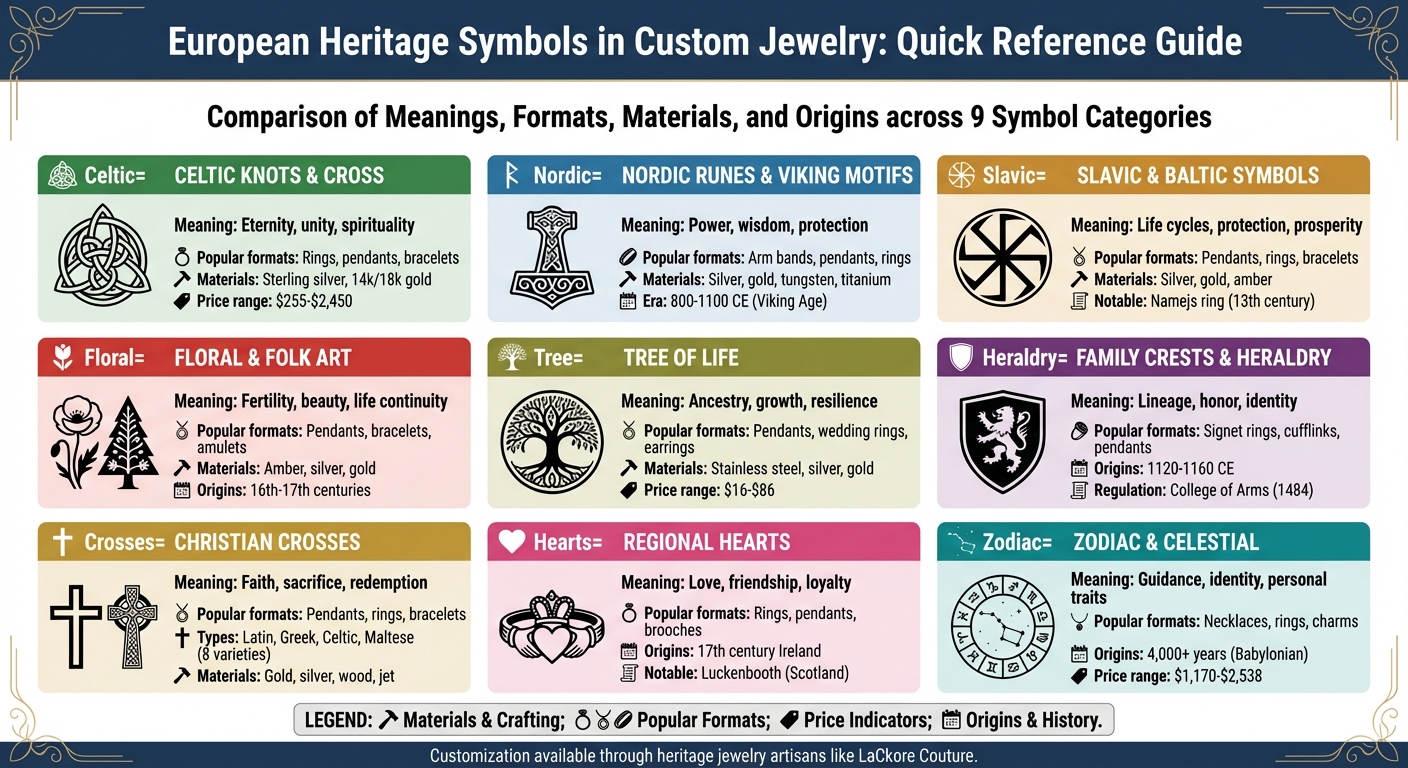
European Heritage Symbols in Jewelry: Meanings and Formats Guide
1. Celtic Knots and Celtic Cross
Historical Origins and Background
Celtic knotwork traces its roots back to mosaics from the late Roman Empire (3rd–4th centuries AD). These intricate interlace patterns made their way through Byzantine, Coptic, and Islamic art before being adopted and transformed by Celtic artists in northern Britain and Ireland by the 7th century. During the 7th and 8th centuries, Celtic monks perfected what became known as the "Insular" style, characterized by endless loops symbolizing eternity. This style is beautifully preserved in illuminated manuscripts like the Book of Kells and Lindisfarne Gospels.
The Celtic Cross, another iconic symbol, evolved from carved stone slabs into the free-standing "High Crosses" by the 8th century. Approximately 300 of these crosses remain in Ireland today. Originally, they served as tools for teaching scripture and as markers for monastic boundaries.
Symbolism and Meaning
Celtic knotwork is rich in symbolism, with its unbroken lines representing eternity, the cyclical nature of life, and the connection between the physical and spiritual worlds. Different knots carry specific meanings. The Trinity Knot (Triquetra) symbolizes threefold unity, often interpreted as the Holy Trinity or the three realms of time - past, present, and future. The Love Knot, with its intertwined loops, signifies the unbreakable bond between two people, while the Dara Knot, inspired by the strength of oak tree roots, represents resilience and inner strength.
The Celtic Cross blends both pagan and Christian elements. Tradition holds that St. Patrick combined the Christian cross with a solar symbol to make Christianity more relatable to the Celts. The ring encircling the cross represents eternity and unity, while the four arms are thought to symbolize the cardinal directions, the elements, or the seasons. These meanings continue to resonate in modern interpretations and designs.
Modern Jewelry Applications
Today, Celtic symbols have found a new life in custom jewelry, where they transform ancient meanings into personal expressions. Each knot tells its own story: the Shield Knot is often featured in protective amulets and bold pendants, while the Sailor's Knot appears in bracelets and woven bands, symbolizing loyalty across long distances. Modern jewelers often use oxidized finishes on sterling silver to create a striking antique look that emphasizes the intricate details of these designs.
LaCkore Couture brings this timeless tradition into modern fashion by offering customizable pieces combining ancient symbolism with contemporary aesthetics. Their designs allow customers to choose specific knots - like the Dara Knot for someone seeking strength or the Love Knot as a symbol of enduring affection - crafted from high-quality materials such as 14k or 18k gold and .925 sterling silver.
Common Jewelry Formats
Celtic designs are most commonly featured in rings (especially for weddings and engagements), pendants, bracelets, earrings, and brooches. These pieces are typically crafted from sterling silver, gold in various shades (yellow, white, or rose), and platinum. They are often adorned with traditional Irish gemstones, such as Connemara marble, alongside emeralds and diamonds. Prices vary based on materials and craftsmanship. For instance, a Silver Connemara Marble Celtic Knot Cross Necklace might cost around $255, while a Gold Celtic Warrior Shield Cross can fetch up to $2,450.
| Knot Type | Primary Meaning | Common Jewelry Use |
|---|---|---|
| Trinity (Triquetra) | Eternity, Unity, Three Realms | Pendants, Earrings |
| Love Knot | Unbreakable Bonds, Fidelity | Wedding/Engagement Rings |
| Dara Knot | Strength, Resilience, Roots | Pendants, Rings |
| Shield Knot | Protection, Strength | Amulets, Men's Rings |
| Sailor's Knot | Loyalty, Friendship | Bracelets, Keepsakes |
2. Nordic Runes and Viking Motifs
Historical Origins and Background
The Elder Futhark, a 24-character runic system used by early Germanic tribes between 150 and 800 CE, eventually gave way to the simpler 16-character Younger Futhark during the Viking Age (800–1100 CE). These runes appeared on artifacts and runestones, serving as both communication tools and symbols of power and spirituality.
In Norse mythology, Odin's quest for wisdom is deeply tied to the origins of the runes. The Hávamál recounts how Odin sacrificed himself by hanging from Yggdrasil - the World Tree - for nine nights, pierced by his own spear, to gain the divine knowledge of the runes. Runes were traditionally carved into durable materials like wood, bone, stone, and metal. To date, over 4,000 runic inscriptions have been documented worldwide, with approximately 2,500 found in Sweden alone.
Symbolism and Meaning
Runes carry meanings that go far beyond their phonetic use. For instance, Fehu (ᚠ) signifies wealth and prosperity, Algiz (ᛉ) represents divine protection, and Tiwaz (ᛏ) - linked to the god Tyr - embodies justice and courage. As Victoria Symons, a scholar in the field, explains:
Runic letters, on the other hand, are inherently multivalent; they can, and often do, represent several different kinds of information simultaneously.
Viking motifs like Mjölnir (Thor's Hammer) and the Valknut (three interlocking triangles associated with Odin) further highlight themes of strength, protection, and bravery. Another enduring symbol, Yggdrasil, represents the interconnectedness of all nine realms and the cyclical nature of life, death, and rebirth. However, it’s worth noting that symbols like the Vegvísir (Wayfinder) and Ægishjálmr (Helm of Awe) actually come from Icelandic manuscripts dating back to the 17th–19th centuries, rather than the Viking Age itself.
These symbols, steeped in history and mythology, continue to inspire modern interpretations and designs.
Modern Jewelry Applications
Nordic symbols have found new life in contemporary jewelry, blending ancient heritage with personal expression.
LaCkore Couture exemplifies this by crafting custom pieces that celebrate Nordic ancestry. Their artisans use sterling silver and gold to create jewelry featuring specific runes chosen for their meanings. For example, Ansuz represents wisdom and divine inspiration, Raido symbolizes travel and movement, and Othala reflects ancestral heritage. These runes can be engraved individually as protective charms or combined into intricate inscriptions that carry personal significance.
Designs often incorporate three-dimensional elements like sculpted ravens, wolves, or detailed knotwork. Historical finds, such as the 1873 discovery of the Hiddensee Treasure - a collection of gold items linked to King Harald Bluetooth's family - and a recently unearthed 9th-century silver Mjölnir amulet in Sweden, highlight the enduring appeal of these motifs.
Common Jewelry Formats
Nordic symbols frequently appear in rings, arm bands, pendants, and bracelets. During the Viking Age, arm rings served as tokens of loyalty and even as a form of currency. Today, modern designs echo this tradition with twisted metal bands and cuff bracelets engraved with runic inscriptions. Pendants often feature iconic symbols like Mjölnir, the Valknut, or Yggdrasil, while rings are engraved with either the full Futhark or selected protective runes. Materials range from classic sterling silver to contemporary options like tungsten carbide and titanium, with gold reserved for high-end pieces. Additionally, symbols appear in unique formats such as beard beads and brooches, adding a distinctive touch to modern accessories.
3. Slavic and Baltic Folk Symbols
Historical Origins and Background
The roots of Slavic and Baltic symbols trace back to ancient Indo-European tribes. Baltic symbols emerged from hunter-gatherer societies in the Baltic region between 8000 and 3000 BCE. Meanwhile, Slavic tribes in Southeastern and Central Europe developed their own signs to represent nature and their deities. By the Iron Age, jewelry became a way to express cultural identity, social status, and cosmic beliefs. Some motifs, like the Baltic Thunder Cross, are believed to date back around 3,000 years, roughly to 1000 BCE.
When Christianity spread through the region - reaching Lithuania as late as 1387 - pagan symbols weren’t entirely abandoned. Instead, they were often blended with Christian imagery. For instance, the Baltic Sun symbol was incorporated into Christian cross designs to sidestep restrictions on celestial worship. A fascinating example of this fusion is Lithuanian cross-crafting, which combines ancient Baltic motifs with Christian elements. This unique art form earned recognition from UNESCO as an Intangible Cultural Heritage of Humanity in 2001.
Symbolism and Meaning
Slavic and Baltic symbols are deeply tied to nature and cosmic balance. For the Slavs, the Kolovrat (Sun Wheel) represents the sun god Dazhbog and the endless cycle of life, death, and rebirth. Perun's Axe, linked to the thunder god Perun, symbolizes divine justice and serves as a protective talisman. Archaeological finds show bronze hatchet amulets, dating back to the 11th and 12th centuries, were widely used in regions like Russia, Ukraine, Poland, and the Balkans.
Baltic symbols also reflect reverence for natural forces and household prosperity. The Grass Snake (Zalktis), seen as a symbol of renewal and fertility, was even kept as a sacred household pet to bring wealth. The Jumis, represented as a double-spiked grain stalk, signifies fertility and abundance. Both traditions share the Tree of Life, which connects the celestial, earthly, and underworld realms in Slavic belief, while in Baltic thought, it represents the flow of time - past, present, and future.
| Symbol Name | Origin/Culture | Primary Meaning |
|---|---|---|
| Kolovrat | Slavic | Solar energy, life cycles, victory of light |
| Perun's Axe | Slavic | Divine justice, thunder, protection |
| Thunder Cross | Baltic | Fire, thunder, fortune, health |
| Grass Snake (Zalktis) | Baltic | Renewal, fertility, household wealth |
| Jumis | Baltic | Fertility, prosperity |
| Lunica | Slavic | Feminine energy, lunar cycles, intuition |
Modern Jewelry Applications
In the 30 years since the Soviet Union's collapse, these ancient symbols have seen a revival in modern jewelry design. Brands like LaCkore Couture now incorporate these motifs into pendants, rings, and bracelets, often using materials like sterling silver, gold, and amber to honor Eastern European heritage.
Artisans frequently use symbols such as the Kolovrat to evoke solar energy and life cycles, while Perun's Axe is popular for its association with strength and protection. Crescent-shaped Lunica pendants resonate with those drawn to feminine power and intuition, while Tree of Life designs help wearers feel connected to their ancestors. Modern interpretations often feature sleek, geometric designs inspired by traditional Latvian patterns, with clean lines and directional breaks. As Egle Gal, Founder of Baltic Gently, explains:
"Baltic pagan symbols provide a way to reconnect with one's roots and discover laws of the universe – no matter what your nationality is."
These symbols have found new life in traditional and contemporary jewelry styles alike.
Common Jewelry Formats
One iconic piece of Baltic jewelry is the Namejs ring, a twisted metal band dating back to the 13th century. Legend has it that Namejs, a Semigallian tribal leader, created this ring as an identification symbol for his son. Originally designed for men, the ring is now a unisex symbol of Latvian identity, especially cherished by diaspora communities.
Other traditional formats include sakta brooches, decorative fasteners often shaped like sun discs or animals, used to secure traditional clothing. The seven days ring, featuring seven charms for luck and protection, is another popular design. Pendants showcasing axe-shaped amulets, Kolovrat wheels, and crescent Lunicas are also common. Materials range from classic amber and silver to modern twisted metal, with many designs incorporating spiral patterns and elements inspired by ancient Iron Age fibulae.
4. Central and Eastern European Floral and Folk Art Motifs
Historical Origins and Background
Floral designs in Central and Eastern European jewelry have their roots in basic geometric patterns. Early Slovak designs, for instance, featured zigzags, circles, and lines, which gradually transformed into elaborate floral motifs during the 16th and 17th centuries under the influence of Renaissance, Baroque, and Rococo styles. While Slavic and Lithuanian traditions leaned heavily on vegetative motifs - roses, tulips, and lilies being common - Latvian ornaments largely stayed true to abstract, linear geometric forms[42, 44]. Interestingly, many of these floral symbols date back to the Sumerian era (12th–3rd centuries B.C.), later blending into the pagan traditions of the Slavic and Baltic regions[41, 45]. These evolving patterns became the cornerstone of rich symbolic meanings in folk art.
Symbolism and Meaning
Over time, these floral motifs developed deeper cultural significance. The poppy, for example, became a symbol of fertility, beauty, and youth, while red ribbons in Ukrainian traditions added layers of magic and sorrow. Roses, mallows, and peonies came to represent faith, hope, and love, while lilies conveyed charm, purity, and virginity. In Lithuanian folk art, the symbolism was even more nuanced - bell-shaped flowers like lilies were seen as feminine, while rosette-shaped flowers, clovers, and sun-like blossoms were considered masculine. The wreath, a recurring motif, symbolized protection from evil and clear skies. Historically, wreaths were exchanged during engagement ceremonies, long before wedding rings became customary. Ukrainian traditions alone boast over 77 distinct types of wreaths, such as "wreaths of love", "wreaths of devotion", and "wreaths of hope".
Modern Jewelry Applications
Today, these traditional motifs are reimagined in contemporary jewelry, offering a blend of heritage and personal storytelling. Artisans often incorporate symbols like the Austra Tree and Sun Sign, working with materials such as sterling silver, gold, and amber. LaCkore Couture, for example, integrates these heritage motifs into modern designs. The Austra Tree (Tree of Dawn), with its symmetrical branches, is often used in pendants to symbolize life’s continuity and the connection between past, present, and future. The Sun Sign, depicted as a circle, grid, or eight-petaled flower, represents life’s movement and maternal energy. Amber, known as Gintaras, is a popular addition to Baltic-inspired pieces. This "golden stone" carries its own symbolism, with light brown representing Earth, yellow symbolizing the sun, and sky-blue signifying strength.
Common Jewelry Formats
Certain jewelry formats are particularly suited to showcasing these motifs. Pendants and necklaces often feature the Austra Tree and Sun Sign, while rings hold a special place in modern Ukrainian traditions, echoing the ancient practice of exchanging floral wreaths during engagements. In regions like Dnipropetrovsk, Ukraine, brides and grooms once wore small wreaths around their wrists - a tradition that has inspired modern folk-style bracelets. Amulets and talismans are another popular format, with Latvian designs often incorporating protective symbols like the Thundercross and Stars into wearable items. These designs not only honor tradition but also carry forward their protective and symbolic meanings into modern life.
5. Tree of Life and European Family Heritage
Historical Origins and Background
The Tree of Life symbol dates back to roughly 6100–5500 BCE, with its earliest known depiction found at Turkey's Neolithic Domuztepe site, where burial pottery featured pine motifs. In Europe, this symbol became deeply rooted in Norse and Celtic traditions. The Norse mythology introduced "Yggdrasil", a cosmic ash tree that linked nine worlds and served as the universe's central axis. Similarly, the Celts celebrated the Crann Bethadh, often represented as a towering oak tree.
For the Celts, trees were viewed as gateways to an Otherworld inhabited by ancestral spirits. This belief was so central that ancient Irish Brehon Law protected sacred trees. Damaging "Lords of the Wood" - such as oak, hazel, holly, yew, ash, Scots pine, and wild apple - resulted in fines of two milk cows and one heifer. Over time, the Tree of Life transformed from a literal spiritual axis connecting heaven, earth, and the underworld into a symbol of family lineage, personal growth, and resilience. This evolution connects ancient spirituality with modern expressions of family pride.
Symbolism and Meaning
In European family traditions, the Tree of Life often doubles as a visual family tree. Its symbolism weaves together personal and shared narratives. Roots represent the past, symbolizing ancestors, stability, and origins. The trunk signifies the strength of the current generation, while branches and leaves point to descendants, future growth, and the expanding family. Many traditional Celtic designs emphasize symmetry, where flipping the tree 180 degrees reveals identical root and branch systems.
"The Tree of Life is a timeless symbol that transcends cultures and generations. With its roots firmly planted in the earth and its branches stretching toward the sky, it speaks to the eternal connection between past and future." - Nomination
The circular frame often surrounding the tree highlights the cycle of life - birth, death, and rebirth. This interconnectedness makes the Tree of Life a meaningful emblem for those delving into their ancestry or cherishing family bonds.
Modern Jewelry Applications
Today’s artisans have adapted the Tree of Life into contemporary jewelry designs. LaCkore Couture, for instance, incorporates heritage-inspired motifs into handcrafted pieces, offering customization options to reflect individual family stories. Many designs feature intricate Celtic knotwork woven into branches and roots, symbolizing eternal connections. Some pieces also include gemstone accents that represent family members or even the seven chakras, adding layers of personal meaning.
Jewelry materials range from sterling silver and gold to stainless steel, often paired with natural stones like amethyst for tranquility or rose quartz for love. The Tree of Life makes a thoughtful gift for occasions like weddings or births, symbolizing growth and future prosperity. Like Celtic knots and Nordic runes, it continues to inspire designs that honor deep heritage ties.
Common Jewelry Formats
Pendants are the most popular choice, often worn close to the heart as a symbol of connection to family roots and life’s journey. These pendants typically feature a central trunk with symmetrical branches and roots encased in a circle. Prices range from $16.00 for stainless steel to $86.00 for sterling silver with gemstones.
Wedding rings featuring the Tree of Life have become a meaningful choice for couples, symbolizing eternal love and shared roots. These rings often showcase engraved branches on wide bands to represent the couple’s growing life together. Bracelets, whether crafted from leather, silver, or natural beads, offer a subtle daily reminder of one’s origins, with prices between $37.00 and $45.00. Earrings, available in stud or drop styles, range from $33.00 to $66.00 and often feature "Heart of the Forest" motifs, symbolizing wisdom and spiritual guardianship.
6. Family Crests, Coats of Arms, and Heraldic Animals
Historical Origins and Background
Family crests and coats of arms carry centuries of history, representing lineage, identity, and honor. Heraldry first appeared between 1120 and 1160 in Northern Europe, particularly in southern England and the northern French regions of Vermandois and Champagne. It arose from a practical need during battles and tournaments, where knights' faces were hidden by their armor. The term "coat of arms" originally described the surcoat, a garment worn over chainmail that displayed the same symbols as the knight's shield.
"The coat of arms was a necessary part of the tournament as it enabled participants and spectators to identify those who performed well." – Peter O'Donoghue, Herald of the College of Arms
By the 13th century, heraldry became hereditary, signifying family heritage, status, and wealth. The College of Arms, founded in 1484, took on the role of regulating and recording these emblems in the UK. Many families embraced canting arms - visual puns on their surnames. For instance, the Lucy family used pike fish (a play on the Latin word "lucius"). After the Battle of Worcester in 1651, King Charles II honored the Lane family with an "augmentation of honor", adding the lions of England to their arms in recognition of Jane Lane's bravery in aiding his escape. These traditions have shaped the intricate symbolism we see in heraldic devices today.
Symbolism and Meaning
Heraldic animals were chosen to reflect a family's qualities, with their species and poses carrying specific meanings. A lion rampant (rearing on hind legs) represents courage and readiness for battle, while a stag symbolizes peace and harmony. A wolf depicted as leaping, or salient, conveys boldness and a willingness to take risks.
"The animals on your family crest are not chosen randomly. It's a privilege to be part of a family lineage whose members have amazing qualities that mirror the best strengths of these animals." – crestsandarms.com
Heraldry also uses seven main colors, or tinctures - gold, silver, red, blue, green, black, and purple - to add depth and meaning. Marks of cadency, such as a crescent for the second son or a martlet (a type of bird) for the third, were used to distinguish birth order within families. Today, in the UK, using someone else's registered coat of arms without permission is considered identity theft and is illegal.
Modern Jewelry Applications
Centuries of heraldic tradition have found new life in modern jewelry. Designers like LaCkore Couture craft custom pieces that incorporate heraldic symbols, blending historical elements with contemporary style. These personalized creations allow individuals to design unofficial coats of arms that reflect both their heritage and personal values. This trend highlights a renewed interest in connecting with ancestry while expressing individuality.
When creating heraldic jewelry, the animal's pose can be chosen to reflect the wearer's personality. For example, a fox in a sejant (sitting) position conveys strategy, while a hound in a courant (running) pose suggests ambition and energy. Experts in heraldry can help verify family crests before commissioning a piece, ensuring authenticity.
Common Jewelry Formats
Signet rings are perhaps the most iconic way to display a family crest. Historically, these rings were used to press designs into wax seals, serving as a personal signature. Pendants offer another popular option, showcasing either the full coat of arms or just the crest for a more subtle look. Cufflinks featuring heraldic designs add a refined touch to formal attire, blending tradition with modern fashion. Beyond jewelry, heraldic symbols have expanded into other formats, appearing on stationery, glassware, and even tattoos - offering unique ways to honor family heritage in everyday life.
7. Crosses, Saints, and Christian Devotional Motifs
Historical Origins and Background
Christian motifs, deeply rooted in Europe's symbolic heritage, have long served as powerful expressions of faith and transformation. The cross itself predates Christianity, with earlier civilizations assigning it profound meanings. For example, the Ancient Egyptians revered the ankh as a sign of eternal life, while pagan traditions used solar crosses to represent divine harmony. In 312 AD, Emperor Constantine redefined the cross's identity by adopting it as his military standard. This act shifted its association from an instrument of execution to a symbol of triumph, and he subsequently outlawed crucifixion as a punishment.
In Ireland and Britain, High Crosses merged Christian themes with Celtic knotwork, resonating with solar imagery familiar to converts. The crux gemmata, or jeweled crosses, became prominent in the Medieval period, adorned with precious stones to symbolize the "New Jerusalem" and the Tree of Life. By the Renaissance, crosses evolved into intricate art pieces, often featuring family crests and detailed enameling, reflecting both devotion and social standing. In the Victorian era, mourning jewelry gained popularity, with Queen Victoria's black jet crosses becoming a somber fashion statement after Prince Albert's death in 1861.
Symbolism and Meaning
Each cross design carries its own spiritual significance. The Latin cross (crux immissa), with its elongated vertical beam, has symbolized sacrifice and redemption since the 2nd century. The Greek cross, with arms of equal length, represents balance, harmony, and the four gospels, making it central to Byzantine and Orthodox traditions. The Celtic cross, recognized by its circular element, signifies eternity and the unity of spiritual and earthly realms.
"The cross is an ancient symbol with a rich, multifaceted history and is primarily worn to represent one's Christian faith." – Rachel Nipp, Author, Shane Co.
The Maltese Cross, with its eight points, reflects the virtues upheld by the Knights of Malta, such as loyalty and mercy. The Jerusalem Cross, composed of five crosses, symbolizes either Christ's five wounds or the four evangelists. The Tau cross, resembling the letter "T", is linked to the Franciscan Order and embodies humility. Beyond crosses, devotional medals like the Medal of Saint Benedict, first noted in a 1415 manuscript, act as spiritual protectors.
Modern Jewelry Applications
Today, designers like LaCkore Couture blend historical motifs with contemporary aesthetics. Minimalist geometric crosses in gold or silver are popular, while bold, gem-encrusted designs make striking statements. The "sideways cross", often interpreted as a symbol of Jesus laying down the cross after completing salvation, has gained traction as a modern style. Layering multiple cross necklaces of varying lengths has also become a trend, with gender-neutral designs broadening their appeal.
Material choices often add personal significance. Wooden crosses, particularly those crafted from olive wood, emphasize simplicity and humility, while jet continues to evoke the Victorian tradition of mourning. For those seeking a blend of faith and sustainability, lab-grown diamonds offer an eco-conscious luxury option. Choosing a cross that reflects one's heritage - such as a Celtic design for Irish or Scottish ancestry, or a Patriarchal cross for Eastern Orthodox connections - adds another layer of meaning.
Common Jewelry Formats
Pendants and necklaces remain the most traditional way to wear crosses, ranging from simple Latin designs to elaborate recreations of High Crosses. Modern innovations, like sliding or hidden bails, create a seamless floating effect. Rings are also popular, including signet styles that display heritage symbols, crucifix rings, and stackable designs featuring cross motifs. Bracelets come in various forms, such as tennis, bangle, bolo, or charm styles, often incorporating crosses alongside other meaningful symbols like birthstones or zodiac signs. Earrings appear as studs, hoops, or dangling designs, while rosaries, traditionally used for prayer, have been reimagined as fashionable necklaces and bracelets.
For casual wear, a "rabbit ear" bail ensures the pendant stays upright, while minimalist sliding bails offer a polished look for formal occasions. These versatile formats show how historical symbols continue to inspire modern jewelry, blending tradition with personal expression.
8. Regional Hearts and Love Symbols
Historical Origins and Background
Across Europe, regional heart symbols have long been tied to expressions of love and protection, each reflecting the unique traditions of its origin. One of the most iconic examples is the Claddagh ring, which originated in the 17th century in the fishing village of Claddagh near Galway, Ireland. Its design traces back to Ancient Roman fede rings (mani in fede, meaning "hands joined in faith"), which symbolized pledged vows during medieval and Renaissance times.
In Scotland, the Witch's Heart emerged in the 14th and 15th centuries as a curved talisman believed to ward off evil spirits. Over time, this evolved into Luckenbooth brooches, which were sold near St Giles' Cathedral in Edinburgh. These brooches were often given as tokens of affection or pinned to infants for protection. The heart as a metaphor for love made its first visual appearance in the 13th-century French manuscript Roman de la Poire. By the 18th century, a double heart motif became a common sign of marriage or a committed relationship. Later, Queen Victoria further popularized heart-themed jewelry in the 19th century, famously wearing a charm bracelet with heart-shaped charms representing each of her nine children.
These traditions laid the groundwork for a variety of symbolic interpretations, which continue to evolve.
Symbolism and Meaning
Each regional heart design carries its own story, deeply rooted in tradition. The Claddagh ring features a heart held by two hands and topped with a crown, symbolizing love, friendship, and loyalty. The Celtic Love Knot, also known as the Anam Cara knot (meaning "soul friend"), represents eternal love and the interconnectedness of life’s cycles.
"The Celtic love knot consists of two interweaving hearts, symbolizing the love between two people. It is a beautiful symbol, and Celts used the emblem to celebrate their love." – ShanOre
In Scotland, the Luckenbooth heart transitioned from a protective charm to a romantic emblem, often interpreted as meaning "bewitched by love". The Sacred Heart, prominent in Catholic tradition, conveys divine love and is depicted as a flaming heart encircled by thorns and topped with a cross. Meanwhile, Gimmel rings, with their interlocking bands and heart motifs, were favored as engagement rings across Continental Europe.
Modern Jewelry Applications
Today, these time-honored symbols are reimagined in contemporary jewelry designs. Brands like LaCkore Couture update traditional motifs with modern touches, offering minimalist Claddagh rings in polished gold or silver, layered Celtic Love Knot necklaces, and bold gemstone pieces that can be personalized with engravings or birthstones.
Luxury versions incorporate heart-cut diamonds, tanzanite, and gold vermeil, transforming these symbols into high-end statement pieces. The Claddagh ring continues to serve as a relationship status indicator: worn on the right hand with the heart facing outward, it signals being single; turned inward, it implies being in a relationship. On the left hand, the heart facing outward denotes engagement, while inward signifies marriage.
Common Jewelry Formats
Regional heart motifs have seamlessly adapted to modern jewelry styles, offering a blend of tradition and personal expression. Rings remain one of the most popular formats, particularly for Claddagh and Celtic Love Knot designs, which are often used as engagement or wedding bands. Pendants and necklaces also showcase these symbols, ranging from traditional heart-shaped lockets (once used to hold locks of hair) to sleek, modern slider designs.
Brooches, like the crowned Luckenbooth style, continue to be cherished for formal occasions or as heirloom pieces. Charm bracelets allow wearers to combine multiple heart symbols with other meaningful elements like birthstones or zodiac charms, creating deeply personal narratives. Layering heart pendants in different sizes and styles has also become a popular trend.
Whether it’s a protective Witch’s Heart, a romantic Claddagh ring, or a symbolic Celtic Love Knot, these jewelry formats offer countless ways to celebrate European heritage while embracing individual style.
9. Zodiac, Astrology, and Celestial Motifs in European Heritage
Historical Origins and Background
Europe's jewelry traditions are steeped in rich symbolism, and zodiac motifs are no exception. The zodiac system itself dates back over 4,000 years to the Babylonians, who charted the Sun's path. The Greeks later built upon this knowledge, connecting constellations to myths, while the Romans carried these traditions across Europe. Even ancient Egyptians and biblical traditions featured celestial symbolism, as seen in the Breastplate of Aaron, which incorporated gemstones with cosmic significance.
"The birthstone is a staple of humanity that dates back several thousand years... The earliest known recording of birthstones go all the way back to the ancient Egyptians." - LaCkore Couture
By the 16th century, Poland and Germany popularized the practice of wearing birthstones tied to birth months. In 1912, the Jewelers of America Association formalized the modern birthstone list, which often overlaps with zodiac signs. Celestial motifs like stars and crescents have also been enduring themes, with Victorian and Edwardian women favoring diamond starbursts and crescent-shaped designs in their jewelry collections.
Symbolism and Meaning
Zodiac-inspired jewelry serves as more than just adornment - it acts as a personal talisman, reflecting the wearer's traits. Design choices often align with these characteristics, such as bold signet rings for Leos, known for their leadership qualities, or understated pieces for the practical and detail-oriented Virgo. Traditional astrology even links zodiac signs to specific body parts - for instance, Taurus governs the neck, historically making Taureans gravitate toward bold necklaces and scarves.
"A zodiac pendant isn't just jewelry, it's a tiny, wearable reflection of who you tend to be." - Katie Silver, Founder, Argent & Asher
The four classical elements - fire, water, earth, and air - add another layer of meaning, influencing material and color choices. Water signs like Pisces are often drawn to aquamarine and blue hues, while fiery Leos shine in gold and rubies. These enduring symbols easily adapt to contemporary jewelry, letting wearers express their individuality in fresh ways.
Modern Jewelry Applications
Today’s jewelry designers continue to weave zodiac and celestial themes into their creations, crafting pieces that feel both personal and timeless. LaCkore Couture, for example, offers constellation necklaces, tarot-inspired charms, and pearl-accented designs that combine zodiac symbols with personalized engravings. Layering remains a popular styling choice - pairing zodiac pendants with moon charms or constellation designs creates a layered celestial aesthetic. For those seeking high-end options, zodiac coin pendants start at $2,538.00, while dog tag pendants are available from $1,170.00.
Common Jewelry Formats
Celestial jewelry takes many forms, with necklaces and pendants leading the way. These often feature medallions, constellation maps, or zodiac glyphs on delicate chains. Rings range from engraved signet styles to Victorian-inspired "gypsy rings" with gemstones, and bold cocktail rings cater to statement-making signs like Libra. Earrings include everything from minimalist star studs to elaborate constellation drops, while bracelets offer customizable charms featuring zodiac symbols and birthstones. Vintage-inspired formats, like Victorian crescent moon brooches and starburst pins, have also made a comeback, offering a nod to historical designs.
For a subtle look, a fine zodiac pendant pairs beautifully with simple, everyday outfits. On the other hand, chunky medallions or bold cocktail rings make for striking accessories suited to evening wear. These versatile designs ensure that celestial motifs remain a cherished part of European jewelry traditions.
Comparison Table
This table highlights the meanings, typical formats, and personalization ideas for some of the most popular European heritage symbols. Each symbol carries its own story, making it a meaningful choice for jewelry that celebrates love, strength, faith, or family connections.
| Heritage Symbol | Primary Meaning | Common Jewelry Formats | Customization Options |
|---|---|---|---|
| Claddagh | Love, friendship, and loyalty | Rings, pendants, earrings, bracelets | Central birthstone; relationship status positioning |
| Trinity Knot | Eternity, unity, and the Holy Trinity | Wedding bands, necklaces, rings | Diamonds or emeralds; engraved names |
| Tree of Life | Connection to ancestors, strength, and balance | Large pendants, brooches, medallions | Family birthstones on branches; engraved family names |
| Celtic Cross | Faith, protection, and hope | Pendants, tie tacks | Biblical scene carvings; emerald or diamond accents |
| Dara Knot | Strength, unity, and peace | Bracelets, rings, wedding bands | Oxidized finishes; robust metal bands |
| Shamrock | Luck and the Holy Trinity | Charms, stud earrings | Green enamel; pavé crystals |
| Family Crests | Bravery, lineage, and clan loyalty | Signet rings, cufflinks, brooches, wax seal pendants | Clan motifs; family mottos; mixed metals |
| Zodiac/Celestial | Guidance, clarity, and personal identity | Necklaces, pendants, rings, earrings | Constellation maps; birthstone accents |
Jewelry formats can amplify a symbol's meaning. Rings, for instance, are ideal for symbols of eternity and commitment, like the Claddagh or Trinity Knot, thanks to their unbroken circular design. Pendants and necklaces, often used for protective or spiritual symbols like the Celtic Cross or Tree of Life, keep these tokens close to the heart. Family crests, traditionally engraved on signet rings, add a sense of history and lineage.
Personalization transforms these symbols into one-of-a-kind treasures. Consider adding birthstones to signify family members, engraving ancestral coordinates, or using ancient scripts like Ogham for a historical touch. Opt for timeless 14k or 18k gold, or choose sterling silver (925) for a more modern style. Always check for hallmarks to ensure the quality of your chosen metal.
For a truly personal piece, explore these symbols and customization options at LaCkore Couture (https://lackorecouture.com).
Conclusion
Custom jewelry today breathes new life into centuries-old traditions, transforming heritage symbols into meaningful, wearable art. Whether it’s a Celtic knot celebrating Irish ancestry or a family crest honoring generations past, these designs serve as a bridge to the past, connecting us to our roots in a deeply personal way.
Each handcrafted piece tells a story, blending historical motifs like birth flowers or geographic coordinates with the wearer’s unique identity. This combination of tradition and individuality makes every piece more than just jewelry - it becomes a treasured keepsake.
"Jewelry is history. It's memory. It's protest and prayer and hope and healing." - Stradley & Daughter
For a truly timeless creation, work with skilled artisans who specialize in crafting authentic, custom designs built to last. LaCkore Couture, for example, offers handcrafted pieces that merge traditional symbols with modern personalization, ensuring your jewelry reflects both your heritage and personal journey. Explore their offerings at LaCkore Couture.
FAQs
How do I choose a heritage symbol that fits my story?
When considering heritage symbols like Celtic knots or family crests, think about the deeper meanings they carry. These symbols often represent values such as courage, loyalty, or the importance of family ties. Start by reflecting on the qualities or stories you want your chosen symbol to convey. Personal connection is essential - select symbols that align with your own experiences and heritage.
Take the time to research the historical background of these symbols. Understanding their origins and significance can help ensure they genuinely reflect your story and cultural roots. This thoughtful approach adds depth and authenticity to the symbols you choose.
How can I confirm a symbol’s historical meaning is accurate?
To understand the historical meaning of a symbol, dive into trustworthy resources like scholarly articles, specialized jewelry guides, or detailed websites that explore its origins and significance. LaCkore Couture suggests prioritizing materials that provide both historical and cultural context, ensuring interpretations are rooted in verified information. Reading about specific symbols, such as Celtic knots or Irish motifs, can also offer valuable insights into their deeper meanings and origins.
What’s the best way to personalize a heritage jewelry piece?
Personalizing a heritage jewelry piece can make it deeply meaningful and unique. Adding elements like symbols, birthstones, or engravings is a great way to connect it to your personal story and background. For instance, you could pair birthstones with motifs like hearts, religious icons, or other designs that hold personal significance. Engravings of names, important dates, or cherished words also add a personal touch. To tie it to your heritage, consider incorporating traditional symbols, such as Celtic patterns or motifs inspired by your roots, making the piece a beautiful reflection of your history and identity.