Skip to content




Why Handmade Jewelry Gains Value Over Time
Handmade jewelry stands out because it’s crafted with care, high-quality materials, and an artisan’s touch. Unlike mass-produced pieces, which often lose value due to poor craftsmanship and fleeting trends, handmade jewelry is durable, unique, and often appreciates over time. Here’s why:
- Craftsmanship: Skilled artisans use precise techniques to create durable, one-of-a-kind designs.
- Materials: Solid gold, sterling silver, and natural gemstones ensure long-lasting quality.
- Longevity: Timeless designs and superior materials mean these pieces can last decades.
- Exclusivity: Small production batches make each piece rare and desirable.
- Sustainability: Many artisans prioritize ethical practices, appealing to conscious buyers.
In contrast, mass-produced jewelry often relies on shortcuts, lower-quality materials, and trendy designs, leading to quick wear and little resale value. Investing in handmade pieces offers both financial and emotional rewards, making them heirlooms rather than disposable accessories.
Why Mass-Produced Jewelry Loses Value
Mass-produced jewelry focuses on producing large quantities at low costs, which directly affects its ability to retain value over time. This manufacturing approach comes with several drawbacks that highlight why handmade jewelry - with its attention to detail and enduring designs - often holds its worth better.
Poor Craftsmanship and Durability
In mass production, speed takes precedence over quality. To keep prices low, manufacturers often cut corners, leading to weaker and less durable jewelry. Common shortcuts include using thinner bands, hollow designs, and poor finishing, which make these pieces prone to breaking or wearing out over time. Instead of high-quality materials like solid gold or platinum, mass-market jewelry frequently relies on steel, copper, plastics, or low-grade metal alloys [4, 9].
"During the mass production process, it is not guaranteed that every piece will be inspected to the same level or at all. It is too easy for imperfect or faulty jewelry items to pass through quality control..." – Finematter
Quality control is another major issue. With thousands of identical pieces being produced, manufacturers rely on batch testing rather than inspecting each item individually. This allows defective items to slip through unnoticed. Additionally, when gold prices fluctuate - sometimes by as much as 15% in a single quarter - producers often reduce material quality further to maintain their retail prices. Beyond these quality concerns, mass production also strips jewelry of its uniqueness.
Too Many Identical Designs
When a piece of jewelry is owned by hundreds of thousands of people, it loses its exclusivity - and with it, any resale value. Unlike bespoke pieces, which can recover 50–70% of their original price on resale, mass-produced jewelry often has no secondary market appeal. This is due to factors like lower material purity and a lack of brand recognition.
The issue is worsened by fast-changing trends fueled by social media. Retailers rush to produce trendy designs, flooding the market with items that quickly become outdated as the fashion cycle moves on.
Short-Lived Fashion Trends
Even designs that gain momentary popularity fail to hold value as trends inevitably shift. These pieces are created for quick turnover rather than long-term appeal. Once a trend fades, demand for those specific designs disappears, leaving them with little to no resale value. Compounding the issue is the use of inferior materials - gold plating over base metals might look appealing at first, but it eventually wears off, revealing a tarnished layer underneath that signals the piece’s lack of real value.
"Mass-produced jewelry... is more likely to depreciate due to high availability and lower craftsmanship standards." – Rick Terry Jewelry Designs
Unlike classic styles - such as solitaire rings or tennis bracelets - that maintain strong resale potential regardless of trends, mass-market designs tied to fleeting fads rarely hold any long-term appeal. They lack both the intrinsic value of high-quality metals and the historical significance that gives timeless jewelry its enduring worth. For those who see jewelry as more than just a disposable accessory, these flaws make mass-produced pieces a poor choice in the long run.
What Makes Handmade Jewelry Appreciate in Value
Unlike mass-produced jewelry, which often loses value right after purchase, handmade jewelry tends to grow in worth over time. This happens because artisan pieces boast qualities that set them apart from factory-made alternatives.
Expert Craftsmanship and Attention to Detail
Artisans bring a level of skill to their work that machines just can't match. Techniques like the cable twist, which adds strength to prevent bending or breaking, showcase the precision and care that go into each piece. These meticulous details create a flawless finish that speaks to the expertise behind the design.
Another hallmark of handmade jewelry is its uniqueness. Small imperfections, which are impossible to replicate, make each piece one-of-a-kind. This rarity often adds to its value.
"Wherever two artists are selling the same thing, the one with the better craftsmanship will always command the higher price." – Wendi, Founder, Door 44 Studios
For example, Lisa and Ed Guariglia of LEXACO in Harwich Port have carried on the legacy of Monahan & Company by creating maritime-inspired jewelry. Using 14K gold and sterling silver, they craft pieces like "The Ultimate" 14K gold bracelet ($485) and the "Classic Twist" ($270). These pieces are marketed as lifetime investments, standing in stark contrast to mass-produced alternatives priced at $30–$50, which often fail within a year.
Limited Availability and Exclusivity
Artisan jewelry often comes in limited quantities, which helps maintain its uniqueness and resale value. With only a few of each design available, owners feel a special connection to their pieces, knowing they own something rare.
This scarcity also shields artisans from competing on price. While mass-market brands rely on discounts to attract buyers, handmade jewelry creators focus on building compelling stories and motifs around their work. Wholesale and consignment prices for handmade pieces typically range from 50% to 60% of the retail price, reflecting the steady demand for exclusive designs.
Classic Designs That Last
Handmade jewelry prioritizes timeless appeal over fleeting trends. Instead of chasing viral styles, artisans often draw inspiration from enduring aesthetics - think solitaire settings, maritime-inspired designs, or traditional Moroccan metalsmithing. These classic elements ensure that the jewelry remains relevant for years, even decades.
Such pieces are often designed to become heirlooms. For instance, a $250 bracelet worn twice a week over five years comes out to just $0.48 per wear. Compare that to replacing $30 trendy pieces annually, and the long-term value of handmade jewelry becomes evident. Pairing timeless designs with high-quality materials further cements their lasting worth.
Premium Materials
Handmade jewelry often incorporates 14K gold, sterling silver, and natural gemstones, materials that hold intrinsic value. Unlike mass-produced pieces made from steel, copper, or plastic, these premium materials retain their worth regardless of changing fashion trends.
"The quality of the materials combined with craftsmanship is what makes handcrafted jewelry truly valuable." – Finematter
These materials also ensure durability. A 14K gold piece, for example, can last decades with little maintenance, while sterling silver develops a beautiful patina over time, showcasing its authenticity. Many artisans now use SCS-certified recycled gold and conflict-free gemstones, adding an ethical dimension for buyers who value responsible sourcing.
At LaCkore Couture, every piece reflects this dedication to quality and longevity. LEXACO, another handmade jewelry brand, has earned a 4.8-star rating from verified customers, underscoring how the market rewards craftsmanship and premium materials. When you invest in handmade jewelry, you're not just purchasing an accessory - you're acquiring a piece of lasting value, built with care, rare materials, and timeless design.
How LaCkore Couture Creates Lasting Value
LaCkore Couture stands out by blending artistry and durability in its handmade jewelry. Every piece is designed to last, making it a smart investment for those who value quality and timeless appeal.
Focus on Quality Craftsmanship
Every item from LaCkore Couture is meticulously handcrafted. The brand emphasizes precision and dedication in its artisanal approach.
"The time and effort we put into each piece we make is what separates us from a lot of the competition." – LaCkore Couture
To reinforce this commitment, LaCkore Couture offers a Lifetime Guarantee - No Worries, Ever on all products. This guarantee underscores the durability and craftsmanship of their designs. Customers can also personalize pieces to match their unique style, adding an extra layer of care and individuality.
Customizable and Personal Designs
LaCkore Couture's Charm Bar and Bracelet Stacks allow customers to craft jewelry that tells their personal story. Whether it’s a bracelet with a meaningful message, a name, or a custom design, these options ensure every piece feels deeply personal.
Personalization transforms jewelry into something irreplaceable. A piece that reflects your milestones or style becomes more than an accessory - it becomes a cherished keepsake. This exclusivity not only enhances its sentimental value but also helps preserve its worth over time.
Gold, Silver, and Natural Stones
The brand uses premium materials like gold, silver, and natural stones to ensure every piece retains its value. These materials are prized for their enduring worth, making them reliable investments that hold appeal far beyond fleeting fashion trends.
LaCkore Couture also prioritizes ethical practices. By using recycled or sustainably sourced materials and ensuring fair wages for workers, the brand appeals to socially conscious buyers while maintaining high-quality standards. Their expert craftsmanship extends to stone settings, treating them as structural features rather than mere decoration. This attention to detail protects the stones from damage or loosening over time, ensuring each piece is built to last and ready to be passed down as an heirloom.
Handmade vs. Mass-Produced Jewelry
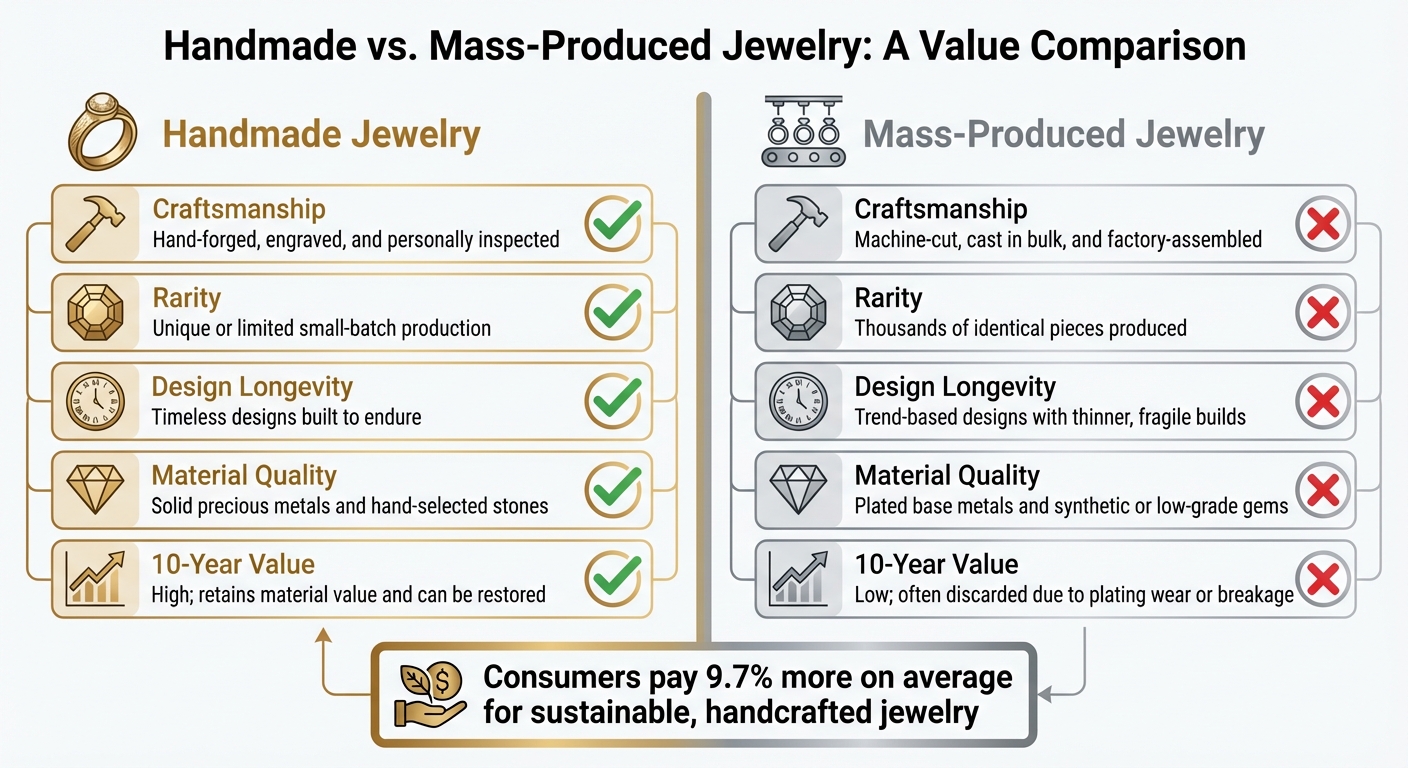
Handmade vs Mass-Produced Jewelry Value Comparison
When deciding between handmade and mass-produced jewelry, the differences go far beyond just appearance. The two approaches vary significantly in terms of craftsmanship, materials, and durability.
Mass-produced jewelry is created on assembly lines, relying heavily on automated processes like machine cutting. To keep production costs low, manufacturers often use plated base metals such as brass, copper, or nickel, which are layered over hollow forms or thin bands. While these pieces may look appealing initially, their quality tends to decline quickly - many show signs of wear within just a few months.
On the other hand, handmade jewelry is the result of skilled artisans' expertise. These pieces are crafted using solid precious metals like gold, sterling silver, or platinum, alongside traditional techniques such as lost-wax casting, hand engraving, and bezel settings. The attention to detail and craftsmanship ensures a level of structural integrity that machines simply can't replicate. Each piece is meticulously inspected before it reaches the customer. Unlike mass-produced alternatives, handmade jewelry not only maintains its value but often appreciates over time due to the superior materials and techniques used. As Tracy Robinson of Robinson's Jewelers notes:
"Mass-produced jewelry often cuts corners to meet high demand, resulting in weaker settings, lower-quality materials, and less durability."
Key Differences Comparison Table
Here's a side-by-side look at how handmade and mass-produced jewelry compare:
| Feature | Handmade Jewelry | Mass-Produced Jewelry |
|---|---|---|
| Craftsmanship | Hand-forged, engraved, and personally inspected | Machine-cut, cast in bulk, and factory-assembled |
| Rarity | Unique or limited small-batch production | Thousands of identical pieces produced |
| Design Longevity | Timeless designs built to endure | Trend-based designs with thinner, fragile builds |
| Material Quality | Solid precious metals and hand-selected stones | Plated base metals and synthetic or low-grade gems |
| 10-Year Value | High; retains material value and can be restored | Low; often discarded due to plating wear or breakage |
Interestingly, consumer surveys reveal that people are willing to pay an average of 9.7% more for sustainable, handcrafted options. This willingness reflects the recognition that handmade jewelry is not just a purchase - it's an investment in quality, durability, and lasting value.
Conclusion
Handmade jewelry is more than just a fashion statement - it's an investment that stands the test of time. The blend of expert craftsmanship, high-quality materials, and limited production ensures that these pieces not only maintain their value but often grow in worth over the years.
What truly sets handmade jewelry apart is its one-of-a-kind nature. Every piece carries the artisan's personal touch, from the subtle tool marks to the slight variations in design, making each creation truly irreplaceable. Add in the opportunity to personalize pieces with meaningful messages or custom designs, and you have something that’s both financially and emotionally valuable - qualities that mass-produced jewelry simply can't replicate.
LaCkore Couture embodies this ethos with its dedication to handcrafted excellence. By combining nature-inspired aesthetics with modern trends, the brand creates jewelry that feels timeless yet fresh. As Tracy Robinson of Robinson's Jewelers aptly puts it:
"When you choose handcrafted jewelry, you're not just buying an accessory - you're investing in a work of art."
With a Lifetime Guarantee accompanying every piece, LaCkore Couture underscores its confidence in the enduring quality of its creations. This assurance, paired with the artistry and care discussed throughout this article, highlights why handmade jewelry is a smart choice. Each piece is more than an accessory - it’s a treasured heirloom and a meaningful investment.
FAQs
How can I tell if jewelry is truly handmade?
Handmade jewelry stands out for its one-of-a-kind details, showcasing the artisan's craftsmanship and personal style - qualities you won’t find in mass-produced items. These pieces often have slight variations or imperfections, which add charm and individuality. Look for premium materials like gold, silver, or natural gemstones, as they’re often a hallmark of genuine handmade work. Each piece represents hours of careful effort, created start to finish by a skilled artisan dedicated to their craft.
Does handmade jewelry really hold resale value?
Handmade jewelry tends to retain its resale value because of its premium materials, meticulous craftsmanship, and one-of-a-kind designs. Unlike mass-produced pieces, these elements give handmade jewelry a timeless appeal. Its uniqueness and artistic touch often attract collectors, which can drive up its value over time.
What care helps handmade pieces last for decades?
To keep your handmade jewelry looking beautiful for years, it's important to build a few simple habits. Take off your jewelry before washing your hands, working out, or coming into contact with chemicals. When cleaning, stick to mild soap, water, and a soft cloth - steer clear of harsh chemicals or abrasive materials that could cause damage. For storage, choose a cool, dark, and dry spot to protect your pieces from tarnishing or getting scratched. These straightforward practices can go a long way in maintaining both the beauty and value of your cherished jewelry.