Skip to content




How Greek Jewelry Influenced Roman Fashion
Greek jewelry, defined by its fine goldwork and nature-inspired motifs, set the stage for Roman designs. When Greek artisans moved to Rome, they brought techniques like filigree and granulation, which Romans adapted for mass production. Greek pieces often symbolized status and spirituality, while Roman jewelry leaned into bold designs, colorful gemstones, and accessibility across social classes. Over time, Roman styles incorporated Greek elements but emphasized wealth and rank. This exchange shaped ancient adornment and continues to inspire modern design.
Key Takeaways:
- Greek Jewelry: Known for delicate craftsmanship, gold focus, and symbolic motifs like acanthus leaves and Herakles knots.
- Roman Jewelry: Adapted Greek techniques, introduced mass production, and prioritized gemstones and bold designs.
- Cultural Exchange: Greek artistry influenced Roman styles, blending functionality with luxury.
The evolution from Greek to Roman jewelry reflects a blend of artistry, social identity, and practicality that still resonates today.
1. Greek Jewelry
Techniques and Craftsmanship
Greek jewelers set a high standard for luxury metalwork, mastering techniques that highlighted their artistry. Two standout methods were filigree, which involved weaving delicate gold wires into intricate designs, and granulation, where tiny gold spheres were meticulously applied to a surface to create texture and detail . They also demonstrated remarkable skill in crafting durable gold chains by linking beads.
Their attention to detail was extraordinary. Some Hellenistic earrings were like miniature sculptures, such as a 3rd-century B.C. piece depicting a winged figure steering a two-horse chariot. Guido Gregorietti, Director of the Poldi Pezzoli Museum, aptly described Greek jewelry by saying:
In its long history, Greek jewelry has the predominant character of sculpture in miniature and represents isolated figures or religious, mythological, or heroic scenes.
These advances in technique naturally complemented their distinctive choice of materials and gemstones.
Materials and Gemstones
Gold was the centerpiece of Greek jewelry, celebrated for its durability and resistance to tarnish, a quality often referred to as "incorruptibility" by scholars. Before 331 B.C., gold was scarce, but the conquests of Alexander the Great unlocked vast treasures, fueling a booming market .
The Greeks preferred gemstones like garnets, carnelians, and banded agates, which were typically cut into smooth, rounded cabochons rather than faceted shapes . During the Hellenistic period, expanded trade routes introduced emeralds and pearls, making them increasingly popular . To add vibrant contrasts, jewelers also incorporated colorful enamel and vitreous paste into their designs . Silver, on the other hand, was rarely used due to its tendency to tarnish and its association with infections in pierced ears.
This thoughtful use of materials laid the foundation for the evolution of Greek design motifs.
Design Motifs and Style Evolution
Greek jewelry was rich in symbolic and natural motifs, reflecting both their craftsmanship and cultural values. Designers often drew inspiration from nature, incorporating acanthus leaves, beechnut pendants, and floral patterns into their work . Mythological themes were equally prominent, with figures like Eros, Nike, and serpents adorning necklaces and earrings, weaving religious and cultural narratives into their designs . One of the most iconic motifs was the Herakles knot, which was not just decorative but also believed to offer protection. Some necklaces were particularly elaborate, featuring over 75 miniature dangling vases, showcasing both complexity and elegance.
Social and Religious Roles
Jewelry in ancient Greece was more than mere adornment; it was a marker of identity and status. It revealed details about the wearer’s age, gender, and family wealth. For elite women, pieces like Eros earrings or diadems symbolized beauty, fertility, and the societal expectation of producing heirs. Rings featuring motifs of doves and Eros were often used as betrothal tokens as early as the 4th century B.C..
Jewelry also held deep cultural and spiritual significance. It was commonly passed down as family heirlooms, offered as votive gifts to deities at sanctuaries like Delos, and included in burial rituals to signify status in the afterlife . During the early Hellenistic period, wealthy Macedonians were frequently buried with elaborate gold jewelry, though this practice declined as attitudes toward wealth and its use evolved. These multifaceted roles not only shaped Greek society but also influenced Roman traditions, enriching their cultural exchange.
2. Roman Jewelry
Techniques and Craftsmanship
The Romans took inspiration from Greek artistry but adapted it to suit their own needs and preferences. Unlike the Greeks, who were celebrated for their intricate, handcrafted metalwork, Roman jewelers leaned toward molds and casting techniques. This shift allowed jewelry to be produced on a larger scale, making it more accessible to a wider audience. While this approach sometimes sacrificed the individual artistry seen in Greek pieces, it helped Roman designs spread far and wide.
Roman artisans borrowed popular Greek motifs like the Herakles knot, acanthus leaf, and beechnut pendant while introducing their own innovations. Techniques such as opus interrasile - piercing gold to create intricate patterns - and the use of niello, a black metal sulfide inlay, added striking contrasts to gold and silver jewelry .
Another standout Roman contribution was cameo glass, inspired by Greek glyptic arts, which used layered semi-precious stones. Roman glassmakers became so skilled that their glass beads often looked like genuine gemstones. After conquering Greek cities like Tarentum and Syracuse, the Romans also adopted customs such as crafting gold diadems from delicate golden leaves, often used in funerary rites.
Materials and Gemstones
Roman jewelry expanded the range of materials used, moving beyond the Greek focus on flawless metalwork to incorporate vibrant gemstones and glass. They sourced emeralds from Egypt, pearls from the Persian Gulf, amber from the Baltic, and sapphires from Sri Lanka. These materials were prized for their vivid colors and rarity . Emeralds were often left in their natural hexagonal shapes, simply drilled and strung, while pearls were so treasured that they were fashioned into earrings called "crotalia", named for the soft rattling sound they produced.
Gold remained central to Roman jewelry, though its availability and use evolved over time. In early Rome, gold was scarce, but by the 1st century BC, displays of wealth became more extravagant. For example, General Sylla showcased 15,000 pounds of gold and 115,000 pounds of silver during a single triumph. Initially, Romans favored iron rings as symbols of martial success, a tradition borrowed from the Greeks. However, gold rings eventually became a status symbol, legally reserved for senators, while common citizens wore bronze or iron.
This expanded use of materials allowed for new and diverse styles to emerge.
Design Motifs and Style Evolution
Roman jewelry blended classic Greek designs with influences from other cultures. For example, snake bracelets - likely inspired by Persian styles that had spread through the Greek world - became a popular accessory. This fusion of artistic traditions highlights how Roman jewelry reflected a broader exchange of ideas across regions.
One iconic piece, the bulla, originated in Greece during the 4th and 3rd centuries BC but became a staple for Roman children. As Pliny the Elder noted:
Tarquinius Priscus, however, it is well known, was the first who presented his son with the golden bulla... from which period the custom of wearing the bulla has been continued.
By the 3rd century AD, Roman jewelry had grown increasingly elaborate and colorful. During times of inflation, gold coins were even incorporated into jewelry as both decoration and a way to safeguard wealth. Roman men also began wearing multiple rings, each signifying specific social norms.
Social and Religious Roles
Jewelry in Roman society went beyond adornment, serving as a marker of identity, status, and belief. While Greek jewelry often carried deep religious meaning, Roman pieces adapted these roles to fit their evolving society. During the Republic, jewelry symbolized family lineage, while in the Imperial period, it reflected personal rank. Roman women, in particular, enjoyed the right to own jewelry as personal property, granting them a degree of economic independence uncommon in many ancient societies.
Mass production techniques allowed even lower classes to own modest pieces, though gold and other luxuries remained the privilege of the elite. Religious practices also played a role in jewelry design and use. Romans continued the Greek tradition of offering jewelry as votive gifts at temples and used gold wreaths or diadems in funerary rites to signify the deceased's status. Protective amulets, such as the bulla or the phallic-shaped fascinus, were worn by children to ward off evil, blending Greek spiritual traditions with uniquely Roman customs.
Pros and Cons
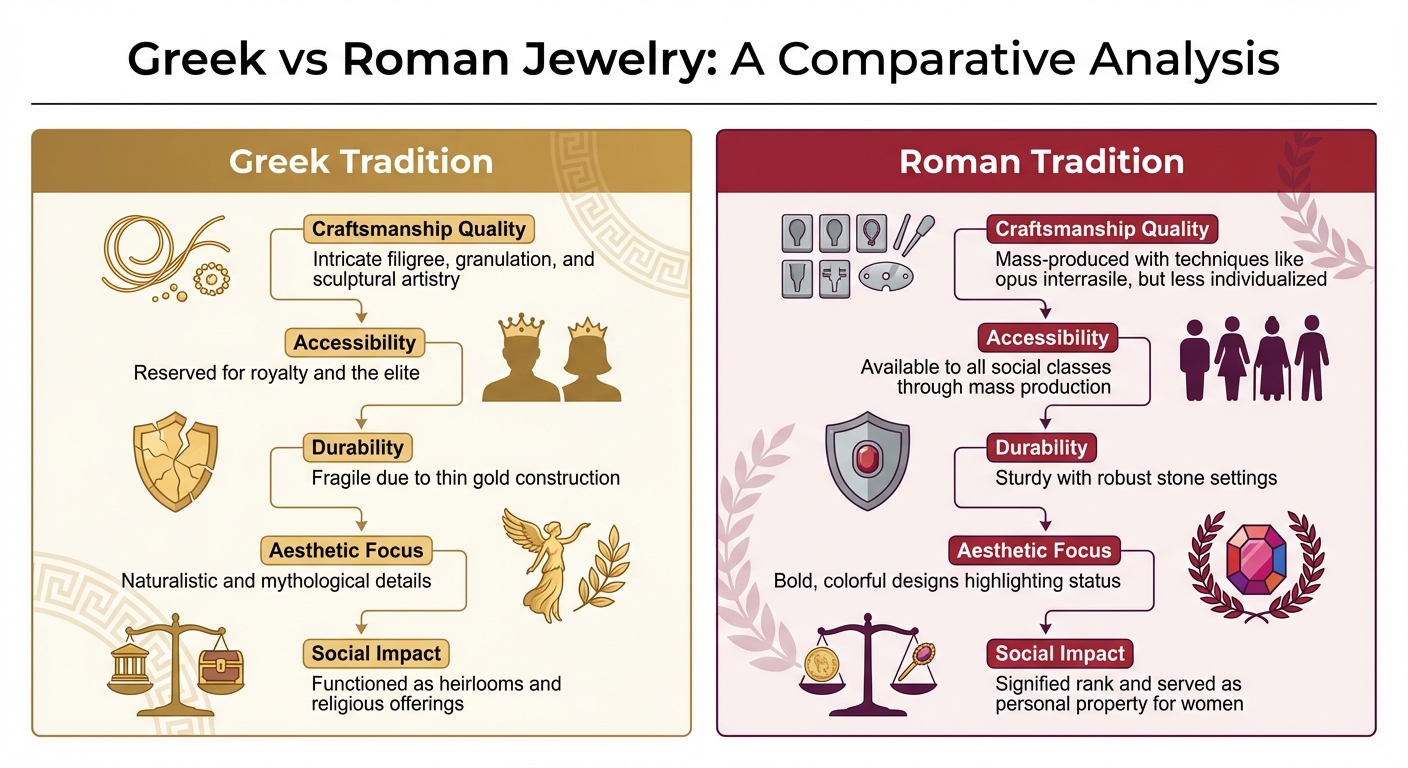
Greek vs Roman Jewelry: Key Differences in Craftsmanship, Materials, and Social Impact
Greek and Roman jewelry each reflected distinct priorities and techniques, shaped by their respective cultures and methods of production.
Greek jewelry stood out for its exceptional craftsmanship. Techniques like filigree, granulation, and sculptural detailing gave their pieces a timeless elegance. However, this level of artistry came with trade-offs. The lightweight sheet gold construction made these pieces delicate and primarily accessible to royalty and the wealthy elite. While the technical skill was unparalleled, it also meant the jewelry was less durable and more exclusive.
Roman jewelry, on the other hand, leaned toward practicality and accessibility. Casting techniques allowed for mass production, making jewelry available across all social classes. Roman artisans embraced bold designs, incorporating colorful gemstones and glass to create striking pieces. Their glassmakers even mastered the art of crafting beads that mimicked real gemstones. However, the focus on mass production often resulted in less refined craftsmanship compared to Greek works. As Guido Gregorietti noted, Roman jewelry evolved to highlight vibrant stones like topazes, emeralds, rubies, sapphires, and pearls, which became central to its identity.
Durability also set these traditions apart. Greek jewelry, with its thin and lightweight gold, was more fragile. In contrast, Roman pieces were sturdier, thanks to their robust stone settings. However, by the 3rd century A.D., some designs became overly extravagant, incorporating gold coins as a response to inflation, which occasionally compromised their aesthetic appeal.
The purpose of jewelry also differed significantly. Greek pieces often served as heirlooms or religious offerings, emphasizing their cultural and spiritual value. Roman jewelry, meanwhile, was a clear marker of social rank. For women, it also held practical significance as personal property they could manage independently. These contrasting roles not only defined ancient jewelry but also influenced modern design practices.
The table below highlights these differences:
| Aspect | Greek Tradition | Roman Tradition |
|---|---|---|
| Craftsmanship Quality | Intricate filigree, granulation, and sculptural artistry | Mass-produced with techniques like opus interrasile, but less individualized |
| Accessibility | Reserved for royalty and the elite | Available to all social classes through mass production |
| Durability | Fragile due to thin gold construction | Sturdy with robust stone settings |
| Aesthetic Focus | Naturalistic and mythological details | Bold, colorful designs highlighting status |
| Social Impact | Functioned as heirlooms and religious offerings | Signified rank and served as personal property for women |
Conclusion
The evolution of jewelry from Greek to Roman times offers a fascinating glimpse into how cultures influence one another through fashion. The Romans took inspiration from Greek artistry, transforming its delicate filigree and nature-inspired motifs into striking, bold designs that symbolized power and authority. This transformation reflects a broader shift in how personal identity was expressed through adornment.
While the Greeks celebrated the intricate craftsmanship of gold, the Romans shifted the focus to vibrant gemstones. They adorned their jewelry with treasures like emeralds from Egypt, pearls from the Persian Gulf, and sapphires sourced from far-off regions - marking a new era in jewelry design. Despite this shift, Greek motifs remained a staple in Roman creations, illustrating that artistic influence can endure beyond political domination. Research from The Metropolitan Museum of Art highlights Rome’s pivotal role in this artistic evolution.
Even today, the interplay between these ancient cultures continues to inspire modern jewelry. Designers like LaCkore Couture draw from this rich heritage, incorporating classical elements such as coin-inspired designs, intricate goldwork, and vivid gemstones into their collections. This enduring influence underscores how cultural exchange enhances rather than diminishes creativity - leaving behind timeless symbols of identity, status, and artistry that continue to captivate across generations.
FAQs
How did Greek jewelry techniques influence Roman designs?
Greek jewelry-making techniques, such as filigree and granulation, had a profound influence on Roman jewelry design. Filigree, with its delicate metal threads and intricate patterns, became a hallmark of Roman craftsmanship. Likewise, granulation, which involves arranging tiny gold or silver beads to create intricate textures, was embraced by Roman artisans to add a refined touch to their creations.
This exchange of methods underscores the artistic exchange between Greek and Roman cultures. While the Romans adopted these Greek techniques, they also brought their own innovations into the mix, such as the use of molds and casting, which made jewelry production more efficient. The result was a fusion of Greek artistry and Roman practicality, showcasing the shared and evolving artistic heritage of the ancient Mediterranean.
How did Greek jewelry styles influence Roman fashion trends?
Greek jewelry left a lasting mark on Roman fashion, especially through the use of gemstones. During the Hellenistic period, Greek artisans displayed incredible skill, crafting intricate gold designs adorned with precious stones like emeralds, garnets, and rock crystals. These pieces were more than just accessories - they symbolized wealth, elegance, and a refined sense of style. As Greek culture influenced neighboring regions, their jewelry-making techniques and designs gained wider recognition.
The Romans embraced these Greek traditions and took them a step further. Gemstones became a way to showcase not just wealth and status but also individuality and artistic taste. With advancements in mass production, jewelry became more accessible, and colored stones, along with glass imitations, grew in popularity. This blending of Greek and Roman styles reflects a shift in jewelry's role - from an exclusive luxury to a form of expression that combined beauty and innovation for a larger audience.
How did Greek jewelry influence Roman designs and cultural trends?
Greek jewelry left a lasting impression on Roman designs, highlighting the rich exchange of ideas between these two ancient cultures. During the Hellenistic period, Greek artisans brought forward intricate patterns, advanced craftsmanship, and the use of luxurious materials like gold, emeralds, and rock crystal. Their creations often carried deep symbolic meaning, representing themes such as beauty, fertility, and mythology, which showcased the Greeks' dedication to both artistry and storytelling.
The Romans, deeply influenced by these Greek styles, made them their own by emphasizing grandeur and status. Roman jewelry became more ornate and extravagant, often serving as a clear display of wealth and power. While Greek designs celebrated artistic expression and cultural values, Roman pieces leaned into practicality and political symbolism, reflecting the differing priorities of these two civilizations.