Skip to content




Gold Jewelry Investment Tips for US Buyers
Gold jewelry can be both a stylish accessory and a smart financial move. With gold prices hitting record highs - surpassing $5,000 per ounce in January 2026 and currently at $4,915.50 per ounce - investing in gold jewelry offers stability in uncertain economic times. The value of gold has risen 500% over the past two decades, making it a reliable asset for long-term growth.
To maximize returns, focus on:
- Higher-karat gold (18K or 24K) for better resale value.
- Timeless designs like simple chains or solid bangles that retain demand.
- Authenticity checks to avoid counterfeits and ensure quality.
- Ethical sourcing to protect resale value and support responsible practices.
- Market timing to purchase during price dips and off-peak seasons.
Gold jewelry stands out as a portable, private, and durable investment. By choosing high-purity pieces and staying informed about market trends, you can combine elegance with financial security.
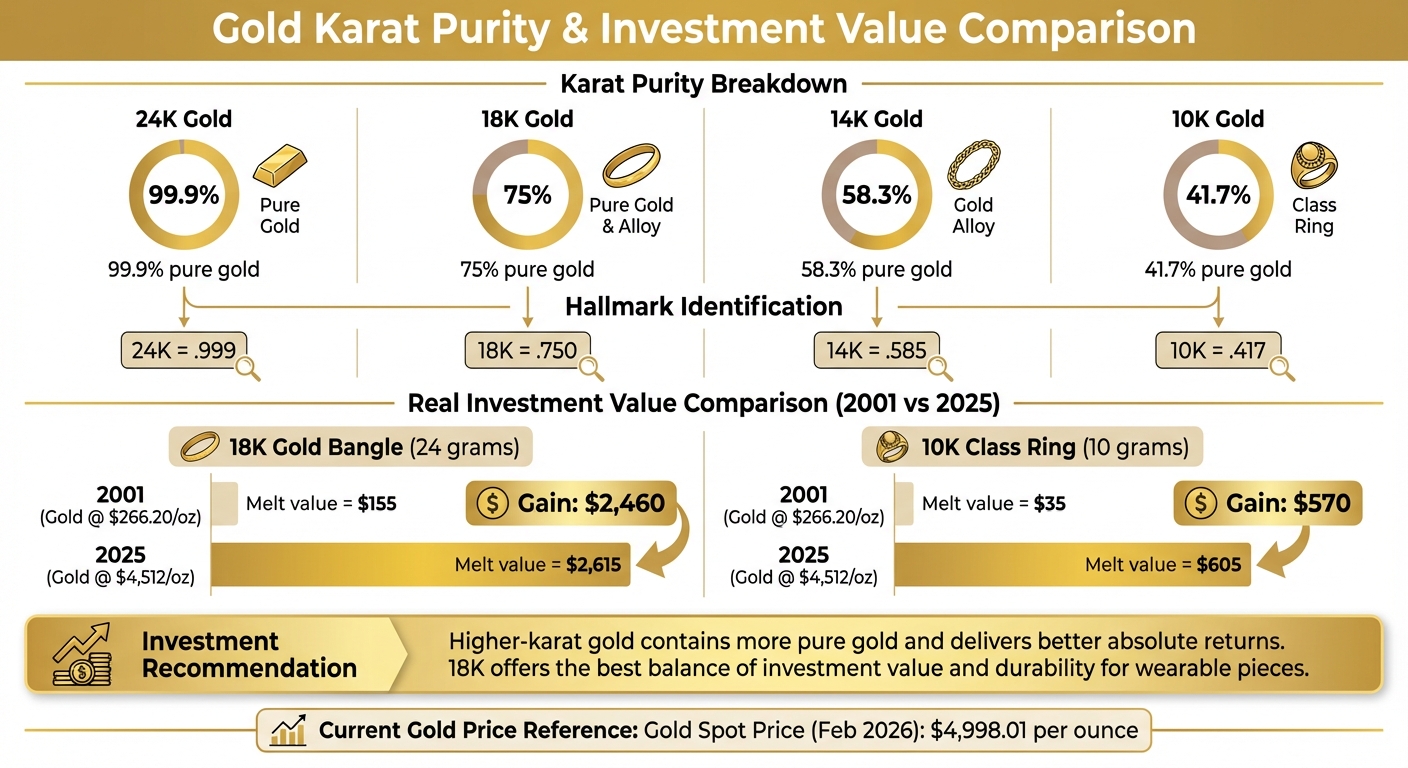
Gold Karat Purity Comparison and Investment Value Guide
1. Buy Higher-Karat Gold for Better Resale Value
Choosing higher-karat gold is a smart move if you're aiming to maximize resale value. The reason is simple: the purer the gold, the higher its melt value. While 10K and 14K gold are popular in the U.S. for their durability and suitability for daily wear, they contain much less gold compared to 18K or 24K options.
Here’s a quick breakdown: 24K gold is 99.9% pure, 18K is 75% pure, 14K is 58.3% pure, and 10K is only 41.7% pure. The remaining percentage is made up of alloy metals like copper, silver, or zinc. When it comes time to sell, buyers focus on the gold content - the melt value - not the original retail price. As Brandon Aversano, Founder of The Alloy Market, puts it:
"Many consumers are surprised by how much their jewelry is worth. They often don't realize how much value is retained through its precious metal content alone".
Let’s look at an example. The Alloy Market analyzed an 18K gold bangle weighing 24 grams. Back in January 2001, when gold was priced at $266.20 per ounce, its melt value was $155. Fast forward to 2025, with gold reaching $4,512 per ounce, and that same bracelet’s melt value skyrocketed to approximately $2,615. In contrast, a 10-gram 10K class ring increased from $35 to $605 over the same period. The higher purity of the 18K piece led to a much larger absolute gain.
According to Houston Cash for Gold, "higher-karat gold is always seen as a more stable investment because it contains a larger percentage of pure gold, which tends to retain its value better than lower-karat items". For those balancing investment potential with wearability, 18K gold is a great option - it offers strong resale value while still being durable enough for occasional use. If your focus is purely on investment, 22K or 24K gold is ideal, as it closely tracks the spot price of gold, which stood at $4,998.01 per ounce as of February 2026.
To ensure authenticity, always check for hallmarks stamped on the jewelry. For instance, ".750" signifies 18K gold, while ".999" indicates 24K. These marks not only confirm purity but also make resale easier. By keeping these tips in mind, you can make informed decisions and choose pieces that align closely with gold’s market value.
2. Select Classic Designs That Hold Value
When buying gold jewelry, the design is just as important as the karat weight. Timeless designs consistently retain their appeal, even as fashion trends come and go. Simple gold chains, classic hoop earrings, solid bangles, and signet rings are perfect examples of enduring styles that have remained popular for generations.
Take this as an example: In 2025, The Alloy Market analyzed a 14K gold wedding band weighing 5 grams. Back in January 2001, when gold was priced at $266.20 per ounce, the melt value of this band was around $25. Fast forward to 2025, with gold trading at approximately $4,512 per ounce, that same band’s intrinsic value soared to $425 - a staggering 1,600% increase over 24 years. The key to this appreciation? Its timeless design, which ensured its desirability across decades, paired with the rising value of gold.
Classic designs also offer a level of market liquidity that trendier pieces struggle to match. A solid Cuban link chain or a pair of 15–25mm gold hoops - accounting for roughly 27% of global fine earring sales - will always attract buyers. On the other hand, trendy designs often come with retail markups of 200% to 400% for their "fashion appeal", but this premium disappears once the trend fades.
Avoid hollow or overly ornate designs. Hollow chains and bangles may cost less initially, but they’re prone to denting, difficult to repair, and contain less gold, reducing their melt value. Similarly, designs tied to specific eras, like disco-era cocktail rings or charm bracelets from the 2000s, often lose their appeal once the trend is over, making them harder to resell.
Focus on versatile pieces that transition seamlessly between casual and formal wear. Gold hoops, tennis bracelets, and solid bangles are excellent examples. Auction records from Christie's between 2010 and 2020 show that vintage gold statement necklaces from the 1970s appreciated by an average of 24% in resale value, thanks to their enduring design and the rising price of gold. This demonstrates how classic designs not only complement your wardrobe but also hold their value over time.
3. Check for Authenticity and Ethical Sources
Ensuring the authenticity of gold is as crucial as verifying its purity - it's the foundation of securing long-term value. In the United States, gold items marked with a karat quality (such as 14K or 18K) must also include a registered trademark. This trademark, which could be a symbol, name, or initials, identifies the maker. As the Federal Trade Commission advises:
"If you're thinking about buying a piece of gold jewelry but don't see a trademark along with the karat mark, don't buy it".
This legal requirement, established under the National Gold and Silver Marking Act of 1906, not only holds manufacturers accountable but also helps protect buyers from counterfeit items. To ensure accuracy, use tools like a jeweler's loupe to closely inspect these marks. Look for uniform font and clean, precise edges - irregular or poorly stamped marks can be a red flag for counterfeits [32,33].
These hallmarks are often located inside ring bands, near necklace clasps, or on earring posts. Pay close attention to letter codes, too. For example, "14KP" signifies plumb gold, meaning it contains exactly 58.3% pure gold. On the other hand, marks like "GP" (gold plated) or "GF" (gold filled, containing at least 5% gold) indicate the item is not solid gold.
This attention to detail is essential. Industry data reveals that around 20% of gold items in pawnshops fail authenticity tests. In 2024 alone, scams involving counterfeit gold bars caused losses exceeding $126 million.
Equally important is ensuring your gold is ethically sourced. Gold tied to human rights violations, child labor, or environmental harm can tarnish both its reputation and resale value [35,38]. With more buyers prioritizing responsible sourcing, ethically verified gold often holds better long-term value. Ask retailers about their refiners and whether they undergo third-party audits by groups like the London Bullion Market Association or the Responsible Jewellery Council. Notably, over 96% of the world's gold is processed by refiners that meet these audit standards.
Look for certifications such as Fairmined, Fairtrade, or Just Gold, which confirm responsible sourcing and support artisanal mining communities. For instance:
"Tiffany & Co. has traced 100% of its newly mined gold back to a single mine of origin since February 2018 and conducts regular human rights assessments there".
Retailers associated with organizations like Jewelers of America also demonstrate a commitment to ethical practices.
For high-value purchases, consider using X-Ray Fluorescence (XRF) testing to verify gold purity without damaging the item. Always pay with a credit card to provide a layer of protection if any issues arise, and request an itemized receipt along with any certifications. Taking these steps to confirm both authenticity and ethical standards not only safeguards your investment but also provides peace of mind.
For trusted gold pieces verified for authenticity and ethical sourcing, check out retailers like LaCkore Couture (https://lackorecouture.com).
4. Monitor Market Conditions Before Buying
Gold prices are highly sensitive to inflation, currency movements, and global events. Understanding these factors can help you make smarter buying decisions and steer clear of overpaying during market spikes. Let’s break down how these dynamics influence gold prices.
Inflation often pushes investors toward gold as a reliable store of value. When the dollar's purchasing power weakens, demand for gold typically rises. For example, between early 2025 and February 2026, gold prices skyrocketed nearly 60%, peaking at an all-time high of $5,602.22 per troy ounce on January 28, 2026. This surge led retailers to adjust their pricing strategies. Mejuri, for instance, raised prices in September 2025 and introduced 10-karat solid gold products to address soaring material costs and new tariffs. Similarly, Signet Jewelers reported a 30% increase in gold costs, which directly impacted their manufacturing and pricing.
The strength of the U.S. dollar is another critical factor. Gold and the dollar tend to move in opposite directions - when the dollar weakens, gold becomes more affordable for international buyers, boosting demand and prices. Keep an eye on the Dollar Index (DXY) to track these trends. Federal Reserve interest rate policies also play a role. Lower interest rates reduce the opportunity cost of holding gold, which doesn’t generate yield, often leading to price increases. For instance, when the Fed cut rates by 25 basis points on December 10, 2025, gold prices stabilized between $4,290 and $4,310.
Geopolitical uncertainty and central bank actions further shape gold prices. During times of political instability or conflict, gold often acts as a safe haven. Central banks have been major players in the gold market, purchasing over 1,000 tonnes annually from 2022 to 2024, which created a price floor. Natasha Kaneva, Head of Global Commodities Strategy at J.P. Morgan, observed:
"The long-term trend of official reserve and investor diversification into gold has further to run. We expect gold demand to push prices toward $5,000/oz by year-end 2026".
To make informed purchases, calculate the melt value of any gold piece based on the current spot price (Weight × Purity % × Spot Price per ounce). As of February 18, 2026, gold is trading at $4,918.51 per ounce, or $158.13 per gram. This calculation ensures that retail prices align closely with the intrinsic melt value. To get the best deal, monitor live price tickers daily and compare multiple quotes when purchasing high-value items.
5. Diversify Across Different Precious Metals
Putting all your investment eggs in the gold basket can leave you exposed to unnecessary risks. By spreading your investment across gold, silver, and platinum, you create a more balanced portfolio that can better handle changing market conditions. Many experts suggest keeping 10–15% of your portfolio in precious metals for a well-rounded approach.
Each metal has its own way of responding to economic changes, which helps smooth out returns when one isn't performing well. Gold often shines during inflationary periods, platinum benefits from its industrial uses, and silver serves as a bridge between investment demand and industrial utility. As the United States Gold Bureau explains:
"Precious metals balance portfolios that may be heavily weighted toward equities, real estate, or digital assets".
This balance becomes particularly important during economic downturns. While stocks may falter, precious metals often hold their value or even increase, offering a financial cushion [55,56].
To diversify further, consider mixing different forms of precious metals. For instance, you could combine investment-grade 24K jewelry - though it typically carries a 30–55% markup - with pieces like standard 14K or 18K jewelry, sterling silver (.925), or 95% pure platinum [6,58,37]. This approach not only provides "wearable wealth" but also gives you stylish, portable investments.
Regularly reviewing your portfolio ensures your metal allocations stay aligned with your financial goals. When purchasing high-purity pieces for investment purposes, always verify their authenticity through hallmarks and certificates.
For those in the U.S. looking to add wearable investments, brands like LaCkore Couture offer handcrafted jewelry that combines artistry with diverse precious metal designs. This strategy not only enhances your portfolio but also allows for targeted investments, such as yellow gold, which consistently enjoys strong demand.
6. Focus on Yellow Gold for Consistent Demand
Yellow gold holds a distinct appeal for investors because it’s the only form of gold available in pure 24K. Unlike white or rose gold, which are alloyed, yellow gold’s purity sets it apart when evaluating long-term value.
Here’s an example that highlights its growth in value: an 18K yellow gold bangle weighing 24 grams had an intrinsic melt value of just $155 in 2001. By 2025, when gold prices hit $4,512 per ounce, that same bangle's melt value had risen to approximately $2,615. This combination of value appreciation and low maintenance makes yellow gold a standout choice.
Yellow gold also offers practical advantages. Unlike white gold, which needs rhodium replating every 12–18 months to maintain its silvery sheen, yellow gold keeps its natural color indefinitely. It only requires basic cleaning and doesn’t tarnish, oxidize, or corrode. In contrast, the alloys in white or rose gold can react to environmental factors over time.
From an investment perspective, yellow gold is also easier to liquidate. It typically delivers better resale returns than white gold because of its higher pure gold content and global market demand. The World Gold Council emphasizes this enduring appeal:
"Gold resonates particularly well with those consumers looking to buy a piece that they feel is associated with tradition... it keeps an inherent emotional and financial value over time".
This universal recognition makes yellow gold a reliable option when you need to convert your jewelry back into cash.
For investment purposes, focus on 18K or higher yellow gold pieces in timeless designs like bangles or chains. These items, containing at least 75% pure gold, maximize intrinsic value. Always check for purity hallmarks - look for "750" on 18K pieces or "585" on 14K - and consider requesting X-ray fluorescence (XRF) testing to confirm authenticity. For US buyers, reputable sources like LaCkore Couture offer high-quality options, combining craftsmanship with authenticity in gold jewelry.
7. Assess Gemstone Quality Carefully
When it comes to jewelry featuring gemstones, evaluating their quality is just as critical as considering the purity of gold or the timelessness of the design. Here's a key distinction to keep in mind: carat refers to the weight of a gemstone (1 carat equals 0.2 grams), while karat measures the purity of gold - two entirely different metrics. It's also essential to ensure the gemstone's size and proportions are well-suited to its setting.
For colored gemstones like rubies, sapphires, and emeralds, color is the most important factor influencing value. Clarity, especially in transparent stones, determines how light interacts with the gem, enhancing its brilliance. Interestingly, more than 95% of rubies on the market undergo heat treatment to enhance their appearance. Always ask sellers about any treatments, such as heating, oiling, or fracture filling, as these can affect the stone's value and care requirements.
Natural gemstones typically command higher prices than lab-created ones, even though both share identical chemical compositions. If you're buying with investment in mind, focus on the "Big Three" gemstones - rubies, sapphires, and emeralds. Stones with verified origins, like Burmese rubies or Colombian emeralds, are particularly sought after. These gems are also highly durable, with rubies and sapphires ranking around 9 on the Mohs scale, making them ideal for everyday wear in rings or bracelets.
To confirm a gemstone's weight, clarity, and origin, request a GIA grading report. For diamonds, investment-grade stones usually fall within the D–F color range and FL–VS1 clarity. Keep in mind, diamond value doesn't scale linearly with size - a one-carat diamond is worth more than double the price of a half-carat stone of comparable quality.
It's also wise to inquire about "clarity enhancements", such as fracture filling or laser drilling, as these treatments can reduce a gemstone's resale value. For emeralds, inclusions (often called a "garden" or "jardine") are common, but stones with fewer inclusions tend to be more valuable.
To maximize both beauty and long-term value, choose jewelry that combines high-quality gemstones with high-karat gold. This thoughtful pairing ensures your investment not only retains its allure but also holds its monetary worth over time.
8. Time Your Purchases for Better Prices
When it comes to gold jewelry, timing can make a big difference in how much you pay. Gold prices follow seasonal trends, and knowing when to buy can help you save money and get the most value for your investment.
March through early May is one of the best times to shop for fine jewelry. Dustin Lemick, CEO of BriteCo, explains:
"Generally speaking, you're likely to find the best prices on fine jewelry in March, April and early May. Jewelers will have just wrapped up the holiday season and are typically quiet before engagement ring season starts".
During this quieter period, jewelers often offer discounts or are more open to negotiating on premiums and making charges as they work through post-holiday inventory.
The summer months of June and July can also offer favorable prices. With fewer buyers in the market, trading volumes drop, leading to reduced demand and better deals. Plus, shopping during these slower months means less competition, giving you access to a wider selection. Some experts recommend using dollar-cost averaging - investing smaller amounts at regular intervals - to help manage price fluctuations during this time.
On the flip side, avoid buying jewelry between late August and December. Prices tend to rise sharply during this period due to increased demand driven by festive and holiday seasons. For instance, India, which accounts for about 25% of global gold jewelry consumption, sees a surge in demand during Diwali, contributing to price hikes. Even weekly patterns can impact prices - Tuesdays and Thursdays often offer better rates compared to Mondays, which typically experience price corrections after the weekend.
If you're shopping during the optimal times, consider requesting in-stock pieces rather than consignment items to secure better discounts. Also, keep an eye on Federal Reserve interest rate announcements, as gold prices may temporarily dip after rate hikes as the markets adjust. With gold priced at $4,918.65 per ounce as of February 17, 2026, even small timing adjustments can translate into noticeable savings.
At LaCkore Couture (https://lackorecouture.com), for example, their curated collection of in-stock gold jewelry is designed to help you take advantage of these prime buying windows with confidence. Combining smart timing with a focus on quality and ethical sourcing ensures that your purchase is both a financial and personal win.
Conclusion
Gold jewelry investment offers a rare combination of elegance and enduring financial value. To make the most of it, it’s crucial to focus on the factors that truly drive worth: purity, weight, and staying informed about market trends. As we’ve covered, higher-karat pieces tend to align more closely with gold's spot price and avoid the steep markups often found in retail.
The data supports this approach - quality gold jewelry serves as both a luxurious accessory and a financial safeguard. Savvy buyers stick to the basics outlined in this guide: choosing timeless designs, verifying hallmarks for authenticity, keeping an eye on market conditions, and calculating melt value before making a purchase. When financial return is the goal, avoiding gemstone-heavy pieces is key, as trends like the 74% drop in lab-grown diamond prices between 2020 and 2025 illustrate. Instead, aim for pieces with transparent markups, ideally between 30% and 55%.
Gold jewelry is more than just an investment; it’s a wearable asset that combines style with security. Unlike bullion stored in a vault, high-purity jewelry offers portability and discretion while serving as a tangible store of value. With central banks adding over 1,045 tonnes to global reserves and shifts away from the dollar gaining momentum, gold remains a trusted safe-haven asset.
At LaCkore Couture (https://lackorecouture.com), these principles are reflected in every piece. Whether you're starting your collection or making a strategic purchase, combining thoughtful timing with a commitment to authenticity ensures your jewelry brings both personal joy and lasting financial value.
FAQs
How do I estimate a fair price over melt value?
To determine a fair price above the melt value of gold, start by calculating the gold's intrinsic value. This involves factoring in its weight and purity. Once you have that base value, add a reasonable markup - typically between 10% and 30%. This additional cost accounts for elements like craftsmanship, brand reputation, and retail expenses. By doing this, you ensure you're paying a fair amount for both the raw material and the artistry that went into creating the piece.
What documents should I keep for resale in the U.S.?
Keeping essential documents - like receipts, appraisals, or proof of authenticity - is crucial when it comes to gold jewelry. These documents not only back up the resale value but also help ensure a smoother process during valuation or sale. Without them, verifying the item's worth can become a lot more challenging.
Where can I sell gold jewelry for the best payout?
To secure the best return for your gold jewelry, focus on selling to trusted local jewelers, specialized gold buyers, or reliable online platforms that provide transparent evaluations. Take the time to compare multiple quotes to ensure you're getting a fair price based on the current market value. Steer clear of hasty decisions, and always check the credentials of the buyer to safeguard your transaction and maximize your payout.