Skip to content




Gold Jewelry Investment: Risks and Returns
I’d choose bullion coins or bars for gold exposure - and jewelry mainly to wear. Before buying, I’d compare verified gold content, the total purchase cost, and what a buyer would pay today. A 14K piece is 58.3% gold, so its total weight isn’t its gold weight.
My rule: <u>judge returns by what you keep after selling</u>, not by gold’s price alone. Design markups, dealer spreads, storage, insurance, taxes, and selling fees can erase a price gain. Gold pays no income, and theft, damage, or doubts about purity can cut your proceeds.
Quick Comparison
| Factor | Gold jewelry | Bullion coins | Gold bars |
|---|---|---|---|
| Gold content | Varies by karat; exclude stones | Use stated fine-gold weight | Weight × verified fineness |
| Purchase markup | Often includes design and labor | Dealer premium; smaller coins often cost more per ounce | Often lower for larger bars |
| Resale | Metal value; design premiums may not return | More standardized pricing, with dealer spreads | Metal-based pricing; testing fees may apply |
| Ownership trade-off | Wearability, but damage and repair costs | Easier to sell in smaller amounts | Storage costs; large bars limit partial sales |
I’d check purity, keep receipts, and get three written buyback offers showing deductions and fees. For jewelry, I’d request a market or liquidation estimate - not an insurance replacement estimate. Breaking even means covering every purchase, holding, and selling cost.
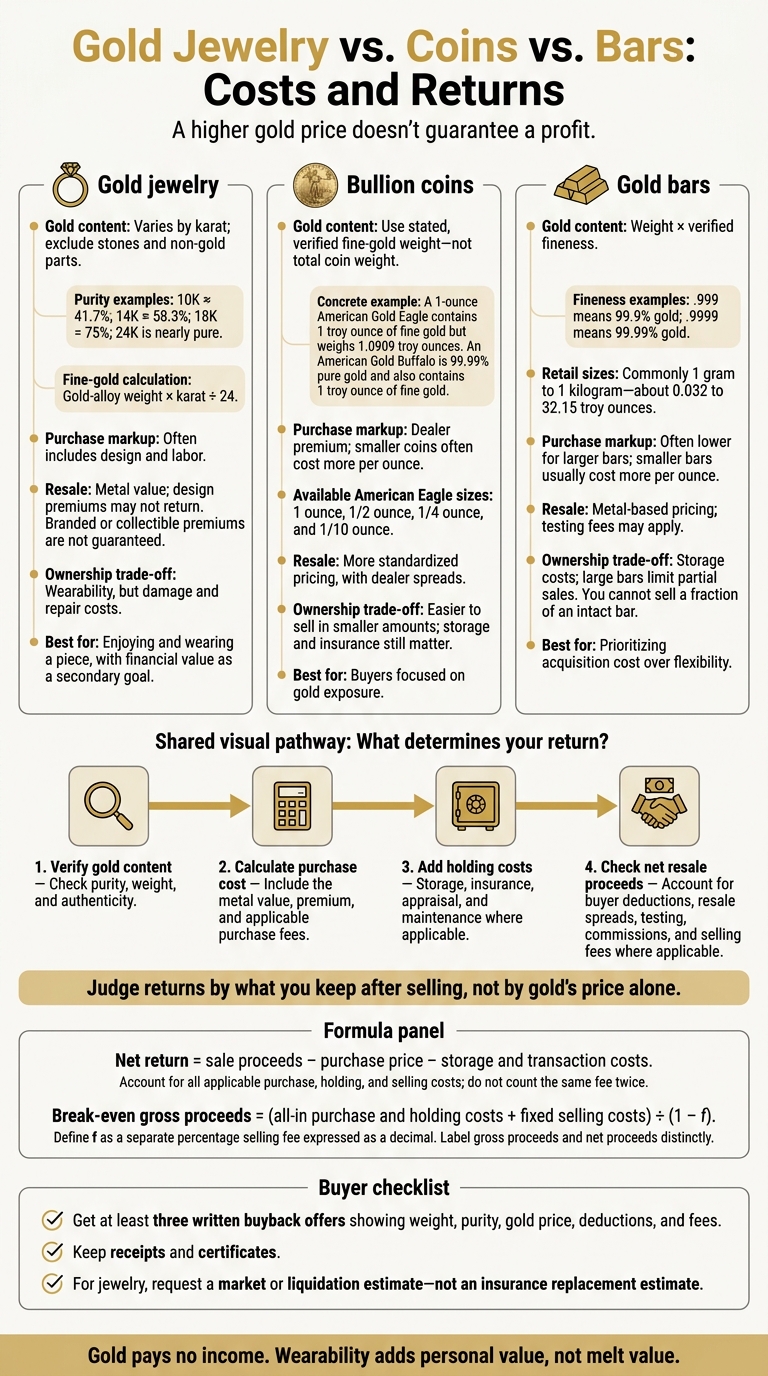
Gold Jewelry vs. Coins vs. Bars: Costs and Returns
1. Gold Jewelry
Purity and Verification
When buying jewelry, purity and workmanship affect both the price and what you can get back when you sell. 14K gold is 58.3% gold. Its alloy metals make it more durable than higher-karat gold, so it’s better suited to daily wear.
Look for a maker’s name or trademark alongside the karat mark. Also confirm whether the piece is solid gold, gold-filled, gold-plated, or vermeil. These categories differ greatly in gold content and potential resale value.
Purchase Premiums and Costs
Ask for the net weight in grams, excluding stones and non-gold parts. Request an itemized invoice that separates materials, labor, and customization costs.
To judge the design premium, compare the purchase price with the recoverable metal value - not the retail presentation. That gap matters when you sell, since buyers usually pay primarily for gold content.
For handcrafted jewelry, assess the piece’s materials and construction rather than treating its retail price as recoverable metal value. Custom details may make a piece worth more to you without adding the same amount to its resale price.
Resale Value and Returns
Many ordinary pieces sell near - or below - melt value, especially when sold to gold buyers or refiners. Branded or collectible jewelry may sell for more, but that premium isn’t guaranteed. Getting it may require authentication, original receipts, boxes, certificates, or access to a specialist marketplace.
Unlike bullion, jewelry’s resale price often depends on how the buyer judges its craftsmanship, brand, and condition. Keep receipts and certificates, and get at least three written offers that show weight, purity, gold price, deductions, and fees.
Being able to wear a piece adds personal value, not melt value. Scratches, damaged clasps, missing stones, and repair bills can reduce your return. Coins and bars usually track gold prices more closely because they carry less design markup.
2. Bullion Coins
Jewelry prices include design markup. Bullion coins sit closer to the value of the gold itself.
Purity and Verification
Bullion coins are priced by fine-gold content, not craftsmanship. Their standardized specifications make prices easier to compare.
The U.S. Mint’s 1-ounce American Gold Eagle contains 1 troy ounce of fine gold but weighs 1.0909 troy ounces because silver and copper are added for durability. The American Gold Buffalo is 99.99% pure gold and also contains 1 troy ounce of fine gold.
Buy from a reputable dealer and check the coin against official mint specifications. Counterfeit coins still exist.
Purchase Premiums and Costs
A coin’s price equals gold’s spot value plus a dealer premium. Compare the total cost, including shipping, insurance, and the buyback spread.
American Eagles come in 1-ounce, 1/2-ounce, 1/4-ounce, and 1/10-ounce sizes; smaller coins allow smaller purchases and sales but usually cost more per ounce.
Skip collectible or proof premiums unless you specifically want those coins. You may not recover that extra cost when you sell.
Resale Value and Returns
Before buying, ask what the dealer would pay to buy the coin back immediately. That spread is your break-even hurdle. Buyback prices differ, so check whether the quote follows spot gold or the dealer’s own buyback benchmark.
A higher gold price doesn’t guarantee a profit. Your sale proceeds must cover the original premium, the resale spread, and any other costs. Bullion coins are easier to price and sell than collectible coins, but claims of rarity can add premiums you may struggle to recover. Set aside “semi-numismatic” claims; the term has no standard meaning.
Gold bars take this approach a step further by removing most design costs.
3. Gold Bars
Bars cut out most design costs, so your return depends more on the premium, storage costs, and resale spread.
Purity and Verification
Gold bars give you direct exposure to gold with the smallest design markup.
Read the fineness, not just “24-karat”: .999 means 99.9% gold and .9999 means 99.99% gold. Fine gold = gross weight × fineness.
Check the refiner’s marks, serial number, weight, and dimensions against the manufacturer’s specifications. An assay card helps verify a bar, but independent testing provides stronger proof for higher-value purchases.
Purchase Premiums and Costs
Retail bars commonly range from 1 gram to 1 kilogram - about 0.032 to 32.15 troy ounces. Smaller bars usually cost more per ounce, but they let you sell part of your holding. Larger bars often carry lower premiums, but you can’t sell a fraction of an intact bar.
Ask for one written quote covering the premium, payment fees, shipping, insurance, and sales tax. Confirm storage charges separately. Compare both the dollar premium and the percentage above fine-gold spot value, not just the advertised price.
A lower premium helps only if storage and resale costs stay low.
Resale Value and Returns
Storage costs don’t stop after purchase. Homeowners insurance often excludes gold stored at home, while safe-deposit boxes and vaults add fees and limit access. If you use a vault, confirm its insurance coverage and your allocated ownership of specific bars.
Before buying, check whether resale requires sealed assay packaging and whether testing or liquidation fees apply. Recognized refiners and clear documentation can make bars easier to sell, but your return depends on the actual buyback offer:
Net return = sale proceeds − purchase price − storage and transaction costs.
What Determines Gold Investment Returns
Gold investment returns depend on four things: verified gold content, the upfront premium, the resale spread, and holding costs.
Gold Purity and Verification
To estimate recoverable gold content, multiply the gold-alloy weight by its karat divided by 24. Value that fine-gold content separately from gemstones and design.
| Gold type | Purity information | Verification checks | Recoverable gold content |
|---|---|---|---|
| Jewelry | 10K ≈ 41.7%; 14K ≈ 58.3%; 18K = 75%; 24K is nearly pure | Karat mark, manufacturer’s identifying mark, invoice or documentation, professional testing when needed | Gross gold-alloy weight × karat ÷ 24 |
| Bullion coins | Some have high fineness; others have lower fineness but state a guaranteed fine-gold weight | Mint specifications, weight, dimensions, documentation, testing if needed | Use verified fine-gold weight, not total coin weight |
| Bars | Commonly 99.9%+ fine gold | Refiner identification, assay documentation, independent testing when justified | Verified weight × stated fineness |
“Solid gold” describes construction, not purity. Hollow pieces weigh less, but their alloy purity stays the same. Exclude gemstones, pearls, non-gold clasps, and other non-gold parts from the gold weight. Account separately for solder with a different purity.
Gold-filled, gold-plated, and vermeil pieces should not be valued as solid-gold investments. Their gold layer may make up only a small share of the total weight.
Purchase Premiums and Ownership Costs
Once you verify the gold content, check how much you’re paying above melt value. Premiums vary by size, seller, and demand. Include shipping, appraisal, storage, insurance, and applicable state and local sales tax. Jewelry and bullion may receive different tax treatment.
Handcrafted jewelry often includes a design premium you may not recover when selling. Check each product’s materials, karat, weight, and construction. Craftsmanship and gold color alone don’t establish investment value.
| Asset | Verified metal value | Uncertain premium | Purchase and ownership costs | Break-even effect |
|---|---|---|---|---|
| Jewelry | Tested fine-gold content | Design, branding, craftsmanship, gemstones | Labor, customization, retail markup; appraisal, insurance, storage, shipping | Retail costs you don’t recover can create a large gap |
| Bullion coins | Verified stated fine-gold weight | Collectible or sovereign features | Minting, distribution, dealer premium; storage and insurance | You must cover the premium and resale spread |
| Bars | Verified fine-gold content | Usually limited design value | Fabrication and dealer premium; storage, insurance, testing | Lower purchase premiums help only if other costs stay low |
Resale Value and Break-Even Returns
Gold produces no income. Your resale price depends on who buys it and what they deduct. Get multiple written offers that show tested gold weight, deductions, and fees. Refiners may pay less than estimated melt value.
Jewelry doesn’t sell like bullion. A buyer who wants to wear a piece may pay for craftsmanship; a buyer who plans to melt it may not. Specialist buyers may pay extra for design or provenance, but that premium isn’t guaranteed. Bullion pricing is generally more standardized. Compare offers with a same-date gold price in matching units.
| Asset | Resale channels and pricing basis | Liquidity and discount risks | Return drivers and net proceeds |
|---|---|---|---|
| Jewelry | Refiners price metal; specialist or auction buyers may value design and stones | Testing, negotiation, commissions, and below-melt offers | Metal payout + any separately recognized premium − selling costs |
| Bullion coins | Dealers generally use fine-gold content and current market quotes | Dealer spreads; collectible premiums may disappear | Metal-price change + recovered premium − selling costs |
| Bars | Dealers and refiners use verified gold content | Testing requirements and buyer discounts can delay or reduce payment | Metal payout − selling costs |
To calculate metal value, multiply verified fine-gold weight by the same-date price per gram. Convert a price per troy ounce to a price per gram by dividing by 31.1035.
Your break-even point depends on the all-in cost, selling fees, and any premium the buyer won’t pay for. For a separate percentage selling fee f, expressed as a decimal:
Break-even gross proceeds = (all-in purchase and holding costs + fixed selling costs) ÷ (1 − f).
Benefits and Risks of Each Gold Type
The table compares the financial upside of each gold type with its ownership costs and risks.
| Asset | Advantages | Disadvantages | Best for |
|---|---|---|---|
| Gold jewelry | Wearability, craftsmanship, personal enjoyment, sentimental value, gold exposure, and potential demand for unusual or vintage designs | Retail markup, variable purity, uncertain resale premiums, physical damage, and theft | Enjoying and wearing a piece, with financial value as a secondary goal |
| Bullion coins | Standardized gold exposure and easier pricing | Purchase premiums, checks to confirm the coins are genuine, and buy-sell spreads | Buyers focused on gold exposure |
| Gold bars | Lower premiums per troy ounce and simple metal-based valuation | Secure-storage needs, verification costs, and limited partial-sale options for larger bars | Prioritizing acquisition cost over flexibility |
The main differences are recoverable gold content, resale spread, and ownership costs.
For jewelry, careful wear matters. Check for loose prongs or damage before putting it on. Missed defects can lead to lost stones or breakage, reducing both wear value and resale value.
Professional jewelry appraisals often cost $75 to $150 per piece or per hour.
Conclusion: Match Costs to Your Goals
Buy gold jewelry when wearing it matters more than resale value. If investment returns come first, focus on metal content rather than style. Bullion coins and bars offer more direct gold exposure because their markups are usually lower. Jewelry’s design premium is harder to recover when you sell.
Ask for a fair market value appraisal, not a replacement-value appraisal. Treat it as a starting point, not a promised sale price: selling fees will reduce what you take home. Then compare that estimate with your total cost. You break even when sale proceeds after fees cover the purchase price plus appraisal, insurance, and maintenance costs.
FAQs
How much must gold rise for my jewelry to break even?
Gold prices need to climb enough for your jewelry’s melt value to exceed what you paid. That can take time: retail prices include markups of 10% to 30% for craftsmanship, brand reputation, and retail expenses.
Buyers typically pay only for the gold’s melt value, calculated as weight in ounces × purity percentage × spot price per ounce. Compare that amount with your original purchase price to find your break-even point.
When is jewelry worth more than its melt value?
Jewelry is worth more than its melt value when its price accounts for more than the gold’s weight and purity. Retail prices also cover craftsmanship, brand reputation, and retail expenses.
Handmade or personalized pieces often retain more value because of their artistry, durability, and emotional meaning. A fair purchase price typically combines the gold’s material value with a reasonable 10% to 30% markup for these added qualities.
Should I choose coins or bars for easier resale?
The right choice depends on your goal. Coins and bars track gold spot prices directly, but some ethical sourcing standards exclude them because their origin is nearly impossible to verify.
For investment, solid gold jewelry of 18K or higher can also offer a reliable financial safeguard. Timeless, handcrafted pieces pair the value of gold itself with quality craftsmanship, which may help them hold or increase their value over time.