Skip to content




Evolution of Celtic Jewelry in Arts and Crafts
Celtic jewelry has a rich history spanning over 2,000 years, originating in the Iron Age and evolving through various eras, from ancient craftsmanship to the 19th-century Arts and Crafts Movement and into modern designs. Here's what you need to know:
- Ancient Roots: Early Celtic artisans worked with bronze, gold, silver, and iron, creating designs with techniques like hammering and repoussé. These pieces symbolized identity and social status.
- Arts and Crafts Revival: In the late 19th century, designers like Archibald Knox revitalized Celtic motifs, blending them with Art Nouveau styles. They used silver, copper, and enamel, focusing on craftsmanship over expensive materials.
- Modern Jewelry: Today’s designs blend ancient symbols like the Trinity Knot and Tree of Life with contemporary styles. Brands like LaCkore Couture emphasize individuality and accessibility, using gold, silver, and natural stones.
Celtic jewelry has transformed from a marker of prestige to a form of personal expression, uniting history with modern aesthetics.
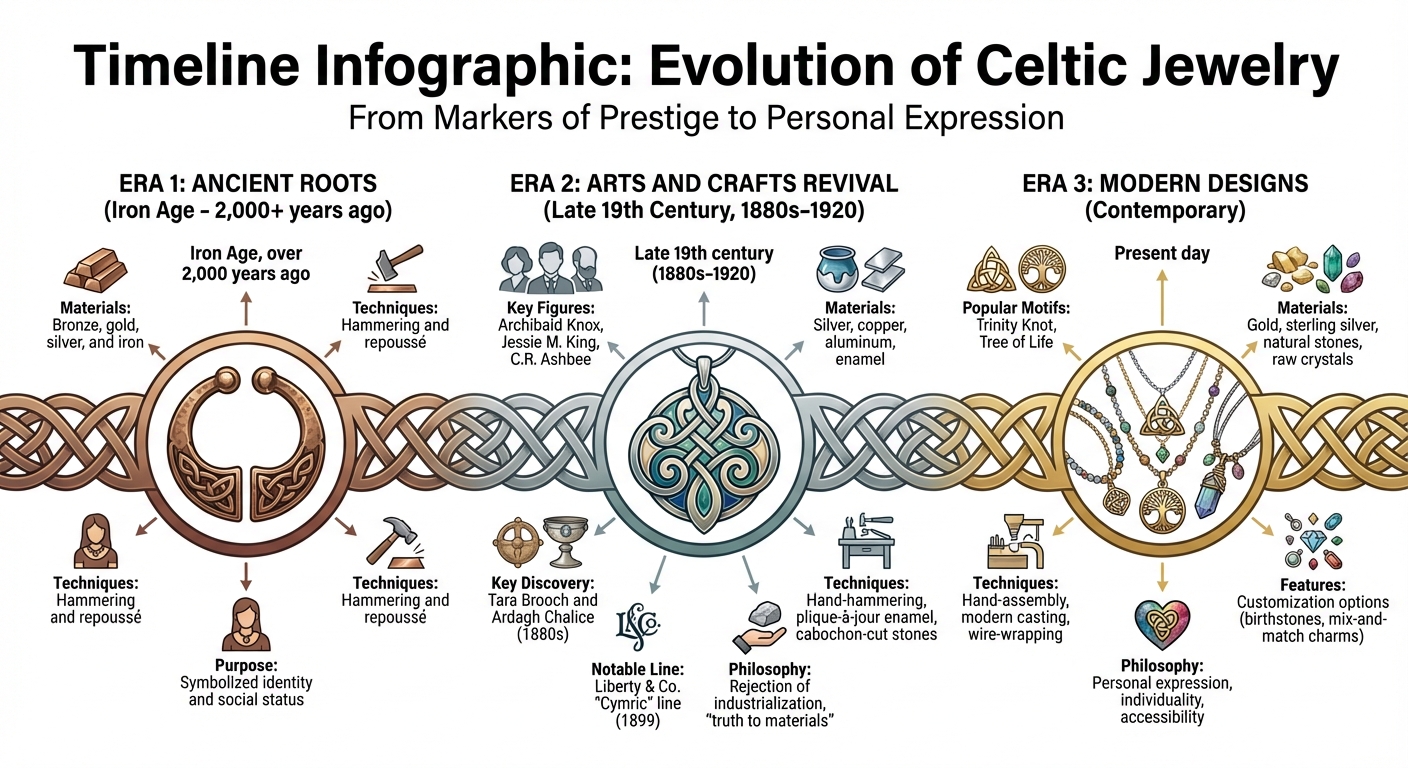
Evolution of Celtic Jewelry: From Ancient Times to Modern Day
Design Motifs and Inspirations
The discovery of the Tara Brooch and Ardagh Chalice in the 1880s sparked a wave of fascination with Celtic design. This newfound interest played a key role in fueling the Celtic Revival within the Arts and Crafts movement, where designers reimagined ancient symbols in fresh, creative ways. Archibald Knox became a leading figure in this transformation, particularly through his work with Liberty & Co. In 1899, the company introduced the "Cymric" line, blending naturalistic themes with intricate Celtic knotwork. The collection was a commercial hit, bringing the beauty of handcrafted designs to a broader audience. This reinterpretation not only preserved Celtic motifs but also set the stage for advancements in how these designs were applied.
Arts and Crafts designers approached Celtic motifs with a sense of restraint and precision, weaving elements like knots, spirals, and interlace patterns into their creations. For example, between 1902 and 1903, Knox designed a silver tea and coffee service for Liberty & Co. that incorporated interlaced designs alongside lapis lazuli cabochons, creating a seamless harmony between form and ornamentation. The Victoria and Albert Museum describes this design philosophy as "non-linear geometric design, inspired by natural forms with symbolism, stylized motifs, or interlacing elements". Other designers, such as Jessie M. King, expanded on this approach by crafting silver and enamel pieces around 1900. Her work merged Celtic-inspired elements with the flowing, organic lines of the Glasgow Style.
The choice of materials was just as deliberate as the designs themselves. Arts and Crafts jewelers steered clear of faceted gemstones, favoring cabochon-cut stones like moonstone, turquoise, and opal to highlight their natural beauty. These were paired with hand-hammered metals such as silver, pewter, and copper. To further enhance the intricate interlace patterns, jewelers often used plique-à-jour enamel in shades of blue and green. This dedication to showcasing the inherent qualities of materials set their work apart from the mass-produced jewelry of the Victorian era. While this traditional craftsmanship defined the movement, modern designers have taken these motifs in new directions.
Today, Celtic symbols are reimagined to align with contemporary fashion trends. Unlike the Arts and Crafts designers, who used these motifs as a quiet rebellion against industrialization, modern brands focus on decorative appeal and personal expression. The emphasis has shifted from structural integration to creating lightweight pieces ideal for layering and everyday wear. Popular motifs like the Trinity Knot, symbolizing the infinite flow of time, and the Tree of Life, representing life's stages, remain central to these designs. This evolution reflects a move away from the social commentary of medieval craftsmanship toward wearable art as a form of individual expression.
LaCkore Couture is a standout example of this modern approach. Their handcrafted collections blend Celtic-inspired designs with contemporary materials such as gold and silver, honoring traditional symbolism while fitting seamlessly into today’s fashion landscape. These pieces capture the individuality and attention to detail championed by the Arts and Crafts movement, making them perfect for modern wearers seeking a connection to the past through timeless yet stylish jewelry.
Craftsmanship Techniques and Materials
The Arts and Crafts Movement celebrated a return to hands-on craftsmanship, deliberately opposing the impersonal nature of factory production. Artisans used techniques like hand-hammering on metals such as silver, copper, and aluminum, creating a soft, organic finish that highlighted the maker's touch. This approach stood out from the sleek, machine-polished aesthetics of the time. Another hallmark was plique-à-jour enamel work, a method that left the enamel without a backing, allowing light to shine through. The result? A stunning stained-glass effect that achieved brilliance without the need for costly gemstones. One standout example of this philosophy in action was C.R. Ashbee's Guild of Handicraft in London's East End. Pieces like his intricate peacock pendant-brooch from around 1900 showcased the artistry and rejection of mass production that defined the movement. These techniques laid the foundation for material choices that made handcrafted jewelry more accessible.
Materials were intentionally chosen for their symbolism and accessibility. Instead of relying on gold, artisans turned to silver, copper, and aluminum, making jewelry more attainable and less associated with exclusivity. Cabochon cuts, which emphasize the natural beauty of stones, were also championed by figures like John Ruskin. Stones such as moonstone, turquoise, and opal became favorites, celebrated for their natural allure. The founding of Morris and Company in 1861 offered a model for this approach. As Charlotte Gere and Geoffrey C. Munn observed:
The founding of Morris and Company in 1861... provided the example which was to inspire a number of other apparently uncommercial ventures, and to remove the monopoly in supplying the public from the mass-manufacturers.
Today, handcrafted jewelry builds on these traditions while embracing modern innovations. Gold and sterling silver now share the stage with traditional metals, and natural stones appear in both raw and faceted forms. While maintaining the Arts and Crafts focus on quality and individuality, modern techniques like precision soldering and updated casting methods have enhanced both durability and design. Brands like LaCkore Couture embody this evolution, blending gold, silver, and natural stones through hand-assembly, staying true to the spirit of craftsmanship while meeting contemporary standards. The table below highlights how these practices have evolved over time:
| Feature | Arts and Crafts Movement (c. 1880–1920) | Modern Craftsmanship |
|---|---|---|
| Primary Metals | Silver, copper, aluminum | Gold, sterling silver, brass |
| Key Techniques | Hand-hammering, plique-à-jour enamel, chasing, repoussé | Hand-assembly, modern casting, wire-wrapping |
| Stone Treatment | Cabochon-cut semi-precious stones (moonstone, turquoise, opal) | Natural stones, raw crystals, faceted gems |
| Surface Finish | Hand-hammered textures | Varied: high-polish, brushed, or intentionally textured |
| Design Philosophy | Rejection of industrialization; "truth to materials" | Wearable art with ethical sourcing and contemporary appeal |
The transition from predominantly silver-based designs to incorporating gold reflects shifting consumer tastes and the growing accessibility of diverse materials. While early artisans worked with softer metals that demanded delicate handling, modern advancements in alloys ensure both beauty and everyday durability. Despite these changes, the core principle remains: showcasing the natural qualities of each material while adapting to modern lifestyles and aesthetics.
Symbolism and Customization
Celtic jewelry during the Arts and Crafts Movement wasn’t just about beauty - it carried deep meaning, reflecting national identity and a connection to nature. Designers like Archibald Knox, who collaborated with Liberty & Co. for more than a decade, brought Celtic lore to life through intricate designs. Knotted plant forms, spirals, triskelions, and interlace patterns were crafted using silver, enamel, and semi-precious stones like moonstone or turquoise. These elements symbolized themes like growth and eternal continuity, blending artistry with storytelling.
The Celtic Revival, a movement that sought to rekindle cultural pride among modern Celts in the British Isles, leaned heavily on these traditional symbols to express nationalism and self-identity. However, during this era, customization was minimal. While customers sometimes selected enamel colors or gemstones, the final designs were largely shaped by the artisan’s creative vision. This approach, rooted in fixed symbolism, laid the groundwork for today’s trend of blending tradition with personal expression.
Over time, this legacy of symbolic design evolved into a more personalized form of storytelling in contemporary jewelry. Today, handcrafted pieces prioritize individuality, allowing wearers to merge ancient Celtic motifs with their own milestones. For instance, an emerald embedded in a Celtic Tree of Life can represent growth and renewal, while a sapphire set within a Shield Knot might serve as a symbol of protection. These combinations transform traditional designs into deeply personal emblems.
LaCkore Couture exemplifies this modern evolution by offering handcrafted jewelry that respects timeless traditions while embracing personalization. With options like charm customization and mix-and-match features, customers can create pieces that reflect their unique style and heritage. As LaCkore Couture explains:
When you wear artisan jewelry, you are not only making a style statement, but also supporting traditional craftsmanship.
This seamless blend of heritage and individuality allows modern jewelry to honor the past while celebrating personal stories, connecting tradition with today’s desire for self-expression.
Pros and Cons
Taking a closer look at the shift from traditional symbolism to more personalized expression, we can weigh the pros and cons of different approaches to Celtic jewelry across eras.
When comparing the Arts and Crafts Celtic Revival to modern Celtic jewelry, the differences in design philosophy and production methods stand out. The historical movement emphasized single-artisan craftsmanship, where one individual handled every step of creating a piece. This resulted in intricate, hand-forged details and authentic textures that machines simply couldn't replicate. However, this rejection of industrial tools came with an unintended consequence. As Lang Antiques explains:
The items thus intended for the masses were only affordable by the elite, aesthetically astute; the experiment which rejected all use of machinery was failing.
This exclusivity persists today. For example, an original Archibald Knox silver-mounted decanter can fetch around $1,250 at auction, making such pieces unattainable for most collectors.
Modern handcrafted Celtic jewelry, on the other hand, has benefited from advancements in technology and the rise of online marketplaces. Global shipping has made these designs more accessible, with options ranging from budget-friendly plated pieces to high-quality sterling silver stamped with .925 hallmarks. Modern artisans often use precision tools to create versatile pieces featuring birthstones, adjustable sizes, and interchangeable charms.
| Aspect | Arts & Crafts Celtic Revival | Modern Handcrafted Celtic Jewelry |
|---|---|---|
| Authenticity | High; verified by designer marks (e.g., Knox) | Variable; depends on hallmarks like .925 or 14k |
| Accessibility | Low; available only via auctions and antique dealers | High; widely available online with global shipping |
| Affordability | Low; collector demand drives prices ($750–$1,250) | High; options for every budget |
| Customization | Minimal; fixed designs with limited stone choices | Extensive; includes birthstones, adjustable sizes, and bespoke designs |
| Craftsmanship | Fully hand-forged by a single artisan | Precision assembly with modern tools |
This contrast highlights the evolution of Celtic jewelry. Historical pieces showcase the unmatched artistry of a single vision, while modern designs prioritize accessibility and personalization. Both approaches celebrate Celtic heritage - one by preserving its artistic roots and the other by inviting more people to connect with it in their own way.
Conclusion
Tracing its journey from meticulous handcrafting to modern artistry, Celtic jewelry has evolved from the exclusive craftsmanship of the Arts and Crafts Movement to the accessible designs we see today. The Celtic Revival laid the groundwork for blending ancient knot-work with the graceful curves of Art Nouveau. Designers like Archibald Knox demonstrated how Celtic motifs could move beyond historical artifacts, blending intricate interlacing patterns with flowing, modern lines to create jewelry that feels both timeless and contemporary.
Modern artisans have taken these traditional techniques and adapted them with updated production methods. This approach has made it possible to extend the reach of classic designs while preserving the hand-finished aesthetic that defines their charm.
LaCkore Couture embodies the enduring values of this movement: quality craftsmanship, natural materials, and individuality. As Charlotte Gere and Geoffrey Munn described the Craft Revival:
to bring the pleasure of original creative activity into the lives of the men and women.
Customization options - like birthstones and mix-and-match charms - reflect the belief that jewelry should hold personal significance rather than merely display wealth. This blending of tradition and innovation keeps the spirit of Celtic jewelry alive, offering not just adornment but meaningful, wearable art.
Perhaps the greatest legacy of the Celtic Revival is its philosophy: that jewelry can be both beautiful and meaningful without relying on precious metals or traditional gemstones. Modern handcrafted pieces honor this tradition by using silver, natural stones, and intricate details to create designs that connect wearers to centuries of Celtic heritage. At the same time, these pieces celebrate personal stories, making each item a unique expression of its owner. In this way, modern Celtic jewelry not only preserves its rich history but also invites wearers to weave their own narratives into every piece.
FAQs
How did the Arts and Crafts Movement shape the evolution of Celtic jewelry design?
The Arts and Crafts Movement of the late 19th century brought a renewed appreciation for handcrafted artistry, pushing back against the rise of mass production. This movement championed the use of high-quality materials, detailed craftsmanship, and designs inspired by nature and historical styles. It redefined jewelry as more than just ornamentation - it became a true form of artistic expression.
Celtic jewelry saw a remarkable resurgence during this era. Designers like Archibald Knox drew from traditional Celtic motifs, incorporating interlacing knots, geometric patterns, and stylized natural forms into their creations. By merging these age-old symbols with the movement's emphasis on craftsmanship, they produced jewelry that celebrated Celtic heritage while embracing contemporary design sensibilities.
Carrying this legacy forward, LaCkore Couture offers handcrafted jewelry inspired by Celtic traditions. Made in the USA, their pieces embody the same commitment to artistry, quality, and individuality, giving wearers a meaningful connection to the timeless beauty of Celtic design.
What are the main symbols found in modern Celtic jewelry designs?
Modern Celtic jewelry showcases symbols steeped in history and meaning, making them both captivating and deeply symbolic. Among the most recognized designs is the triskele (triple spiral), often associated with unity and balance. Another iconic feature is the intricate interwoven knotwork, a representation of eternal connections and continuity. Additionally, spirals frequently appear, symbolizing growth and the cycles of life.
Geometric patterns like zigzags, triangles, and kite shapes also play a role, reflecting the artistic legacy of Celtic craftsmanship. Today, these timeless motifs inspire contemporary artisans, who skillfully merge tradition with modern design to craft jewelry that is both meaningful and stylish.
How have the materials used in Celtic jewelry changed over time?
Celtic jewelry has come a long way since its origins in the Iron Age, where artisans worked with locally sourced metals like bronze, iron, silver, and gold. Using techniques like embossing and repoussé, they crafted intricate designs that often reflected their connection to nature. Materials such as amber, jet, and glass were also added, bringing vibrant colors and symbolic depth to their creations.
Fast forward to the late 19th century, the Arts and Crafts Movement brought a resurgence of interest in Celtic-inspired designs. Jewelers of this era embraced techniques like enameling, which added glossy, colorful finishes, and incorporated cabochon-cut gemstones to highlight nature-inspired patterns. This period introduced a broader range of materials, including richly colored enamel, polished stones, and decorative glass, aligning perfectly with the movement’s emphasis on handcrafted artistry.
Today, brands like LaCkore Couture carry forward this tradition by merging classic Celtic motifs, such as knotwork, with modern elements like sterling silver, 14-karat gold, and natural stones. These contemporary designs strike a balance between honoring Celtic heritage and embracing modern craftsmanship, offering timeless pieces that feel both rooted in history and refreshingly current.