Skip to content




Cultural Color Symbolism in Jewelry
Jewelry colors carry deep meanings that differ across societies. For instance, red symbolizes passion in the West but represents luck in China. White, often tied to purity in American weddings, is associated with mourning in some Asian traditions. Blue stones like sapphires signify calmness and protection, while gold conveys wealth and vitality. Green gems like jade are celebrated for renewal in China but can signify death in South America. Understanding these meanings helps you choose pieces that align with personal milestones or cultural values.
- Red: Passion (West), luck (China), purity (India), love/heartache (Zulu).
- Blue: Serenity, loyalty, protection (Middle East, Hinduism).
- Gold: Wealth (Incas, India), energy, marital commitment.
- Green: Growth (China), death (South America), harmony (Native Americans).
- White: Purity (West), mourning (Asia), spiritual love (Zulu).
Jewelry design reflects history and beliefs, from Indian mangalsutras to Native American turquoise and Chinese jade. Selecting colors thoughtfully transforms jewelry into meaningful expressions of identity and tradition.
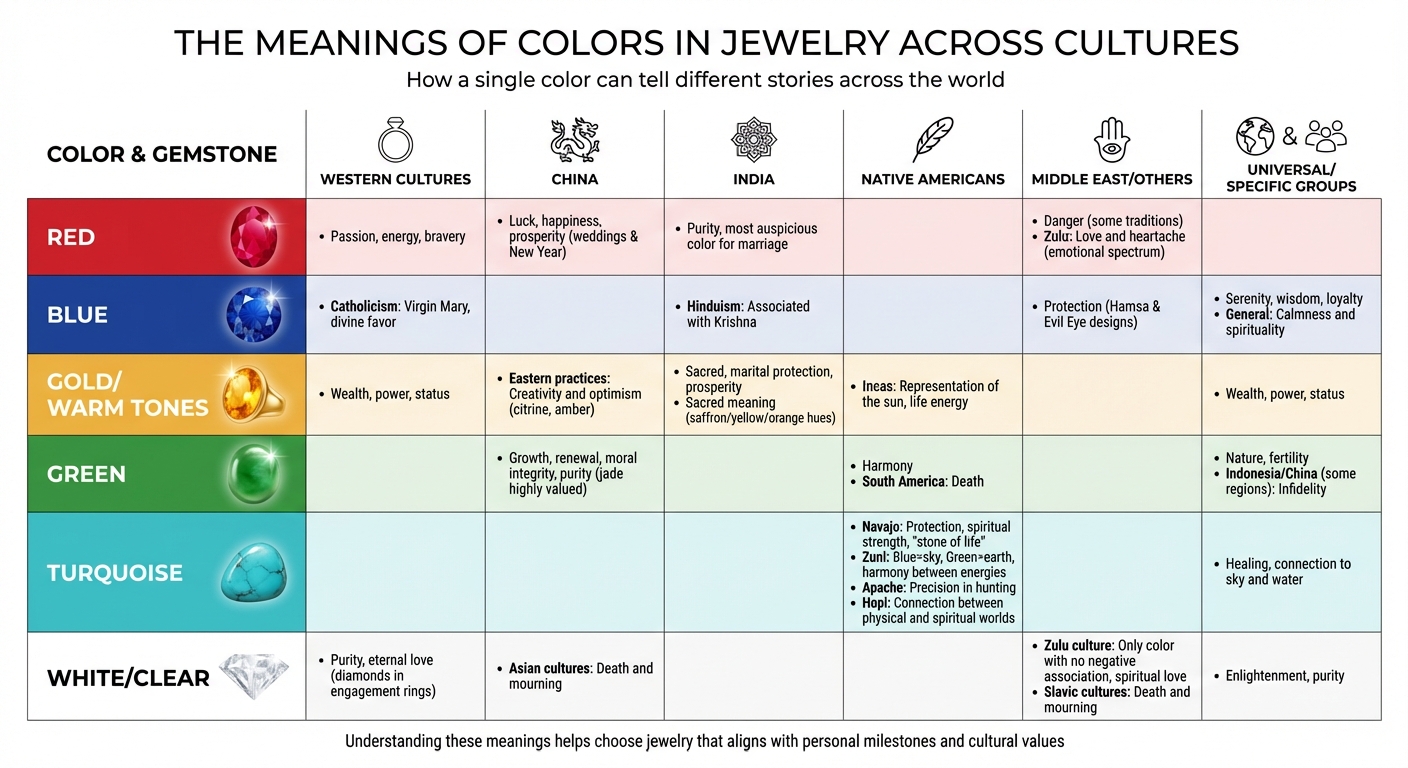
Cultural Color Meanings in Jewelry Across Different Societies
Color Meanings in Jewelry Across Different Societies
Colors in jewelry carry meanings that vary widely across cultures. A single hue can signify joy in one tradition and sorrow in another, making the choice of color both deeply personal and culturally significant. Let’s take a closer look at how different colors hold unique meanings in various societies.
Red: Passion, Courage, and Fortune
Red gemstones like rubies and garnets often symbolize energy, passion, and bravery in many cultures. In China, red dominates weddings and New Year celebrations as a symbol of luck, happiness, and prosperity. For Indian brides, red signifies purity and is considered the most auspicious color for marriage. Among the Zulu people, red reflects life’s emotional spectrum, representing both love and heartache. However, in some Middle Eastern traditions, red can signify danger, and ancient Chinese customs occasionally linked it to mourning. These diverse interpretations highlight red’s multifaceted role in cultural symbolism.
Blue: Calmness, Protection, and Spirituality
Blue gemstones like sapphires, aquamarines, and lapis lazuli are often associated with serenity, wisdom, and loyalty. Lapis lazuli, for instance, has been used for over 6,500 years in jewelry and art. In Middle Eastern traditions, blue is a protective color, frequently featured in Hamsa and Evil Eye designs to ward off negativity. In Catholicism, blue symbolizes the Virgin Mary and divine favor, while in Hinduism, it is closely tied to Krishna. As color psychology expert Angela Wright explains:
"Colors have the ability to profoundly influence human emotions and perceptions, making their choice in areas such as jewelry crucial".
Blue’s widespread cultural significance makes it a powerful choice for both spiritual and emotional expression.
Gold and Warm Tones: Wealth and Vitality
Gold has long been a symbol of wealth, power, and status. For the Incas, gold was seen as a representation of the sun, the ultimate source of life and energy. In Indian traditions, gold is considered sacred and is often used in jewelry like the mangalsutra to signify marital protection and prosperity. Similarly, warm-toned gemstones such as citrine and amber are linked to creativity and optimism, particularly in Eastern spiritual practices. The saffron-like hues of yellow and orange also hold sacred meaning in Indian culture.
Turquoise and Green: Healing and Renewal
Turquoise plays a central role in Native American jewelry, symbolizing healing, protection, and a spiritual bond with the sky and water. Green gemstones like emeralds and jade are often associated with nature, fertility, and growth. In Chinese culture, jade is especially revered, often valued more highly than gold or diamonds, and represents moral integrity, purity, and protection. However, green carries different meanings in other regions; for example, it can symbolize death in South America or infidelity in parts of Indonesia and China.
White and Clear Stones: Purity and Spirituality
Diamonds, pearls, and clear quartz are often seen as symbols of purity and enlightenment. In Western traditions, diamonds represent eternal love, especially in engagement rings. While white is embraced in Western weddings as the color of purity, in many Asian and Slavic cultures, it is traditionally associated with death and mourning. Interestingly, in Zulu culture, white is the only color that lacks a negative association. These varying interpretations illustrate how colors like white can carry vastly different meanings depending on cultural context, turning jewelry into a canvas for storytelling.
How Different Societies Use Color in Jewelry Design
Color in jewelry is far more than just decoration - it’s a reflection of culture, history, and belief systems. Across the world, jewelers use color to tell stories, express heritage, and symbolize deeply held values. Through intricate combinations of metals and gemstones, traditions are preserved and artistry evolves.
Indian Jewelry: A Kaleidoscope of Heritage
Indian jewelry is renowned for its vibrant and colorful designs, achieved through the generous use of pearls and an array of precious and semiprecious stones. These bold colors are steeped in religious and spiritual meaning, with many designs tied to Hindu beliefs.
One ancient example is the Nauratan (or Navaratna), a gold amulet featuring nine different gemstones, each chosen for its spiritual significance. These stones are often arranged to correspond with the body's energy centers. For instance, the maang tikka, a forehead ornament adorned with gems or pearls, is placed on the agya chakra (third eye) to balance energy and provide protection.
"The great variety of types of jewelry depicted and the dominance of polychromy indicate the high degree of development attained by the art of jewelry making." – Britannica Editors
Color also plays a vital role in ceremonial jewelry. The mangalsutra, a necklace featuring black beads and gold, represents not just marital commitment but also protective symbolism. Gold bangles, seen as auspicious, often signify family heritage, while glass bangles in vibrant colors are traditionally worn during weddings to symbolize prosperity. During the Mughal period, jewelry designs became even more intricate, with floral motifs and contrasting hues created using rubies, emeralds, pearls, and enamel.
The tradition of wearing multiple bangles dates back to the Indus Valley civilization, around 2300–1750 BCE. Today, Indian jewelry continues to blend traditional motifs, like peacocks and elephants, with modern styles, maintaining its connection to heritage while embracing contemporary aesthetics. This rich use of color sets a foundation for exploring how other cultures incorporate symbolism into their jewelry.
Native American Jewelry: The Spirit of Turquoise
In Native American traditions, turquoise holds a sacred status as the "stone of life," representing the connection between heaven and earth. For many tribes, particularly the Navajo, turquoise is seen as a living stone whose changing hues reflect its dynamic spirit.
Silver is a key element in Native American jewelry, not just for its beauty but for its role in enhancing the energy of gemstones. Navajo artisans, for example, use silver settings to protect and amplify the spiritual power of turquoise. This pairing creates jewelry that is both visually stunning and deeply meaningful.
Different tribes have their own interpretations of turquoise. For the Navajo, it serves as a talisman for protection and victory in battle. The Zuni associate blue turquoise with the sky and green turquoise with the earth, symbolizing harmony between male and female energies. The Apache use turquoise for precision in hunting, often attaching it to bows. Meanwhile, the Hopi link turquoise to the lizard, a creature believed to traverse the realms of "the above" and "the below", offering strength and security.
| Tribe | Primary Technique | Symbolic Focus |
|---|---|---|
| Navajo | Repoussé & Engraving | Protection, spiritual strength, connection to nature |
| Zuni | Intricate Inlay Work | Harmony, balance, and storytelling |
| Hopi | Silver Overlay | Balance between physical and spiritual worlds |
When turquoise is combined with materials like coral or spiny oyster shell, the warm reds and oranges represent the earth, creating a balance with the cool blues and greens of the sky. This harmony is also reflected in ceremonial practices, such as the use of turquoise in sand paintings to attract spiritual power or in drought rituals to summon rain by dipping the stone into water.
Just as Native American jewelry merges nature and spirituality, Chinese designs bring together ancient symbols and refined artistry.
Chinese Jewelry: Jade and Red as Symbols of Fortune
In Chinese culture, jade is more than a gemstone - it’s a symbol of purity, resilience, and moral virtues. The Chinese word for jade (yu) encompasses five key values: kindness (lustre), rectitude (transparency), wisdom (tranquil tone), bravery (durability), and purity (sharp edges not used for harm). Jade has been a cornerstone of Chinese decorative arts since the Neolithic period, around 3000–2000 BCE.
"Jade-mounted gold jewelry has a long history in Chinese culture, where gold represents splendor and jade symbolizes elegance. Chinese people use the relationship between gold and jade to symbolize a happy marriage." – Andrew Lucas et al., Gems & Gemology
The pairing of gold and jade is a hallmark of Chinese jewelry, often enhanced with red stones like rubies or coral. This combination symbolizes prosperity, happiness, and high social status. Traditional motifs such as dragons (strength and power) and phoenixes (grace and renewal) are frequently carved into jade or accented with red to represent harmony between masculine and feminine energies.
A particular variety of jade, feicui (meaning "kingfisher feathers") - a brilliant green jadeite - became highly prized in the 18th century. Due to its hardness, jade cannot be carved with metal tools, requiring meticulous grinding with abrasive pastes, a labor-intensive process that adds to its value.
Jade also plays a protective role in Chinese culture. In ancient burials, jade was used to seal the body’s orifices, safeguarding the deceased in the afterlife. More recently, jade saw a resurgence in popularity after being featured in the 2008 Olympics, where medals incorporated jade alongside gold, sparking a renewed interest in this timeless material.
How to Choose Jewelry Based on Color Symbolism
Choosing jewelry with an eye for color symbolism can turn a simple accessory into something deeply personal. Whether you're picking out a piece for yourself or searching for a meaningful gift, understanding the meanings behind colors can help you make thoughtful decisions that resonate on a deeper level.
Understanding the Meaning of Colors
Before buying jewelry, it’s helpful to explore the symbolic meanings tied to different colors. Some colors, like blue, retain their essence across various shades, while others shift significantly - yellow can darken into black, red may deepen into brown, and lighter reds often appear pink rather than staying red.
Think about how the colors align with your intentions. For example, red gemstones like rubies or garnets are often associated with passion and energy, while blue stones such as sapphires or lapis lazuli are linked to calmness and clear communication. In spiritual practices, certain colors are also tied to chakras - green represents the heart chakra and compassion, while blue corresponds to the throat chakra and communication. Choosing jewelry with these connections in mind can support personal growth and mindfulness.
Combining Symbolism with Modern Design
The traditional meanings of colors can easily blend with today’s jewelry styles. Modern designs often feature multi-tone combinations - mixing gold, silver, and rose gold - allowing you to layer symbolic meanings while staying on-trend. A great example is the Russian wedding ring, which uses three interlocking bands to represent the past, present, and future, merging ancient symbolism with timeless elegance.
Your skin’s undertone can also guide your metal choice. To determine your undertone, check the veins on your wrist under natural light: green or yellow veins suggest warm undertones that pair well with gold and copper, while blue or purple veins indicate cool undertones that look great with silver and platinum.
Layering and stacking jewelry is another way to express yourself. Combining pieces with different symbolic colors - such as stacking rose gold rings for feminine energy with silver ones for calm and balance - can create a meaningful narrative. Handcrafted jewelry from artisan makers adds an extra layer of authenticity, reflecting the traditions and creativity of the craftsperson. Brands like LaCkore Couture, known for their natural stones and customizable designs, make it easy to combine symbolism with modern aesthetics while supporting American craftsmanship.
These thoughtful design approaches naturally lend themselves to selecting jewelry gifts with meaning.
Picking Jewelry Gifts with Purpose
When choosing jewelry as a gift, understanding the occasion and the recipient’s background can make your selection more meaningful. For engagements and weddings, diamonds remain a timeless choice - representing eternal love and accounting for roughly 80% of gemstone sales revenue. Sapphires, symbolizing loyalty and wisdom, also carry special significance for commitment ceremonies.
Consider matching gemstones to life milestones. Pearls, for instance, are often gifted during coming-of-age celebrations, symbolizing purity and elegance. Emeralds are a fitting choice for 25th or 35th wedding anniversaries, while turquoise is thought to bring protection and healing. Researching the recipient’s heritage can also ensure your choice aligns with their cultural traditions.
When it comes to metals, gold is often associated with the sun and abundance, while silver is linked to the moon and fertility. For gifts that symbolize transformation or protection, look for designs featuring motifs like the Hamsa hand or Evil Eye, which blend meaningful symbolism with contemporary style.
Conclusion
Jewelry is so much more than just decorative - it’s a vibrant thread weaving together centuries of tradition, belief, and identity. As jewelry historian Dr. Sigrid van Roode puts it, "By paying attention to the colors in traditional jewellery, we glimpse how people in the region used adornment as a language of meaning, belief, and identity". Each piece tells a story, and its colors are the words that carry deep cultural significance.
Choosing jewelry with symbolic colors is a way to connect with traditions that span generations and continents. Whether it’s the protective blue of an Evil Eye charm, the prosperity-associated green of jade, or the passionate energy of red gemstones, every shade holds a unique meaning and intention. These aren’t just accessories - they’re storytellers.
Handcrafted jewelry takes this connection a step further, offering a tangible link to the artisans and cultures behind each piece. As Duncan Pay, Editor-in-Chief of Gems & Gemology, observes, "Each [piece of gemstone] says something about the skill of the artisans and the values of the societies that produced them". These creations reflect both the artistry and the cultural values of their origins. Collections like LaCkore Couture blend this rich heritage with modern design, giving you the chance to wear pieces that honor both past and present.
So, the next time you pick out a piece of jewelry, think about the story its colors tell. Let it reflect your personal values while celebrating the traditions and meanings that have shaped it. This thoughtful approach transforms jewelry into something far more meaningful - a celebration of global heritage and personal connection.
FAQs
How do different cultures influence the meaning of colors in jewelry?
Cultural differences significantly influence how colors are perceived and used in jewelry, with each culture assigning distinct meanings rooted in its traditions, beliefs, and historical context. Take red, for instance - while it often signifies passion, energy, or good fortune in many cultures, in others, it can represent danger or conflict. In ancient Rome, purple was a symbol of power and wealth, worn exclusively by the elite due to the rarity and high cost of the dye required to produce it.
In Chinese culture, color symbolism is deeply intertwined with natural elements and spiritual concepts. Red is associated with fire and good luck, yellow represents earth and royalty, and white is connected to metal and purity. These interpretations demonstrate how cultural heritage and the surrounding environment influence the meaning of colors in jewelry, turning each piece into a meaningful reflection of its cultural origins.
What are some examples of jewelry that combine different color meanings?
Jewelry frequently incorporates a variety of colors, each chosen to express specific meanings or reflect cultural traditions. Take jade, for example - it's deeply cherished in Chinese culture. Its green shades are often seen as symbols of purity, wisdom, and protection. On the other hand, red gemstones like rubies or garnets are tied to ideas of passion, love, and strength, though these associations might shift depending on the cultural lens.
Some jewelry designs take it a step further by blending colors to create even richer symbolism. Imagine a piece that pairs blue with gold - it could signify a balance of tranquility and wisdom alongside prosperity and success. These carefully chosen color combinations give jewelry the power to convey personal, spiritual, or cultural narratives, turning each piece into something truly special.
How can I choose jewelry that reflects my personal or cultural values?
Choosing jewelry that resonates with your personal or cultural values starts with understanding the symbolism behind colors, materials, and designs. Across many traditions, colors carry profound meanings - red might represent passion or protection, while white often signifies purity or spirituality. Materials and symbols also play a role; for instance, jade is deeply valued in Chinese culture for its connection to health and harmony.
To make your jewelry feel more meaningful, look for pieces that include elements tied to your beliefs or heritage. Customizable options, like selecting specific gemstones, metals, or motifs, allow you to craft something deeply personal. By appreciating the cultural and symbolic layers of jewelry, you can select pieces that not only elevate your style but also reflect your values and honor your traditions.