Skip to content




Checklist for Buying Ethical Gemstones
When purchasing gemstones, ensuring they are ethically sourced is critical for supporting fair labor practices and reducing harm to the planet. Here's how you can make informed decisions:
- Traceability: Always ask for documentation tracing the gemstone's journey, from the mine to the market. Sellers should provide specific details about the mine and region of origin. Avoid vague answers like "somewhere in Africa."
- Labor Practices: Confirm that miners and cutters are paid fairly and work in safe conditions. Look for initiatives like Moyo Gems or certifications like the Responsible Jewellery Council (RJC), which uphold labor standards.
- Environmental Impact: Inquire about mining methods and land reclamation efforts. Responsible operations minimize damage and restore ecosystems after mining.
- Certifications: Seek third-party certifications such as the Kimberley Process for diamonds or RJC standards for broader ethical compliance.
- Natural vs. Lab-Created: Decide based on your priorities. Natural stones often have complex supply chains, while lab-created ones avoid mining but may raise energy-use concerns.
Key Tip: Always ask for written proof of origin, labor conditions, and environmental practices. Ethical claims without documentation are a red flag.
Check Traceability and Origin Documentation
Start your checklist by verifying the gemstone's traceability and documented origin. Without clear origin documentation, there's no way to confirm that a gemstone has been ethically sourced. Gemstones often pass through 10–15 intermediaries - from miners to importers - making detailed records critical for ensuring ethical practices.
Courtney MacDougall of Gem Breakfast explains:
"If a seller can't tell you where a gemstone came from or how it was sourced, it isn't truly ethical - no matter how it's marketed."
Having detailed mine-to-market documentation is key. This type of record provides a transparent path from the specific mine, through the cutting process, all the way to the final buyer.
Request Mine-to-Market Information
Ask your seller for documentation that traces the gemstone's journey. For rough diamonds, request a mining invoice that includes the invoice number, lot number, weight, quantity, and country of origin. If the diamond is being imported, a Kimberley Process certificate is also essential.
For high-end stones, ask for a lab origin report - such as one from GIA - that confirms the stone's journey from its rough state to its polished form. Avoid vague responses like "somewhere in Africa" or "Asia." Instead, push for specifics about the exact mine or region where the stone originated. Programs like Moyo Gems in Tanzania and Earth's Treasury in Montana, USA, demonstrate that tracking gemstones to within a small area - sometimes as precise as 5-to-10 acres - is entirely possible. Keep detailed records to ensure every step in the gemstone's journey is fully documented.
Look for Transparency from Sellers
Beyond traceable documentation, ensure that sellers provide clear, written proof of a gemstone's origin and processing. Reputable sellers won't hesitate to share this information. You should receive written documentation or an information card - often stamped on the invoice - that specifies the stone's origin, any treatments it has undergone, and whether it is natural or lab-created . If a seller is willing to provide details verbally but refuses to put them in writing, consider it a serious red flag. Written documentation is the foundation of any ethical gemstone purchase.
Be cautious when dealing with sellers who can't identify the person or entity responsible for cutting the stone. Traceability doesn't stop at mining; it also includes the cutting process. Missing information here indicates a gap in the supply chain. Additionally, watch out for vague claims about "sustainability." Gemstones are non-renewable resources, so terms like "sustainable" can often be misleading or used for greenwashing. Similarly, the term "conflict-free" only means that a stone hasn't funded wars - it says nothing about worker conditions or environmental impact . Always ask for specifics, not buzzwords, to ensure you're making an informed and ethical purchase.
Confirm Fair Labor Practices
Once you've confirmed traceability, the next step is ensuring ethical labor practices. Workers deserve fair wages and safe working conditions, but these aren't always guaranteed. A "conflict-free" label only means the stone didn't fund wars - it doesn't address whether miners received fair pay or worked in safe environments. Ethical sourcing goes beyond this, ensuring workers across the entire supply chain - from mining to cutting - are treated with respect, paid fairly, and provided safe conditions.
Ask About Worker Conditions
Ask questions like: "Are miners and cutters paid fairly and treated with respect? Can you trace this stone back to a specific mine?" If the seller hesitates or can't provide clear answers, that's a warning sign. Ethical sellers should be able to share specifics about the stone's origin and the people involved in its production.
Some programs actively improve workers' lives. For example, Moyo Gems, an initiative in Tanzania and Kenya, collaborates with the Tanzania Association of Women Miners (TAWOMA). This program ensures female artisanal miners receive fair market value for their gems, reportedly paying them 3 to 10 times more than they'd earn otherwise. Similarly, Anza Gems sources gemstones from East Africa and reinvests 10% of sales into local mining communities. They offer training in skills like gem-cutting and grading, helping artisans earn higher wages.
These examples highlight the importance of transparency and measurable impact when evaluating worker conditions.
Review Supply Chain Labor Standards
The gemstone supply chain often spans multiple countries, with stones mined in one location and cut or polished in another - each with varying labor standards. To ensure fairness, ask: "Who cut this stone? Were they paid fairly and provided safe working conditions?"
Third-party certifications can offer additional peace of mind. The Responsible Jewellery Council (RJC), for instance, has a Code of Practices with 45 provisions that uphold human rights and international labor standards throughout the supply chain. RJC-certified sellers undergo independent audits to confirm compliance. A notable example is Columbia Gem House, which has followed its "Fair Trade Gems Protocols" since 1976, ensuring ethical practices and full traceability from mine to market.
Here’s a quick comparison of verification methods:
| Verification Method | What It Confirms | Limitations |
|---|---|---|
| Kimberley Process | Ensures the stone didn’t fund conflict | Doesn’t address fair wages or labor rights |
| Mine-to-Market | Tracks the stone from mine to retail | Often comes with higher labor costs |
| RJC Certification | Adherence to 45 ethical labor standards | Requires voluntary membership and audits |
| Blockchain | Transparent transaction records | Only as reliable as the data entered at the source |
These tools and certifications help verify ethical practices, but it's always important to ask questions and seek clear answers from sellers.
Review Environmental Responsibility
When considering ethical gemstone sourcing, it’s not just about fair labor practices - nature matters too. Mining inevitably impacts the environment, but the goal is to ensure these effects are minimized. Responsible mining operations focus on reducing damage and actively work to restore ecosystems once extraction is complete. Compared to metal mining, gemstone mining tends to have a lighter environmental footprint, as it avoids the use of harsh chemicals often required for refining metals.
Ask About Mining Practices
It’s important to ask questions like: "What mining methods were used, and were any harsh chemicals involved?" Most gemstones are cleaned with just water or a mild, biodegradable acid like oxalic acid, which is far gentler than the chemicals used in metal mining. Many sustainable operations also rely on manual tools, such as shovels and chisels, instead of using dynamite, which can cause significant landscape damage.
"The chemical impacts that come from mining are less likely in gemstone mining."
- Estelle Levin-Nally, Founder and CEO, Levin Sources
Additionally, inquire whether the mining operation complies with environmental standards, such as those established by the Responsible Jewellery Council (RJC). The RJC requires its members to report greenhouse gas emissions and take measures to protect biodiversity. These practices are an essential part of ethical gemstone sourcing, just like fair labor standards.
Check for Land Reclamation Efforts
Land reclamation is critical to restoring ecosystems after mining activities. In countries like the U.S., Canada, and Australia, reclamation is often required by law. The RJC's 2024 Code of Practices emphasizes this with its "Rehabilitation & Closure" provision (COP 43), ensuring that mines do not leave permanent scars on the environment.
Ask sellers: "Is the mine legally required to reclaim the land? Can you provide documentation of restoration plans?" Be cautious of vague or incomplete answers. Favor gemstones sourced from regions with strict environmental regulations, such as Montana sapphires from the U.S., where dealers like Earth's Treasury follow rigorous reclamation standards. Transparent sellers should be able to confirm that the mine has a plan to restore vegetation, protect waterways, and return the land to its natural state after mining.
Look for Third-Party Certifications
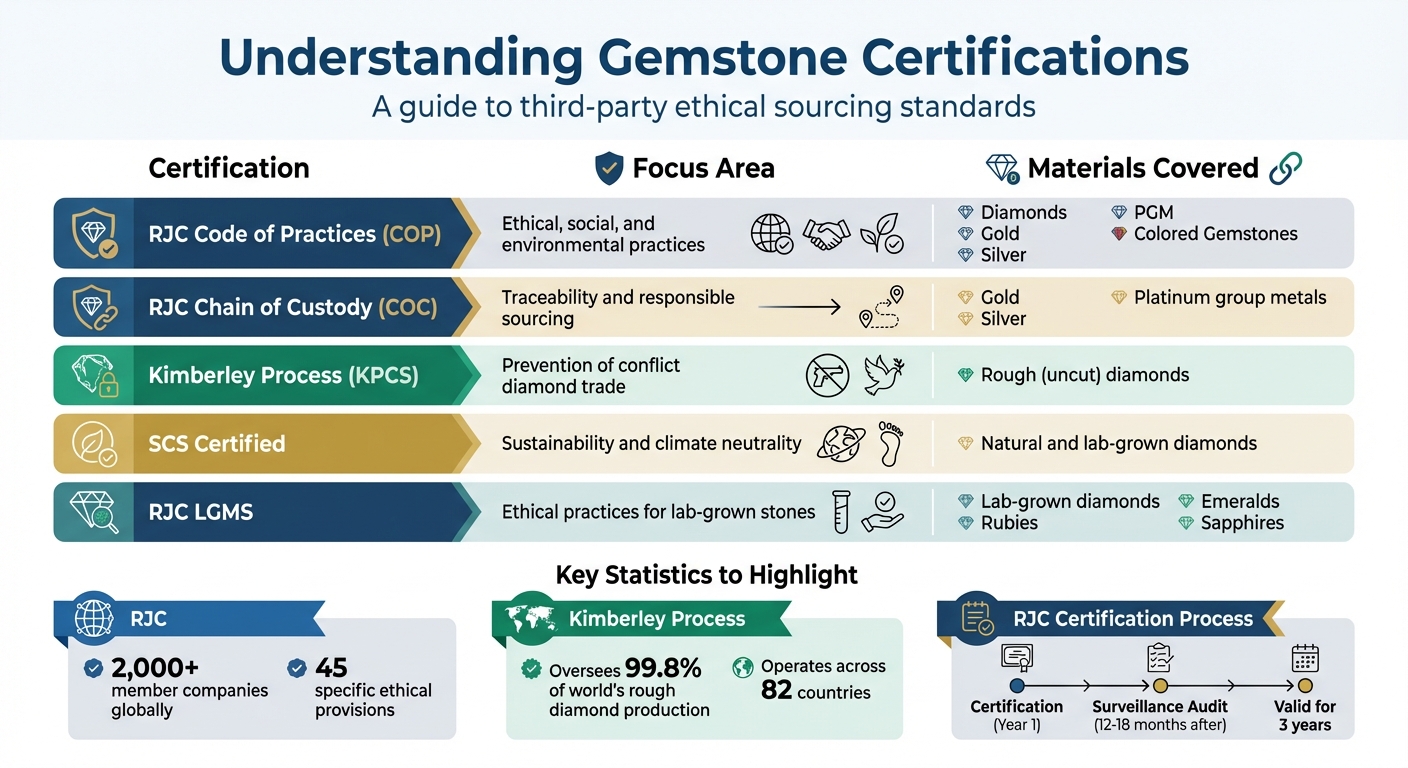
Gemstone Certification Comparison: RJC, Kimberley Process, and SCS Standards
After considering traceability and fair labor practices, third-party certifications offer extra confidence when it comes to ethical sourcing. These certifications act as visual proof that a seller has successfully passed independent audits. These audits cover a wide range of areas, from human rights to environmental standards. The Responsible Jewellery Council (RJC) stands out as a leading name in this space, bringing together more than 2,000 companies from across the global supply chain. Members are required to comply with 45 specific provisions related to ethics, labor conditions, and environmental safeguards. Other key certifications include the Kimberley Process Certification Scheme (KPCS), which prevents conflict diamonds from entering the market and oversees 99.8% of the world’s rough diamond production across 82 countries, and SCS Global Services, which certifies diamonds based on five pillars, including climate neutrality and origin traceability.
Know the Trusted Certifications
It’s important to note that certifications vary in their focus areas. For instance, the RJC Code of Practices (COP) addresses responsible business practices, including human rights, worker safety, and environmental impact. Meanwhile, the RJC Chain of Custody (COC) ensures the traceability of gold, silver, and platinum from the mine to retail. If you’re considering lab-grown stones, the RJC Laboratory Grown Material Standard (LGMS) - effective starting May 1, 2025 - covers lab-created diamonds, rubies, emeralds, and sapphires. Other notable certifications include the GIA Diamond Origin Program, which tracks diamonds from rough to polished, and Fairtrade Gold, which supports fair wages and community development for artisanal miners.
| Certification | Focus Area | Materials Covered |
|---|---|---|
| RJC Code of Practices (COP) | Ethical, social, and environmental practices | Diamonds, gold, silver, PGM, colored gemstones |
| RJC Chain of Custody (COC) | Traceability and responsible sourcing | Gold, silver, platinum group metals |
| Kimberley Process (KPCS) | Prevention of conflict diamond trade | Rough (uncut) diamonds |
| SCS Certified | Sustainability and climate neutrality | Natural and lab-grown diamonds |
| RJC LGMS | Ethical practices for lab-grown stones | Lab-grown diamonds, rubies, emeralds, sapphires |
Understand What Certifications Mean
Certifications ensure accountability through independent audits. For instance, obtaining RJC certification involves several steps: a self-assessment, an independent audit by an approved firm, and a follow-up surveillance visit 12–18 months later to confirm ongoing compliance. These certifications are generally valid for three years, though significant issues can shorten this period to just one year. Starting January 1, 2026, all new RJC certifications will need to meet updated 2024 standards, which include stricter guidelines like reporting greenhouse gas emissions and implementing stronger diversity measures.
"The COP defines the requirements for establishing responsible business practices throughout the jewellery supply chain, from mine to retail."
- Responsible Jewellery Council
To verify certifications, you can use official directories. For example, the RJC provides a public "Find a Member" tool on their website, allowing you to confirm a seller's certification status and check which facilities are covered. Always request written documentation that includes unique certificate numbers for online verification. If a seller claims something specific, such as offering "ethically sourced Montana sapphires", they should provide proof of an additional "bolt-on" audit under RJC COP 14 to confirm those claims. Avoid purchasing from any seller who cannot provide written proof.
Consider Gemstone-Specific Factors
Every gemstone comes with its own set of ethical considerations. For instance, natural stones often raise concerns about mining practices. Around 70% of colored gemstones are sourced from small-scale artisanal mines, which, when responsibly managed, can provide significant economic benefits to local communities. On the other hand, lab-created gemstones sidestep many of the human rights challenges tied to mining and typically have more straightforward, transparent supply chains. However, they aren’t inherently free from ethical issues - some production facilities may release harmful chemicals or rely on energy-intensive processes powered by non-renewable resources.
When evaluating lab-grown stones, it’s important to assess their energy consumption and labor practices. Meanwhile, natural gemstones often pass through multiple intermediaries, making it difficult to trace their origins unless they are sold directly from "mine-to-market" sources. To make an informed choice, it’s helpful to weigh the pros and cons of natural versus lab-created stones and ensure the gemstone’s durability aligns with its intended use.
Compare Natural vs. Lab-Created Stones
Ethical sourcing also requires an understanding of a gemstone's physical properties. For example, only 2% of mined diamonds are classified as Type IIa, a distinction that lab-grown diamonds consistently achieve. Lab-grown diamonds are generally more affordable but might have a lower resale value compared to their natural counterparts. When considering lab-created options, ask about the production facility's energy sources - does it use renewable energy? - and whether fair labor standards are upheld. Additionally, request a grading report to confirm the stone's lab-grown origin and note any treatments it has undergone.
Match Durability to Purpose
Durability is another critical factor, especially when choosing gemstones for specific types of jewelry. For items like engagement rings that are worn daily, opt for stones with a Mohs hardness of 7 or higher. Diamonds (10), sapphires (9), and rubies (9) are excellent choices for such purposes. Softer gemstones, such as opals, pearls, and emeralds, are better suited for pieces that experience less wear, like necklaces or earrings.
| Gemstone | Mohs Hardness | Recommended Use |
|---|---|---|
| Diamond | 10 | Daily wear (rings, bracelets) |
| Sapphire / Ruby | 9 | Daily wear |
| Topaz / Spinel | 8 | Daily wear |
| Emerald / Aquamarine | 7.5–8 | Careful daily wear / earrings |
| Amethyst / Citrine | 7 | Occasional wear / earrings |
| Tanzanite | 6–7 | Occasional wear / necklaces |
| Opal | 5.5–6.5 | Occasional wear / protected settings |
| Pearl | 2.5–4.5 | Occasional wear / necklaces |
Ask for Supply Chain Information
When it comes to buying ethical gemstones, transparency is non-negotiable. A trustworthy seller should be able to provide a clear and detailed account of a gemstone's journey - from the mine where it was sourced, to the hands that cut it, and every step in between. Insisting on mine-to-market documentation not only ensures traceability but also helps verify fair labor practices and responsible environmental efforts throughout the supply chain.
Ask Specific Sourcing Questions
To ensure ethical sourcing, ask your seller for mine-to-market documentation. Here are some key questions you can use:
- Can this stone be traced to a specific mine?
- Where was the gemstone mined, and who cut it?
- Are the miners and cutters paid fairly and working in safe conditions?
- Does the mine use environmentally responsible practices, such as land reclamation?
One often-overlooked aspect is the cutting process. While sellers may emphasize the mining stage, they sometimes neglect to address the working conditions of the lapidaries who shape the stones. Ask for written certificates or audits that confirm the gemstone’s traceable journey and ethical sourcing. Programs like Moyo Gems in Kenya and Tanzania demonstrate how full traceability can work in practice, with miners reportedly earning three to ten times the typical market rate.
Avoid Sellers with Vague Answers
If a retailer struggles to provide clear, detailed information about a gemstone's origin, it's a red flag. Ethical claims without evidence should always be questioned. Watch out for these warning signs:
- Lack of specific origin details
- Ethical claims that aren't backed by documentation
- Generalized or unsupported claims about sustainability
"Knowing the origin of a gemstone is essential to verify its ethical sourcing. Without this information, ethical sourcing claims are unfounded."
– Lauréline Colliard FGA, Gem Gazette
Reputable sellers understand how crucial transparency is and will gladly answer your questions. If they can’t, it might be time to take your business elsewhere.
At LaCkore Couture, we require full traceability and detailed sourcing information from all our partners. This ensures that every gemstone in our handcrafted collection upholds the highest ethical standards.
Conclusion
This checklist gives you the tools to push for higher standards across the jewelry industry. Choosing ethical gemstones isn’t just about buying a product - it’s about supporting fair practices and safeguarding the planet. When you prioritize traceability, fair labor practices, and responsible environmental efforts, your purchase sends a clear message: ethical standards matter. Without transparency, however, claims of ethical sourcing lose their weight.
Ethical sourcing programs can have a meaningful impact on mining communities. By asking the right questions and requiring proper documentation, you play a role in improving lives around the world.
"The more questions we ask, the more the industry will see that shoppers care about ethical gemstones, and they will make ethical sourcing a priority."
– Courtney MacDougall, Gem Breakfast
It’s important to remember that conflict-free doesn’t mean ethical. A gemstone may not contribute to war, yet it could still involve exploitative labor or environmental damage. That’s why going beyond surface-level certifications is crucial - dig deeper into working conditions, wages, and land restoration practices.
Every checklist item, from ensuring traceability to supporting fair labor, helps create a full picture of what ethical sourcing really means. At LaCkore Couture, we believe every piece of jewelry should carry a story you can be proud of. Use this checklist, ask the tough questions, and demand transparency to help shape a more responsible future for jewelry.
FAQs
How can I confirm that a gemstone is ethically sourced if the seller provides limited information about its origin?
When buying a gemstone, it's important to verify that it was sourced responsibly. Start by asking the seller for detailed documentation about where the gemstone came from. Certifications like the GIA Identification & Origin Report can be especially helpful. These reports use scientific methods to confirm the mining location and shed light on the supply chain, offering greater transparency. If the seller can't provide this information, it might be worth rethinking the purchase to ensure it aligns with your ethical standards.
What certifications guarantee that a gemstone is ethically sourced?
When shopping for ethically sourced gemstones, look for certifications from the Responsible Jewelry Council (RJC). Key certifications to check include the RJC Member Certification, the RJC Code of Practices, and the RJC Chain-of-Custody Certification. These ensure the gemstone aligns with strict standards regarding fair labor practices, respect for human rights, and responsible environmental practices.
Opting for gemstones with these certifications helps ensure your purchase contributes to ethical and responsible sourcing efforts.
Why is it important to know where a gemstone comes from when buying ethically?
Understanding where a gemstone comes from is key to ensuring it was sourced responsibly. Traceability allows you to verify that the mining and cutting processes adhered to fair labor standards and respected environmental guidelines. By knowing the origin of your gemstone, you can make choices that promote ethical practices and support industries striving for sustainability.