Skip to content




Chakra Stones in Jewelry: Types and Meanings
I’d choose chakra jewelry by meaning, fit, and daily wear - not color alone. Start with one intention, such as rose quartz for compassion, then pick a piece that feels comfortable and keeps the stone secure.
The 7-chakra system offers common stone and color pairings, but these vary. I treat them as symbols for reflection, not medical treatment.
Quick Comparison
| Jewelry type | Placement and meaning | Fit and style | Main care concern |
|---|---|---|---|
| Rings | One stone on a finger; an easy-to-see reminder | Snug fit; worn alone or stacked | Hand contact can damage stones or settings |
| Bracelets | One intention or a seven-stone sequence at the wrist | Room to move; worn alone or layered | Beads rub; cords and clasps wear |
| Necklaces | A pendant near the throat or chest | Length and weight affect comfort and neckline pairing | Chains snag; heavy pendants pull or swing |
| Charms | Swappable stones on a bracelet or necklace | Small accents; base must support their weight | Connectors must fit and close securely |
Before buying, I check <u>stone treatments, water sensitivity, and attachment security</u>. A stone’s meaning can guide my choice, but comfort and care determine whether I’ll want to wear it often.
Chakra Stones and Their Meanings
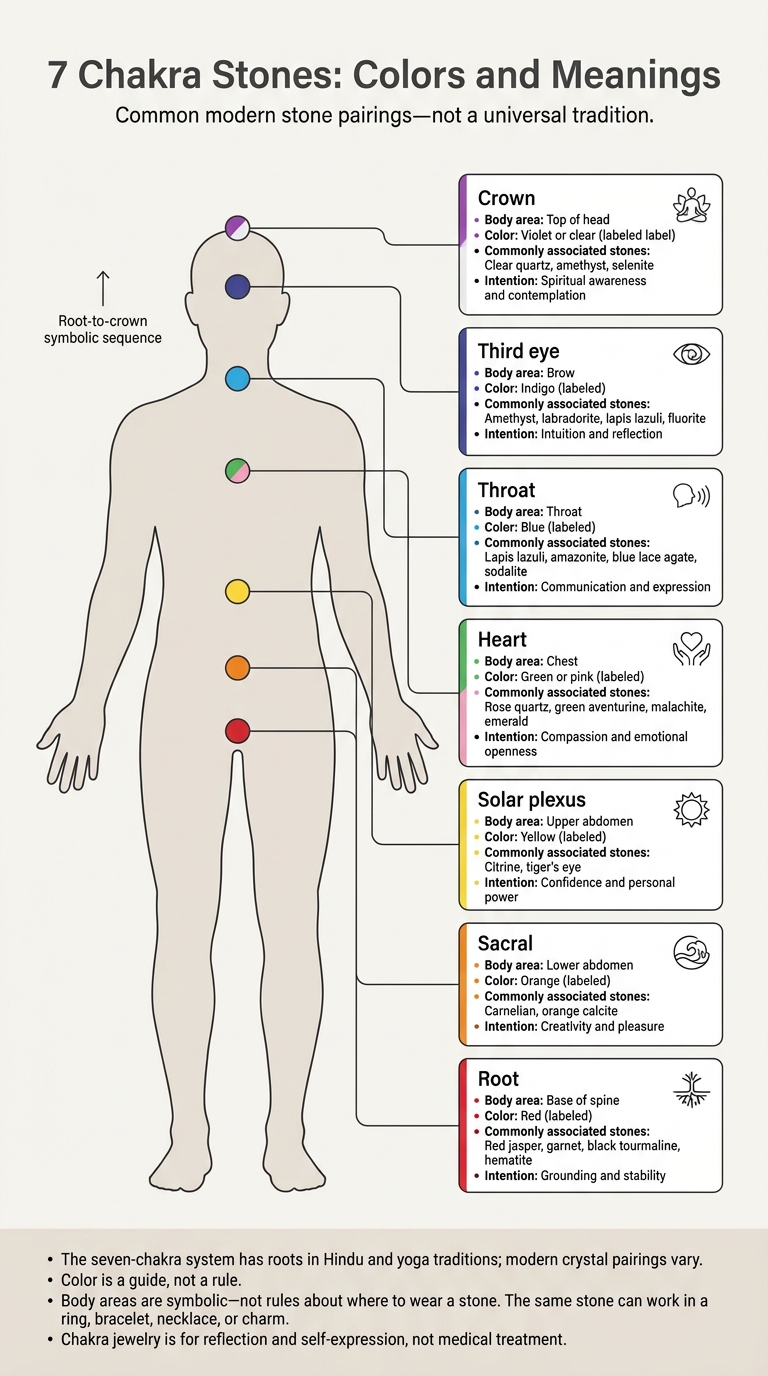
7 Chakra Stones: Colors and Meanings
The seven-chakra system has roots in Hindu and yoga traditions. In crystal jewelry, it often serves as a symbolic map from root to crown. The chart below lists common modern stone pairings, not a universal tradition. Use it as a reference for the jewelry types that follow.
| Chakra | Body area | Color | Commonly associated stones | Intention |
|---|---|---|---|---|
| Root | Base of spine | Red | Red jasper, garnet, black tourmaline, hematite | Grounding and stability |
| Sacral | Lower abdomen | Orange | Carnelian, orange calcite | Creativity and pleasure |
| Solar plexus | Upper abdomen | Yellow | Citrine, tiger’s eye | Confidence and personal power |
| Heart | Chest | Green or pink | Rose quartz, green aventurine, malachite, emerald | Compassion and emotional openness |
| Throat | Throat | Blue | Lapis lazuli, amazonite, blue lace agate, sodalite | Communication and expression |
| Third eye | Brow | Indigo | Amethyst, labradorite, lapis lazuli, fluorite | Intuition and reflection |
| Crown | Top of head | Violet or clear | Clear quartz, amethyst, selenite | Spiritual awareness and contemplation |
Color is a guide, not a rule. A stone’s symbolism also depends on the culture, its mineral traits, and your intention.
Start with your intention, then choose the jewelry format. The body areas above are symbolic - not rules about where to wear a stone. The same stone can work in a ring, bracelet, necklace, or charm. The next sections look at how placement, comfort, and styling change the experience of wearing it.
1. Rings
Rings keep a chakra stone in view throughout the day. Unlike necklaces or charms, they stay in your line of sight during everyday tasks, making them an easy-to-see daily reminder.
Placement and Symbolism
A discreet, single-stone ring puts one intention front and center: red jasper for grounding, tiger’s eye for confidence, or rose quartz for compassion. Finger choice and comfort then become the main design factors.
Choose a finger that feels natural and works with your daily routine. In the U.S., the left ring finger can suggest romance. For a nonromantic meaning, another finger or your right hand may be a better fit.
Comfort and Fit
Measure your finger at the end of the day, not when your hands are cold. The ring should feel snug but slide over your knuckle without force. Bands 6 mm or more in width may need a half-size up; follow your jeweler’s sizing guidance.
Rounded bands and low-profile settings work well for typing. Stones that sit higher are more likely to bump against surfaces during daily tasks.
Styling Choices
A low-profile cabochon works with denim, office wear, and minimalist looks. Wear it alone for a quiet accent, or stack it with plain bands. Just check that neighboring rings don’t rub against the stone or setting. Match the metal to your usual jewelry to tie the look together.
Stone Security and Care
Rings make frequent contact with other surfaces, so the setting matters as much as the stone. A bezel protects more of the stone’s edges. Prongs leave more of the stone exposed but can snag.
Water tolerance depends on the stone, treatment, metal, and setting - not chakra meaning. Remove rings before swimming, showering, exercise, or household cleaning unless the maker explicitly approves those activities. After wear, wipe the ring with a soft cloth and store it separately. Stop wearing it if the stone rattles or a prong lifts.
2. Bracelets
Placement and Symbolism
While rings spotlight a single stone, bracelets spread chakra symbolism across the wrist. Single-stone styles center on one intention, such as amethyst for meditation. Seven-stone designs usually follow the root-to-crown color sequence, though stone pairings vary by maker. There’s no standard left-right rule - wear the bracelet on whichever wrist feels most comfortable.
Fit matters, too. Wrist size affects how the bracelet moves and feels.
Comfort and Fit
Measure your wrist where the bracelet will sit using a soft tape or string, then add about 0.5–1 inch for comfortable movement. Larger beads take up more interior length, so check the fit rather than relying on circumference alone.
Bead size also changes the feel: 4–6 mm beads feel light, 8 mm beads are considered standard, and 10–12 mm beads look bolder and feel bulkier. The finished bracelet shouldn’t pinch or slip over your hand.
Styling Choices
Single-stone bracelets work well with minimalist or professional looks. Seven-stone styles make a more colorful statement. Pair either with simple outfits that let the stones stand out.
When stacking, combine one broad strand with slimmer pieces. Leave enough room for movement so the bracelets don’t press tightly against one another.
Stone Security and Care
Stretch cord makes a bracelet easy to put on, but repeated pulling weakens it. A clasped bracelet better supports heavier stones and offers a more precise fit. Check whether the listed length includes the clasp.
Before buying, check the stone identities, treatments, bead diameter, and closure construction. For a seven-stone design, confirm that all seven stones are included.
Inspect elastic for fraying, looseness, or visible gaps, and check clasp connections regularly. Remove the bracelet before bathing or swimming, and keep lotion and perfume away from both the cord and stones. For mixed-stone designs, apply the strictest care rule to the entire bracelet. Avoid ultrasonic cleaning if any stones are treated or fragile.
3. Necklaces
Placement and Symbolism
Necklaces shift chakra focus upward toward the throat and chest compared with rings and bracelets. A short blue pendant suggests throat-chakra themes of communication and self-expression. Green or pink pendants near the center of the chest suggest heart-chakra themes of compassion and connection.
Color and length help shape the meaning. Longer necklaces may sit near the upper abdomen, but they generally don’t reach the sacral or root chakra areas. Their symbolism comes from color, intention, and visual placement rather than exact anatomical alignment.
Comfort and Fit
Length determines where the pendant rests. Start with 16–18 inches for throat-focused styling, 18–22 inches for chest-level placement, or 24 inches for a lower drop. Test the length with string first, since neck size and pendant height affect how far it hangs.
Heavier stones can pull the chain down and strain the back of your neck. Choose a chain suited to the pendant’s weight, a smooth, well-finished pendant back, and hypoallergenic metals your skin tolerates.
Styling Choices
Once the fit feels right, pair the necklace with your neckline to control how much the stone stands out. A solitaire draws attention to one stone and one intention. Multistone designs combine meanings and create a bolder look.
Try 16 inches with open necklines, 18 inches for a range of necklines, and 20–24 inches with higher necklines. When layering, leave roughly 2–4 inches between chains and let one piece stand out. Check how the necklaces sit as you move to help reduce tangling.
Stone Security and Care
Check that the bail - the loop connecting the pendant to the chain - moves freely and that the stone sits firmly in place. The clasp, jump rings, and setting should also stay secure, especially on heavier or multistone pendants.
After wearing, wipe the necklace with a soft, dry cloth. Keep it away from perfumes, lotions, household chemicals, and prolonged moisture, and store it separately in a soft pouch.
4. Charms
Placement and Symbolism
Charms let you swap stones without replacing the whole piece. Unlike fixed settings, they let you change the stone itself. Bracelet charms stay visible and easy to touch, while necklace charms sit near the chest or throat. You can change the meaning, placement, or style without buying a new piece.
Comfort and Fit
Choose smaller, lighter charms for your wrist, where movement can knock them against a desk or snag them on sleeves. Measure your wrist and add roughly 1/2 to 3/4 inch for movement. Allow extra room if you plan to add several charms, and check the base piece’s weight limit before adding more.
Styling Choices
Start with one main stone and one or two small accents. Stick to one metal finish for a coordinated look, or add an initial for a personal touch. Interchangeable charms let you choose a stone for the occasion, making them the most flexible option for changing meaning and look while keeping the same base piece.
Stone Security and Care
Check compatibility before swapping: the connector must fit the bracelet or chain, and every removable part must close fully.
Leave space between charms so they’re less likely to collide. Scratch resistance doesn’t prevent chipping. Stop wearing a charm if its connector opens or its stone moves. Store detached charms separately in a soft pouch or lined compartment.
Next, compare how each jewelry type handles placement, comfort, and daily wear.
How the Jewelry Types Compare
Here’s how each jewelry type compares on placement, comfort, styling, and care.
Placement and Chakra Symbolism
| Jewelry type | Placement | One stone vs. seven stones |
|---|---|---|
| Rings | Finger | Best for one focal stone |
| Bracelets | Wrist | Works with one or seven stones |
| Necklaces | Collarbone or chest | Single pendant or beaded sequence |
| Charms | Bracelet, necklace, or accessory | Stone count depends on the base piece |
Symbolism may guide your choice, but fit affects how often you’ll wear it.
Sizing and Wear Comfort
| Jewelry type | Fit priority | Weight and movement | Skin contact |
|---|---|---|---|
| Rings | Snug without pressure | A good fit limits rotation | Usually continuous |
| Bracelets | Enough room to move without slipping off | Slides and rubs against the wrist | Frequent friction |
| Necklaces | Pendant position against your body and clothing | Heavy pendants pull or swing | Varies with clothing |
| Charms | An attachment that fits and a base that supports it | Added weight shifts the balance | Depends on placement |
Styling and Clothing Pairings
Choose a format that works with the clothes you wear most.
| Jewelry type | Visual role | Stacking or layering jewelry | Clothing compatibility |
|---|---|---|---|
| Rings | Small focal point | Finger comfort limits stacking | Works regardless of neckline or sleeve length |
| Bracelets | Color and texture at the wrist | Easy to stack, but watch for rubbing | Needs room beneath cuffs |
| Necklaces | Draws attention to the neckline | Different lengths reduce overlap | Can sit above or beneath clothing |
| Charms | Accents you can swap | Depends on how much the base can hold | Dangling parts may catch on knits or cuffs |
Looks are only part of the choice. Hardware and stone protection affect how well a piece holds up.
Settings, Attachments, and Stone Care
| Jewelry type | Impact and abrasion | Snagging | Moisture exposure | Hardware wear |
|---|---|---|---|---|
| Rings | Frequent bumps during hand use | High-set stones can catch fabric | Handwashing and wet tasks | Prongs and settings |
| Bracelets | Contact with desks and beads rubbing together | Links can catch cuffs | Handwashing and sweat | Cord, elastic, and clasps |
| Necklaces | Pendants can swing into objects | Chains can catch hair or collars | Sweat and showering | Chains, clasps, and bails |
| Charms | Collisions with nearby pieces | Dangling parts can catch fabric | Depends on where the base is worn | Connectors can loosen or bend out of shape |
Pros and Cons
Match your choice to your daily routine and the care you’re willing to give it.
| Jewelry type | Choose for | Accept the trade-off |
|---|---|---|
| Rings | An always-visible reminder | Frequent bumps during hand use |
| Bracelets | A seven-stone layout | Wrist movement and rubbing |
| Necklaces | A focal stone away from your hands | Swinging and dependence on neckline |
| Charms | Swapping stones on one base | More connectors to inspect |
Conclusion: Choose for Your Intention and Daily Wear
Use the comparison above to find a format that fits your routine. Comfort comes first: let chakra symbolism guide your choice, not dictate it. Rings offer subtle reminders, bracelets layer symbolism, necklaces create a visible focal point, and charms let you change things up.
| Jewelry type | Suitable chakra focus | Best daily use | Main limitation |
|---|---|---|---|
| Ring | One selected focus | A discreet reminder at work or with understated outfits | Frequent hand contact |
| Bracelet | Multiple focuses or a seven-stone sequence | Layering or a full chakra sequence | Stones may rub together |
| Necklace | Heart- or throat-related symbolism | A focal piece with clean, centered styling | Pendants may swing or feel heavy |
| Charm | Any selected focus | Custom pieces, gifting, and changing intentions | Loops and clasps can loosen or wear out |
Start with your intention, then choose the stone and a comfortable placement you’ll want to wear often. Check durability, setting security, and compatibility, including connector fit. Ask about stone treatments and water sensitivity, follow the care instructions, and store pieces separately to reduce scratches and tangling.
Chakra jewelry can support reflection, ritual, and self-expression, but it cannot diagnose, prevent, treat, or cure a medical condition. Do not use it as a substitute for medical evaluation or treatment.
FAQs
Can I combine chakra stones with different meanings?
Yes, you can combine chakra stones with different meanings. In chakra practices, people choose stones linked to the chakras they want to support and their personal intentions, with the aim of balancing energy.
Layer necklaces to work with multiple chakras, or stack rings and bracelets to focus your energy work. These practices also involve considering the stones’ believed vibrations and cleansing them regularly so they work in harmony. These energy effects haven’t been scientifically established.
Which chakra stones hold up best in everyday rings?
Clear quartz and rose quartz are often recommended in crystal practices to support energy flow through the hands, though this belief isn’t backed by scientific evidence. For everyday rings, put durability and sturdy construction first.
Choose low-profile settings to limit snagging. Pointed cuts, such as pear or marquise, need protective prongs at their tips. Since rings frequently touch surfaces and neighboring fingers, check that prongs are secure, bezel settings hold stones firmly, and bands are thick enough for daily wear.
How can I tell if a chakra stone is treated?
Look for natural imperfections and a dense feel. The stone should feel cool at first and warm slowly in your hand. If it warms quickly, it may be synthetic. Air bubbles can also point to a manufactured piece. Check its translucency, too.
For high-quality pieces, LaCkore Couture provides certifications from trusted gemological laboratories to verify that the stones are genuine.