Skip to content




Celtic Torcs: Symbols of Power
A Celtic torc was a hard metal neck ring that showed power fast. From about 1200 BC into the 3rd century CE, torcs marked rank, wealth, war status, and sacred use. Gold examples like the Snettisham Great Torc, which weighs over 2.2 pounds, show that these pieces were far more than jewelry.
If I had to sum up the article in a few points, it would be this:
- Torcs were status markers worn by elites, warriors, and rulers.
- They changed over time from simple Bronze Age forms to complex Iron Age gold work.
- Archaeology backs their role through hoards, burials, and river deposits.
- Ancient writers linked them to rank and public display.
- Some torcs had ritual use, not just personal wear.
- Modern torc-inspired jewelry still uses the same open-front shape, rigid curve, and bold ends.
A few facts make the point clear:
- The Snettisham site produced about 60 complete torcs and pieces from as many as 158 more.
- One Roman victory report counted 1,500 gold torcs taken as war booty.
- The Snettisham Great Torc was made from 64 wires twisted into 8 ropes.
- The Trichtingen Torc weighs about 14.8 pounds, far too heavy for normal wear.
So when I look at Celtic torcs, I do not see simple ornament. I see metal worn as rank, wealth put on display, and, at times, an object tied to the gods. That same idea still shapes torc-style jewelry now.
How Celtic Torcs Changed Over Time
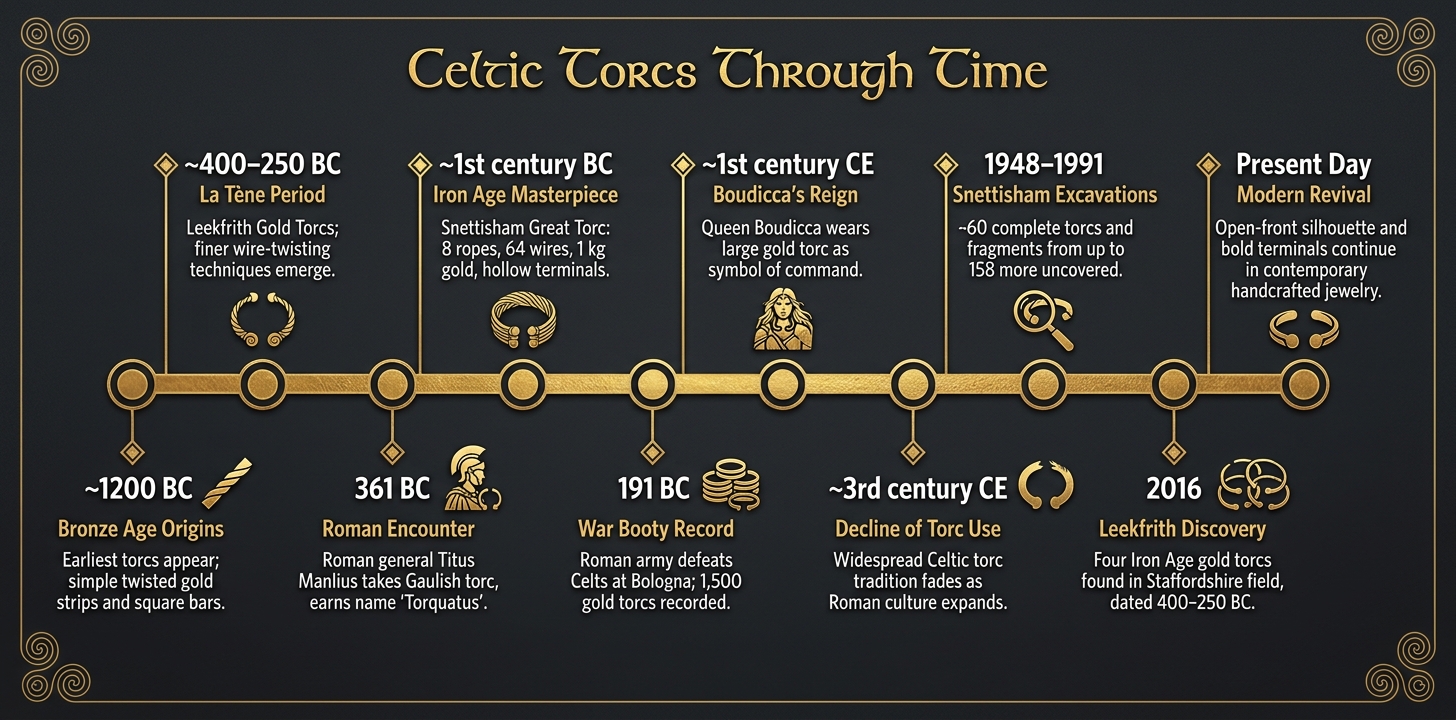
Celtic Torcs Through Time: From Bronze Age to Modern Jewelry
From Bronze Age bands to Iron Age masterpieces
The earliest torcs, dating to around 1200 BC, were fairly simple. Smiths twisted thin gold strips or square bars into spiral forms, then finished them with flared or hooked ends.
By the Iron Age, that had changed. Torc-making grew much more advanced, with smiths moving beyond single twisted bars to multi-strand builds and hollow-cast tubes. The shift wasn’t just about style. It reflected a world where power was shown more openly. As torcs became more detailed, they also became more expensive to make - and stronger as marks of status.
The Leekfrith Gold Torcs, found in Staffordshire in 2016 and dated to about 400–250 BC, show the finer wire-twisting linked to the La Tène period .
Craft methods that signaled prestige
The work itself sent a message. The harder a torc was to make, the more rank it could signal. Elite torcs stood out not just for their gold, but for the labor behind them. Twisting multiple wires, casting hollow tubes, and hammering sheet gold into terminals all demanded more time, skill, and expense.
The Snettisham Great Torc, found in Norfolk in 1950 and dated to the 1st century BC, makes that plain. It was built from 64 separate wires, first twisted into eight ropes and then twisted together again into one piece. It contains more than 1 kilogram of gold. Its hollow terminals were decorated with La Tène relief work. Strabo described Celtic elites wearing gold torcs and bracelets as open signs of rank. Finds like this suggest torcs mattered both as elite possessions and as objects with ritual force.
Key archaeological finds that inform what we know
Archaeology backs this up: torcs were not just decorative pieces. They worked as public signs of rank. Much of what we know comes from two kinds of finds: elite burials and ritual hoards.
The Leekfrith torcs were found in a field in Staffordshire and were probably placed there on purpose. The Snettisham site in Norfolk goes even further. Between 1948 and 1991, excavations uncovered about 60 complete torcs, along with fragments from as many as 158 more. Multiple torcs recovered from the River Thames are understood as votive offerings - gifts to deities, not accidental losses . Taken together, these finds show torcs moving between elite display and sacred use.
Why Torcs Stood for Status, Leadership, and Sacred Authority
The finds above show where torcs were placed. This section is about what they signaled.
Torcs marked rank in public life, in burials, and in ritual settings. The meaning could shift with the setting, but the visual message was hard to miss.
Warriors, chieftains, and elite households
Archaeological evidence suggests that during the Hallstatt period, torcs appeared most often in the graves of women and girls, and they were usually made of bronze. By the 3rd century BCE, gold torcs had become closely tied to male warriors and chieftains.
Cassius Dio described Boudicca wearing a large gold necklace as part of her public image:
"Around her neck was a large golden necklace... This was her invariable attire." - Cassius Dio, Roman Writer (describing Queen Boudicca)
That detail says a lot. A torc wasn't just decoration. It signaled rank, wealth, and command at a glance.
The same idea shows up in conflict. Roman general Titus Manlius earned the nickname Torquatus after killing a Gaulish chief in 361 BCE and taking his torc as a trophy. Once removed from a defeated leader, the torc became more than jewelry. It turned into proof of victory.
Torcs as wealth worn in plain sight
Torcs also worked as portable wealth. You could wear status on your body, in plain view.
"They amass a great quantity of gold which is used for ornament not only by the women but also by the men. They wear bracelets on their wrists and arms, and heavy necklaces of solid gold..." - Diodorus Siculus, Historian
That account lines up with the scale of the finds. In 191 BCE, a Roman army defeated a Celtic force at Bologna and amassed 1,500 gold torcs as war booty. That's not a small cache. It points to a huge amount of concentrated wealth tied up in these objects.
Once torcs became public signs of rank, they also made sense as gifts to the gods.
Divine imagery, offerings, and ritual meaning
Torcs carried sacred meaning too. One of the clearest examples is the horned god Cernunnos on the Gundestrup Cauldron, shown wearing a torc around his neck and holding another in his hand. The image links the torc with divine rule and abundance.
Some torcs were likely never meant for a person to wear. The Trichtingen Torc, made of silver-plated iron, weighs 14.8 lbs (6.7 kg), which is simply too heavy for normal wear. It likely adorned a cult statue.
Taken together, Cernunnos, serpent terminals, bull heads, and votive deposits connect torcs with sovereignty, abundance, and ritual offering.
Those same rigid forms still shape torc-inspired jewelry today.
How to Spot Celtic Torc Design in Modern Jewelry
Design details that define a torc-inspired piece
In modern jewelry, the torc still stands out as a clear sign of strength and status. The easiest way to spot one is its open-front "C" shape, which sets it apart from a closed necklace or bracelet.
Shape is only part of the story, though. Look for a rigid curve that holds its form, a twisted-metal texture running along the body, and bold terminals at each end. Those terminals are the decorative end-caps where the metal stops. They might look like flat buffers, pear-shaped ends, or sculpted animal heads such as serpents or bulls.
A famous example is the Snettisham Great Torc. Its surface work is far from simple: it uses 64 individual strands twisted into eight ropes, with each strand measuring about 0.07 inches thick. That kind of detail helps explain why torc design still feels so striking today.
The main features to watch for are:
- Open front - the classic "C" silhouette
- Rigid form - keeps its shape instead of draping
- Twisted or braided texture - along the body of the piece
- Bold terminals - caps, spheres, gemstones, or sculpted animal heads
You’ll now see those same shapes used in lighter metals that are easier to wear day to day.
Modern materials and styling in the United States
Handcrafted U.S.-made pieces often use sterling silver, 14k gold, gold vermeil, or mixed metals. Some also add stone terminals for contrast and a bit of color. Rigid neck rings tend to look best with open necklines, since that lets the sculpted ends sit flat against the collarbone. The effect feels a lot like the old use of the torc as a visible marker of rank.
Because torc-inspired jewelry is rigid, it also needs a little more care than softer pieces.
How to care for rigid neck rings, cuffs, and statement pieces
Store rigid neck rings and cuffs in a dry, padded jewelry box so they don’t get scratched or bent. When you put on a torc-style cuff, slide the opening over the narrowest part of your wrist instead of pulling the ends apart. That small habit can help prevent stress on the metal.
For cleaning, use a soft, lint-free cloth. Skip abrasive polishes, since they can wear down twisted surface details. It’s also smart to remove torc-inspired pieces before using hairspray, perfume, or household cleaners so the finish and settings stay secure.
Conclusion: Why Celtic Torcs Still Stand for Power
Celtic torcs were far more than decoration. They served as public signs of rank, wealth, and authority.
A torc made wealth visible. It turned social standing into something people could see at a glance through its size, materials, and fine workmanship.
The Snettisham Great Torc shows this plainly. Its detailed construction strengthened that message. To own a torc was to show wealth, status, and authority.
That mix of bold shape, rich material, and personal meaning helps explain why the torc still feels strong today. The open-front silhouette, rigid curve, and sculpted terminals still look deliberate and powerful in modern jewelry. And that same silhouette still holds up now. For torc-inspired jewelry, LaCkore Couture offers handcrafted made-in-the-USA pieces in gold and silver.
FAQs
Who was allowed to wear a Celtic torc?
In ancient Celtic societies, torcs were worn mainly by the elite. They signaled status, wealth, and authority. As time went on, both men and women wore them.
During the Hallstatt Period, torcs were tied mostly to elites. By the La Tène Period, they also showed up among warriors. Art from the time also depicts gods and legendary figures wearing torcs, and in some cases, children as well.
Were all Celtic torcs meant to be worn?
No. Many Celtic torcs were worn as jewelry to show status or identity, but that wasn't their only use.
Some also had ritual or symbolic meaning. In some cases, torcs were simply too heavy to wear in any practical way. And torcs found in hoards may have been votive offerings or markers of communal wealth, not personal adornment.
Why were torcs placed in rivers and hoards?
Torcs were placed in rivers and hoards mainly as votive offerings to gods or natural deities. That points to two things at once: these objects were expensive, and they carried deep spiritual weight.
Some may have been hidden for safekeeping during times of conflict. But in many cases, they seem to have been placed with care in sacred places as long-term communal dedications. Offering jewelry this valuable in public could also help elites show status and power.