Skip to content



Celtic Nature Symbols: Jewelry Guide
I choose Celtic nature jewelry by checking three things: the motif, its history, and how it fits. A symbol can have personal meaning without having a proven ancient meaning - so I look for a named place, period, or source behind historical claims.
Here’s what I consider:
- Plants, trees, and animals: From shamrocks to salmon, meanings depend on the source. The familiar Tree of Life design is best treated as Celtic-inspired unless its history is documented.
- Water, sun, moon, and spirals: These shapes can suggest movement or renewal, but they don’t share one fixed ancient meaning.
- Wear and care: I check metal content, stone settings, measurements, seller terms, and cleaning instructions - not just the design.
My rule: <u>choose meaning you connect with, then check the details</u>. For rings, that includes U.S. sizing; for pendants and earrings, it means checking size, weight, and comfort.
Plant, Tree, and Animal Symbols
Plant, tree, and animal motifs turn natural shapes into compact symbols that remain easy to recognize in jewelry.
Oak, Shamrock, Thistle, and Mistletoe
Oak, shamrock, thistle, and mistletoe carry familiar meanings, though the historical evidence differs for each.
The shamrock’s three leaflets make it a recognizable Irish emblem. Its connection to Saint Patrick and the Trinity comes from later tradition. Scotland’s national emblem, the thistle, often represents resilience, defense, and pride - but its popular origin story is legend, not established history. Pliny’s account of oak and mistletoe is the best-known ancient reference, though it doesn’t prove that all Celtic peoples shared the same belief.
For jewelry, let the plant’s shape do the work. Clear oak leaf outlines suit engraved rings, while distinct thistle flower heads work well on botanical earrings. Simple shamrocks stay readable on small charms, and mistletoe branch pendants offer a softer botanical look.
Tree of Life: Meanings and Jewelry Designs
Use Celtic-inspired Tree of Life to describe a modern design without a specific historical source. Interlaced roots can suggest family ties. Circular pendants and rings give branches room to spread, while small charms need fewer, bolder lines to keep the design clear.
| Motif | Commonly assigned meaning | Historical support and certainty | Suitable jewelry formats |
|---|---|---|---|
| Oak | Strength, endurance, wisdom, longevity, healing, protection | Associations in local customs and folklore vary by region; modern meanings are partly reconstructed. | Leaf pendants, engraved rings, earrings, charms |
| Shamrock | Luck | Strong association with Irish identity; the Saint Patrick connection comes from later tradition. | Pendants, earrings, charms |
| Thistle | Scottish identity, resilience, defense, pride | Strong national emblem; origin stories should be labeled as legends. | Botanical earrings, pendants, rings, charms |
| Mistletoe | Healing, protection, liminality, seasonal renewal | Classical sources and folklore provide evidence, but the surviving record is limited. | Branch pendants, delicate earrings, engraved rings, seasonal charms |
| Tree of Life | Continuity, ancestry, renewal, earth–sky connection | Common modern Celtic-inspired reading; the standard jewelry design is not securely ancient. | Circular pendants, rings, charms |
Stag, Boar, Raven, and Salmon
An animal motif should be easy to recognize and tied to the right tradition. Antlers identify a stag; tusks and bristles distinguish a boar. On small rings and charms, keep those details bold.
Ravens call for extra care. Irish traditions connect the Morrígan with battlefield birds, so describe a raven pendant as specific to that myth or associated with battle, rather than a universal Celtic symbol of wisdom.
In the Salmon of Knowledge tale, the salmon gains wisdom by eating hazelnuts from the Well of Segais. Fionn mac Cumhaill then gains that wisdom by tasting the salmon.
| Animal motif | Associated meaning | Source context | Visual style | Suitable jewelry formats |
|---|---|---|---|---|
| Stag | Wild nature, strength, abundance, transformation | Some Celtic imagery from mainland Europe connects stags with Cernunnos; broader meanings vary by source and region. | Antlered head or full-body silhouette | Signet-style rings, pendants, charms |
| Boar | Ferocity, courage, hunting, warrior power | Supported by archaeological boar imagery and Irish mythological associations. | Tusks, bristles, armored profile, bold relief | Signet rings, pendants, charms |
| Raven | Battle, prophecy, fate, transformation | Irish Morrígan tradition. | Perched profile, spread wings, engraved feathers | Pendants, earrings, rings, charms |
| Salmon | Wisdom, knowledge, memory, learning | Irish Salmon of Knowledge tale. | Curved body, wave lines, hazelnut or well imagery | Pendants, earrings, charms |
Next come water, sun, moon, and spiral motifs, shifting the focus from nature’s forms to movement.
Water, Sun, Moon, and Spiral Symbols
Alongside plant and animal motifs, Celtic-inspired jewelry draws on water and celestial forms. Flowing lines, sky shapes, and repeated curves suggest movement and cycles. But similar shapes don’t prove a shared ancient Celtic meaning.
Water and River Motifs
Wave-engraved rings, flowing pendants, drop-shaped earrings, and water-inspired charms can suggest continuity or renewal. Blue, green, or translucent stones bring out the water theme.
Rivers and springs mattered in some Celtic traditions. Named river deities and water offerings support that connection, but they don’t establish a fixed meaning for every wave design. Ideas of cycles and change also appear in sun and moon motifs.
Sunbursts, Crescents, and Moon Phases
Sunbursts work well on statement pendants, while small crescent earrings give a simpler celestial look. Moon-phase necklaces need enough space between shapes to make the sequence easy to follow.
Medieval Irish sources connect major festivals with seasonal turning points, but they don’t establish universal meanings for sunbursts or crescents. Cycles, seasons, and renewal are modern Celtic-inspired readings. Spirals take the theme of movement into the shape of the design itself.
Spirals and Triskele Designs
Ancient spirals influence modern jewelry, but their history needs care. Newgrange’s spiral carvings are Neolithic, dating to long before historically identified Celtic societies. Their original meaning remains unknown.
A triskele, or triskelion, is a threefold motif, often formed from three spirals or curved arms. Later Iron Age and La Tène art used similar rotating and three-part forms. Growth, solar motion, and recurring cycles are interpretations - not proven original meanings.
Jewelry designs include spiral bands, three-armed signet motifs, and circular pendants. For historical accuracy, choose a design based on a documented artifact or one clearly presented as a contemporary interpretation.
How to Choose and Style Celtic Nature Jewelry
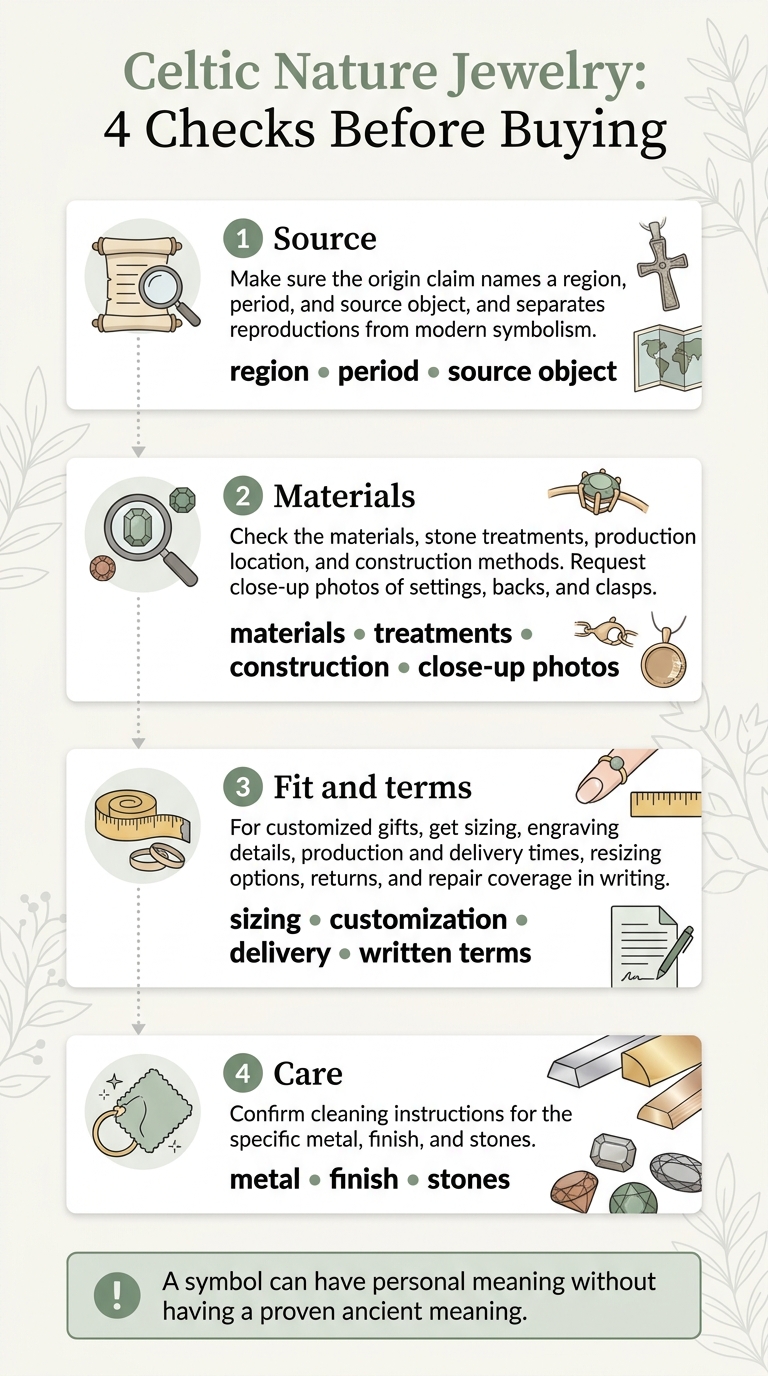
Celtic Nature Jewelry: 4 Checks Before Buying
Once you know what each motif means, choose a jewelry format that suits its size, visibility, and comfort.
Match the Symbol to the Jewelry Type
Give the design enough room to read clearly. Compact engravings suit rings, while pendants and brooches allow for larger designs. For earrings, choose lightweight silhouettes. Charms work well when you want to mix motifs.
| Symbolic focus | Jewelry format | Design scale | Customization considerations |
|---|---|---|---|
| Oak, shamrock, thistle, or mistletoe | Ring, small pendant, or charm | Small to medium | Confirm botanical detail, engraved initials, or birthstone options |
| Tree of Life | Pendant, brooch, or statement ring | Medium to large | Choose branch density, frame shape, chain length, and optional stones |
| Stag, boar, raven, or salmon | Pendant or larger charm | Medium to large | Compare realistic, stylized, or silhouette designs and confirm orientation |
| Water, wave, or river motif | Pendant, bracelet, or charm | Small to medium | Consider openwork, blue or green stone accents, or an engraved date |
| Sunburst or crescent moon | Earrings, pendant, or ring | Small to medium | Select matching or mismatched earrings, moon phases, and a polished or oxidized finish |
| Spiral or triskele | Ring, earrings, or compact pendant | Small to medium | Check line depth and spacing so the design stays clear at the chosen size |
With the motif and format chosen, look at the metal, stones, and setting.
Choose Metals, Stones, and Sizes
Color alone doesn't prove metal content or durability. Check whether the piece is solid precious metal, an alloy, gold-filled, vermeil, plated, or costume metal. Ask about the base metal, nickel content, and finish, too.
Confirm each stone’s identity and treatments, along with how it's held in place: bezel-set, prong-set, flush-set, or glued. For frequent wear, look for protected settings and smooth edges.
Measure before ordering. A 16–18-inch necklace often sits near the collarbone, while a 20–24-inch chain gives a pendant more space, depending on the wearer. Check pendant height and width in inches, bail strength, earring weight, and clasp security. Have rings measured in U.S. sizing, especially wide bands.
LaCkore Couture offers handcrafted pieces in gold, silver, and natural stones, with customization options. Check each listing for the motif, materials, and construction.
Check Origins, Materials, and Care
Before ordering, review the seller’s disclosures and care instructions. Work through these checks:
- Source: Make sure the origin claim names a region, period, and source object, and separates reproductions from modern symbolism.
- Materials: Check the materials, stone treatments, production location, and construction methods. Request close-up photos of settings, backs, and clasps.
- Fit and terms: For customized gifts, get sizing, engraving details, production and delivery times, resizing options, returns, and repair coverage in writing.
- Care: Confirm cleaning instructions for the specific metal, finish, and stones.
Remove jewelry before swimming, showering, exercising, applying cosmetics, or using household cleaners. Use mild soap and lukewarm water only if the care instructions permit it. Rinse in a container rather than over an open drain.
Avoid abrasive polishing on plated or intentionally oxidized finishes, and don't soak delicate or porous stones. Store pieces separately to prevent scratches, and keep sterling silver in anti-tarnish packaging.
Conclusion: Balance Meaning, History, and Comfort
Celtic nature motifs carry modern meanings - not fixed ancient ones.
Celtic jewelry has no universal symbol system. These traditions span more than 2,000 years, with meanings that vary by region and period. Keep documented associations separate from folklore and personal meaning. Uncertainty doesn’t make a design less meaningful.
Let the motif guide your choice, but put clear provenance, good craftsmanship, and a comfortable fit first. Choose jewelry you’ll want to wear.
FAQs
Can I wear Celtic symbols without Celtic ancestry?
Yes, you can wear Celtic symbols without Celtic ancestry. These motifs have historically represented Irish, Scottish, or Welsh heritage. Today, anyone can wear them to celebrate interconnectedness, nature’s beauty, personal growth, and life’s eternal cycles.
At LaCkore Couture, we believe these symbols can give your jewelry personal meaning - a way to express your journey and style.
Can I combine Celtic nature symbols in one piece?
You can combine Celtic nature symbols in one piece of jewelry to tell your personal story. Pair a Celtic Tree of Life with an emerald to symbolize growth and renewal, or add a sapphire to a Shield Knot to represent protection.
LaCkore Couture’s customization options and charm-style designs let you mix symbols that matter to you in handcrafted jewelry that honors your heritage and reflects your personal style.
How can I verify a symbol’s historical origins?
Turn to reliable sources, such as scholarly articles, specialized jewelry guides, or detailed historical websites. Look into specific motifs, like Celtic knots, to learn their history and meaning.
LaCkore Couture recommends using verified information about a symbol’s history and the communities it comes from. This helps you choose symbolism that reflects your personal story and heritage.